Why Defence AI Teams Are Building Their Own Enemies — Adversarial AI and Red-Teaming Explained
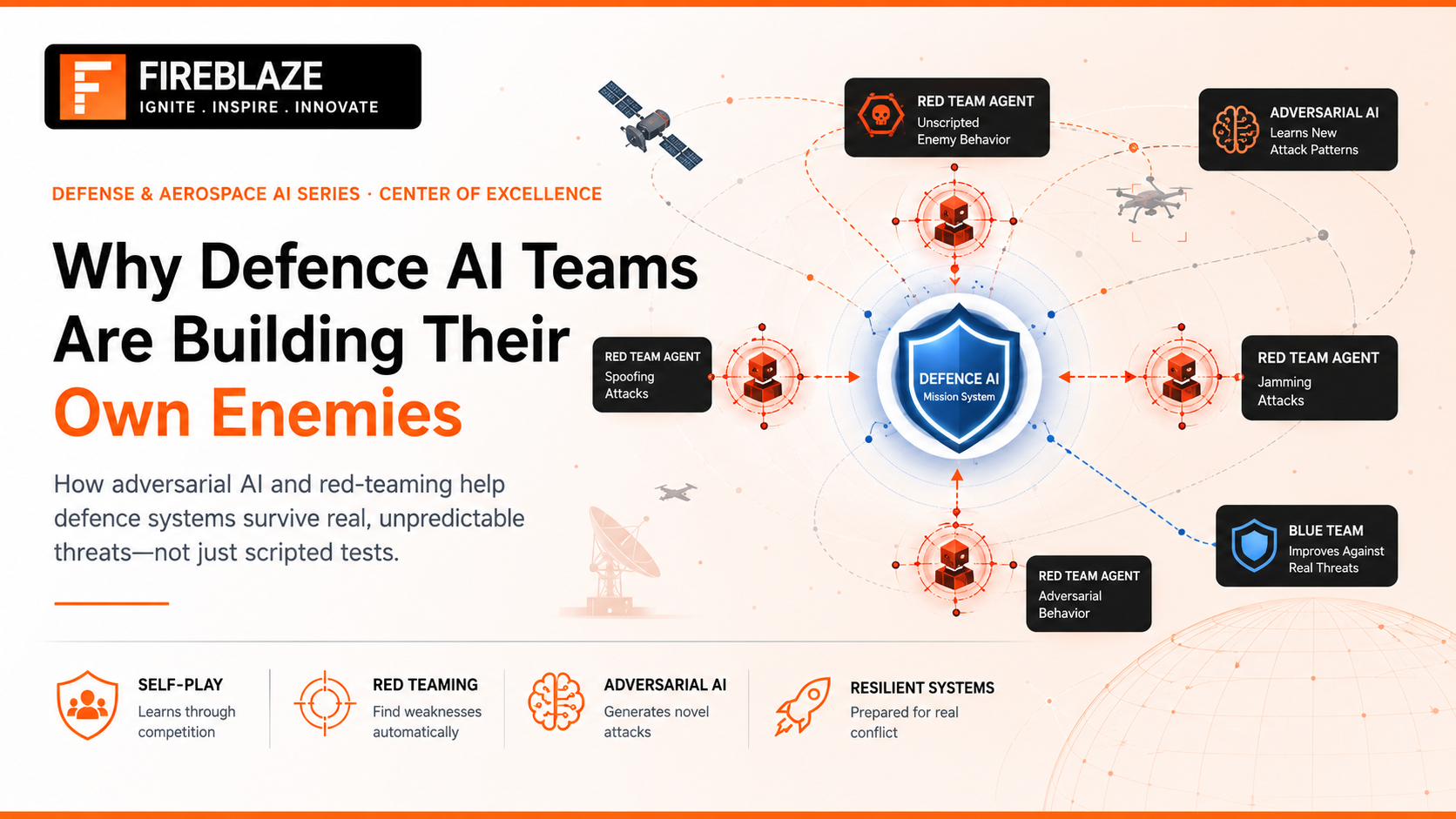
If you wanted to know whether a lock was any good, you wouldn't just look at it you'd hire someone to try to pick it. That's the entire idea behind red-teaming, and it's becoming one of the most important trends in defense AI in 2026, from cybersecurity to orbital warfare.
1. What is red-teaming, in plain terms?
Red-teaming means putting together a team whose whole job is to act like the enemy to attack, trick, or break a system on purpose, so the people defending it can find weaknesses before a real adversary does. The term comes from military war-gaming, where the "Red Team" plays the opposing force and the "Blue Team" defends.
For a long time, red-teaming was done by humans. A skilled team of people would sit down and try to think like an attacker, then test the system by hand. This works, but it's slow, limited by how much time and imagination the human team has, and it only covers the specific tricks that team happens to think of.
2. Why AI changes this completely
AI-driven red-teaming flips the model. Instead of a small human team trying a handful of attack ideas, you train an AI system to generate attacks on its own automatically, at scale, and often in ways no human would have thought to try.
This matters most in defense because two things are true at the same time: systems are getting more complex (more sensors, more data, more automated decision-making), and adversaries are getting smarter and more adaptive. A defense system tested only against fixed, scripted attacks will look strong right up until it meets a real enemy who doesn't follow the script.
A good example, covered elsewhere in this series, is TALOS an AI agent built by Slingshot Aerospace that learns realistic satellite maneuver patterns from real data and then acts as a synthetic adversary inside training simulations, instead of following a human-written script. The Space Force uses it specifically because a scripted enemy can't teach operators to handle something unpredictable.
3. Where this idea comes from — it's older than you'd think
Adversarial AI isn't a brand-new invention for defense. The core idea — training one system to try to fool or beat another, so both get better has deep roots in AI research generally.
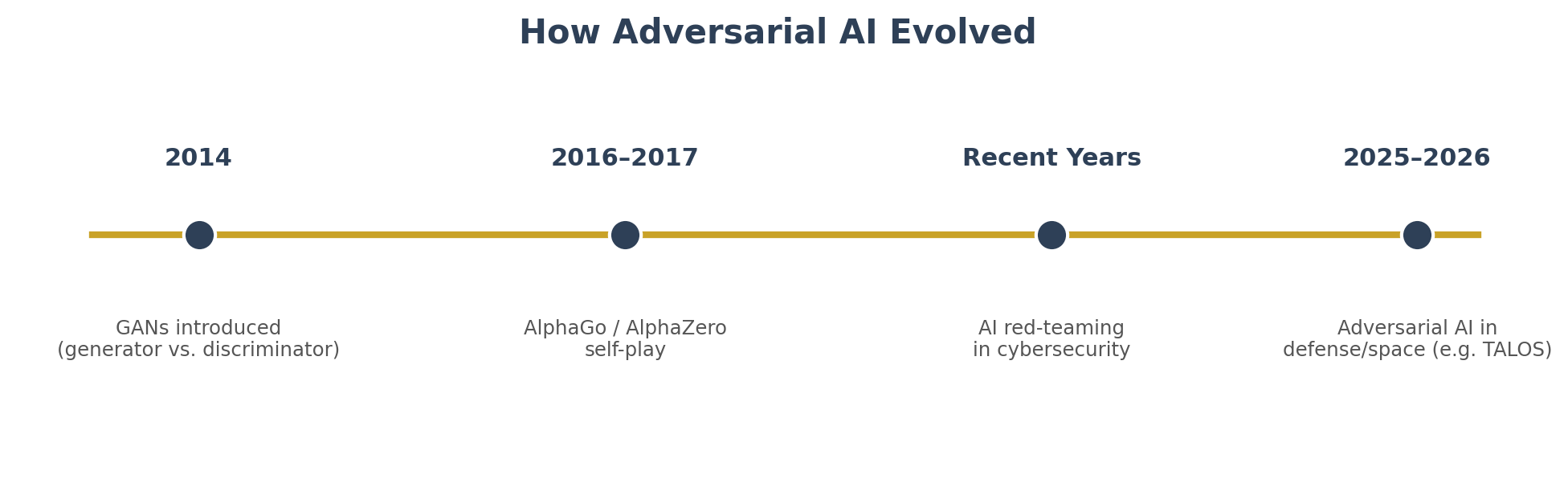
Generative Adversarial Networks (GANs), a well-known AI technique from 2014, work on exactly this principle: one AI (the generator) tries to create fake data realistic enough to fool a second AI (the discriminator), while the discriminator tries to catch the fakes. Both improve together through competition. Years later, DeepMind's AlphaGo and AlphaZero used a similar self-play idea the AI played against itself millions of times, effectively acting as its own "red team," to get better at the game of Go and chess.
In cybersecurity, this same idea now has a name: AI red-teaming, where automated systems try to find prompt-injection attacks, jailbreaks, or vulnerabilities in other AI systems before real attackers do. Defense AI is simply applying a well-tested pattern to a new, higher-stakes domain orbit, battlefields, and command systems instead of software alone.
4. Why defense specifically needs this more than most industries
A few reasons make red-teaming especially important in defense AI, more than in most commercial software:
The cost of being wrong is much higher. A defense AI system that fails in the real world doesn't just lose money it can put people or national assets at risk. Testing it against a realistic, adaptive opponent before deployment is a way of catching failures cheaply, in simulation, instead of expensively, in reality.
Real adversaries don't play fair. Military opponents actively try to deceive, confuse, or exploit weaknesses in detection systems on purpose. A defense AI that's only ever been tested against "normal," expected behavior will be blind to deliberate deception which is exactly the kind of behavior a real adversary will use.
Data on real attacks is rare and often classified. Unlike a company that can log millions of real customer interactions, militaries often don't have large amounts of real adversarial behavior data to learn from because real conflicts are (thankfully) rare and much of what does happen is classified. Building a synthetic adversary that learns from what limited real data exists, and then generates realistic new scenarios from it, is one of the only ways to get enough "practice" data.
5. What this actually looks like in practice
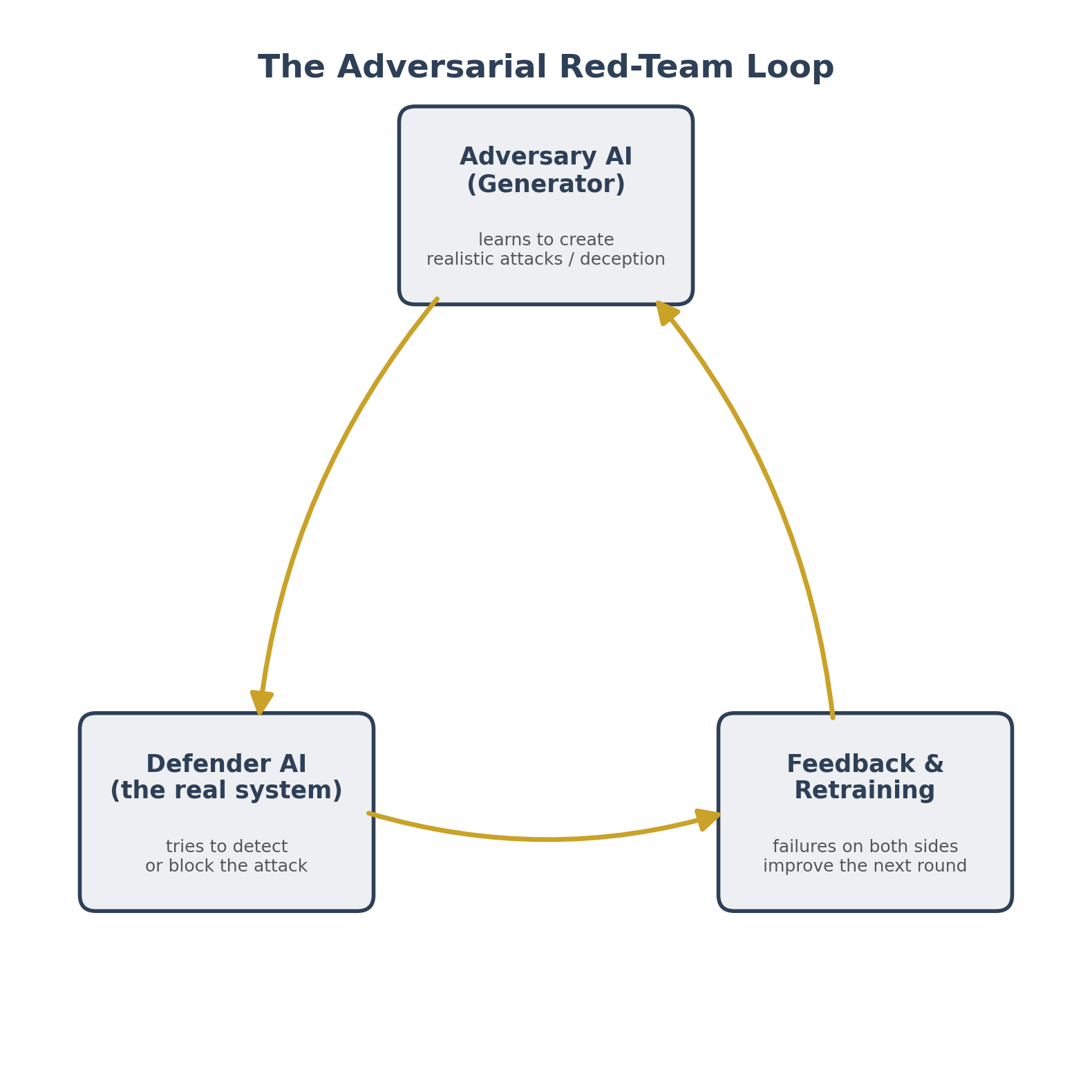
Adversarial red-teaming in defense AI generally follows a loop with three parts:
A generator or adversary model — an AI trained to produce realistic attacking, deceptive, or evasive behavior. This could be a simulated hostile satellite maneuver, a synthetic cyberattack pattern, or a fake radar signature designed to confuse a detector.
A defender model — the actual detection or decision-making system meant to be used in the real world, being tested against the generator's output.
A feedback loop — when the defender catches the adversary's trick, the generator adapts and tries a new approach; when the generator succeeds in fooling the defender, that failure gets logged and used to strengthen the defender. Over many rounds, both sides get sharper, and the final defender is far more robust than one that was only trained on "normal" data.
This loop is why red-teaming is often described as "training your own enemy to make your defenses stronger" — the adversary AI isn't the end product. It's a tool used to build a better, more battle-tested defender.
6. Why this matters going into the rest of 2026
Expect to see this pattern show up far beyond space and cybersecurity. Wherever a defense AI system makes high-stakes decisions threat classification, autonomous vehicle navigation, signal intelligence, missile defense the same question will get asked: has this system been tested against a realistic, adaptive opponent, or only against easy, predictable scenarios?
As adversarial AI tools get easier to build, expect "red-team your own AI before deploying it" to become close to a standard requirement for defense AI programs, the same way software testing became a standard step in traditional engineering. Understanding this pattern generator vs. defender, competing to make both stronger is one of the most useful mental models for understanding where defense AI is heading in 2026 and beyond.
Sources: This piece explains general, publicly known AI/ML concepts (GANs, self-play, AI red-teaming) alongside a factual reference to Slingshot Aerospace's TALOS system, covered in more detail elsewhere in this series. No proprietary or classified information is described.