Anduril's Lattice — The $61B Bet on AI-Run Battle Networks
Why This Company, Why Now
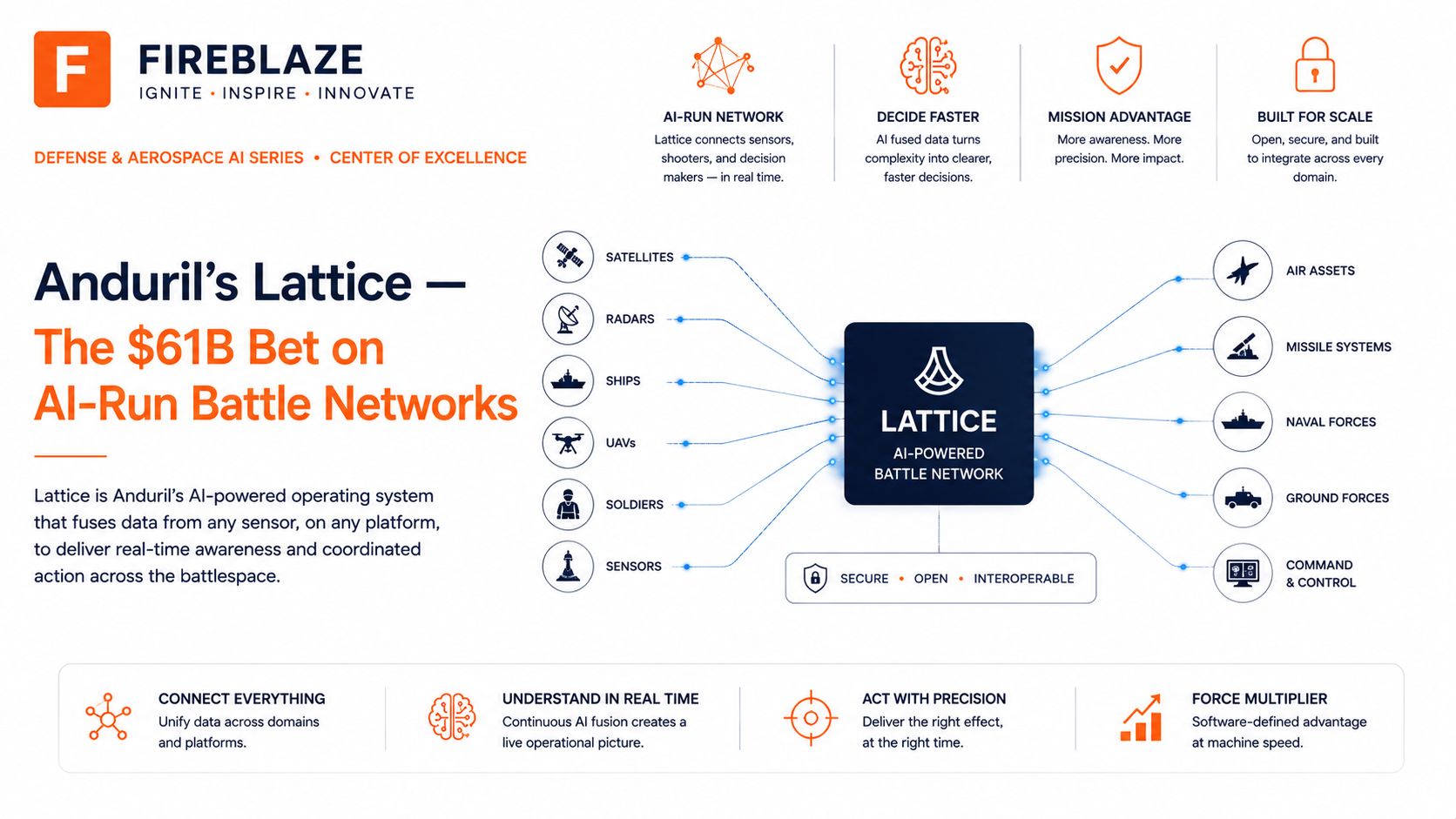
In March 2026, the U.S. Army signed a 10-year enterprise contract with Anduril Industries worth up to $20 billion — one of the largest software-centric defense contracts ever awarded to a company that didn't exist a decade ago. The deal consolidates more than 120 separate Army procurement actions into a single framework built around Anduril's Lattice platform, an AI system designed to fuse sensor data and help commanders make faster decisions on the battlefield.
Two months later, in May 2026, Anduril closed a $5 billion funding round at a $61 billion valuation — nearly double what it was worth just eleven months earlier. By any measure, Anduril has become the most significant new defense contractor in a generation, and its bet is a specific one: that AI-run "battle networks" like Lattice, not any single weapon, will define who wins the next war.
The Problem Anduril Is Solving
Modern militaries generate a flood of sensor data — radar, video, lidar, signals intelligence, drone feeds — from dozens of disconnected systems that were never built to talk to each other. Traditionally, fusing that data into a single, usable picture has required rooms full of analysts and slow, manual coordination between separate command systems, each built by a different defense contractor over different decades.
Anduril's founders, several of whom previously worked at Palantir, saw this as fundamentally a software problem being solved with 1990s-era defense contracting: exquisite, closed, hardware-first systems that took a decade to field and couldn't be upgraded like a phone app. Lattice was built on the opposite premise — an open, AI-native software layer that ingests data from many different sensors and platforms, applies machine learning to detect and classify threats automatically, and gives commanders a single operating picture in near real time, upgradeable the way consumer software is.
Company Background
Anduril Industries was founded on April 20, 2017, by five people: Palmer Luckey (creator of the Oculus Rift virtual-reality headset, which he sold to Facebook in 2014 for roughly $2 billion), Brian Schimpf, Trae Stephens, Matt Grimm, and Joseph Chen. Several of the founding team, including Schimpf, previously worked at Palantir Technologies. The company is headquartered in Costa Mesa, California.
Luckey serves as the company's public face and sets strategic vision, but the CEO role belongs to Brian Schimpf, who has run day-to-day operations since founding. Trae Stephens serves as executive chairman. This split — a famous, outspoken founder who isn't the CEO — is a deliberate structure that has held steady since the company's early days.
Anduril's funding trajectory has been unusually steep even by defense-tech standards: a $1.48 billion Series E in 2022 valued the company at $8.48 billion; by August 2024 that had risen to roughly $14 billion; by June 2025, $30.5 billion; and by May 2026, following a $5 billion Series H led by Andreessen Horowitz and Thrive Capital, $61 billion. The company reported approximately $2.2 billion in 2025 revenue and is targeting $4.3 billion in 2026. As of 2026, Anduril employs roughly 7,000 people and remains privately held — Luckey has said an IPO is "definitely" coming, though no S-1 has been filed and CEO Schimpf has publicly cautioned against listing "in the middle of a hype cycle."
What Anduril Actually Builds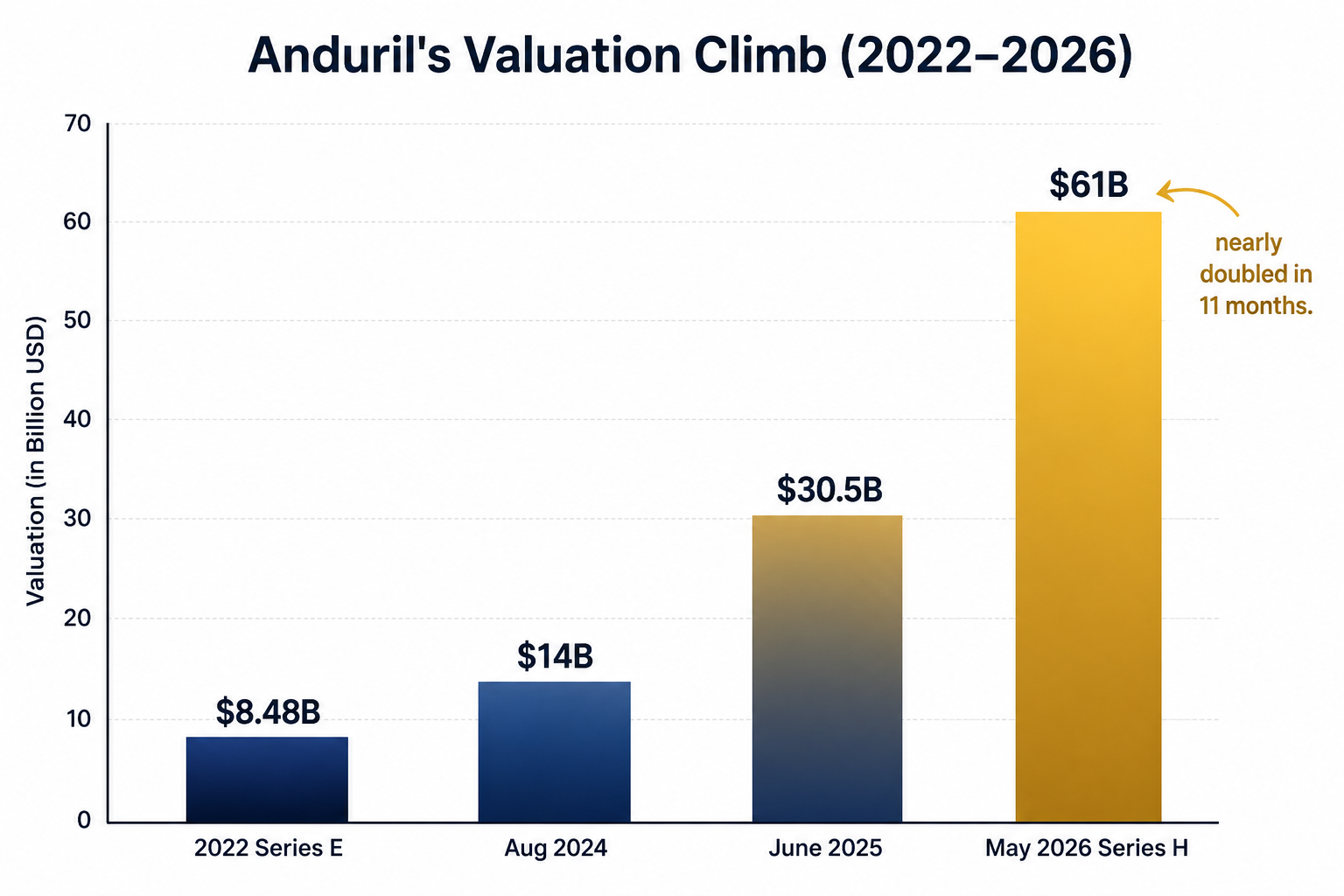
Lattice OS is the software core of everything Anduril sells, but the company's catalog spans hardware built specifically to plug into it:
- Lattice OS — the AI-powered command-and-control software that fuses sensor data and supports human decision-making
- Altius — a family of long-endurance unmanned aerial vehicles
- Ghost / Anvil — smaller counter-drone aircraft designed to detect and physically intercept hostile drones
- Menace-T and Menace-X — portable and expeditionary command-and-control hardware that runs Lattice at the tactical edge, built to keep functioning in denied or degraded communications environments
- Dive — a family of autonomous underwater vehicles
- Roadrunner — a reusable, autonomous interceptor aircraft designed to destroy hostile drones and cruise missiles
The unifying idea across all of it: hardware is treated as a sensor or effector that plugs into Lattice, not a standalone product with its own separate command system.
Deep Dive: Lattice
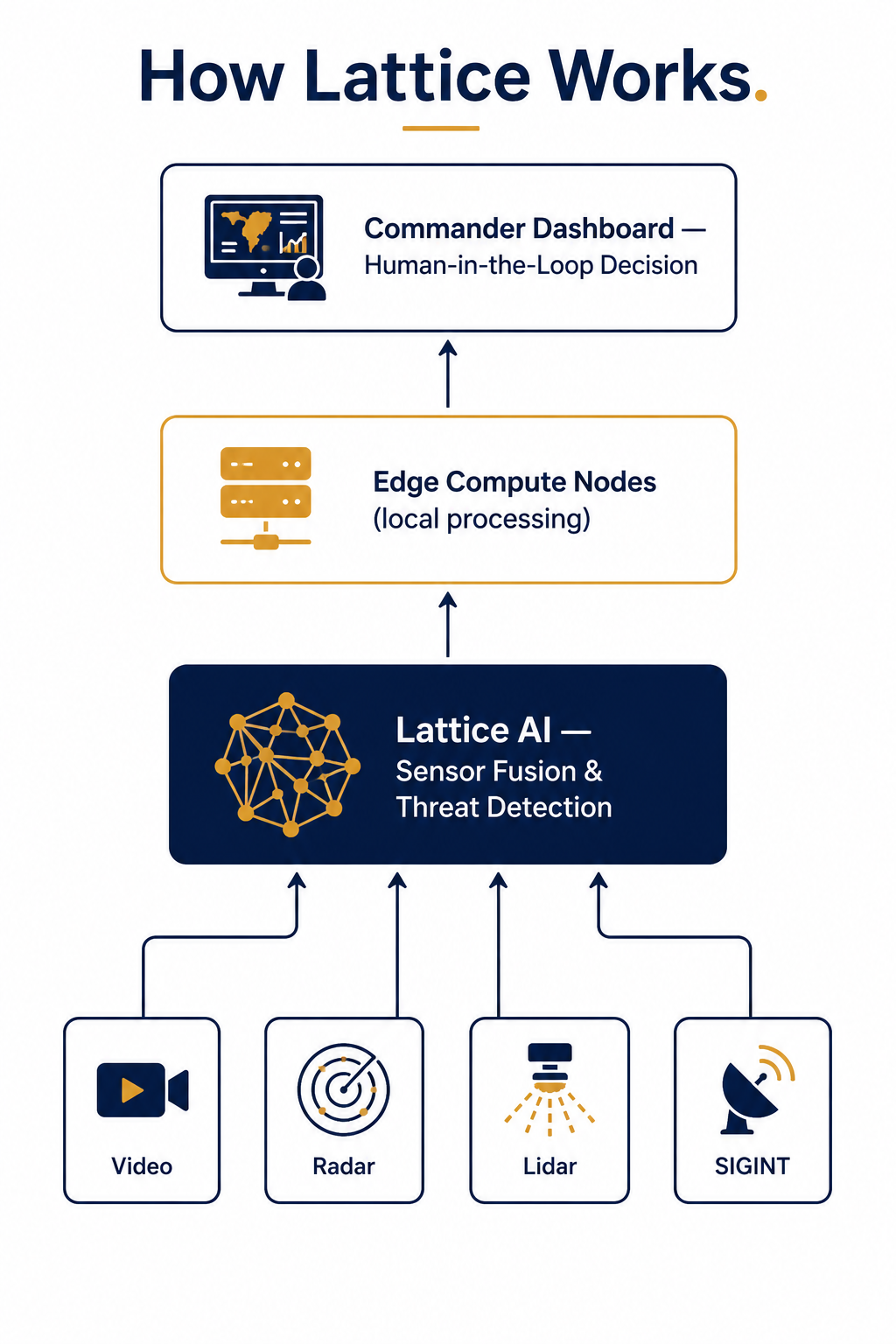
Lattice's core technical claim is autonomous sensor fusion — ingesting video, radar, lidar, and signals-intelligence streams simultaneously and applying deep-learning models to detect, classify, and track objects with sub-second latency. On top of that detection layer sits a predictive component: reinforcement-learning agents that attempt to forecast likely enemy movement and suggest countermeasures, rather than simply reporting what sensors currently see.
Critically, Lattice is built around edge computing — distributed compute nodes that process data locally rather than routing everything back to a centralized server. This matters operationally because military networks are frequently degraded or jammed in contested environments; a system that only works with a stable connection back to a data center is a system that fails exactly when it's needed most. Lattice is designed so that human commanders issue high-level intent through the interface while the AI executes tactical-level coordination underneath — a "human-in-the-loop" design the company positions as central to responsible deployment, not full autonomy over lethal decisions.
The Contract, In Plain Terms
| Detail | Value |
|---|---|
| Amount | Up to $20 billion (ceiling) |
| Duration | 10 years (5-year base + 5-year option), through March 2036 |
| Customer | U.S. Army, via Army Contracting Command, Aberdeen Proving Ground |
| Contract number | W9128Z-26-D-A001 |
| Mechanism | Firm-fixed-price enterprise IDIQ, consolidating 120+ prior procurement actions |
| Scope | Lattice software, autonomous hardware, edge-compute infrastructure, full-lifecycle support |
| First task order | ~$87 million, awarded under Joint Interagency Task Force 401 (the Army's counter-drone task force) |
This is a ceiling, not a guaranteed spend — the Army will issue individual task orders as needs and funding allow over the decade-long period, meaning actual realized revenue could land well below $20 billion depending on how aggressively the Army exercises the contract.
Recent Milestones (Last 12 Months)
- August 2024 — Valuation reaches $14 billion
- February 2025 — Anduril takes over the Army's Integrated Visual Augmentation System (IVAS) program from Microsoft, redesigning next-generation soldier goggles
- March 2025 — Selected to provide autonomy software for U.S. Special Operations Command's uncrewed platforms ($86 million)
- June 2025 — Valuation reaches $30.5 billion
- March 14–15, 2026 — U.S. Army awards the $20 billion, 10-year Lattice enterprise contract
- March 2026 — Arsenal-1, Anduril's large-scale manufacturing facility in Ohio, begins production operations
- June 12, 2026 — U.S. Customs and Border Protection adds 200 additional Anduril Sentry surveillance towers to the southern border network
- May 2026 — Anduril closes a $5 billion Series H at a $61 billion valuation
Competitive Landscape
| Company | Core Approach | Primary Differentiator |
|---|---|---|
| Anduril | Software-first (Lattice) + full autonomous hardware portfolio | Broadest system-integration position; only player selling sensors, C2 software, interceptors, and autonomous aircraft together |
| Shield AI | Autonomy software (Hivemind) for existing aircraft | Deployed Hivemind for the U.S. Air Force's Collaborative Combat Aircraft program (Feb 2026); valued near $12.7B |
| Palantir | Data fusion and AI-decision software, no hardware | Longest track record in defense data/AI software; Anduril's founding team came largely from here |
| Traditional primes (Lockheed, RTX, Northrop) | Legacy hardware-first defense contracting | Massive existing production scale and government relationships, slower software iteration |
| Helsing | European AI defense software and autonomous systems | Leading European counterpart to Anduril; reportedly valued near $18B |
Why This Matters Beyond One Company
- Software-defined defense is becoming the default posture. The Army didn't build this in-house or through a traditional prime — it bought a commercial AI platform and is restructuring 120+ procurement pathways around it, a genuinely new pattern for how the Pentagon buys technology.
- "Intelligent mass" is the emerging doctrine. Rather than a small number of exquisite, expensive systems, the strategic bet across the industry — visible in Anduril's Arsenal-1 factory investment — is fielding large numbers of cheaper, AI-coordinated autonomous systems.
- Contract consolidation at this scale used to be reserved for legacy primes. A $20 billion enterprise agreement is the kind of deal historically signed with Lockheed or Raytheon, not a nine-year-old company — a real signal of how fast trust in commercial defense-AI vendors has grown.
- Valuation growth is outpacing traditional defense-sector norms. Doubling from $30.5B to $61B in eleven months reflects investor conviction that AI-native defense software, not hardware alone, is where durable value sits.
The Takeaway
Anduril's bet is that the next generation of military advantage comes from software that can fuse, understand, and act on data faster than a human-only process ever could — with hardware built specifically to feed that software rather than operate as isolated systems. The $20 billion Army contract is the clearest evidence yet that the Pentagon agrees, at least enough to restructure how it buys technology around a single company's platform. Whether that bet pays off at scale — and whether Anduril goes public in 2026 or 2027 to prove it — is one of the more consequential open questions in defense technology right now.
Sources
Wikipedia (Anduril Industries); Army Recognition (March 23, 2026); The Defense Post (March 17, 2026); OvertDefense (March 24, 2026); UBOS (March 14, 2026); Beginners in AI (May 16, 2026); FNEX (Anduril funding overview); Value Add VC (Anduril IPO analysis); BBN Times (Palmer Luckey net worth); TechFundingNews (2022 Series E coverage). Valuation and revenue figures are as publicly reported and not independently audited; contract figures reflect the disclosed ceiling value, not guaranteed spend.