Boeing's Orca Program — The XLUUV Redefining Undersea Autonomy
Executive Summary
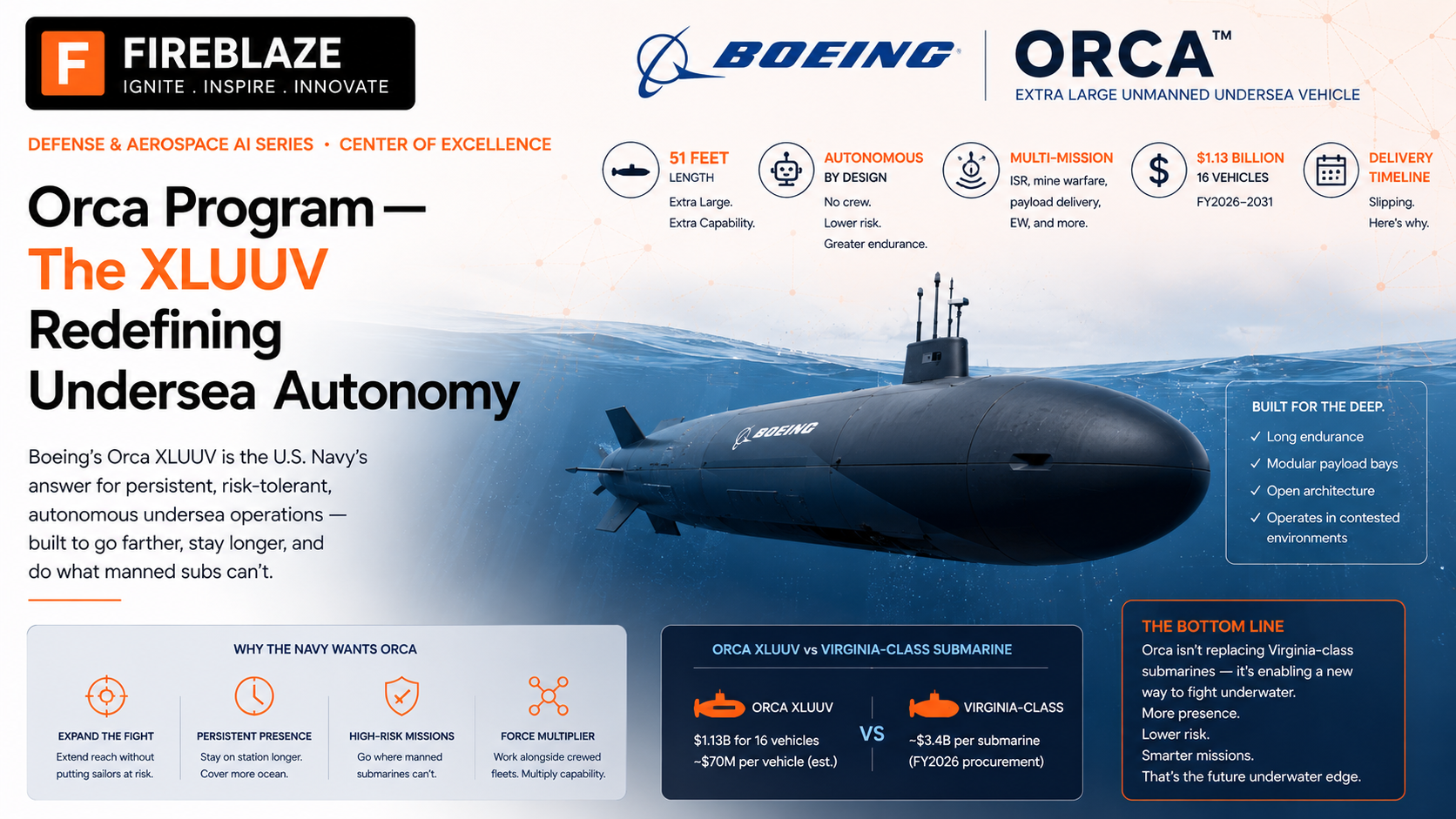
Boeing's Orca Extra Large Unmanned Undersea Vehicle (XLUUV) has spent nine years moving from a 2017 concept contract to, as of May 2026, a funded line item in the U.S. Navy's shipbuilding plan — sixteen vehicles, $1.13 billion, through fiscal year 2031. This report covers what the Orca actually is, how slowly it got here, why the Navy wants a fleet of uncrewed 51-foot submarines in the first place, and what its funding says about where naval autonomy is actually headed versus where it's still catching up.
1. Program Overview
The Orca XLUUV program began in September 2017, when the U.S. Navy awarded parallel design contracts to Boeing ($42.27M) and Lockheed Martin ($43.17M) to compete for what would become a long-endurance autonomous submarine. Boeing won the build phase in February 2019 with a $43 million contract to fabricate, test, and deliver four vehicles; a March 2019 modification added a fifth prototype, bringing the total contract value to roughly $274 million.
The program is built on the technical foundation of Boeing's earlier Echo Voyager — a proof-of-concept unmanned submarine that demonstrated extended endurance and autonomous operation before Orca existed as a named program.
2. Technical Specifications
| Spec | Detail |
|---|---|
| Length (vehicle only) | 51 ft (16 m) |
| Diameter | 8.5 ft (2.6 m) |
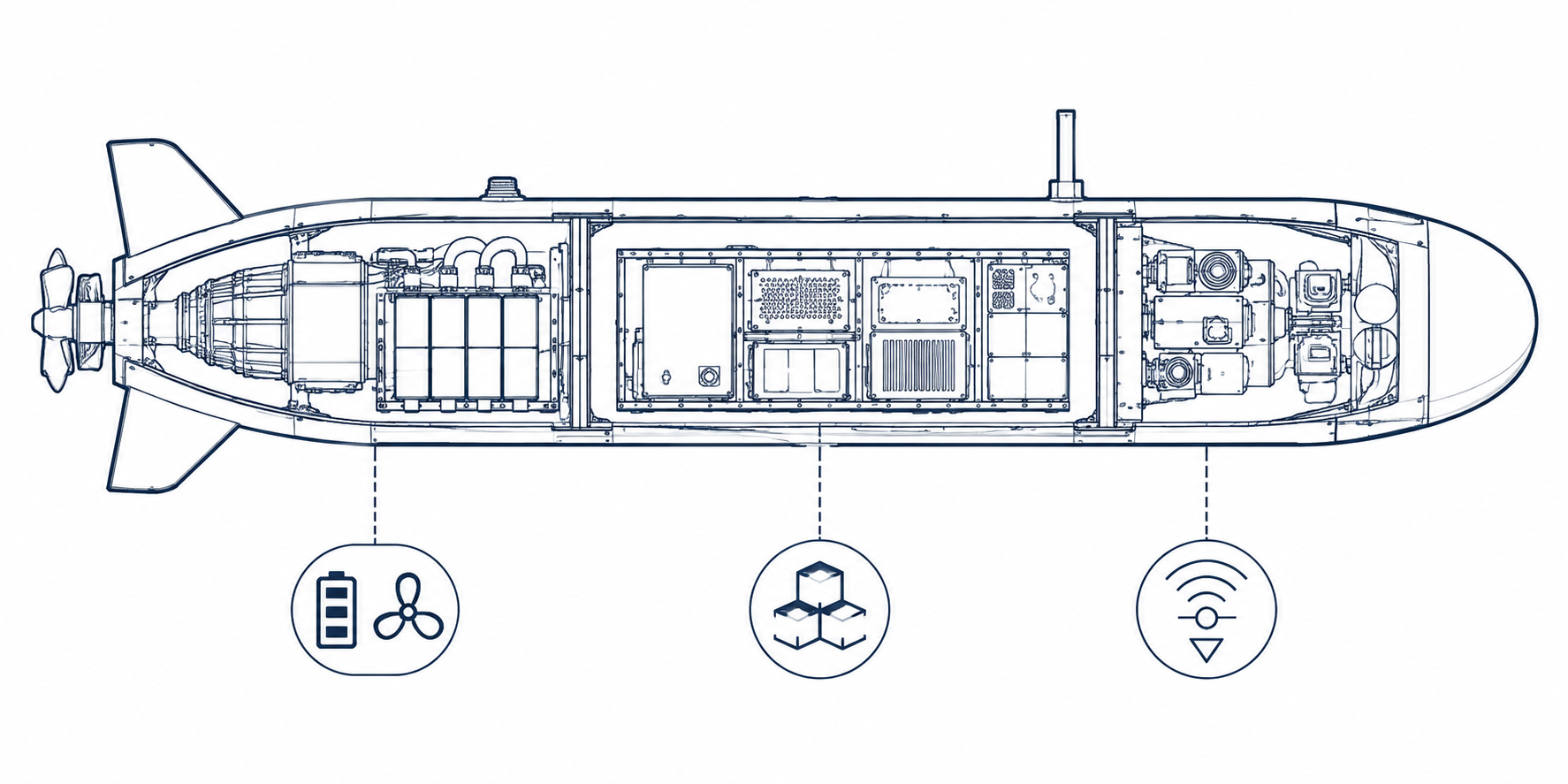
| Payload section | 34 ft (10 m) modular |
| Total length (with payload) | 85 ft (26 m) |
| Payload capacity | Up to 8 tons dry |
| Propulsion | Hybrid — batteries + marine diesel generators |
| Range | Up to 6,500 nautical miles |
| Navigation | Inertial navigation + Doppler velocity logs + depth sensors (no GPS underwater) |
| Stated mission set | Mine countermeasures, anti-surface warfare, anti-submarine warfare, electronic warfare, strike missions, seabed mapping, deception operations |
The navigation detail matters more than it looks: since GPS doesn't function underwater, Orca's entire long-range autonomy claim rests on dead-reckoning-style inertial navigation corrected by Doppler velocity logs — a genuinely hard control problem to sustain error-free over a 6,500 nautical mile range without surfacing.
3. Delivery Timeline — And Why It Matters
Boeing's delivery record tells a more complicated story than the funding headline does.
| Date | Milestone |
|---|---|
| Sep 2017 | Boeing and Lockheed Martin win parallel design contracts |
| Feb 2019 | Boeing wins $43M contract to build 4 XLUUVs |
| Mar 2019 | Contract modified to add a 5th prototype (~$274M total) |
| Apr 2022 | First in-water test |
| Dec 2023 | XLE0 (prototype vehicle) delivered to the Navy |
| 2024 | Risk-reduction and integration testing of XLE0 |
| Sep 2025 | XLE1 — first operational vehicle — delivered |
| Mar 8, 2026 | XLE2 christened at Boeing's Huntington Beach facility |
| May 12, 2026 | Navy formally funds 16 XLUUVs through FY2031 ($1.13B) |
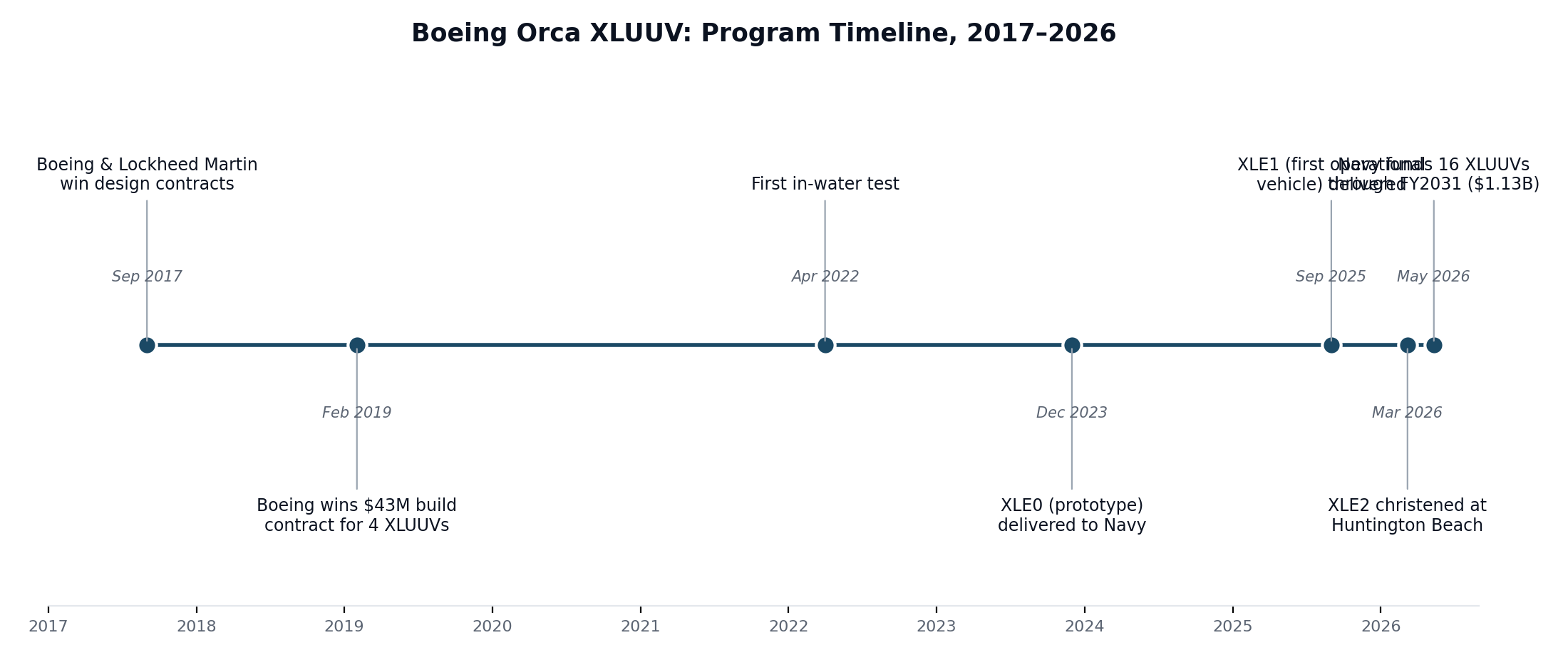
The original 2019 contract targeted delivery of all five vehicles by the end of 2022. That date has long since passed. The gap between XLE0 and XLE1 was roughly a year and a half to two years; the gap between XLE1 and XLE2 narrowed to about a year — real progress, but still well off the pace the program was originally sold on.
4. Why the Navy Wants This
The May 2026 shipbuilding plan is the clearest signal yet of the Navy's actual thinking: Orca isn't meant to replace crewed attack submarines, it's meant to take on the missions where losing the vehicle is an acceptable risk that a crewed platform shouldn't have to take.
The funding split makes the division of labour explicit. In the same Future Years Defense Program:
- 10 Virginia-class nuclear attack submarines — $62.9 billion
- 16 Orca XLUUVs — $1.13 billion
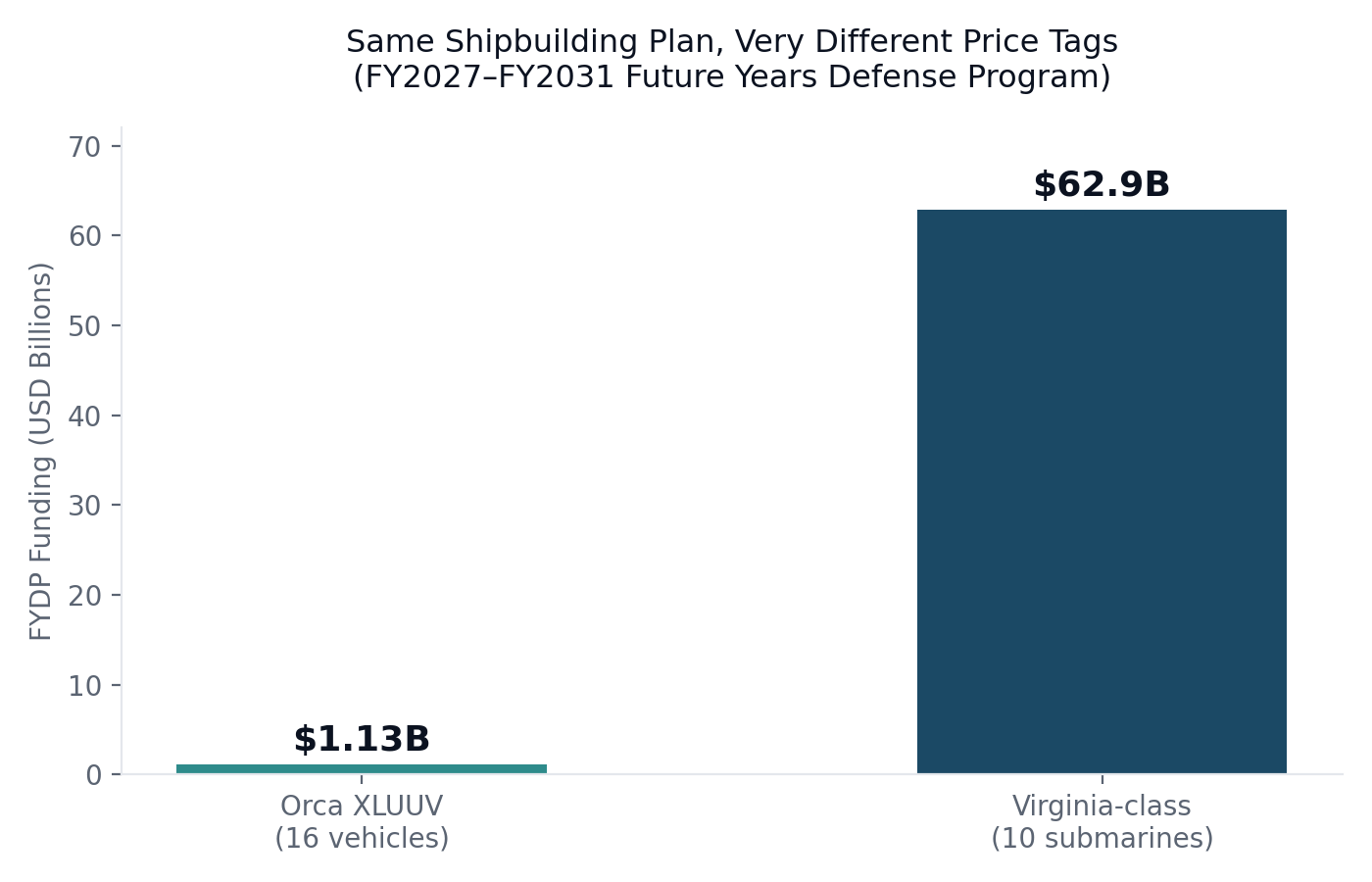
Virginia-class boats keep the missions that need a human crew's judgment, nuclear endurance, high-speed maneuvering, and kinetic strike capability. Orca is positioned for persistent surveillance, seabed mapping, deception operations, mine warfare, and other high-risk, long-duration missions — the kind of work where an uncrewed vehicle being detected, disabled, or lost doesn't cost anyone their life or a billion-dollar hull.
The Orca acquisition is also moving alongside procurement of 47 Medium Unmanned Surface Vessels (MUSVs) — read together, this is a Navy building out a genuinely distributed, partially autonomous fleet structure rather than treating unmanned systems as a side experiment.
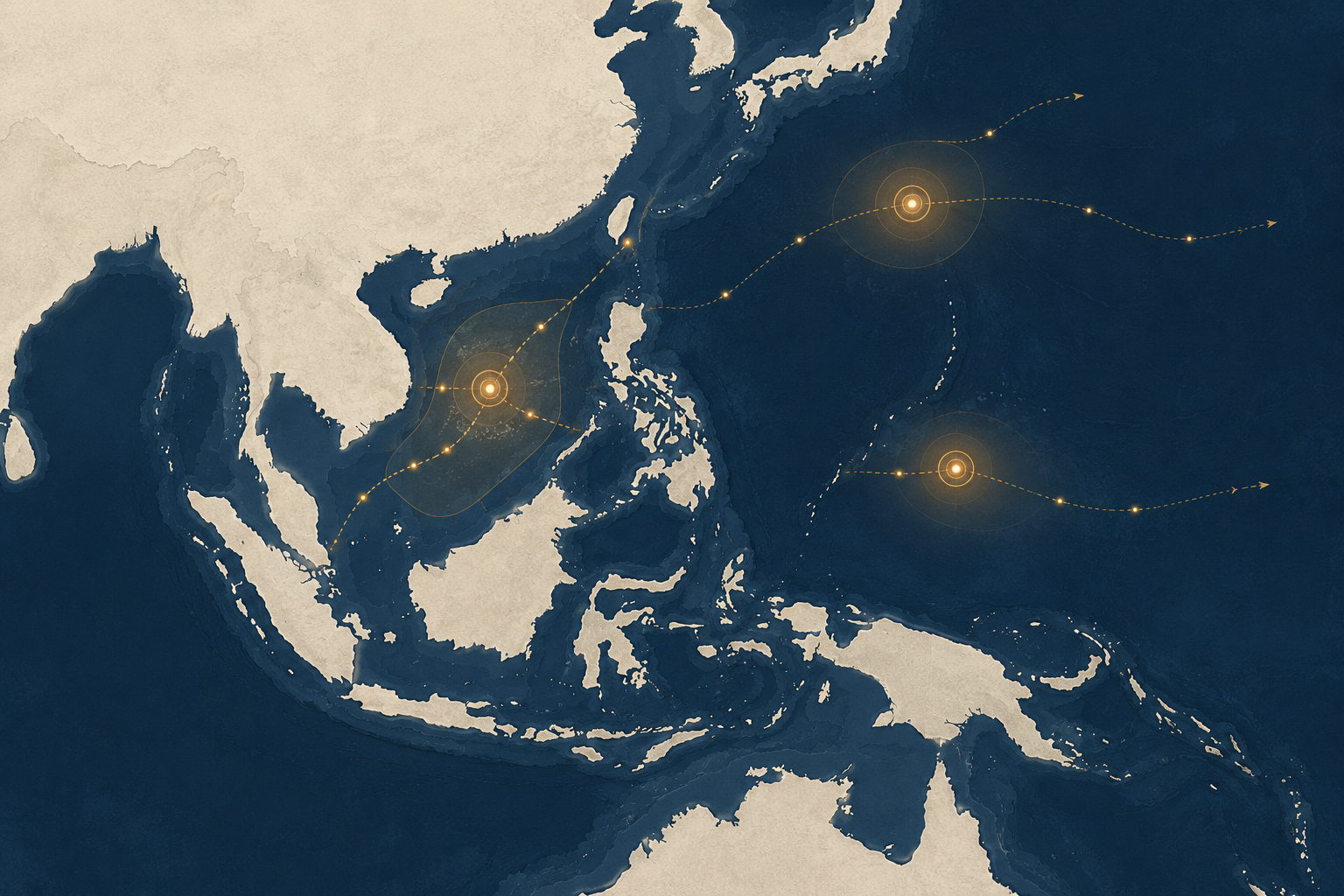
Public reporting has connected the funding increase directly to Pacific-facing, China-oriented planning — persistent undersea presence over a wide operational area is exactly the kind of mission an expensive, crewed submarine is a poor economic fit for, and an autonomous one is well suited to.
5. Not Just a U.S. Program
The U.S. isn't the only navy building large uncrewed submarines. The UK's Royal Navy took delivery of XV Excalibur in December 2025 — a 12-meter, 19-ton experimental XLUUV built under Project Cetus, designed to test payloads, autonomy, and long-range control. Excalibur has already been remotely operated from Australia during Exercise Talisman Sabre — a genuinely striking demonstration of exactly the kind of home-base-to-distant-operations control loop that Orca is also designed around, just at a smaller scale and an earlier stage.
This matters for reading the Orca program correctly: it isn't an isolated U.S. bet, it's one entry in a broader allied pattern of navies deciding that extra-large autonomous undersea vehicles are worth the investment, even while none of them have fully worked out the delivery timelines yet.
6. Program Risk: What to Watch
- Delivery cadence is still the real question. Funding 16 vehicles means little if Boeing can't close the gap between contracted and actual delivery dates. The XLE0→XLE1→XLE2 pattern shows improvement, not resolution.
- Armament status is still not fully public. Naval mine delivery is the most clearly confirmed capability; whether Orca will carry torpedo tubes or missile cells remains unconfirmed in open-source reporting.
- The autonomy claim is unverified at scale. A 6,500 nautical mile range without GPS is an impressive spec on paper. Whether inertial-navigation-plus-Doppler-logs holds up for that distance in an operationally realistic (not test-range) environment is not something available in public reporting yet.
Sources
- "U.S. Navy Allocates $1.13 Billion for 16 Boeing Orca XLUUVs Under 2026 Fleet Expansion Plan," The Defense News, May 12, 2026
- "U.S. Navy Funds 16 Boeing Orca Drone Submarines for China-Focused Pacific Combat Operations," Army Recognition, May 14, 2026
- "Boeing Christens Second Extra-Large Orca Submarine Drone," Naval News, Mar 2026
- "Boeing Launches Second Orca Extra-Large Uncrewed Undersea Vehicle XLE2 for U.S. Navy," The Defense News, Mar 8, 2026
- Boeing Form ARS — FY2024 and FY2025 (SEC filings)
- Orca XLUUV program profile — Naval Technology