Company Report: Orolia (Safran Trusted 4D) — The Commercial Face of Resilient PNT

Company Report: Orolia (Safran Trusted 4D) — The Commercial Face of Resilient PNT
1. Company Snapshot
Orolia was a France/US-headquartered specialist in resilient Positioning, Navigation and Timing (PNT) — the atomic clocks, GNSS simulators, anti-jam/anti-spoof receivers, and emergency beacons that keep militaries, telecoms, and critical infrastructure operating when satellite navigation signals are degraded, jammed, or spoofed. In July 2022, Safran — the French aerospace and defense group — acquired Orolia outright, folding it into Safran Electronics & Defense as a new sub-brand: Safran Trusted 4D. It is no longer an independent company; it operates today as a fully owned division inside a ~€27–30B global aerospace/defense conglomerate, which materially changes how it should be read as a "competitor" — it has the balance sheet of Safran behind it, not venture or PE capital.
| Attribute | Detail |
|---|---|
| Founded | 2006 (Orolia entity); traces product lineage to Spectracom, founded 1972 in Rochester, NY <cite index="8-1">Orolia was formerly known as Spectracom Corporation, founded in Rochester, New York in 1972</cite> |
| HQ | Dual-hubbed: Les Ulis, France (Safran Trusted 4D) and West Henrietts, NY / Rochester, NY (Safran Federal Systems, formerly Orolia Defense & Security) |
| Founders/CEO | No single named "founder" of Orolia as a modern entity — it grew through acquisitions (Spectracom, Talen-X, and others) under private-equity ownership. Current leadership sits under Safran Electronics & Defense; Alexandre Lenoble is named as Head of GNSS & Timing at Safran Electronics & Defense. CEO of the standalone Safran Trusted 4D/Federal Systems entity: [VERIFY: current named CEO] |
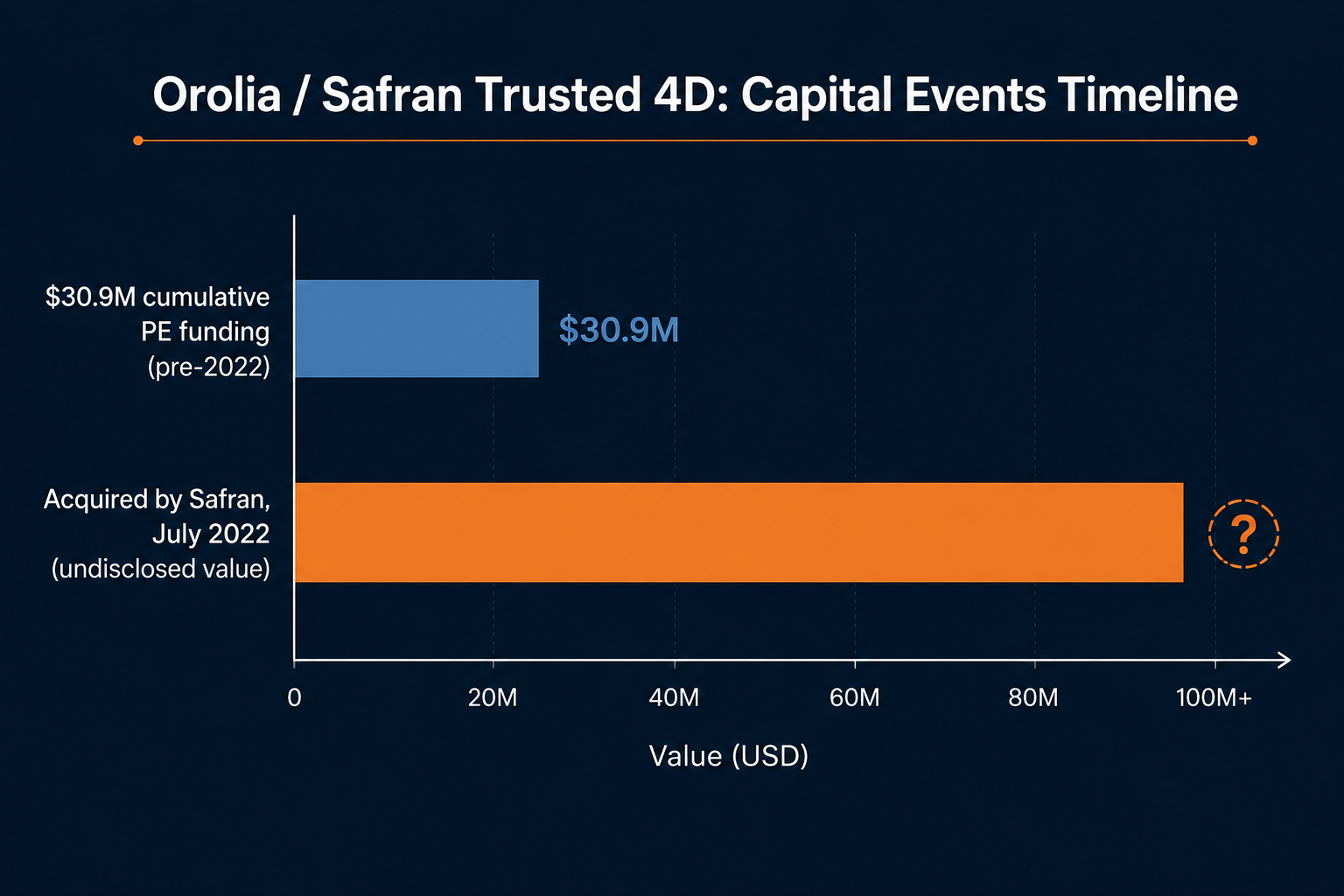
| Total Funding (pre-acquisition) | ~$30.9M in disclosed institutional funding across its life as an independent/PE-backed company, per PitchBook <cite index="13-1">Orolia has raised $30.9M from investors including A Plus Finance, Airtek Capital Group, BNP Paribas Capital Partners, Capza, and Crédit Mutuel Impact</cite> — modest for a "market leader," reflecting a roll-up-by-acquisition growth model rather than venture scaling |
| Latest Valuation | Not publicly disclosed. Safran's 2022 acquisition price was not broken out separately in public releases; Orolia had revenues of around €100 million at acquisition <cite index="7-1">Orolia employs more than 435 people in Europe and North America and has revenues of around €100 million</cite>. [VERIFY: disclosed acquisition price, if any] |
| Employee count | ~435 at time of acquisition (2022) <cite index="7-1">Orolia employs more than 435 people in Europe and North America</cite>; current headcount under Safran not separately broken out |
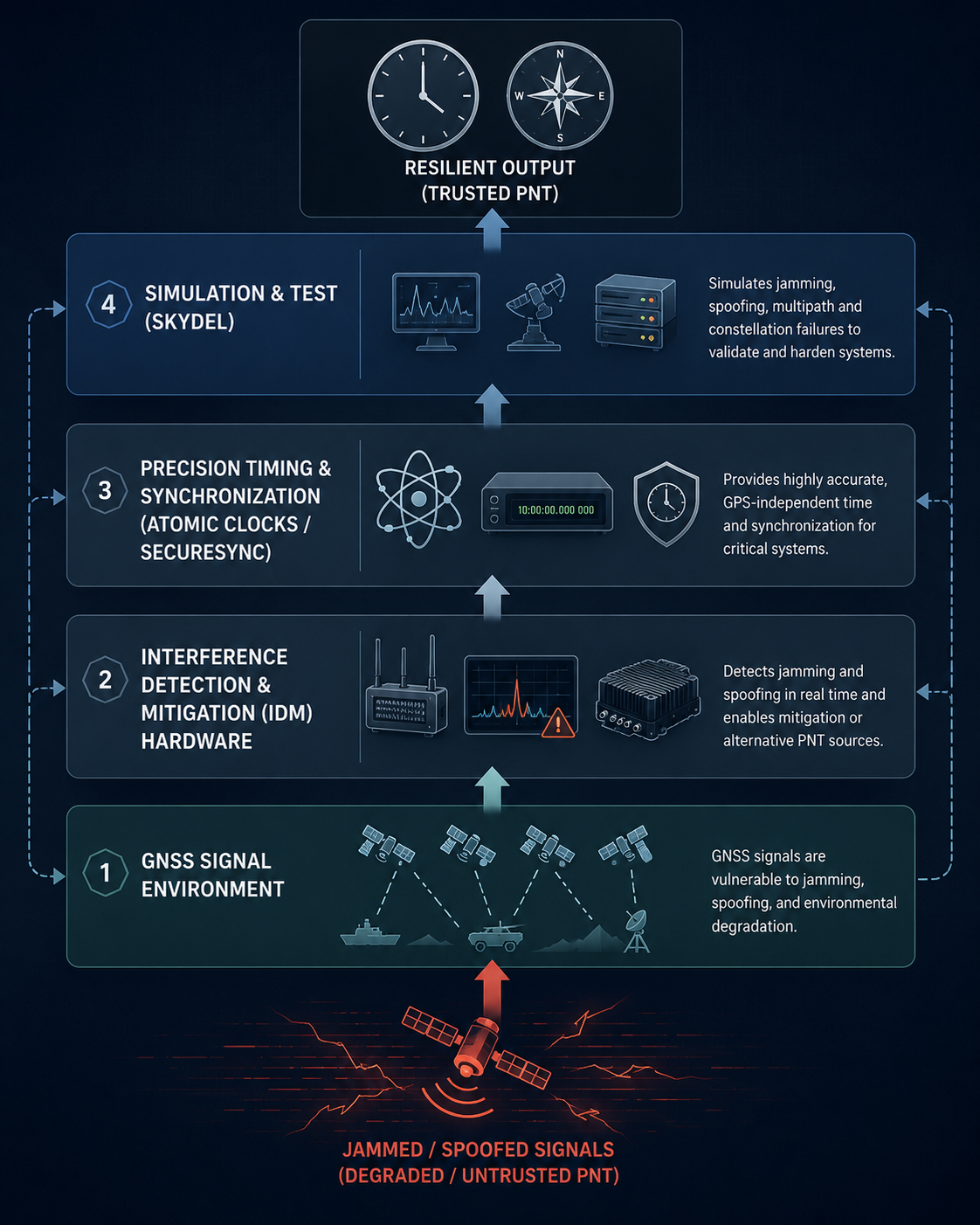
Strip away the branding and Orolia/Safran Trusted 4D sells four adjacent product families, all built around one premise: GPS/GNSS cannot be trusted as a sole source of position or time.
Precision timing. Atomic clocks, network time servers, and synchronization appliances (the SecureSync line) that keep power grids, telecom networks, data centers, and military systems on a common, verifiable clock — independent of GPS if needed.
GNSS simulation and interference testing. Skydel and related tools let defense labs and manufacturers simulate jamming, spoofing, multipath, and constellation failures in a lab environment, so radios, missiles, and aircraft avionics can be hardened before deployment. This is effectively the "red team" half of the business — building the attack tools so the defense tools can be validated.
Interference detection and mitigation (IDM). Hardware and software, developed largely through the Talen-X acquisition, that detects jamming/spoofing in the field and cues an operator or system to switch to an alternate PNT source.
Emergency beacons and inertial/optronic hardware. Through the broader Safran Electronics & Defense umbrella, the portfolio now stretches into aviation emergency locator transmitters, inertial navigation units, and — via recent contracts — submarine periscopes and optronic masts, positioning "resilient PNT" as one layer inside a much larger navigation and sensing stack rather than a standalone product line.
The common thread: Orolia doesn't build the AI-driven detection layer your CoE's SkyGhost-Detect-style projects target. It builds the hardware and firmware substrate — the clocks, simulators, and RF front-ends — that a detection algorithm would sit on top of or validate against.
3. Recent Moves (Last ~6–12 Months)
Safran Trusted 4D's activity over the past year shows a company consolidating a European PNT stack rather than chasing headline-grabbing raises — consistent with its status as a corporate division, not an independent fundraising entity.
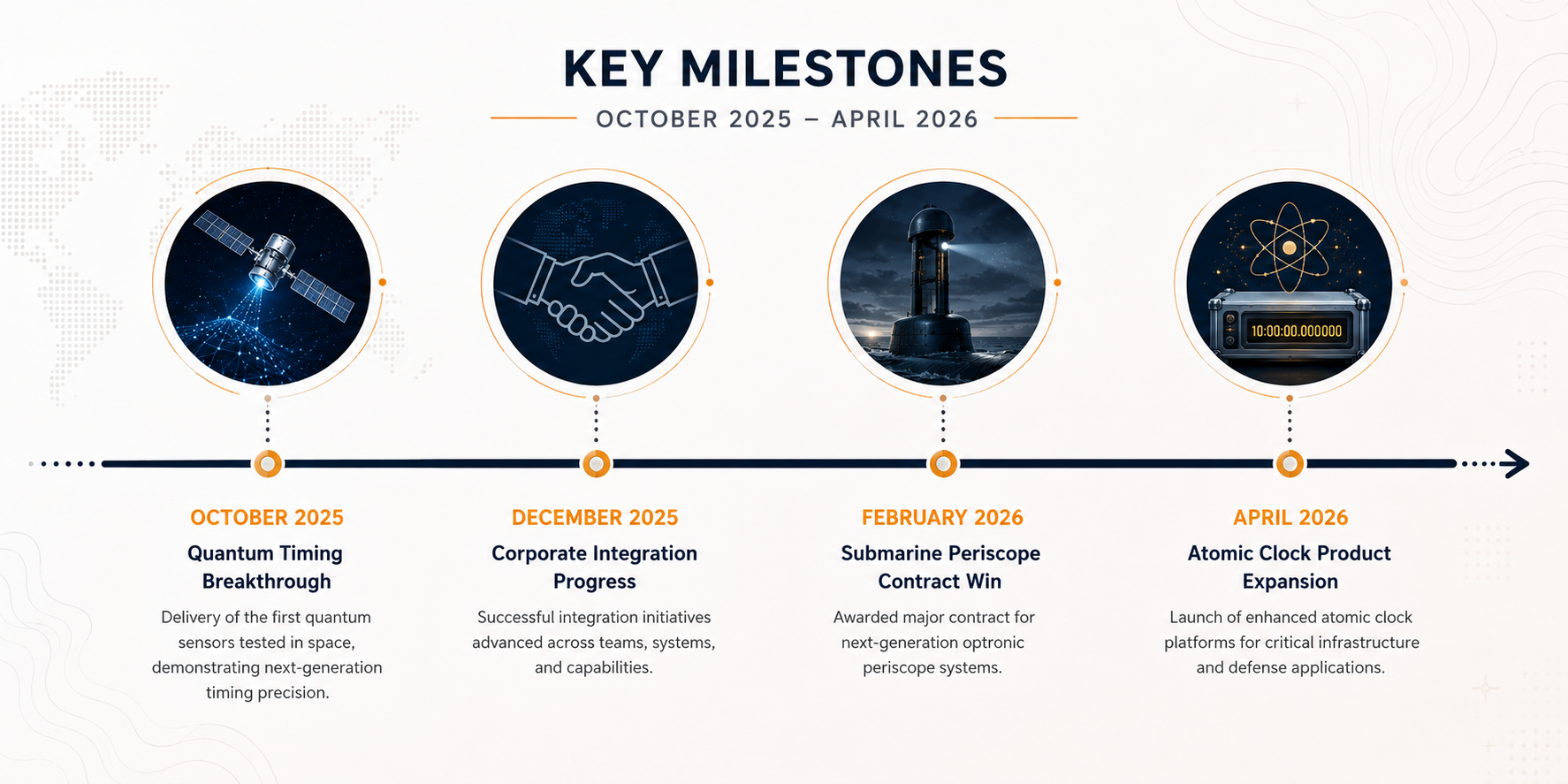
Quantum timing partnership with Infleqtion (December 2025 – April 2026). Safran Electronics & Defense announced a strategic collaboration with Infleqtion (NYSE: INFQ) in December 2025 to integrate Infleqtion's Tiqker neutral-atom optical clock with Safran's White Rabbit and SecureSync synchronization systems <cite index="34-1">the collaboration integrates Infleqtion's Tiqker quantum optical clock with Safran's White Rabbit and SecureSync systems to provide resilient, stable timing for GPS-denied environments</cite>. By April 1, 2026, the two companies announced the solution was validated and commercially available, <cite index="31-1">demonstrating picosecond accuracy versus nanosecond GPS accuracy in a live demonstration conducted with Quantum Corridor</cite>. This is arguably the most technically significant move in the window — it signals Safran betting on quantum clocks, not just better RF filtering, as the next resilience layer.
Syntony acquisition (February 2026). Safran Electronics & Defense acquired Syntony, a Toulouse-founded (2015) GNSS receiver specialist with roughly 70 employees, explicitly to strengthen its position in space-based PNT for LEO constellations and to shrink the size/power footprint of its receivers for drones and counter-UAS platforms <cite index="27-1">the acquisition enables Safran Electronics & Defense to strengthen its resilient technologies to support customers addressing challenges of navigation and positioning, particularly for compact, energy-efficient equipment adaptable to evolving signals</cite>.
DARPA quantum sensor award (October 2025). Safran Federal Systems won a DARPA Robust Quantum Sensor (RoQS) program contract to build quantum sensors for GPS-denied PNT, with a planned helicopter-based field demonstration <cite index="26-1">the award was granted through DARPA's Robust Quantum Sensor program, which aims to address common issues with quantum systems including sensitivity to electromagnetic interference, with work focused on ruggedization, prototyping, and early integration with Department of Defense platforms</cite>.
Canadian submarine contract (February 2026). Safran Trusted 4D Canada was awarded a $118M contract by Canada's Department of National Defence for digital periscopes and in-service support for the Victoria-class submarine fleet <cite index="22-1">the periscope upgrade is part of Canada's Victoria-class diesel electric submarine modernization, with installation beginning in 2030 and work expected to complete by the end of 2033</cite> — a reminder that "PNT" at Safran scale increasingly bleeds into adjacent optronics and sensing hardware.
4. Competitive Position
Safran Trusted 4D is frequently described as the "world leader in resilient PNT," but that claim needs context: it competes less on AI/software sophistication and more on hardware breadth, certification pedigree, and prime-contractor trust — assets built over decades of defense procurement relationships. Its most comparable direct competitor in anti-jam/resilient-PNT hardware is Hexagon | NovAtel, a long-standing GNSS receiver and inertial-navigation supplier also embedded across defense and commercial surveying markets.
| Dimension | Safran Trusted 4D | Hexagon | NovAtel |
|---|---|---|---|
| Core focus | Full-stack PNT hardware: atomic clocks, GNSS simulation, IDM, emergency beacons, plus quantum timing R&D | GNSS receivers, OEM boards, inertial/GNSS-fused navigation systems for defense, survey, and autonomy | |
| Ownership | Wholly owned division of Safran (public, ~€27–30B revenue conglomerate) | Wholly owned division of Hexagon AB (public, Swedish industrial technology group) | |
| Stated edge | Breadth across the full PNT chain (simulate → detect → mitigate → resynchronize) plus early-mover quantum clock integration | Deep GNSS receiver IP and anti-jam antenna arrays (e.g., GAJT product line), strong OEM design-in position | |
| Defense contract base | NATO-aligned (France, Canada, U.S. via Safran Federal Systems), recent DARPA and Canadian DND awards | Strong U.S. DoD and Five Eyes presence, embedded in many autonomy and precision-agriculture platforms | |
| AI/software layer | Thin — hardware and firmware-centric; no disclosed proprietary detection AI comparable to a dedicated software-defined detection stack | Similarly hardware-centric, though increasingly pairs receivers with software-defined anti-jam signal processing |
The practical takeaway for an AI-focused CoE: neither Safran Trusted 4D nor Hexagon | NovAtel is presently marketing a standalone AI-driven anomaly-detection product for GNSS spoofing/dark-aircraft-style use cases — that layer is largely being built by smaller, software-first entrants (e.g., Regulus Cyber-style firms) or left to defense primes' internal data-fusion teams. This is the gap a project like SkyGhost-Detect sits in.
5. Why It Matters
Safran's continued investment in Orolia/Trusted 4D — an acquisition, a DARPA award, a quantum-clock partnership, and a $118M submarine contract all inside a single year — signals that resilient PNT has moved from a niche defense concern to a recognized, budgeted line item across NATO-aligned procurement. It also illustrates a structural pattern in defense-tech: hardware-and-firmware incumbents with certification pedigree are consolidating the physical PNT layer (clocks, receivers, jamming test rigs), while the detection and inference layer — spotting spoofing patterns, correlating anomalous tracks, flagging "dark" aircraft — remains comparatively open. For an AI-focused CoE, that gap is the commercial opportunity: Safran Trusted 4D is not a competitor to an AI detection tool, it is closer to a potential integration partner or a downstream beneficiary of one, since its hardware generates exactly the kind of raw signal data an anomaly-detection model would consume.
6. What to Watch Next
- Quantum clock rollout pace. Whether the Tiqker/White Rabbit/SecureSync bundle moves beyond validation into volume defense contracts through 2026–2027.
- DARPA RoQS Phase 2. Whether Safran's helicopter field demo succeeds and unlocks follow-on funding.
- Syntony integration. Whether the LEO-focused GNSS receiver IP shows up in counter-UAS or New Space product announcements.
- Software/AI signaling. Any public statement from Safran Electronics & Defense about building (or acquiring) a software-defined anomaly-detection layer — that would be the clearest sign the hardware incumbents are moving into the CoE's space directly.
7. Funding Timeline Data
| Round | Date | Amount Raised ($B) | Post-Money Valuation ($B) |
|---|---|---|---|
| Cumulative disclosed PE/institutional funding (pre-acquisition) | Undisclosed dates, aggregated by PitchBook | $0.0309B ($30.9M) | [VERIFY: no disclosed valuation] |
| Acquisition by Safran (100% buyout) | July 8, 2022 | [VERIFY: acquisition price not disclosed in public Safran press release] | [VERIFY: implied enterprise value not disclosed] |
| Syntony bolt-on acquisition (adjacent, not Orolia itself) | February 13, 2026 | [VERIFY: deal value not disclosed] | N/A (private bolt-on) |