Conformal Prediction for Climate Risk: Statistically-Guaranteed Confidence Without Bayesian Assumptions
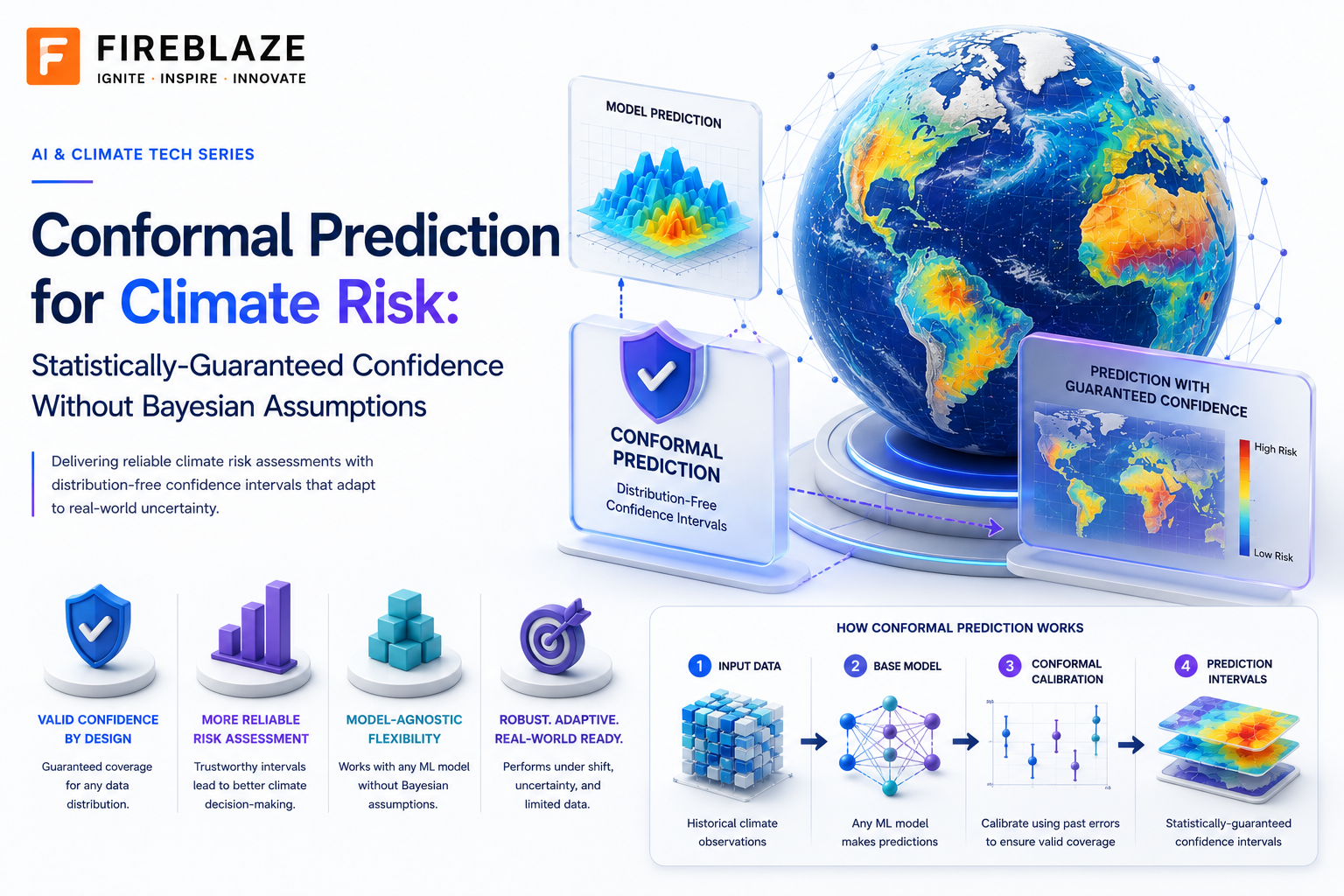
Conformal Prediction for Climate Risk: Statistically-Guaranteed Confidence Without Bayesian Assumptions
A domain-knowledge piece on the most underused, technically sharpest tool in this series so far — one that takes any risk score, from any model covered in the earlier pieces (FourCastNet, GraphCast, GenCast, a PCMCI-derived causal precursor), and wraps it in a confidence interval that is mathematically guaranteed to be right at the stated rate, without assuming a Bayesian prior or a known error distribution.
1. Hook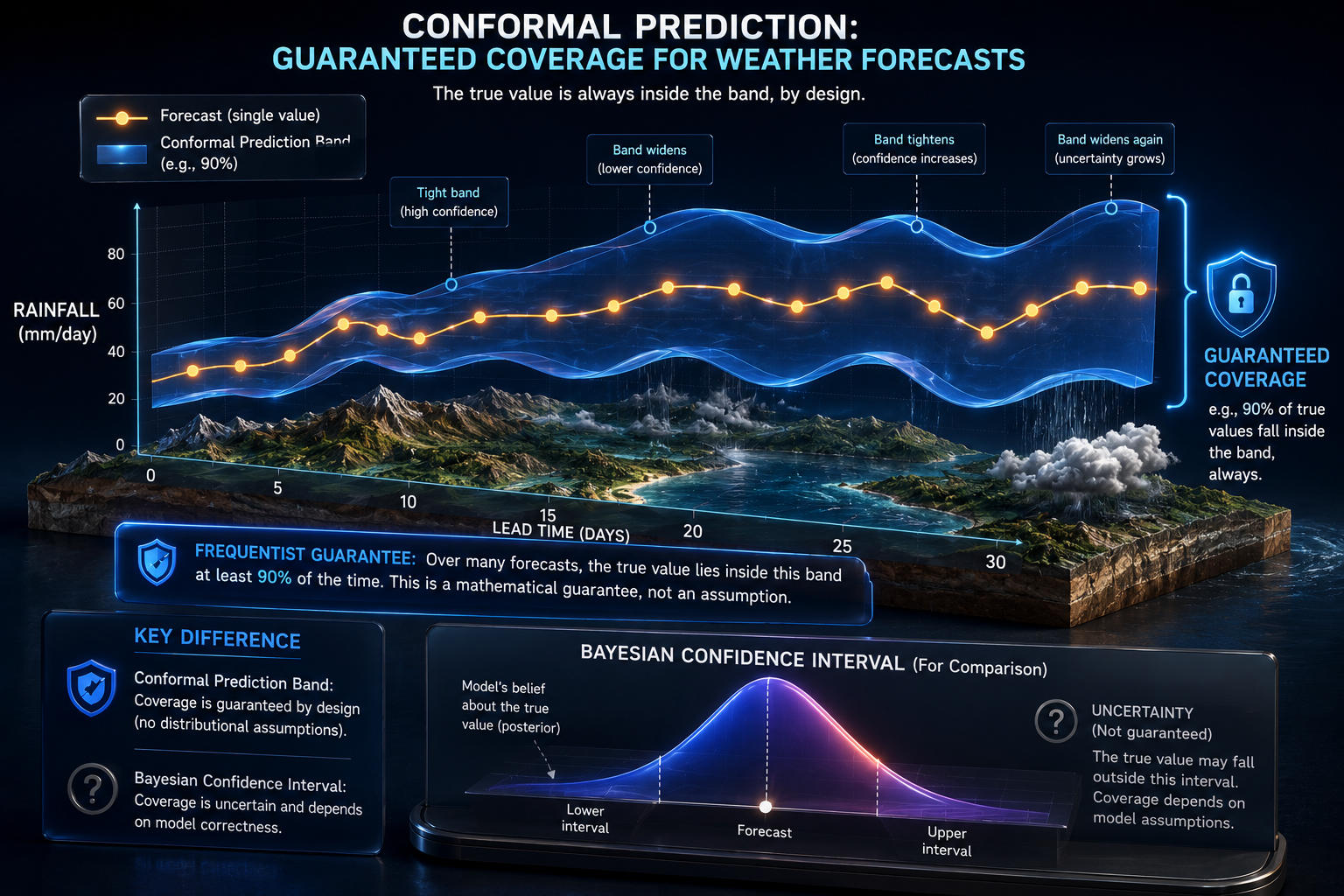
Every uncertainty estimate this series has covered so far comes with an asterisk. GenCast's ensemble spread (covered two pieces back) is a genuinely useful uncertainty signal, but Section 2.5 of that piece showed it can carry a systematic physical bias at the mesoscale — meaning the spread is informative without being calibrated: there's no guarantee that the true outcome falls inside, say, the 90% band 90% of the time. Bayesian approaches to uncertainty come with a sharper version of the same asterisk: they require specifying a prior distribution over outcomes, and the resulting credible interval is only as trustworthy as that prior and the assumed likelihood model — both of which are genuinely hard to get right for a chaotic, non-stationary system like the climate. Conformal prediction answers a narrower but far more rigorously guaranteed question than either of these: given any underlying model's point prediction or score — a temperature forecast, a wildfire risk score, a flood probability — and a modest amount of held-out calibration data, conformal prediction produces a prediction interval or prediction set with a finite-sample, distribution-free coverage guarantee: the true value will fall inside the interval at least the specified rate (say, 90%) no matter what the underlying model is, no matter what distribution the data actually follows, so long as one specific, checkable condition holds. That's a genuinely different kind of promise than "well-calibrated in practice" or "consistent with a reasonable prior," and it's exactly the missing rigor layer this series has been building toward.
2. Core Explanation
2.1 Why Neither Bayesian Nor Standard Frequentist Ensembles Fully Solve This
It's worth being precise about the gap conformal prediction is closing, because both alternatives already covered in this series have real strengths. Bayesian methods are theoretically elegant — a full posterior distribution over outcomes is a rich object — but a review of uncertainty quantification methods for weather forecasting notes plainly that Bayesian methods, while theoretically appealing, involve restrictive assumptions and do not scale well to the complexity of spatio-temporal climate data. Standard frequentist ensemble approaches — perturbing initial conditions, varying neural network weights, training generative ensemble models like GenCast — are the operational workhorse, but the same review is explicit that most of these approaches provide only asymptotically valid prediction intervals, meaning the guarantee only kicks in as data goes to infinity, which may not suffice for the finite, high-stakes samples that actually matter in weather and climate risk applications. The GenCast follow-up study referenced in the previous piece makes the practical consequence concrete: even a state-of-the-art probabilistic AI weather model, widely considered well-calibrated, showed statistical coverage — the true measure of whether a confidence interval is honest — that struggled specifically on extreme events, the exact tail cases a risk-assessment system cares most about getting right.
Conformal prediction's core promise is narrower by design, which is exactly what lets it be unconditionally guaranteed: it doesn't try to characterize the full shape of uncertainty the way a Bayesian posterior does, and it doesn't rely on an ensemble converging to the truth given infinite compute the way a frequentist ensemble does. It asks a much more modest, checkable question — "how large does this interval need to be, based on how wrong this specific model has actually been on recent held-out data, to contain the truth the stated fraction of the time?" — and answers it with a guarantee that holds at any finite sample size.
2.2 The One Condition the Guarantee Actually Rests On: Exchangeability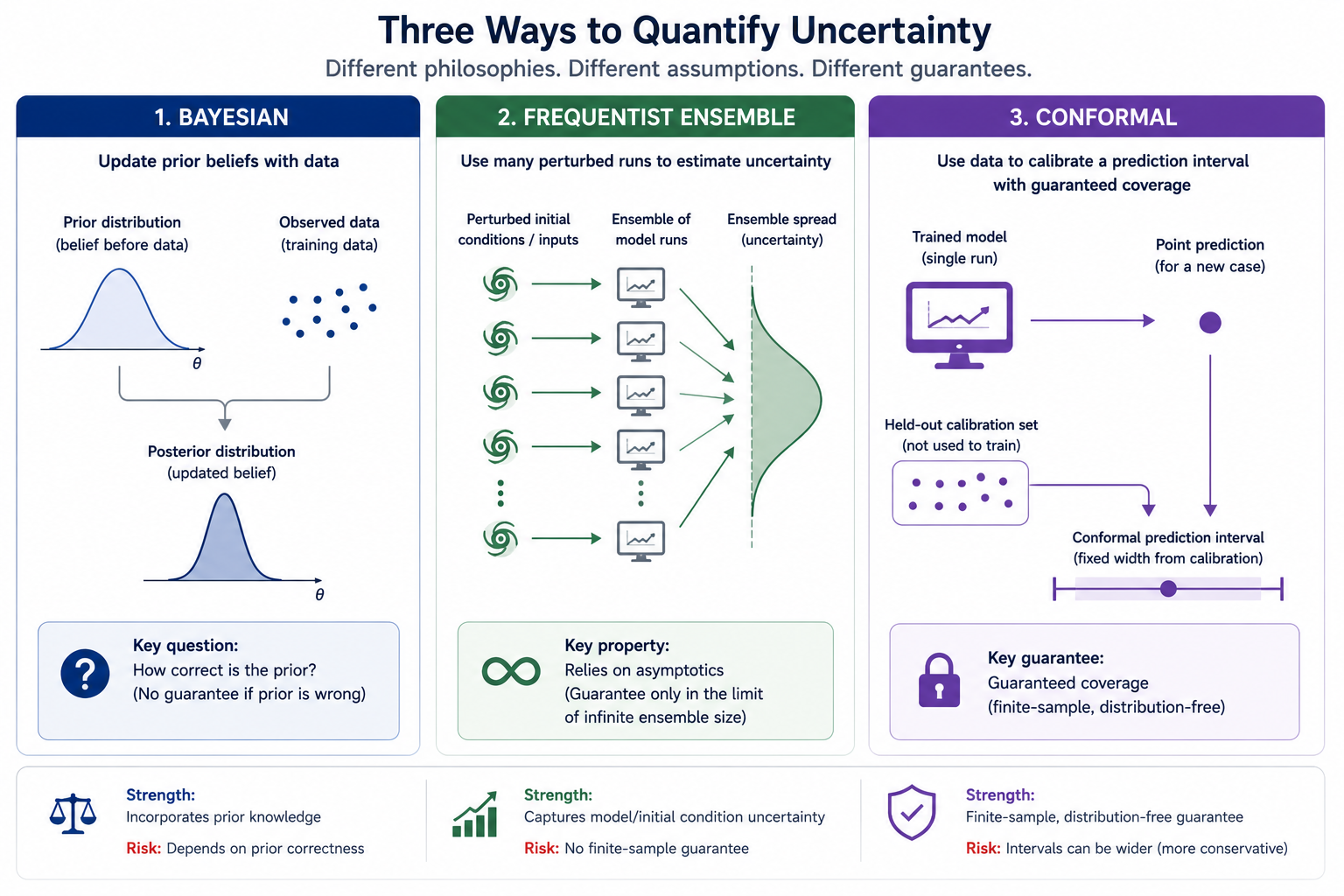
Conformal prediction's guarantee isn't unconditional — it rests on one specific, well-defined statistical assumption called exchangeability: informally, that the calibration data and the future data point being predicted are drawn from the same underlying process in a way that makes their order uninformative, even if the individual values aren't identically distributed in the strict i.i.d. sense. This is a meaningfully weaker requirement than most classical statistical guarantees ask for — no assumption about the shape of the error distribution (it doesn't need to be Gaussian, or symmetric, or unimodal), no assumption about which model produced the prediction (conformal prediction is model-agnostic — it wraps around any predictor, including a black-box deep learning model), and this is precisely why the technique is described as distribution-free.
Climate data's central complication is that exchangeability is not automatically true — a time series with a warming trend, a seasonal cycle, or a shifting storm-track climatology is, by construction, non-stationary, and non-stationary data violates the plain exchangeability assumption. This is not a minor footnote; it's the specific reason a large and active area of recent conformal prediction research is dedicated to relaxing the exchangeability requirement for exactly this kind of sequential, distribution-shifting data, through online and adaptive conformal prediction methods that update the interval width over time as new data arrives, rather than assuming one fixed calibration set stays valid forever.
2.3 The Mechanical Recipe: Split Conformal Prediction
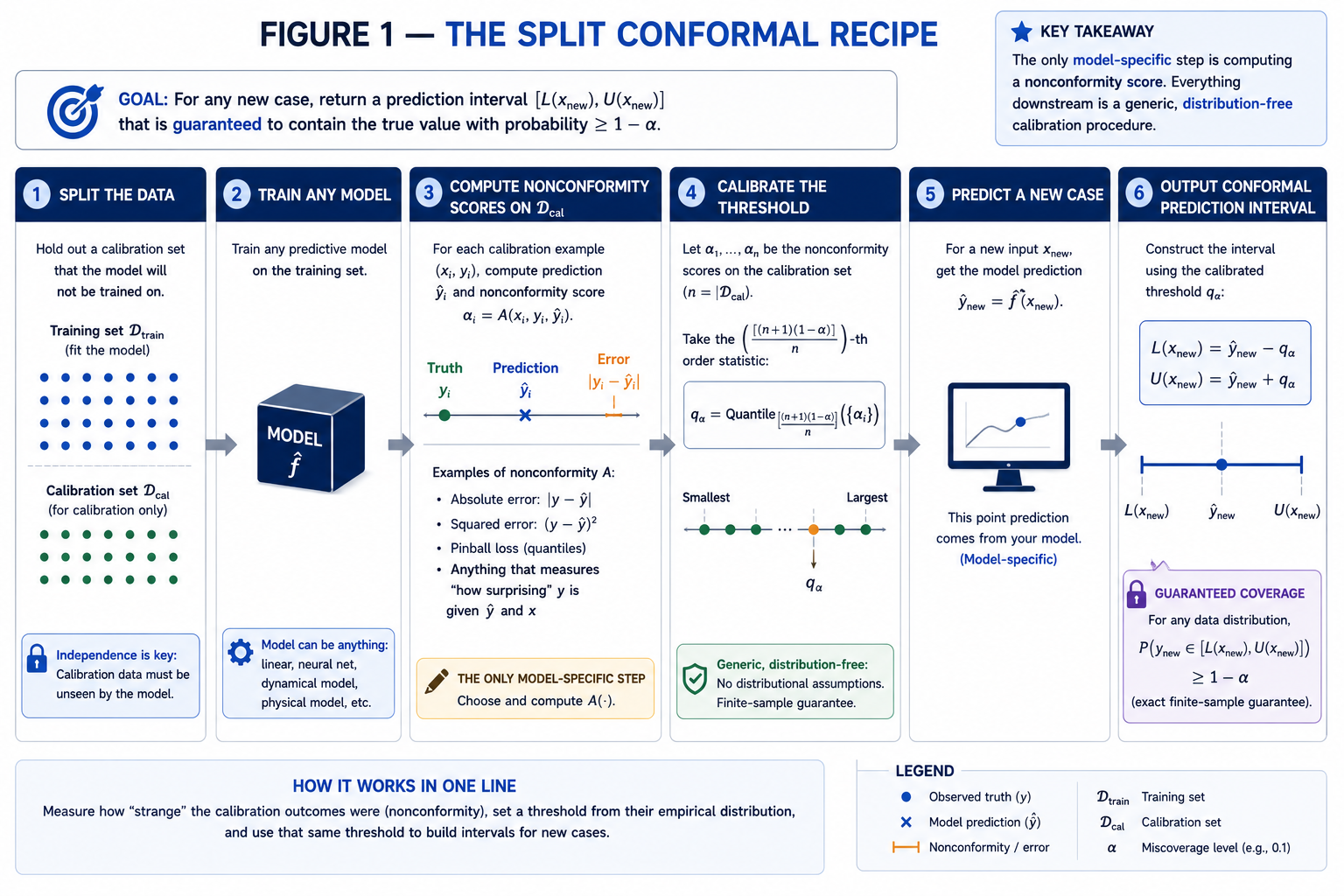
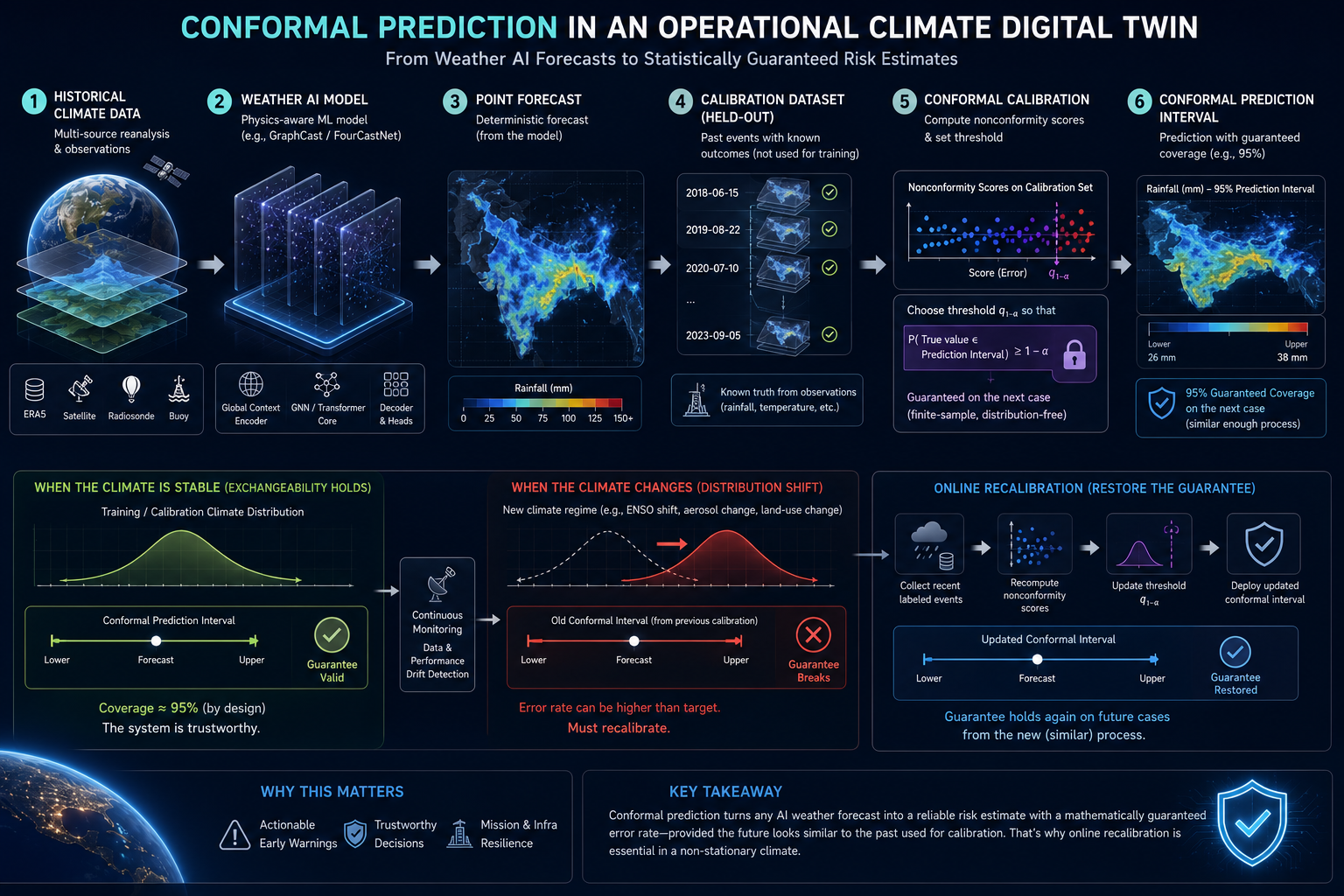
The simplest and most widely deployed version, split conformal prediction, works in four steps that generalize to essentially any underlying model:
- Split the data. Hold out a calibration set that the underlying model was not trained on — a fresh, unused slice of historical data.
- Compute nonconformity scores. For every point in the calibration set, compute how "wrong" the model's prediction was — the simplest choice is the absolute residual (predicted minus actual), though more sophisticated scores exist for different problem types.
- Find the calibration quantile. Take the empirical distribution of those nonconformity scores across the whole calibration set, and find the value below which the desired coverage fraction (e.g., 90%) of scores fall.
- Build the interval. For a new prediction, construct an interval by adding and subtracting that calibration quantile from the model's point prediction.
The guarantee this produces is remarkably close to unconditional: under exchangeability, the resulting interval contains the true value at least the target rate, for any underlying prediction model, without any assumption about that model's internal workings or the shape of its errors. Conformalized Quantile Regression (CQR), a widely used refinement, replaces the fixed-width interval from step 4 with an adaptive-width one by first training the underlying model to predict quantiles (rather than a single point), then conformally calibrating around those quantile predictions — this lets the interval naturally widen in genuinely more uncertain conditions (e.g., a rapidly intensifying storm) and narrow in more predictable ones, rather than applying the same fixed margin everywhere.
2.4 Where This Has Actually Been Applied to Climate Risk
- Tropical cyclone intensity forecasting. Because storm intensity uncertainty is highly regime-dependent — much higher during rapid intensification than during steady states — a static uncertainty band is either too wide in calm conditions or dangerously too narrow during rapid intensification. Recent work applies conformalized quantile regression to dynamically adjust the uncertainty range of tropical cyclone intensity forecasts based on the storm's development stage and forecast lead time, specifically to correct for the fact that most existing uncertainty quantification methods use static setups that don't adapt to changing storm conditions.
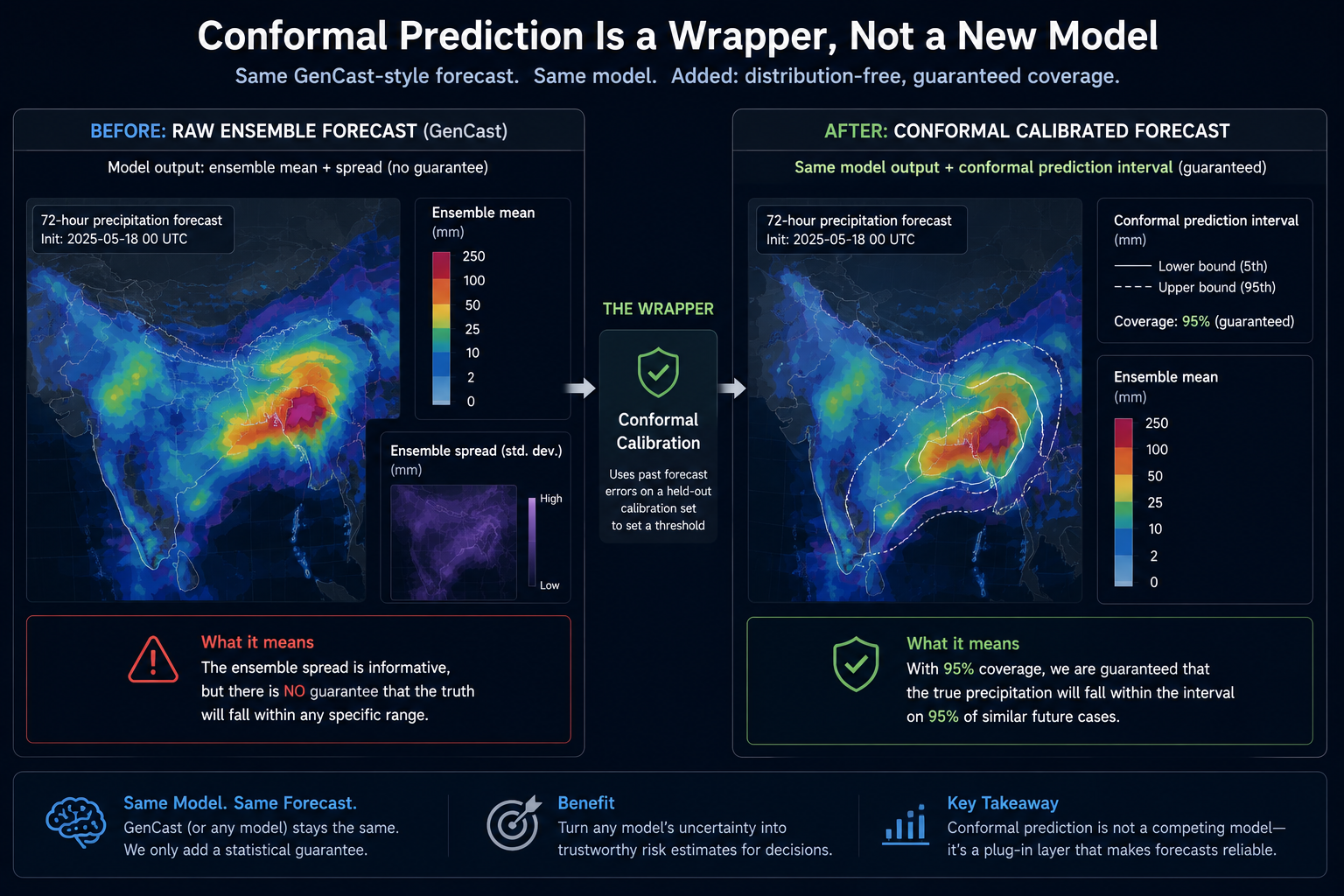
- Calibrating AI weather ensembles at the extremes. The follow-up study on GenCast referenced in the previous piece applies online conformal prediction directly to temperature and precipitation forecasts — including extremes — from three leading global AI weather models (GenCast, NeuralGCM, and AIFS-ENS), specifically because those models' apparent calibration was shown to break down on extreme events; the conformal post-processing step is applied on top of the existing model with no cost to the model's other probabilistic performance metrics, and the method is explicitly designed to be applicable to any forecasting model as a wrapper rather than a replacement.
- Long-range climate projections. "Conformal ensembles," applied to General Circulation Model (GCM) ensembles rather than single forecasts, integrate multi-model ensemble output with observational data to generate prediction sets for future climate states, and the approach is reported to outperform existing inter-model-variability methods for uncertainty quantification across all tested time horizons and most spatial locations under a mid-range emissions scenario — while requiring minimal assumptions and remaining robust to the specific choice of nonconformity measure used.
- Data assimilation. In the process of combining numerical model output with real observations to estimate the current atmospheric state — itself a major source of downstream forecast uncertainty — conformal prediction has been proposed specifically because most machine learning components used in data assimilation pipelines lack coverage guarantees, meaning the probability that the true atmospheric state lies within the estimated interval is otherwise uncontrolled.
- Subgrid physics parameterization. Even at the level of individual microphysical process rates inside a climate model — quantities that can span several orders of magnitude — conformal prediction has been demonstrated as an inexpensive way to attach statistically valid prediction intervals to a model component's output, with the source work explicitly noting that despite being model-agnostic and distribution-free, conformal prediction remains underused in climate science relative to its demonstrated potential.
2.5 The Benchmark Claims, Stated Precisely
Because the earlier pieces in this series have been careful to state specific figures rather than vague superlatives, the same standard applies here. The conformal-ensembles climate-projection work reports empirical coverage close to its nominal target level across the tested scenario, and describes itself as outperforming existing inter-model variability methods for uncertainty quantification across all time horizons and most spatial locations tested. The GenCast/NeuralGCM/AIFS-ENS conformal calibration study's central finding is a gap, not a benchmark win: it demonstrates that the statistical coverage of these otherwise-strong probabilistic AI weather models can struggle specifically on extreme events, which is the finding that motivates applying conformal post-processing in the first place, rather than a headline accuracy number for the conformal method itself. This is worth flagging explicitly: conformal prediction's main published contribution in the weather-AI literature so far is less "it beats other methods on a leaderboard" and more "it's the one wrapper that can honestly tell you when the leaderboard-winning model's confidence intervals are lying to you."
2.6 A Caveat Worth Taking Seriously: The Guarantee Is About Coverage, Not About Being Informative
This is the distinction that keeps "statistically guaranteed" from being an overclaim. Conformal prediction guarantees marginal coverage — that across many predictions, the interval contains the truth at least the target rate, on average over the whole calibration and test distribution. It does not, on its own, guarantee that any individual interval is appropriately sized for the specific conditions of that one prediction — a naive split-conformal interval applies the same fixed margin everywhere, which means it can be needlessly wide in easy cases and can still under-cover in a specific hard subgroup (say, rapidly intensifying storms, or a particular region) even while hitting the target rate in aggregate. This is exactly why the adaptive and regime-aware methods in Section 2.4 (conformalized quantile regression for cyclone intensity, online conformal prediction for AI weather models) exist — they're direct responses to the fact that plain marginal coverage is a real but limited guarantee, not a complete solution to "give me the right-sized interval for this specific situation." And the exchangeability requirement from Section 2.2 is the other half of the same caveat: the guarantee is only as good as the assumption that calibration data and new data come from a stable-enough process, which is precisely the assumption a warming, shifting climate puts the most pressure on — a conformal interval calibrated on a decade of historical storm data carries a weaker practical guarantee under a materially shifted climate regime than the marginal-coverage math alone would suggest, which is why online and adaptive variants that continuously re-calibrate against recent data are the actively developing frontier rather than a solved problem.
2.7 Common Pitfalls
- Treating "statistically guaranteed" as "always tight and informative." As Section 2.6 lays out, the marginal coverage guarantee can be satisfied by an interval that's uselessly wide in easy cases while still under-covering in a specific hard subgroup — coverage and informativeness are separate properties, and only the first one is guaranteed by default.
- Assuming the guarantee survives distribution shift automatically. Exchangeability is doing real, load-bearing work; applying a conformal interval calibrated on a pre-shift climate regime to a post-shift regime without an online or adaptive update quietly weakens the guarantee this piece is built around.
- Confusing conformal prediction with a replacement for the underlying model's skill. Conformal prediction wraps any model with a valid interval — including a bad model. A skillful underlying forecast (like GenCast or FourCastNet, covered in earlier pieces) still produces a tighter conformal interval than a weak one at the same coverage level; conformal prediction guarantees the interval's honesty, not its size.
- Ignoring which nonconformity score was used. A fixed-width interval built on plain residuals behaves very differently from an adaptive-width CQR interval built on quantile predictions — the choice of nonconformity score is where domain knowledge about where uncertainty concentrates (e.g., rapid intensification regimes) actually enters the method, and defaulting to the simplest score throws that domain information away.
3. Worked Example / Analogy
Picture a factory quality-control line that needs to flag whether an incoming batch of parts is likely defective, and needs the flag to come with a trustworthy error rate — "when we say 95% confident this batch is fine, we need to actually be right 95% of the time," not just approximately, not just in theory. A Bayesian approach would ask an engineer to specify a prior belief about how defect rates behave before seeing any data — reasonable if the engineer's prior knowledge is solid, fragile if it isn't. A standard ensemble approach would run several slightly different inspection procedures and look at how much they agree — informative, but only guaranteed to be right "eventually, with enough batches," not on any specific day's batch. The conformal approach does something more modest and more mechanical: it takes the factory's existing inspection tool exactly as-is, runs it on a held-out set of past batches whose true defect status is already known, measures exactly how wrong that tool's confidence scores tend to be on real held-out data, and uses that measured track record — not a prior belief, not an asymptotic argument — to set a threshold that is mathematically guaranteed to hit the target error rate on the next batch, provided the next batch is drawn from a similar-enough process to the batches used for calibration. If the factory changes suppliers or retools the line — breaking that "similar enough" condition — the guarantee stops applying until the calibration set is refreshed against the new process, which is exactly the exchangeability caveat from Section 2.2, and exactly why an operational climate-risk system built this way needs an online recalibration step baked in rather than a one-time calibration treated as permanent.
4. Application to Defence & Aerospace
For a Defence & Aerospace AI Centre of Excellence, conformal prediction is the layer that turns every other piece in this series into something a risk-scoring system can be held accountable to. A GraphCast or FourCastNet point forecast (covered earlier) gives a best estimate; a GenCast ensemble gives a spread that Section 2.5 of that piece showed can carry a physically inconsistent bias at fine scales; a PCMCI-derived causal precursor (the previous piece) gives a mechanistically grounded early-warning signal with an explicit caveat about the assumptions underneath it. None of those, on their own, come with a number a commander or logistics planner can act on with a stated, defensible error rate. Wrapping any of them in a conformal prediction interval — calibrated specifically on the regime relevant to the decision, using an adaptive scheme like the storm-intensity CQR approach in Section 2.4 rather than a single static calibration set — converts "the model thinks there's elevated risk" into "there is at least a 90% guaranteed chance the true outcome falls within this specific, computed range," which is the kind of statement that can actually anchor a go/no-go threshold, a pre-positioning trigger, or a resource-allocation rule in a way that survives an after-action review. The Section 2.6 caveat is the one piece of operational discipline that has to travel with this: the guarantee is about the calibration-and-test population as a whole, and a fast-moving regime shift — an unusually explosive storm season, a rapidly changing climatology at a specific base — is precisely the condition under which a stale calibration set quietly stops delivering the guarantee it appears to promise, which is the direct argument for building recalibration into the operational pipeline rather than treating a conformal interval as a one-time calculation.
5. Quick-Reference Glossary
| Term | Meaning |
|---|---|
| Conformal prediction | A model-agnostic, distribution-free framework that wraps any predictor's output in an interval or set with a finite-sample statistical coverage guarantee |
| Coverage guarantee | The property that the true value falls inside the predicted interval at least the target rate (e.g., 90%), verified mathematically rather than assumed |
| Exchangeability | The condition underlying the coverage guarantee — that calibration data and new data come from a process where their order carries no extra information; weaker than requiring identical distributions, but violated by non-stationary trends |
| Distribution-free | Requiring no assumption about the shape of the underlying error distribution (not necessarily Gaussian, symmetric, etc.) — in contrast to many classical and Bayesian statistical guarantees |
| Nonconformity score | A measure of how "unusual" or "wrong" a prediction was relative to the truth, computed on calibration data and used to size the eventual prediction interval |
| Split conformal prediction | The simplest conformal recipe: hold out a calibration set, compute nonconformity scores on it, find the target-coverage quantile, and build intervals from that quantile |
| Conformalized Quantile Regression (CQR) | A refinement that calibrates around quantile predictions rather than a single point estimate, producing adaptive-width intervals that widen in genuinely more uncertain conditions |
| Online / adaptive conformal prediction | Variants that continuously update the calibration set and interval width as new data arrives, designed to maintain valid coverage under distribution shift rather than relying on one fixed, static calibration set |
| Marginal vs. conditional coverage | Marginal coverage (what standard conformal prediction guarantees) holds on average across the whole population; conditional coverage (not automatically guaranteed) would hold within every specific subgroup or regime |