DARPA's Underwater Hunt: Inside the DASH Program (TRAPS and SHARK)
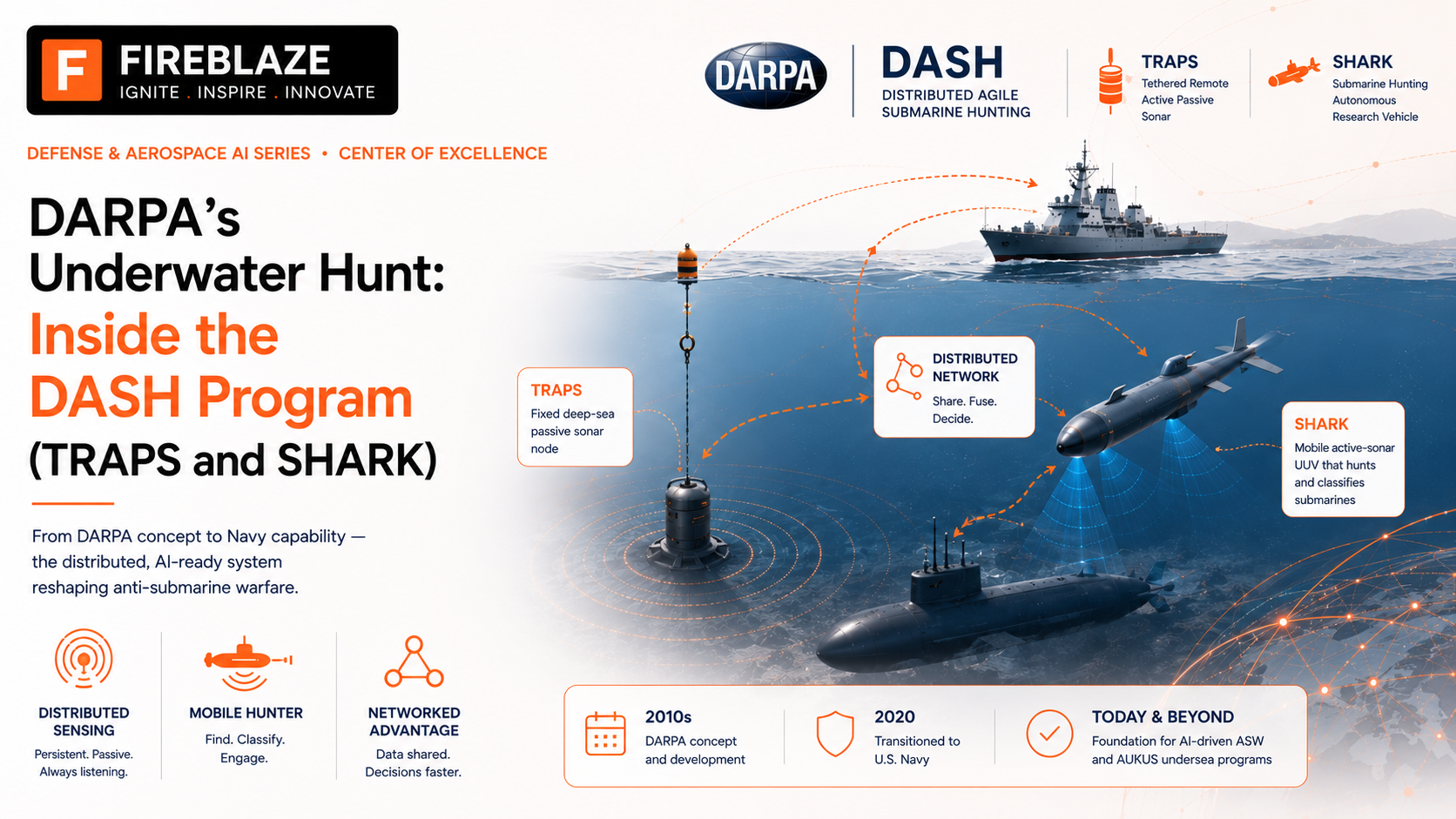
Every time a new wave of concern about undersea sabotage or submarine proliferation hits the headlines, one program tends to resurface in defense circles: DARPA's Distributed Agile Submarine Hunting effort, better known by its two flagship prototypes — TRAPS and SHARK. It's a useful case study precisely because it isn't a hot, breaking-news program. It's a decade-plus example of how a DARPA seed investment quietly becomes a fielded Navy capability, and understanding that arc is directly relevant to why anti-submarine warfare (ASW) is having a resurgence right now — one that increasingly involves allies well beyond the United States.
What DASH Actually Set Out to Solve
The core problem DASH was built to address is deceptively simple to state and brutally hard to solve: modern submarines, especially newer diesel-electric and air-independent propulsion boats, have gotten quieter, cheaper to build, and more numerous, while the traditional tools navies use to find them — towed arrays, sonobuoys, dedicated hunter-killer submarines — are expensive and don't scale. As DARPA program manager Andy Coon put it when the program's first major prototypes were unveiled, the goal wasn't just to solve the hardest problem in ASW, but to do it with systems that are scalable and affordable rather than adding ever more complexity to existing platforms.
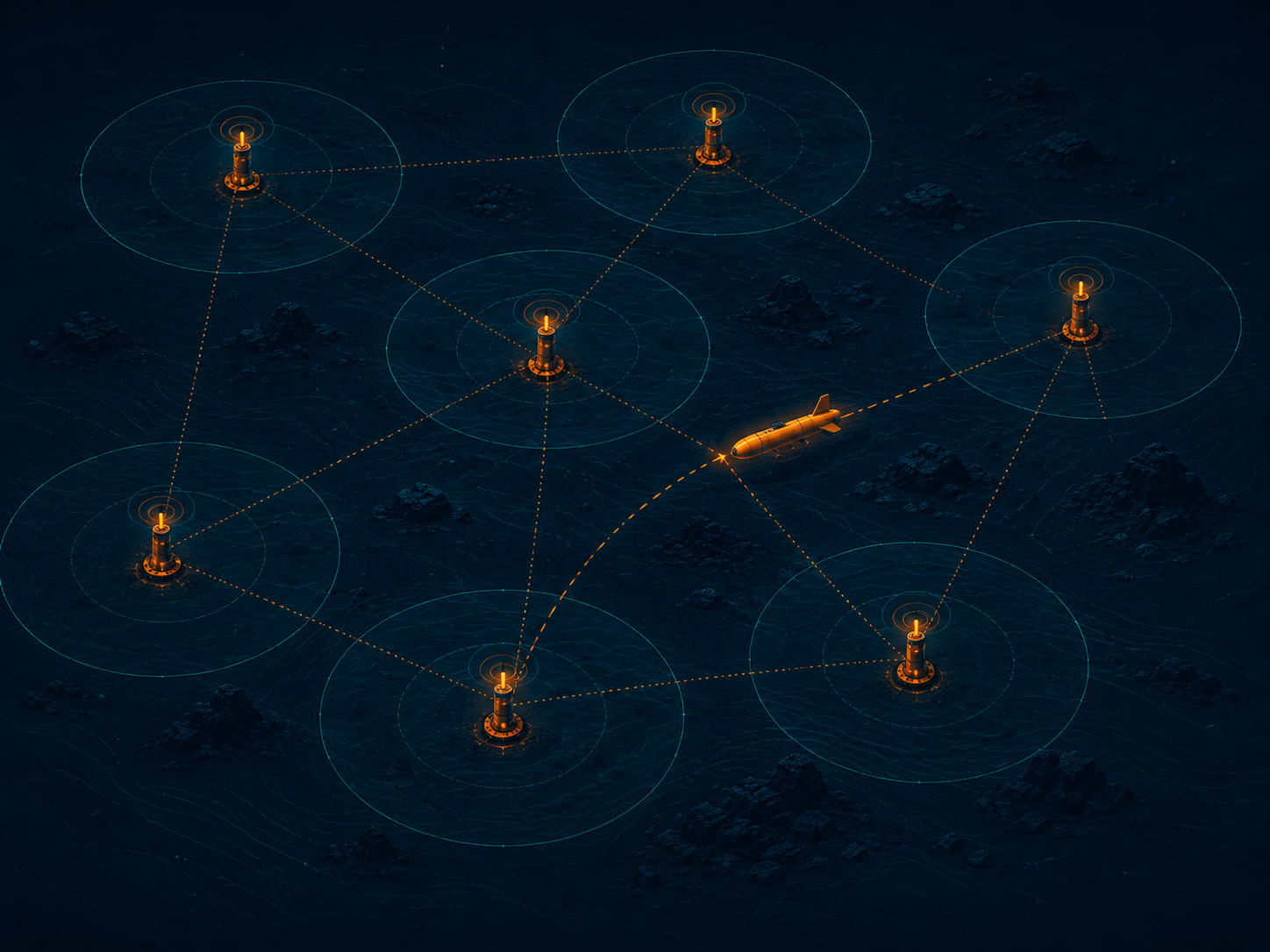
DASH's answer was to flip the traditional approach: instead of one exquisite, expensive sensor array, distribute many simpler, cheaper sensor nodes across a wide area of ocean floor and network them together — trading sophistication in any single node for coverage and resilience across the system as a whole. Coon himself described this trade-off candidly at the time: purposely avoiding larger, more complex arrays to keep hardware and operating costs down was, in his words, "a gamble" — but one DARPA judged worth taking given the scale of the payoff if it worked.
Meet TRAPS: The Deep-Sea Listening Post
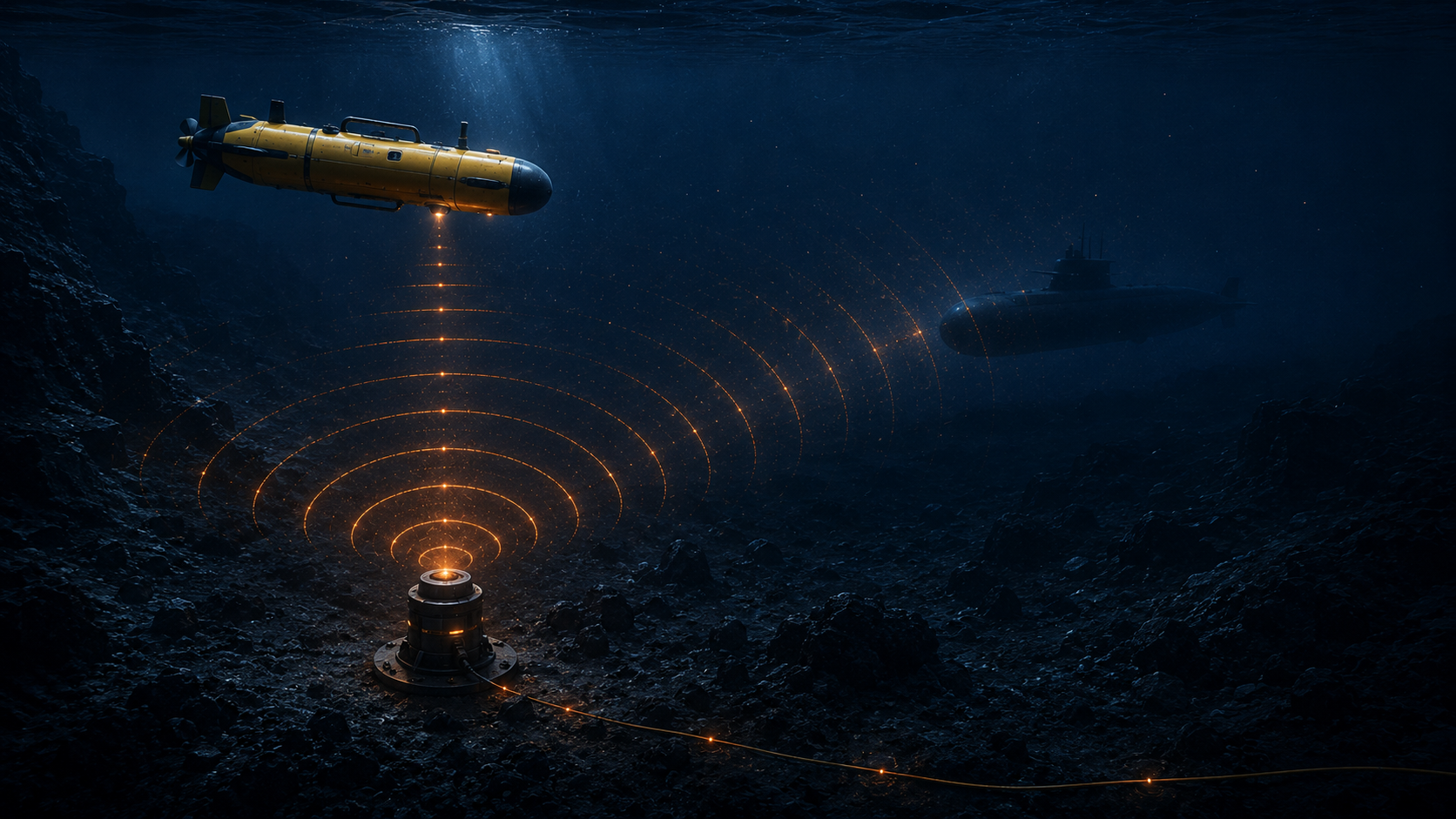
The first pillar of DASH is TRAPS — the Transformational Reliable Acoustic Path System — developed initially by a team led by SAIC and later carried into production by Leidos. TRAPS is a fixed, passive sonar node designed to sit on the deep seafloor and exploit a physical quirk of deep water: sound travels differently and more predictably along certain "reliable acoustic paths" at depth than it does near the surface, giving a single deep node a surprisingly large field of view. That means a limited number of TRAPS nodes can, in principle, cover large operational areas without the cost of a dense sensor grid.
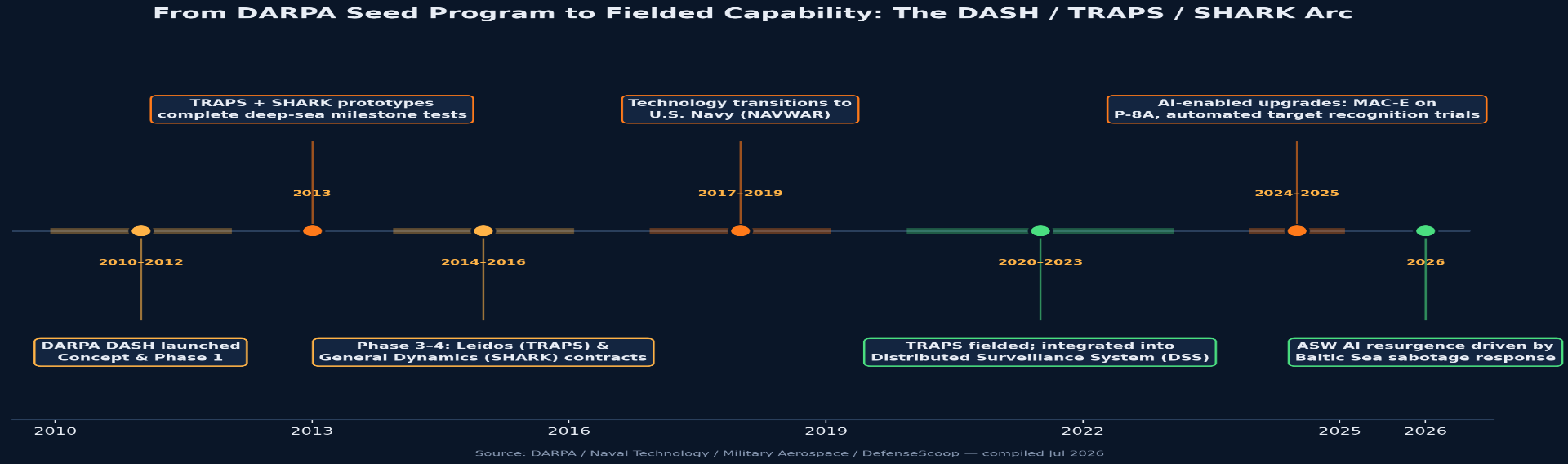
The program moved through defined phases. Early SAIC-led development validated the underlying acoustic-path science against existing Navy datasets before building a working sensor; a subsequent Phase 1B round refined the prototype design specifically for deep-sea operations. By 2013, prototype testing at deep-ocean sites had demonstrated functional sonar, communications, and mobility, with the primary sensor used to collect real deep-ocean acoustic data for further validation. A Phase 3 contract — with a fourteen-month base period and a six-month option worth roughly $10 million if exercised — kept SAIC's acoustic detection work going even as Leidos took over hardware production. From there, Leidos was awarded a $72.8 million Navy contract to fabricate deployable TRAPS prototypes, complementing legacy fixed-surveillance systems like SOSUS, the Fixed Distributed System, and the towed-array SURTASS network rather than replacing them outright.
Meet SHARK: The Mobile Hunter
The second pillar, SHARK — Submarine Hold at RisK — is a torpedo-shaped unmanned underwater vehicle originally developed by a team led by Applied Physical Systems (later folded into General Dynamics Mission Systems, building on earlier work by Bluefin Robotics). Where TRAPS listens passively and covers a wide area, SHARK's job is to actively close in: once a wide-area sensor flags a possible submarine, SHARK is meant to move to the location and use active sonar to hold contact and track it, extending what a fixed sensor field alone could do.
SHARK's own development involved multiple rounds of deep-water testing — including six days of operational testing with two 4,450-meter dives lasting around 11 hours each, examining new capabilities such as an extended operational depth rating, an advanced pressure vessel design, a new power system, a high-powered acoustic transducer, and a transportable docking head for launch and recovery. DARPA has described taking the vehicle to those depths as being "like going to another planet," reflecting just how different deep-ocean engineering is from surface or shallow-water systems. One open engineering question that persisted through much of SHARK's development was propulsion range: Navy engineers at the time had not yet solved long-distance UUV propulsion and fueling short of nuclear power, which is part of why current Navy doctrine favors launching UUVs from existing aircraft, submarines, and surface ships rather than expecting them to transit oceans independently.
Table 1 — TRAPS vs. SHARK at a Glance
Attribute
TRAPS
SHARK
Full Name
Transformational Reliable Acoustic Path System
Submarine Hold at RisK
Role
Fixed, wide-area passive sonar node
Mobile active-sonar tracking UUV
Original Developer
SAIC
Applied Physical Systems / Bluefin Robotics
Production Partner
Leidos
General Dynamics Mission Systems
Mode
Passive listening (deep seafloor)
Active sonar, mobile pursuit
Test Depth
Deep seafloor placement
4,450+ meters during testing dives
Analogy
A fixed "smart microphone" on the ocean floor
A "guard dog" that closes in once alerted
Status (as of 2026)
Fielded by U.S. Navy, integrated into DSS
Matured into broader Navy UUV/USV ASW efforts
From DARPA Prototype to Fielded Navy System
This is the part of the story that doesn't always get told: DASH wasn't a program that produced a flashy demo and then faded away. Through Phase 3 and Phase 4 (the latter awarded to Leidos around 2014 for a two-year period), the technology matured to the point where the U.S. Navy formally took ownership of TRAPS, fielded it, and folded it into its Distributed Surveillance System concept — the Navy's broader effort to modernize undersea listening infrastructure for the 21st century. Budget documents from later years even describe using unmanned glider-type UUVs to service and maintain TRAPS sensor "fields" in place, a sign of just how operationalized the system became — a detail that also helps explain a curious 2016 incident in which the Chinese People's Liberation Army Navy briefly seized one of these underwater drones in the South China Sea. By the early 2020s, follow-on Navy contracts — including a roughly $9.96 million award for mobile undersea acoustic surveillance support and continued Leidos work on active and passive sonar systems — showed the program had transitioned fully from prototype to sustained operational capability, including for at least one non-U.S. customer under Foreign Military Sales funding.
That transition matters as a template. A huge share of DARPA's portfolio never reaches this stage — most seed programs stay experimental or get quietly shelved. DASH is one of the relatively rare cases where a decade of patient, phased development (2010s prototypes → mid-2010s production contracts → late-2010s Navy handoff → 2020s operational integration) produced a system still in active service today.
The 2024–2026 AI Layer
What makes this history newly relevant is what's been layered on top of the base TRAPS/SHARK architecture in the last two years. The Navy has been testing AI-enhanced passive sonar processing and automated target recognition, including trials run by the Office of Naval Research-Global under its TOEE experimentation series — with "limited objective experiments" conducted in January 2025 and a more advanced capability experiment in September 2025, alongside a formal industry call for contractors with "standout" automated target recognition systems. Separately, the Multi-Static Active Coherent-Enhancements (MAC-E) system — tested operationally aboard P-8A Poseidon aircraft at Joint Base Pearl Harbor–Hickam in July 2025 across four sorties — uses advanced coherent-buoy signal processing, funded under a $12.8 million NAVAIR contract, to improve search rates and reduce false-alarm clutter, complementing fixed seafloor sensors like TRAPS with airborne active sonar. The Navy's SURTASS LFA towed-array program is also being extended, with a draft environmental review now covering operations through 2033 across the western and central North Pacific.
In other words, the distributed-sensing philosophy DASH pioneered over a decade ago — many simple nodes, networked and processed intelligently — is exactly the architecture that today's AI-driven acoustic signal processing is built to exploit. More sensors generating more data only pays off if you can fuse and classify that data faster than a human analyst can, which is precisely where machine learning-based acoustic classification is now being layered in.
The Allied Picture: AUKUS and Beyond
DASH's distributed-sensing philosophy is no longer a purely American story. The AUKUS trilateral partnership between the United States, United Kingdom, and Australia has made undersea autonomy one of its most active Pillar 2 workstreams. In May 2026, AUKUS defense ministers meeting in Singapore announced the partnership's first official Pillar 2 signature project — a joint effort to develop payloads, sensors, and weapons systems deployable across all three nations' uncrewed underwater vehicle fleets, backed by a £150 million UK commitment. The stated goal explicitly echoes the DASH mission: strengthening the ability to protect critical seabed infrastructure and "bolster superiority in anti-submarine and anti-surface warfare," with first capabilities expected in Navy service by 2027.
The practical groundwork is already underway. During Exercise Talisman Sabre, an extra-large autonomous underwater vehicle physically located in the UK was remotely operated by personnel in Australia — a live demonstration of trilateral command-and-control interoperability. At REPMUS in Portugal, AUKUS partners tested coordination protocols for multiple classes of uncrewed systems simultaneously. The partnership is also developing a shared "autonomy baseline" and common command-and-control software specifically so that American, British, and Australian systems can operate as one networked fleet rather than three incompatible ones — the same distributed, networked logic that underpinned TRAPS and SHARK a decade earlier, now being scaled to an entire alliance.
Table 2 — DASH Legacy vs. Current Allied Programs
Program
Era
Lead Nation(s)
Core Idea
Status
DARPA DASH (TRAPS/SHARK)
2010–2019 (fielded 2020s)
United States
Distributed fixed + mobile deep-sea sonar
Operational, integrated into Navy DSS
MAC-E (P-8A sonobuoy upgrade)
2024–2025
United States
AI-enhanced coherent active sonar processing
Operational testing complete, 2025
ONR TOEE Automated Target Recognition
2024–2025
United States
AI/ML classification of sonar contacts
Experimentation ongoing through FY2025
AUKUS Pillar 2 UUV Signature Project
2026–
US / UK / Australia
Shared payloads and autonomy baseline for UUV fleets
Signed May 2026; capabilities expected 2027
Why This Case Study Matters for the Current ASW Resurgence
The Baltic Sea cable-sabotage pattern and rising submarine activity from China and other near-peer navies have combined to push anti-submarine warfare back to the top of naval procurement priorities after decades of relative neglect following the Cold War. DASH's TRAPS/SHARK story is a useful reminder that the underlying sensing physics — distributed deep-ocean acoustic paths, passive-then-active handoff — were solved years ago. What's changing now isn't the fundamental sensor architecture; it's the intelligence layer sitting on top of it, the willingness to fund scaling it up, and increasingly the decision to build it jointly across allied navies rather than nation by nation.
For anyone building in the Defence AI space, the takeaway is concrete: the highest-leverage opportunities in ASW right now are less about inventing new sensor hardware and more about building better classification, fusion, and anomaly-detection models on top of acoustic and multi-sensor data streams that programs like DASH already made possible to collect at scale — plus the interoperability layer needed to let allied systems share that intelligence in real time.
Sources
DARPA — "Distributed Agile Submarine Hunting (DASH) Program Completes Milestones"
Naval Technology — SAIC/TRAPS and Leidos/DASH Phase Four contract coverage
Military Aerospace — "Leidos gets Navy go-ahead to fabricate TRAPS deep-ocean sonar system prototypes"
The War Zone (TWZ) — "The Navy Wants a Rapidly Deployable Version of Its Cold War Era Submarine Monitoring Network"
DefenseScoop — "Navy to test automated target recognition capabilities for undersea warfare"
The Defense Watch — "U.S. Navy Advances Sonar Capabilities: AI-Enhanced Passive Systems, P-8A MAC-E Testing & SURTASS Upgrades"
Shephard Media — "Leidos Supports Mobile Undersea Acoustic Surveillance"
GOV.UK / UK Ministry of Defence — "Cutting-Edge Underwater Tech for AUKUS Forces to Be Developed Through Landmark Partnership" (May 2026)
Breaking Defense — "AUKUS Partners Sign Agreement on Underwater Drones, Speed Up Sub Plan"
Naval Today — "AUKUS Partners to Turbocharge Development of Robotic, Autonomous Systems in 2026"