From $25M Seed Money to $27M Production Contract: The Funding Path Defence-AI Startups Are Following
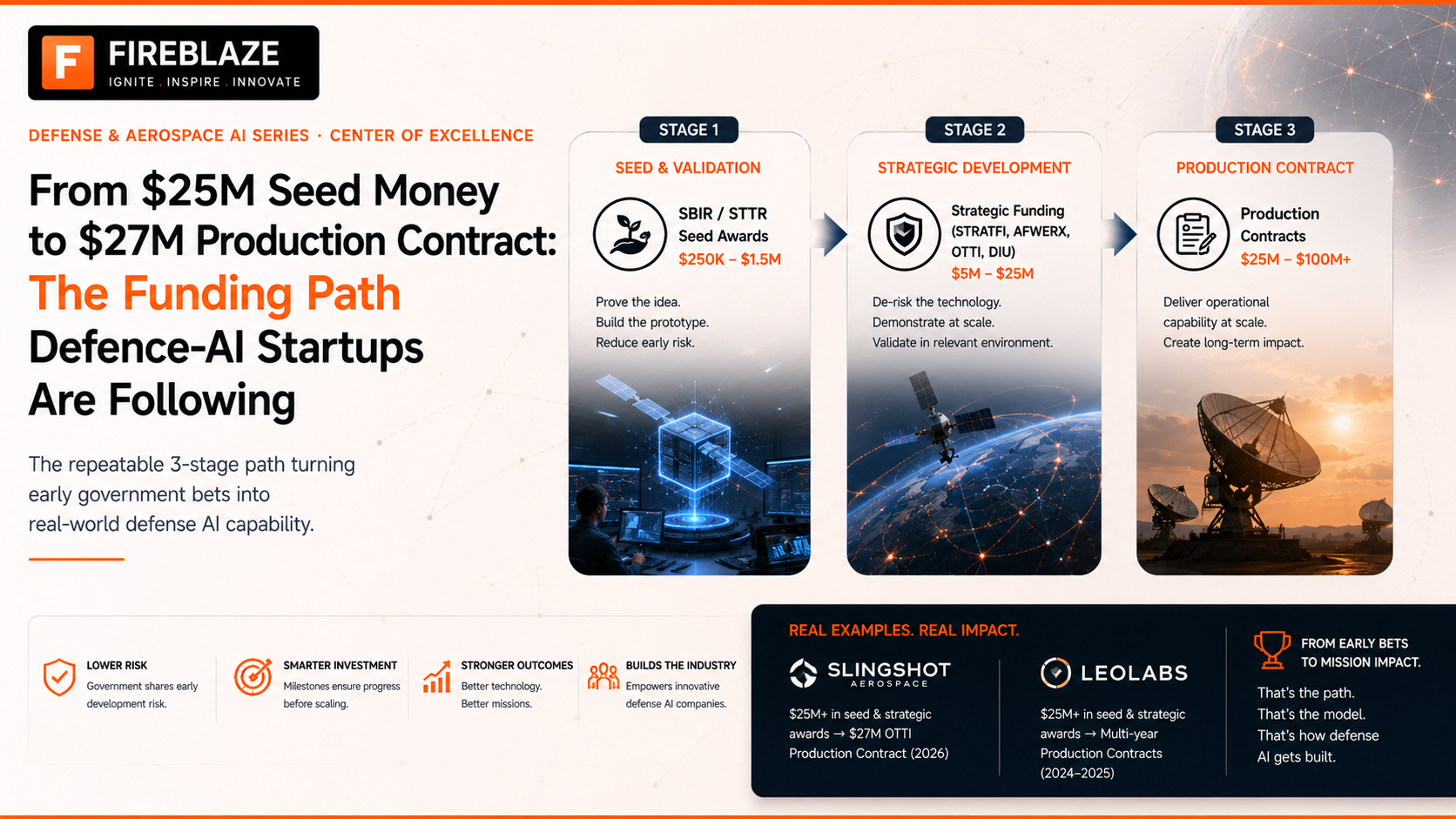
If you look closely at how today's most successful defense-AI companies actually got funded, a clear, repeatable pattern shows up again and again. It's not luck — it's a path, and understanding it explains a lot about how new AI capability actually makes it into military use in 2026.
1. Step one: small, low-risk government seed funding
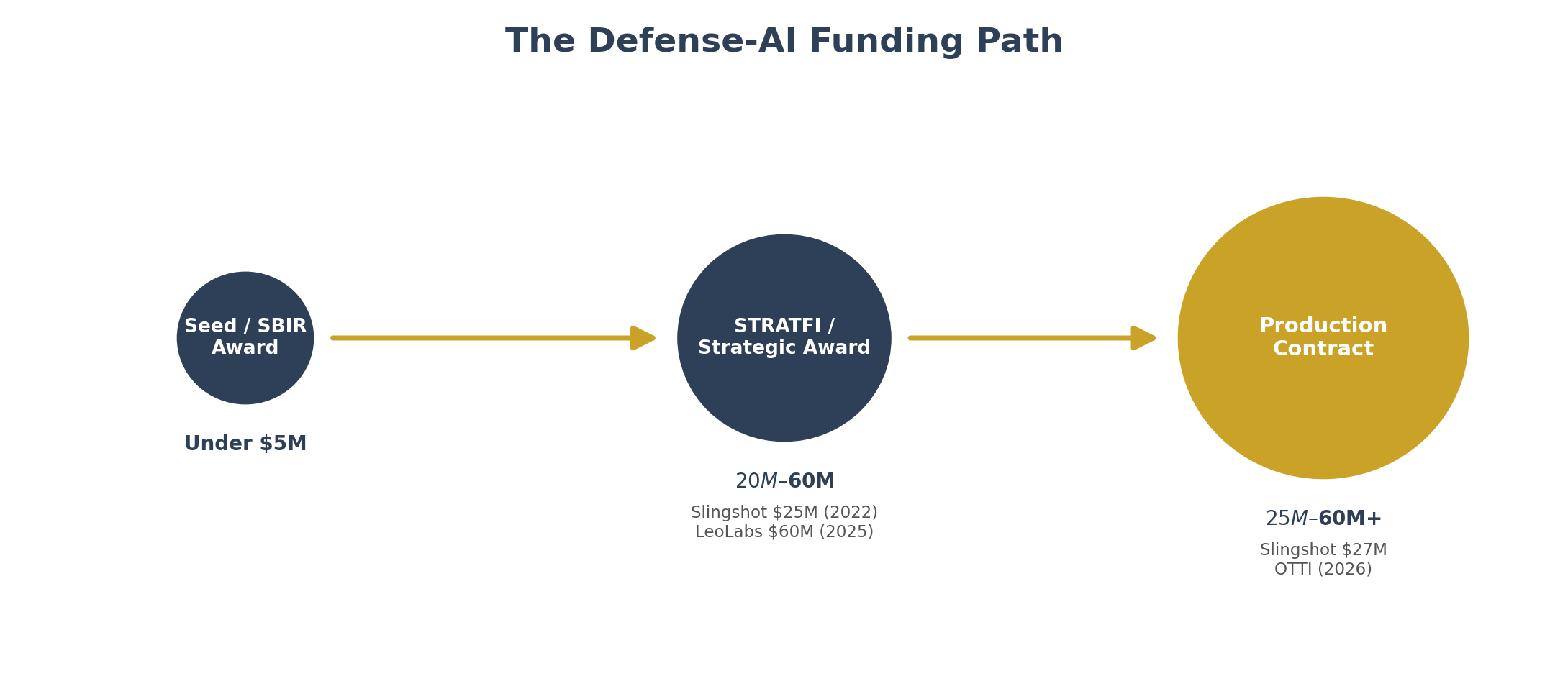
Most defense-AI companies' government funding story starts small, through mechanisms like the Small Business Innovation Research (SBIR) program or the Space Force's SpaceWERX innovation arm. These early awards are usually modest — often well under $5 million — and are explicitly designed to be low-risk for the government: fund a promising idea just enough to prove it's technically feasible, without committing serious production money to something unproven.
This stage is about survival and proof-of-concept, not scale. A company at this stage is usually also raising private venture capital in parallel, and the government seed award often acts as a credibility signal to private investors as much as a source of actual funding.
2. Step two: a mid-size strategic funding award
If the early technology shows real promise, the next step is often a larger, strategic-level award — commonly through programs like STRATFI (Strategic Funding Increase), which specifically combines SBIR/government funding with matching private investment. This stage typically involves awards in the $20–60 million range and usually funds a specific, more mature capability rather than an early experiment.
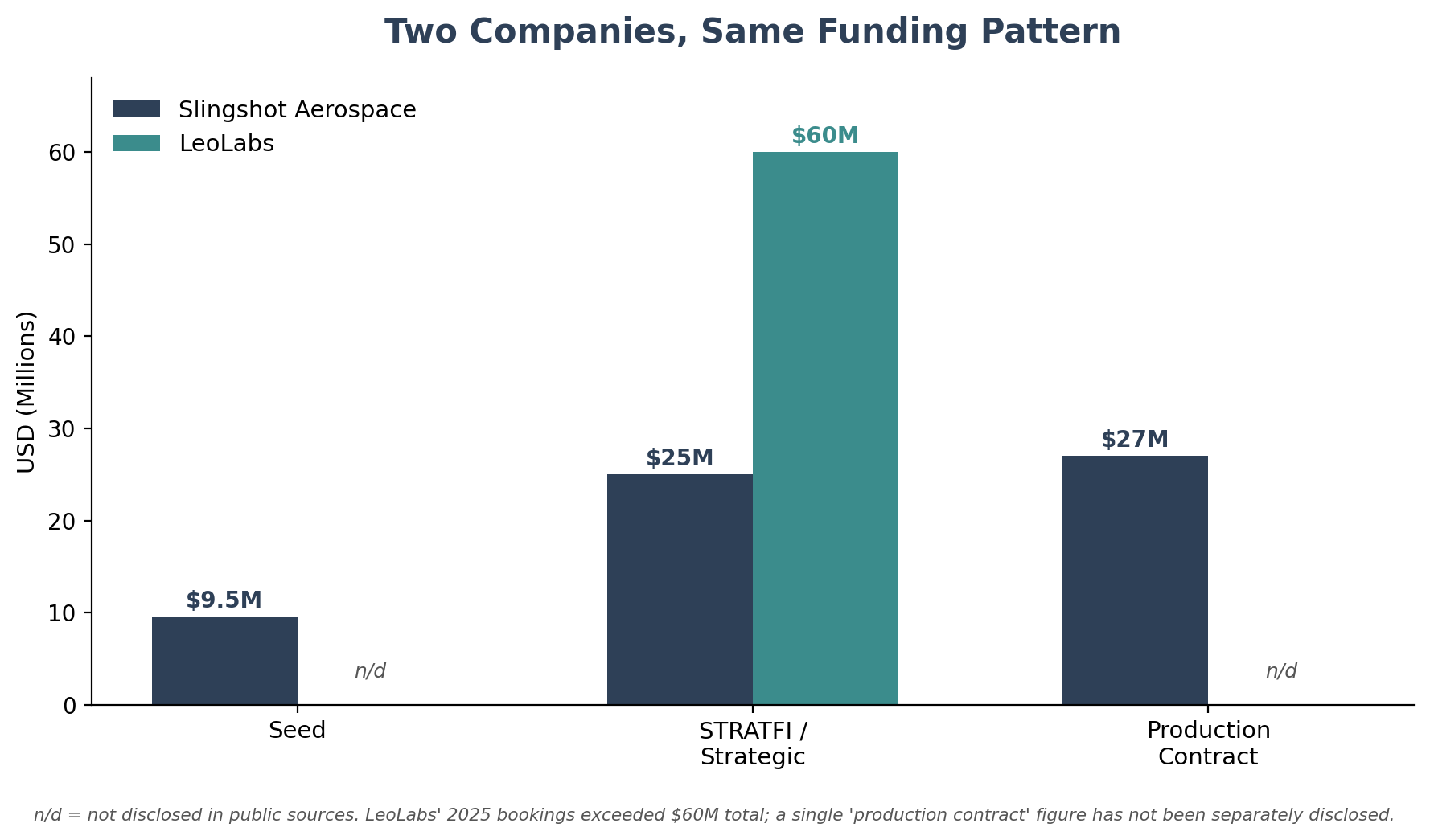
Both companies covered elsewhere in this series followed this exact stage: Slingshot Aerospace received a $25 million STRATFI award from SpaceWERX in 2022, and LeoLabs received a $60 million STRATFI award from SpaceWERX in March 2025 to build a new radar site in the Indo-Pacific region. Notably, a STRATFI award is explicitly structured as half government money and half private investment — meaning winning one also typically requires the company to independently convince private investors the technology is worth betting on, not just convincing the government.
3. Step three: a full production contract
The final stage is a defined production contract — a specific, scoped deal with a set customer, timeline, and integration goal, rather than an open-ended research award. This is the stage Slingshot reached in January 2026 with its $27 million, 18-month OTTI contract to integrate TALOS into Space Force training infrastructure, and the stage LeoLabs is approaching with contract bookings exceeding $60 million in 2025 and inclusion in the competitive range for the Missile Defense Agency's SHIELD contract vehicle (though it's worth noting MDA awarded competitive-range positions to more than 2,300 companies across three tranches, so inclusion signals eligibility for future bidding, not a guaranteed award).
At this stage, a company has typically also built a track record of multiple, growing contracts rather than a single deal — both Slingshot and LeoLabs show a pattern of layered, overlapping awards building on each other over several years, not one isolated win.
4. Why this staged path exists at all
This isn't a bureaucratic accident — it reflects a deliberate approach to managing risk. Defense buyers can't afford to commit large production budgets to unproven technology, but they also can't afford to ignore promising commercial innovation and only work with traditional, slow-moving defense primes. The staged funding path lets the government test a company's technology with small amounts of money first, increase investment as the technology proves itself, and only commit serious production-scale funding once a company has a demonstrated track record.
For an AI startup, this path also solves a chicken-and-egg problem: you need real-world validation to attract serious investment, but you need investment to build something worth validating. Government seed funding breaks that cycle by providing early capital specifically in exchange for proving feasibility, not for guaranteed usage.
5. What this means for anyone watching the defense-AI space in 2026
This funding pattern is a genuinely useful lens for evaluating any defense-AI company's credibility and trajectory. A company with only a single early-stage SBIR award is still very early and unproven. A company with a STRATFI-level award alongside private funding has cleared a meaningful validation bar. A company with an actual production contract, especially one that builds on prior smaller awards rather than appearing out of nowhere, has demonstrated the full path — which is a far stronger signal than funding size alone.
This same three-stage pattern is worth watching for in other companies and other defense-AI categories going forward — it's less about any single company's story and more about how the U.S. government has learned to de-risk and scale investment in AI capability it doesn't fully understand yet, one proof point at a time.
Sources: Slingshot Aerospace and LeoLabs press releases and contract announcements (2020–2026); SpaceNews; robotics.press; SpaceWERX/STRATFI program descriptions as publicly reported. Contract figures are as publicly disclosed; non-public terms are not claimed here.