Diffusion Models as Ensemble Generators: How Neural Networks Are Replacing Monte Carlo Weather Ensembles
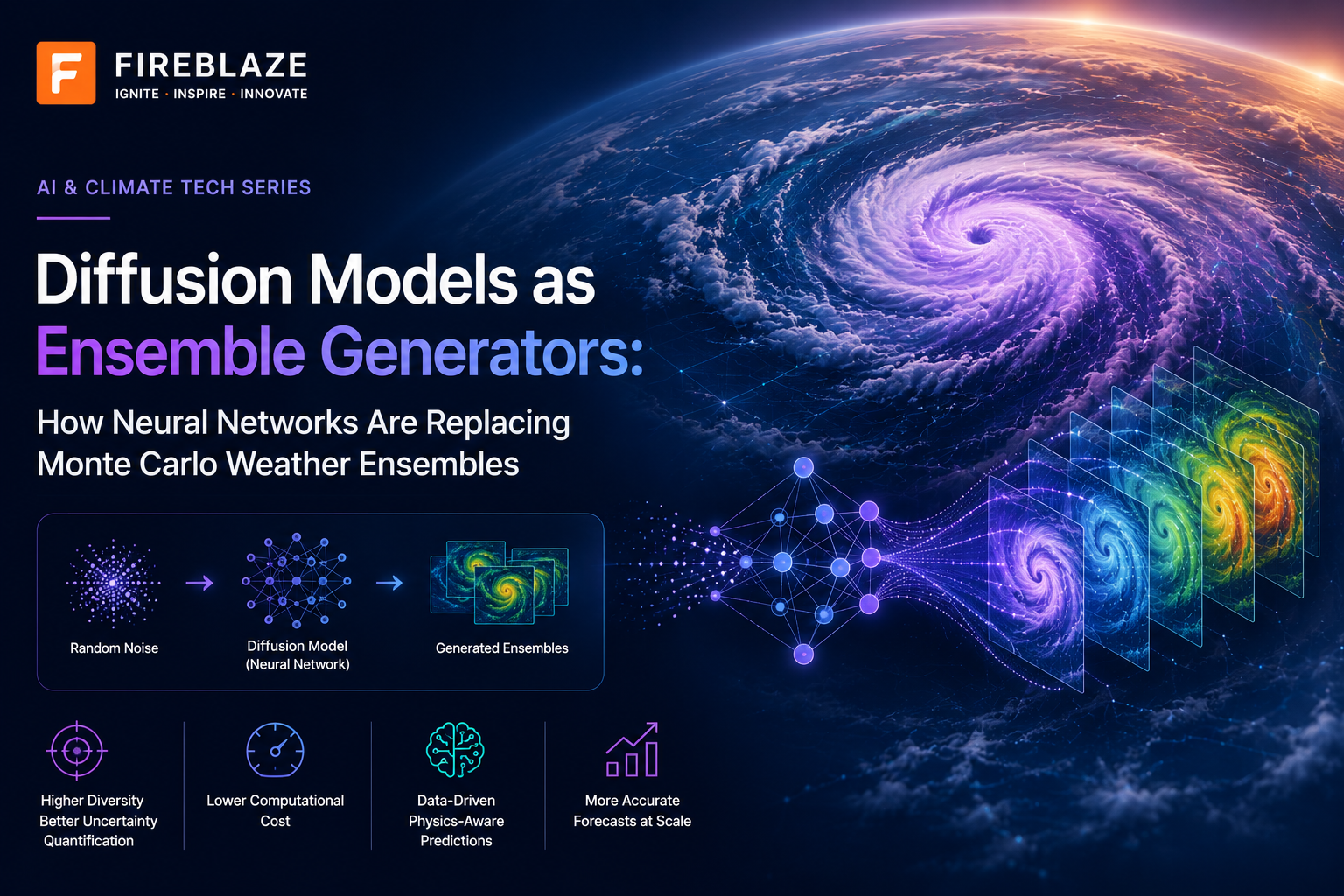
Diffusion Models as Ensemble Generators: How Neural Networks Are Replacing Monte Carlo Weather Ensembles
A domain-knowledge piece on why the same class of model behind image generators is now generating weather forecast ensembles — and why "ensemble generation via denoising" is a fundamentally different job than the "generate more rows of data" use of diffusion models covered in Week 2's FailureGen piece, even though the underlying math is the same.
1. Hook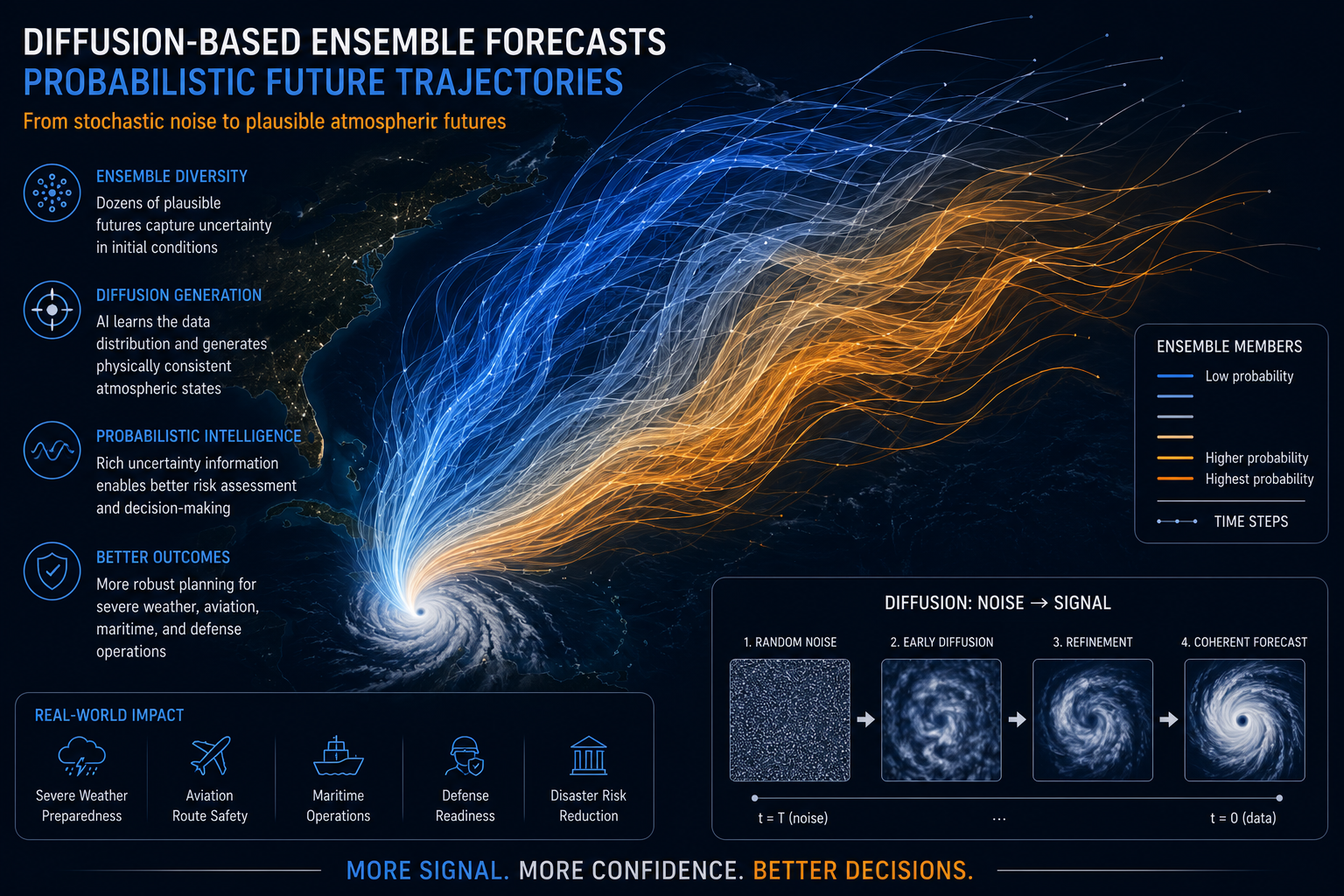
Say "diffusion model" to most people building AI systems and they picture an image generator: noise in, picture out. That association is correct, but it quietly hides a second, less obvious use of the same machinery — one with nothing to do with pictures at all. Google DeepMind's GenCast, published in Nature in December 2024, uses a diffusion model to do something numerical weather prediction (NWP) centers have historically needed a supercomputer with tens of thousands of processors running for hours to do: generate an ensemble of dozens of physically plausible future weather trajectories, so that a forecast comes with a distribution of outcomes rather than a single number. GenCast doesn't predict "the" temperature in Delhi twelve days from now — it samples fifty different plausible atmospheres twelve days from now, and the spread across those fifty samples is the forecast's honest statement of its own uncertainty. That reframing — from "predict a value" to "sample from a distribution of futures" — is the entire point of this piece, and it's also exactly what separates GenCast's use of diffusion from the tabular-augmentation use of diffusion covered in the Week 2 FailureGen piece, where the goal was to generate more synthetic rows of failure data, not to quantify uncertainty about a physical system evolving forward in time.
2. Core Explanation
2.1 Why Traditional Ensembles Are Expensive, and Why a Single Deterministic Forecast Isn't Enough
Weather is chaotic in the technical sense: two atmospheric starting states that differ by an immeasurably small amount can diverge into completely different weather within days — the "butterfly effect." A single deterministic forecast, however accurate on average, can't tell a decision-maker how confident to be in that forecast, and for anything involving real consequences — evacuation timing, flight routing, grid load planning around wind power — the uncertainty band matters as much as the central estimate.
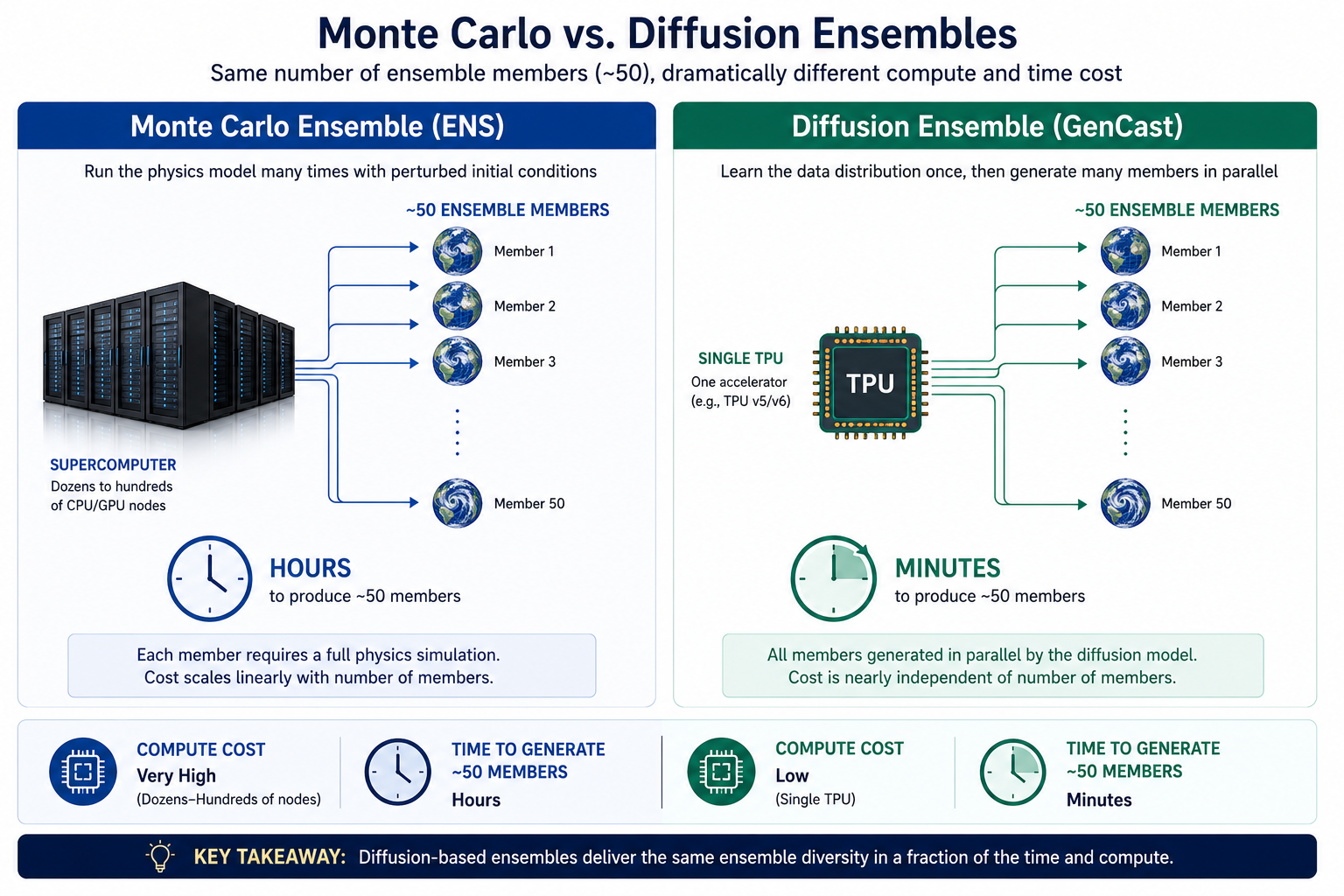
The traditional answer, used operationally by ECMWF's Ensemble Prediction System (ENS), is a Monte Carlo ensemble: perturb the initial atmospheric state by small amounts (using techniques like singular vectors and ensemble-of-data-assimilations), also perturb the physics parameterizations inside the numerical model to reflect scientific uncertainty about sub-grid processes like cloud formation, then run the entire physics-based numerical weather model forward dozens of times from these perturbed starting points. Each run is a full, expensive PDE solve. Traditional physics-based ensemble forecasts such as those produced by ENS, at 0.2° or 0.1° resolution, take hours on a supercomputer with tens of thousands of processors. The ensemble spread — how much the 50-odd runs disagree with each other — is the uncertainty estimate, but it costs an entire supercomputer's worth of compute to obtain it.
2.2 What a Diffusion Model Actually Does (The Part Both Use Cases Share)
Strip away the application and a diffusion model is a two-part learned process. Forward diffusion takes a real data sample and gradually corrupts it by adding small amounts of Gaussian noise over many steps, until it's indistinguishable from pure noise. Reverse diffusion is a neural network trained to undo this, one denoising step at a time — given a noisy sample and a noise level, predict what noise was added, subtract an estimate of it, and repeat until a clean, realistic sample emerges. Critically, because the network is denoising rather than directly outputting a final answer, different random noise inputs to the same trained model produce different, individually plausible outputs — the model has learned to sample from a whole distribution of realistic data, not memorize one deterministic mapping.
That single property — noise in, plausible-but-different sample out, repeatable many times — is exactly what both GenCast and a synthetic-data tool like FailureGen are built on. Where they diverge completely is what they're sampling from and why.
2.3 GenCast: A Conditional Diffusion Model for Atmospheric States
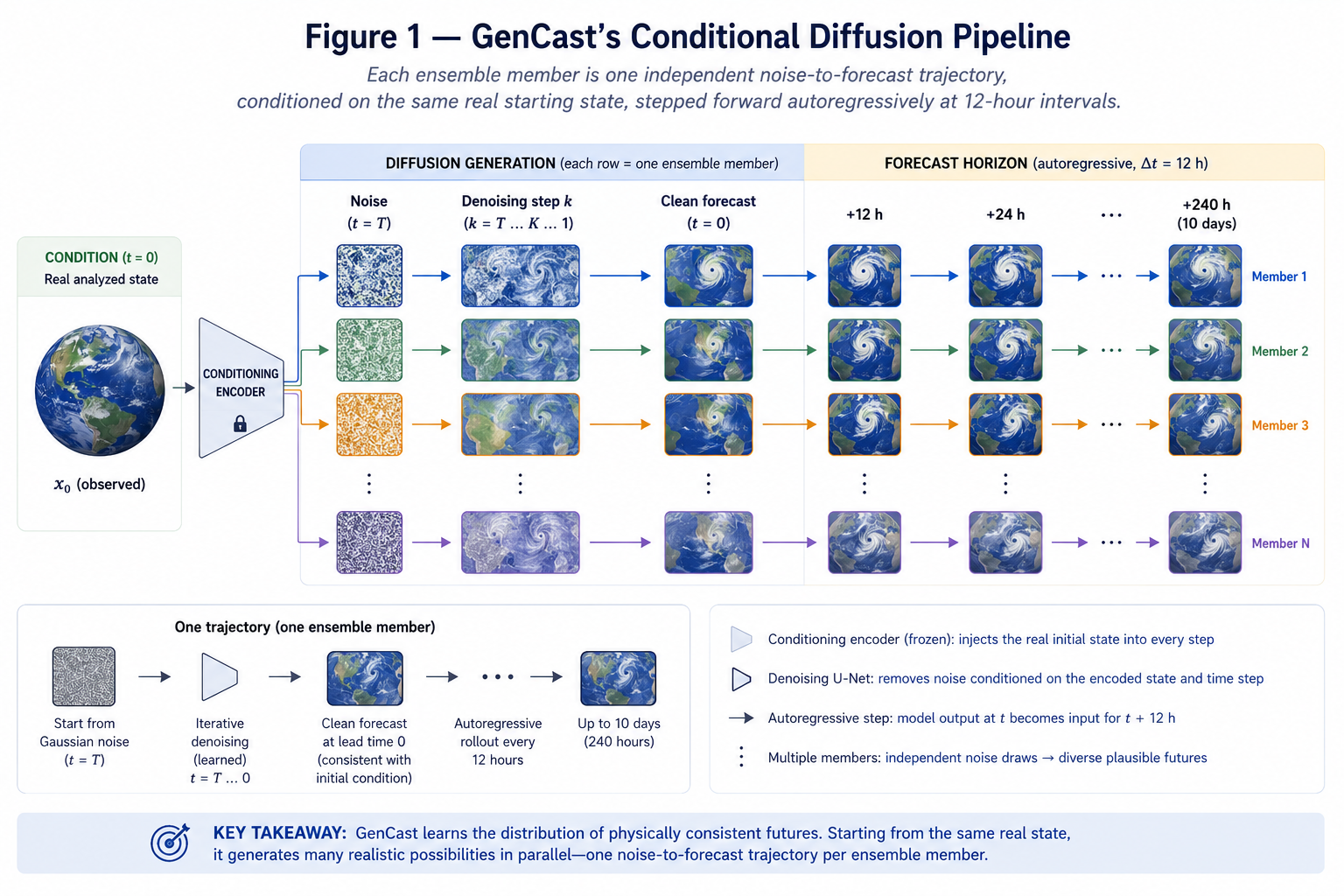
GenCast is a machine learning weather prediction method, trained on decades of ECMWF reanalysis data, that generates an ensemble of stochastic 15-day global forecasts at 12-hour steps and 0.25 degree resolution, covering more than 80 surface and atmospheric variables. Structurally, GenCast pairs the diffusion mechanism from Section 2.2 with the same kind of mesh-based graph representation used by GraphCast (covered in the companion architecture piece): the denoising network operates over an icosahedral-mesh representation of the atmosphere rather than a flat grid, and it is conditioned — at every denoising step, the network sees the two most recent known atmospheric states as context, so what it's learning to reverse-noise into isn't "any plausible weather," it's specifically "weather twelve hours after this exact starting condition."
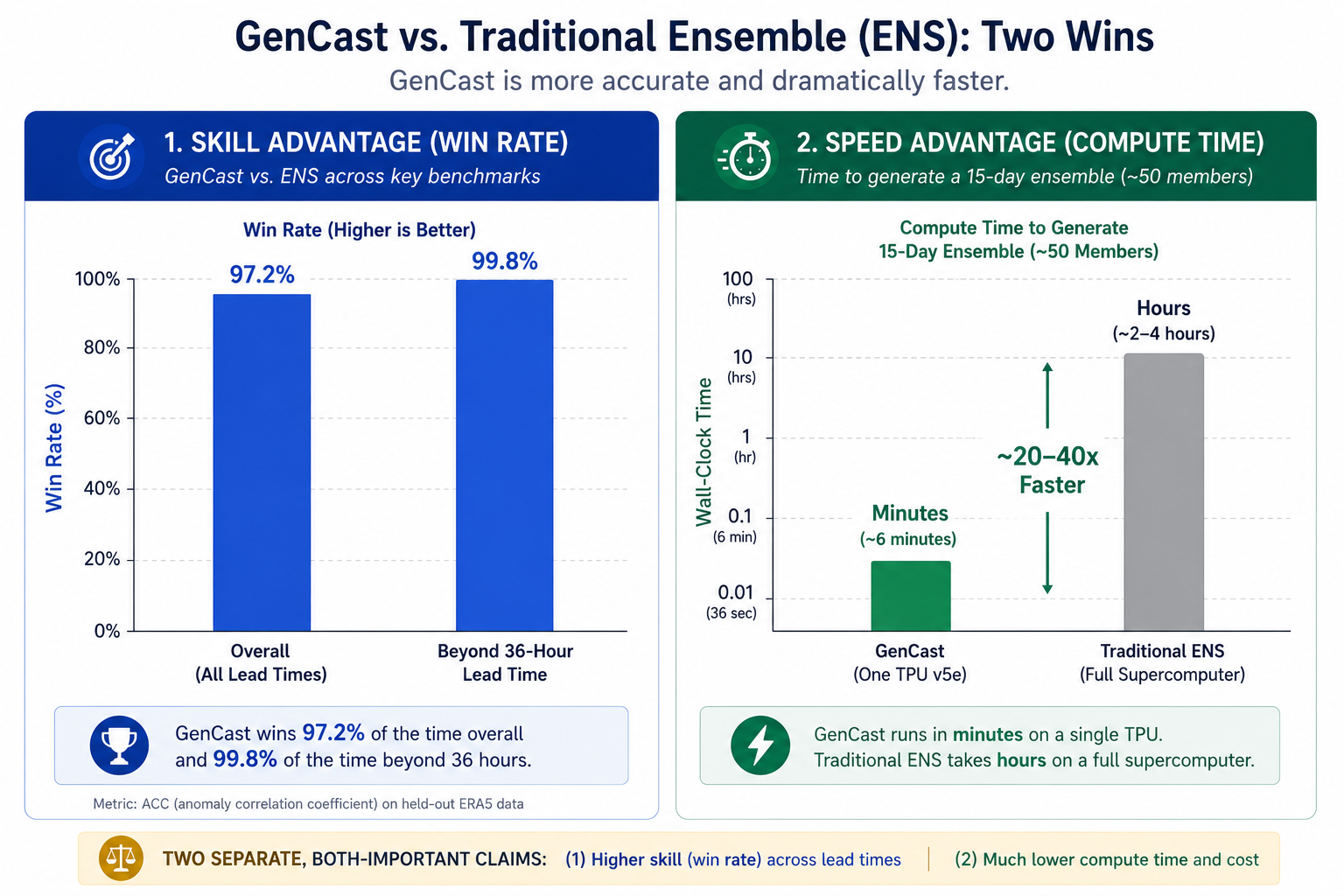
To produce one ensemble member, GenCast starts from pure noise and runs the reverse-diffusion process, conditioned on the current state, all the way to a clean 12-hour-ahead atmospheric state; it then feeds that output back in as the new "current state" and repeats, autoregressively, out to a 15-day horizon. To produce a second ensemble member representing a different plausible future, GenCast starts from a different random noise draw and does the same thing again — same conditioning, different noise trajectory, different but equally plausible outcome. Because each member can be sampled independently and in parallel, a single Google Cloud TPU v5 can produce one 15-day forecast in GenCast's ensemble in just 8 minutes, and every forecast in the ensemble can be generated simultaneously, in parallel — replacing the supercomputer-hours of Section 2.1 with minutes on a single chip.
2.4 The Benchmark Numbers, Stated Precisely
Tested against ECMWF's ENS across 1,320 target combinations of variable and lead time, GenCast was more accurate than ENS on 97.2% of them overall, and on 99.8% of targets at lead times greater than 36 hours. The arXiv preprint reports a closely matching figure: greater skill than ENS on 97.4% of 1,320 evaluated targets, with better prediction of extreme weather, tropical cyclones, and wind power production specifically called out. On tropical cyclones in particular and on extreme heat, cold, and high-wind events, GenCast consistently outperformed ENS when tested on its ability to predict extreme heat and cold and high wind speeds. On cost, the gap is stark: an 8-minute, single-chip GenCast ensemble against an ENS run that needs hours on a machine with tens of thousands of processors.
2.5 A Caveat Worth Taking Seriously: Physical Consistency at Fine Scales
As with the extremes caveat in the FNO/GNN companion piece, this is the finding worth stating precisely rather than folding into a general "AI wins" narrative. A subsequent study examining GenCast's ensembles at the kinetic-energy level found a specific physical inconsistency: tracking kinetic energy at 300 hPa — the altitude of the jet stream, where tiny errors rapidly amplify into major weather shifts (the butterfly effect) — researchers found that GenCast carries a systematic, noise-like bias at the mesoscale. A follow-up decomposition of the wind field made the mechanism concrete: using Helmholtz decomposition to split wind into its rotating and diverging components, the study found that in the real atmosphere these remain strictly separated at certain scales, but in GenCast's output they collapsed together at those same scales. In plain terms: GenCast's ensemble spread can look statistically reasonable in aggregate skill scores while still containing forecast states that violate a real physical constraint on how rotational and divergent wind should behave — a distinction that matters enormously if a downstream system is using individual ensemble members (not just the aggregate spread) to drive a physical simulation or a risk decision, rather than treating GenCast purely as a skill-score benchmark winner.
2.6 Direct Contrast: GenCast's Diffusion vs. Week 2's FailureGen Diffusion
Both tools are, mechanically, "train a denoiser to reverse a noise-corruption process." Everything past that is different, and it's worth being explicit about the contrast rather than leaving it implied:
| Dimension | GenCast (this piece) | FailureGen (Week 2) |
|---|---|---|
| What's being sampled | A full continuous physical field (temperature, wind, pressure, etc.) over a global mesh, at a future point in time | Individual synthetic rows of structured/tabular sensor or failure-event data |
| Conditioning signal | The two most recent real atmospheric states — "what happens next, given exactly this starting point" | Class label or feature subset — "generate a plausible row of this category" |
| Purpose of sampling more than once | Each additional sample is a genuine ensemble member — a different plausible future, used to quantify forecast uncertainty | Each additional sample is training-data augmentation — more examples of an underrepresented class, used to fix data imbalance |
| What "correct" means | Physically consistent with atmospheric dynamics (PDE constraints, energy spectra, wind-field decomposition — see 2.5) | Statistically consistent with the real minority-class distribution (feature correlations, realistic value ranges) |
| Where the output goes | Directly into a decision — a forecast a person or system acts on | Back into a training pipeline — a model trained on the augmented data is what eventually acts on anything |
| Failure mode to watch for | Aggregate skill score looks good while individual members violate physical constraints (Section 2.5) | Aggregate class balance looks fixed while synthetic rows encode unrealistic feature combinations a downstream model then learns as if real |
The one-line version: GenCast's diffusion model is the forecast — its samples are the deliverable. FailureGen's diffusion model is a data-generation step upstream of a separate downstream model — its samples are training fuel, not the deliverable. Conflating the two — for instance, assuming that because a diffusion model "learned the distribution well" in one context, it's automatically trustworthy in the other — is the specific mistake this comparison is meant to head off.
2.7 Common Pitfalls
- Treating GenCast as "just a fancier deterministic model." The entire value proposition is the ensemble spread itself, not any single member — a single sampled trajectory from GenCast is not more meaningful than a single ENS member, and reporting only GenCast's ensemble mean throws away the uncertainty information that's the actual product.
- Assuming ensemble skill-score wins mean every member is physically valid. Section 2.5's Helmholtz-decomposition finding is the clearest illustration of why "beats ENS on 97%+ of targets" and "every member obeys real atmospheric physics" are different claims.
- Assuming diffusion-for-forecasting and diffusion-for-augmentation are the same tool wearing different clothes. Section 2.6 exists specifically because the shared "denoise-from-noise" mechanism makes this an easy mental shortcut to take, and it's the wrong one — conditioning target, correctness criterion, and downstream use are all different.
- Ignoring the reanalysis-data lineage. GenCast was trained on historical weather data up to 2018 and tested on 2019 data — the same ERA5 reanalysis lineage the FNO/GraphCast companion piece flagged for precipitation bias, meaning any bias baked into ERA5 propagates into GenCast's ensembles too.
3. Worked Example / Analogy
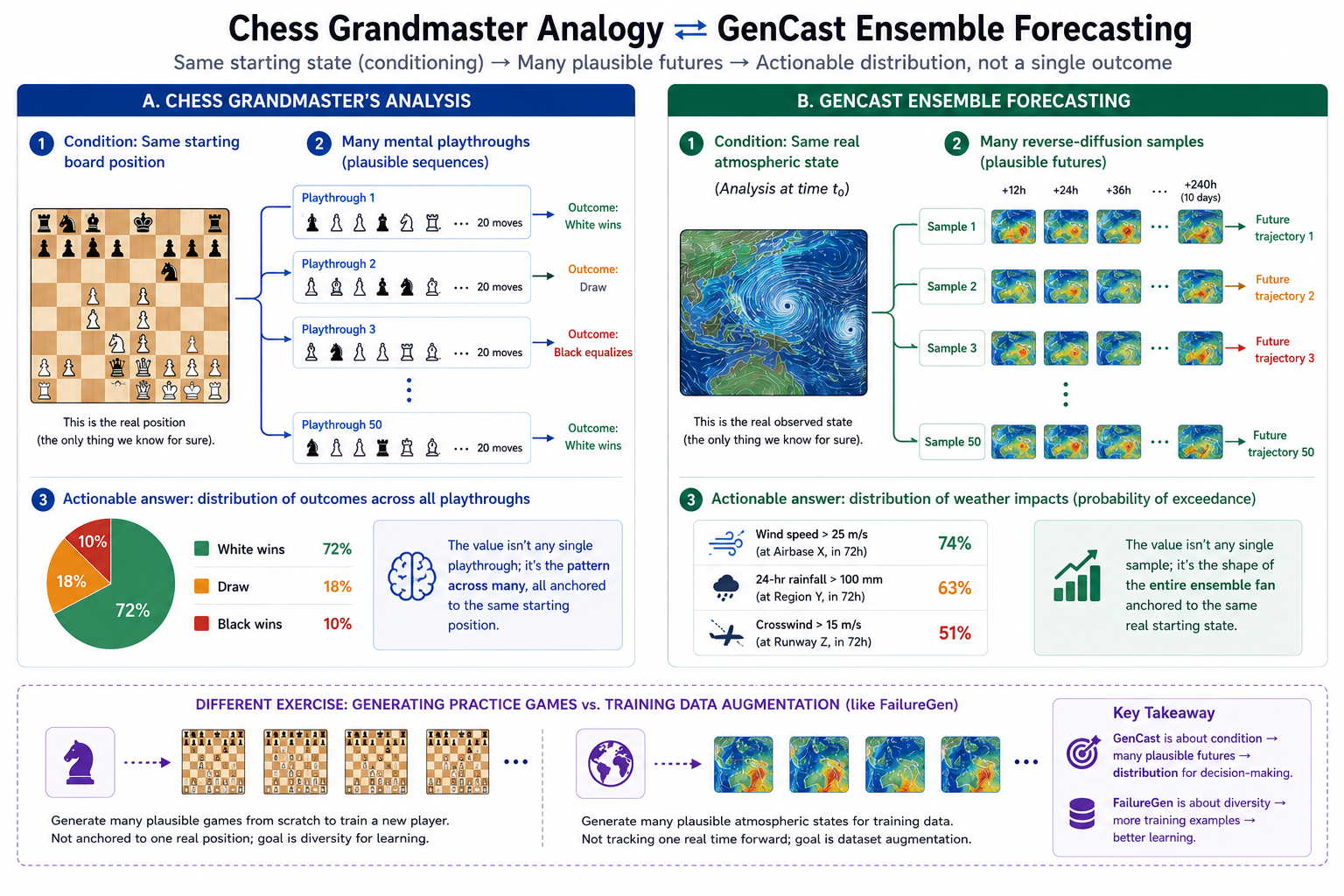
Picture a chess grandmaster asked to predict how a specific ongoing game will unfold from the current position, twenty moves out. A single deterministic prediction — "here is exactly what will happen" — is almost worthless, because chess from move twenty onward branches enormously depending on tiny decisions along the way. What a good analyst actually does instead is play out the position many times in their head, each time making slightly different plausible choices at the branch points, and report back a range of likely outcomes: "in most of my mental playthroughs White ends up better, but in a meaningful minority Black finds a drawing line here." Every one of those mental playthroughs starts from the exact same real board position — that's the conditioning — but ends somewhere different because a different plausible sequence of moves was sampled at each branch. The value isn't any single playthrough; it's the pattern across many playthroughs, all anchored to the same starting position. That's precisely what GenCast is doing with the atmosphere: same real starting state every time (conditioning), fifty different plausible "playthroughs" of how it could evolve (fifty independent reverse-diffusion samples), and the actionable answer is the shape of the whole fifty-member fan, not any one strand of it.
This is a fundamentally different exercise from, say, generating a hundred plausible practice games from scratch to train a newer player who hasn't seen enough real games yet — which is closer to what a tabular-augmentation diffusion model like FailureGen is doing: not tracking one real, specific position forward, but generating a broader pool of realistic-looking examples to fill a gap in a training set.
4. Application to Defence & Aerospace
For a Defence & Aerospace AI Centre of Excellence building a climate digital twin, the shift from deterministic forecasting to diffusion-based ensemble forecasting isn't a nicety — it changes what the system can honestly promise a decision-maker. A single-number forecast feeding a mission-planning or logistics layer implicitly asks the human downstream to trust a point estimate with no attached confidence; an ensemble-based forecast lets that same layer reason directly about probability of exceedance — "what fraction of plausible futures put wind speed above the flight-safety threshold at this airbase in 72 hours" — which is the actual quantity risk-scoring logic needs, not a single best guess. GenCast's speed advantage compounds this: an 8-minute, single-chip ensemble means uncertainty-aware forecasts can be refreshed far more often than an hours-long supercomputer ensemble allows, which matters directly for fast-developing situations like tropical cyclone track updates. At the same time, Section 2.5's physical-consistency caveat is the detail that has to travel with any deployment of this kind: if downstream tooling consumes individual GenCast ensemble members as if they were physically faithful mini-simulations — rather than statistically plausible but occasionally physics-violating samples — it risks quietly inheriting errors at exactly the mesoscale, fast-error-growth regime most relevant to short-fuse tactical weather decisions.
5. Quick-Reference Glossary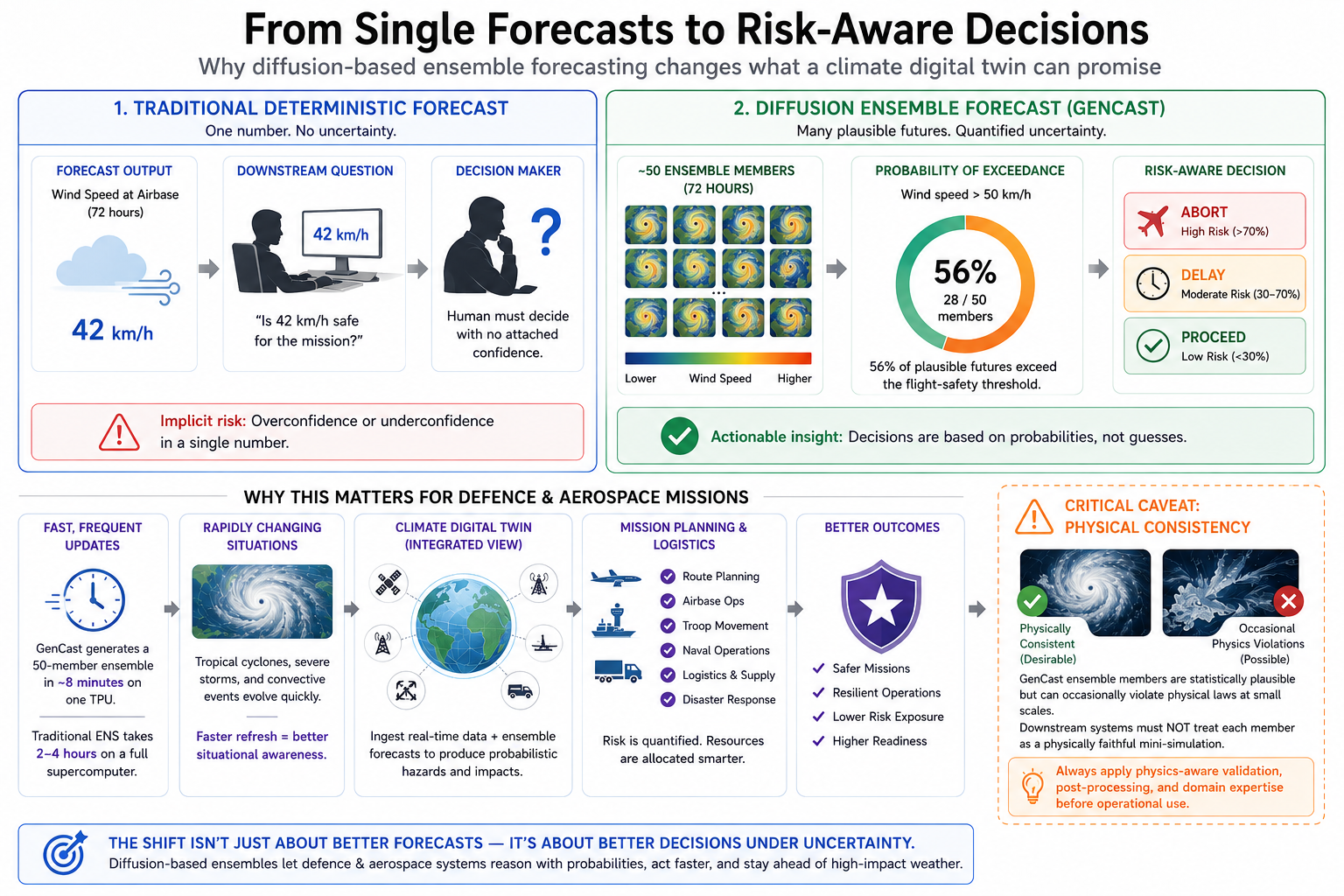
| Term | Meaning |
|---|---|
| Ensemble forecast | A set of multiple forecasts from slightly different starting conditions or model configurations, used to express forecast uncertainty as a spread of outcomes rather than one number |
| Monte Carlo ensemble (physics-based) | The traditional method of generating an ensemble by perturbing initial conditions and physics parameterizations, then running the full numerical weather model forward many times |
| Diffusion model | A generative model trained to reverse a gradual noise-corruption process, learning to sample realistic outputs from pure noise, one denoising step at a time |
| Forward / reverse diffusion | Forward: gradually adding noise to real data until it's unrecognizable. Reverse: the learned process of removing that noise step by step to produce a new sample |
| Conditional diffusion model | A diffusion model whose denoising steps are guided by additional input context (e.g., the current real atmospheric state) so outputs are relevant to that context, not generic samples |
| ENS | ECMWF's operational Ensemble Prediction System — the physics-based Monte Carlo ensemble benchmark AI ensemble models are evaluated against |
| Kinetic energy spectrum | A way of measuring how atmospheric energy is distributed across spatial scales; used to check whether a model's fine-scale (mesoscale) behaviour is physically realistic |
| Helmholtz decomposition | A mathematical technique splitting a wind field into its rotational and divergent components, used here to test whether a model's output respects a real physical separation between the two |
| Data augmentation (tabular) | Generating additional synthetic training examples — often to fix class imbalance — as contrasted here with ensemble generation, which produces the forecast output itself rather than training-data inputs |