Dunnhumby Top Data Analytics Interview Questions and Answers (2026 Guide)
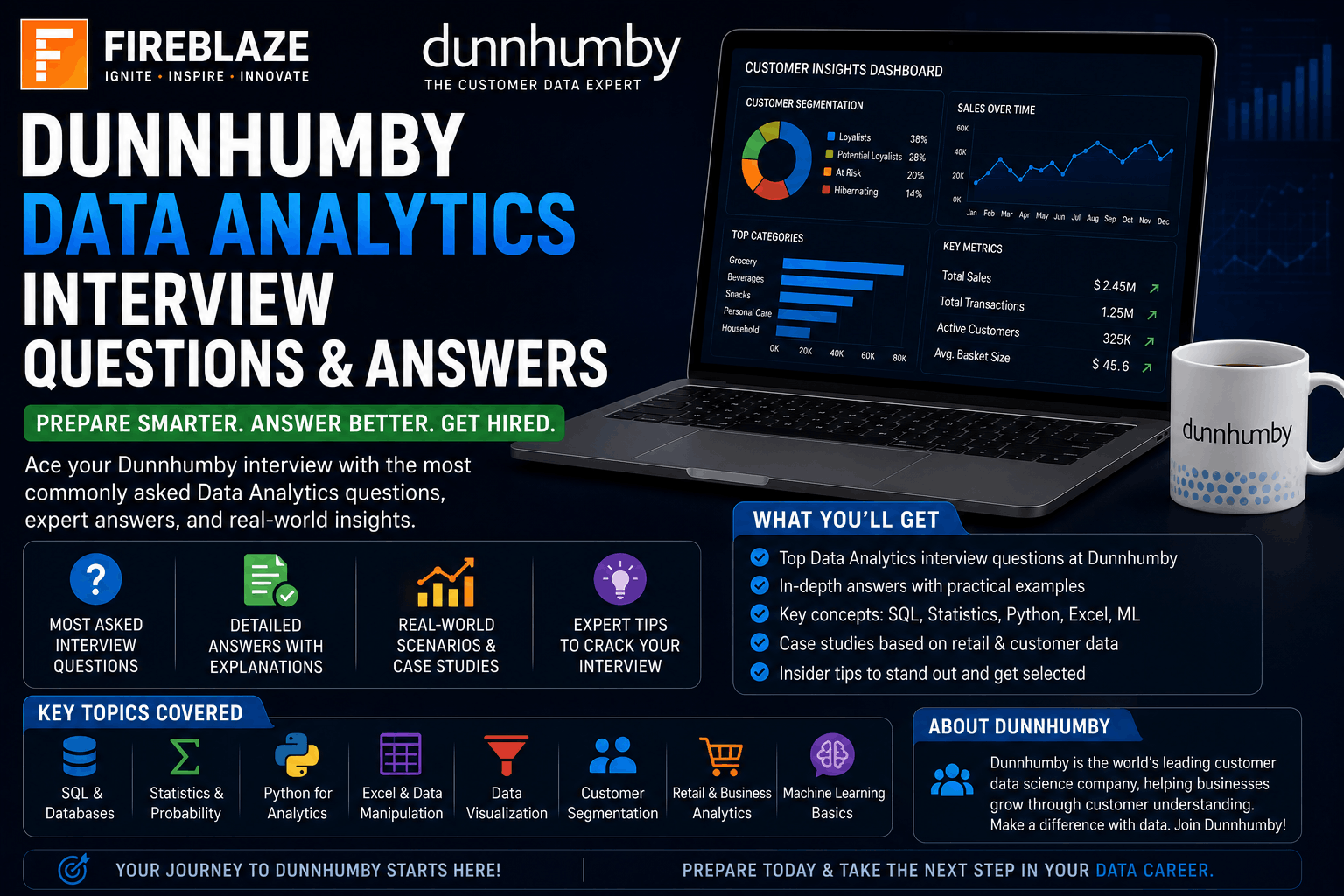
Dunnhumby Top Data Analytics Interview Questions and Answers (2026 Guide)
Dunnhumby is one of the world's leading Customer Data Science and Retail Analytics companies. It helps retailers and brands make better business decisions using customer insights, data analytics, Artificial Intelligence, Machine Learning, and predictive modeling.
The company is known for transforming customer data into actionable business intelligence that improves customer engagement, loyalty, marketing performance, and revenue growth.
If you're preparing for a Dunnhumby Data Analytics interview, understanding the interview process and frequently asked technical questions can significantly improve your chances of success.
In this guide, you'll learn:
Dunnhumby interview process
SQL interview questions
Python interview questions
Statistics questions
Customer Analytics concepts
Retail Analytics case studies
Machine Learning questions
HR interview preparation
About Dunnhumby
Dunnhumby is a global customer data science company that specializes in:
Customer Analytics
Retail Analytics
Data Science
Machine Learning
Marketing Analytics
Customer Personalization
Business Intelligence
The company helps organizations:
Understand customer behavior
Improve loyalty programs
Optimize promotions
Increase customer retention
Enhance product recommendations
Improve business decision-making
Because of this, Dunnhumby actively hires:
Data Analysts
Customer Analysts
Data Scientists
Analytics Associates
Machine Learning Engineers
Business Analysts
Dunnhumby Interview Process
The interview process usually includes multiple rounds.
1. Online Assessment
The assessment may include:
Aptitude questions
Logical reasoning
SQL queries
Data interpretation
Statistics questions
Analytics concepts
2. Technical Interview
Focus areas:
SQL
Data Analytics
Python
Statistics
Customer Analytics
Problem-solving
3. Case Study Round
Candidates are often asked business scenarios involving:
Customer behavior
Marketing performance
Sales analysis
Retail analytics
4. Managerial Round
Discussion topics:
Project experience
Communication skills
Team collaboration
Analytical thinking
5. HR Interview
Evaluation focuses on:
Career goals
Professional attitude
Company fit
Strengths and weaknesses
SQL Interview Questions Asked in Dunnhumby
SQL is one of the most important skills for Analytics roles.
What is an INNER JOIN?
INNER JOIN returns matching records from multiple tables.
SELECT *\nFROM Customers\nINNER JOIN Orders\nON Customers.Customer_ID =\nOrders.Customer_ID;\nDifference Between WHERE and HAVING
| WHERE | HAVING |
|---|---|
| Filters rows | Filters grouped data |
| Used before GROUP BY | Used after GROUP BY |
What are Window Functions?
Window functions perform calculations across rows without grouping them.
SELECT\nCustomer_Name,\nPurchase_Amount,\nRANK() OVER(\nORDER BY Purchase_Amount DESC\n) AS Customer_Rank\nFROM Customers;\nDifference Between DELETE, TRUNCATE, and DROP
| DELETE | TRUNCATE | DROP |
|---|---|---|
| Removes rows | Removes all rows | Removes table |
| Supports WHERE | No WHERE clause | Removes structure |
Python Interview Questions
Difference Between List and Tuple
| List | Tuple |
|---|---|
| Mutable | Immutable |
| Uses [] | Uses () |
What is a Lambda Function?
square = lambda x: x*x\n\nprint(square(5))\nOutput:
25\nImportant Python Libraries for Analytics
Pandas
NumPy
Matplotlib
Seaborn
Scikit-Learn
What is Pandas?
Pandas is used for:
Data Cleaning
Data Analysis
Data Manipulation
Data Transformation
Statistics Interview Questions
What is Mean, Median, and Mode?
Mean
Average value.
Median
Middle value after sorting.
Mode
Most frequently occurring value.
What is Standard Deviation?
Standard deviation measures the spread of values around the mean.
What is Probability?
Probability measures the likelihood of an event occurring.
Formula:
Probability =\nFavorable Outcomes /\nTotal Outcomes\nWhat is Hypothesis Testing?
A statistical method used to validate assumptions about data.
Important concepts:
Null Hypothesis
Alternative Hypothesis
P-value
Confidence Interval
Customer Analytics Interview Questions
What is Customer Analytics?
Customer Analytics involves analyzing customer behavior, preferences, and interactions to improve business decisions.
Applications:
Customer Segmentation
Personalization
Retention Analysis
Recommendation Systems
What is Customer Segmentation?
Customer Segmentation divides customers into groups based on:
Purchase behavior
Demographics
Preferences
Spending patterns
Benefits:
Targeted marketing
Better customer engagement
Improved retention
What is Customer Lifetime Value (CLV)?
Customer Lifetime Value estimates the total revenue a customer generates throughout their relationship with a business.
What is Churn Analysis?
Churn Analysis identifies customers who are likely to stop using a product or service.
Retail Analytics Interview Questions
What is Retail Analytics?
Retail Analytics uses data analysis to improve retail operations and customer experiences.
Applications:
Sales forecasting
Inventory optimization
Promotion analysis
Customer insights
Why is Retail Analytics Important?
Benefits include:
Increased revenue
Better inventory management
Improved customer satisfaction
Data-driven decision-making
Dunnhumby Case Study Questions
Improving Customer Retention
Customer retention rates are declining.
How would you investigate the issue?
Approach
Analyze customer behavior
Segment customers
Identify churn patterns
Study engagement metrics
Develop retention strategies
Promotion Effectiveness Analysis
How would you measure whether a marketing campaign was successful?
Approach
Analyze sales before and after campaigns
Compare conversion rates
Evaluate customer engagement
Measure revenue impact
Product Recommendation System
How would you improve product recommendations?
Approach
Analyze customer purchase history
Use recommendation algorithms
Study browsing behavior
Apply Machine Learning models
Sales Forecasting
How would you forecast future sales?
Approach
Historical sales analysis
Seasonal trend identification
Time Series Forecasting
Predictive Modeling
Machine Learning Interview Questions
Difference Between Supervised and Unsupervised Learning
| Supervised Learning | Unsupervised Learning |
|---|---|
| Uses labeled data | Uses unlabeled data |
| Predicts outputs | Finds hidden patterns |
Examples:
Supervised
Regression
Classification
Unsupervised
Clustering
Association Rules
What is Overfitting?
Overfitting occurs when a model performs well on training data but poorly on unseen data.
Solutions:
Cross-validation
Regularization
More training data
What is Cross Validation?
Cross Validation evaluates model performance using multiple subsets of data.
Popular method:
K-Fold Cross Validation\nData Visualization Questions
What is Data Visualization?
Data Visualization represents information graphically to communicate insights effectively.
Popular tools:
Power BI
Tableau
Excel
Looker
Dashboard vs Report
| Dashboard | Report |
|---|---|
| Interactive | Detailed |
| Real-time insights | Historical analysis |
Business Analytics Questions
What is KPI?
KPI stands for:
Key Performance Indicator\nKPIs measure business performance.
Examples:
Revenue
Customer Retention
Conversion Rate
Sales Growth
What is Conversion Rate?
Conversion Rate measures the percentage of users who complete a desired action.
Examples:
Purchase completion
Registration
Subscription
HR Interview Questions
Tell Me About Yourself
Structure:
Education
Technical skills
Projects
Internship experience
Career goals
Why Dunnhumby?
Sample Answer:
"I am interested in Dunnhumby because of its strong focus on Customer Data Science, Retail Analytics, and data-driven decision-making. The opportunity to work on customer insights, recommendation systems, and advanced analytics projects aligns closely with my interests in Data Science and Business Analytics."
What Are Your Strengths?
Examples:
Analytical thinking
Problem-solving
Communication
Adaptability
Team collaboration
Preparation Tips for Dunnhumby Analytics Interviews
Strengthen SQL Skills
Practice:
Joins
Aggregations
Subqueries
Window Functions
CTEs
Learn Customer Analytics Concepts
Focus on:
Customer Segmentation
Customer Lifetime Value
Churn Analysis
Retention Metrics
Revise Statistics
Important topics:
Probability
Hypothesis Testing
Correlation
Sampling
Distributions
Build Analytics Projects
Projects demonstrate:
Practical experience
Business understanding
Problem-solving skills
Understand Retail Analytics
Important concepts:
Sales Forecasting
Promotion Analysis
Inventory Optimization
Customer Insights
Common Mistakes Candidates Make
Weak SQL preparation
Poor understanding of customer analytics
Weak project explanations
Memorizing answers without understanding
Ignoring business case studies
Final Thoughts
Dunnhumby looks for candidates who can combine analytical thinking, technical expertise, and business problem-solving skills. Strong SQL knowledge, Python programming, statistics fundamentals, customer analytics understanding, Machine Learning concepts, and project experience can significantly improve your chances of success.
Whether you're preparing for a Data Analyst, Customer Analyst, Analytics Associate, Data Scientist, or Machine Learning Engineer role, consistent practice, hands-on projects, and strong communication skills will help you stand out during the Dunnhumby Data Analytics interview process.