Epirus and the Rise of Directed-Energy Counter-Drone Defense

Why This Company, Why Now
In December 2025, a directed-energy weapon built by Epirus did something no publicly disclosed system had done before: it downed a fiber-optic guided drone — a type of drone immune to traditional radio-frequency jamming because it's controlled through a physical cable instead of a wireless signal. It was, by the company's own description, the first known instance of a weaponized electromagnetic-interference system defeating a fiber-optic guided drone, and it landed at a moment when drone-swarm defense has become one of the most urgently funded problems in the U.S. defense budget.
Epirus builds Leonidas, a high-power microwave (HPM) system that disables multiple drones simultaneously by frying their internal electronics rather than shooting them down or jamming their signal. Since 2023, the U.S. Army alone has awarded the company more than $120 million across successive Leonidas contracts, and the company has raised over $550 million in venture funding at a valuation north of $1 billion.
The Problem Epirus Is Solving
Cheap, mass-produced drones have broken the economics of traditional air defense. A single kinetic interceptor missile can cost the U.S. military upward of $2 million to shoot down a drone that costs the adversary a few hundred to a few thousand dollars — a cost ratio that becomes unsustainable the moment an enemy sends dozens or hundreds of drones at once, a tactic already proven in Ukraine and in Houthi attacks in the Red Sea.
Radio-frequency jamming, the traditional low-cost countermeasure, has its own weakness: it doesn't work against drones that don't rely on a wireless radio link, including GPS-independent or fiber-optic guided systems increasingly used specifically because they're jam-resistant. Epirus's answer is directed energy — instead of jamming a signal or physically intercepting an object, Leonidas emits a high-power microwave field that disables the electronic components inside any drone in its path, regardless of how that drone receives its guidance signal, and its magazine is effectively unlimited since it doesn't rely on physical ammunition.
Company Background
Epirus was founded in July 2018 through 8VC's "Build" program — a venture model in which the investment firm assembles founding teams around specific technology gaps it identifies. The six co-founders are Joe Lonsdale (8VC's managing partner and a Palantir co-founder), Nathan Mintz, Dr. Bo Marr, Max Mednik, Grant Verstandig, and John Tenet. The company is headquartered in Torrance, California. Its name is drawn from the mythical Bow of Epirus, a weapon said to have an infinite supply of arrows — a direct reference to the unlimited-magazine pitch behind its core product.
Andy Lowery, a Raytheon veteran, currently serves as CEO. Epirus has raised over $550 million across multiple rounds, including a $200 million round in 2022 (valuing the company at $1.35 billion) and a $250 million Series D in 2025 co-led by 8VC and Washington Harbour Partners, which the company confirmed valued it above $1 billion — notably a step down from its 2022 valuation, reflecting the volatility even well-funded defense-tech startups have seen amid broader market conditions. Investors across its funding history include 8VC, Bedrock Capital, DCVC, T. Rowe Price, and General Dynamics Land Systems — the last a subsidiary of one of the U.S.'s largest traditional defense contractors, notable as a strategic rather than purely financial investor.
What Epirus Actually Builds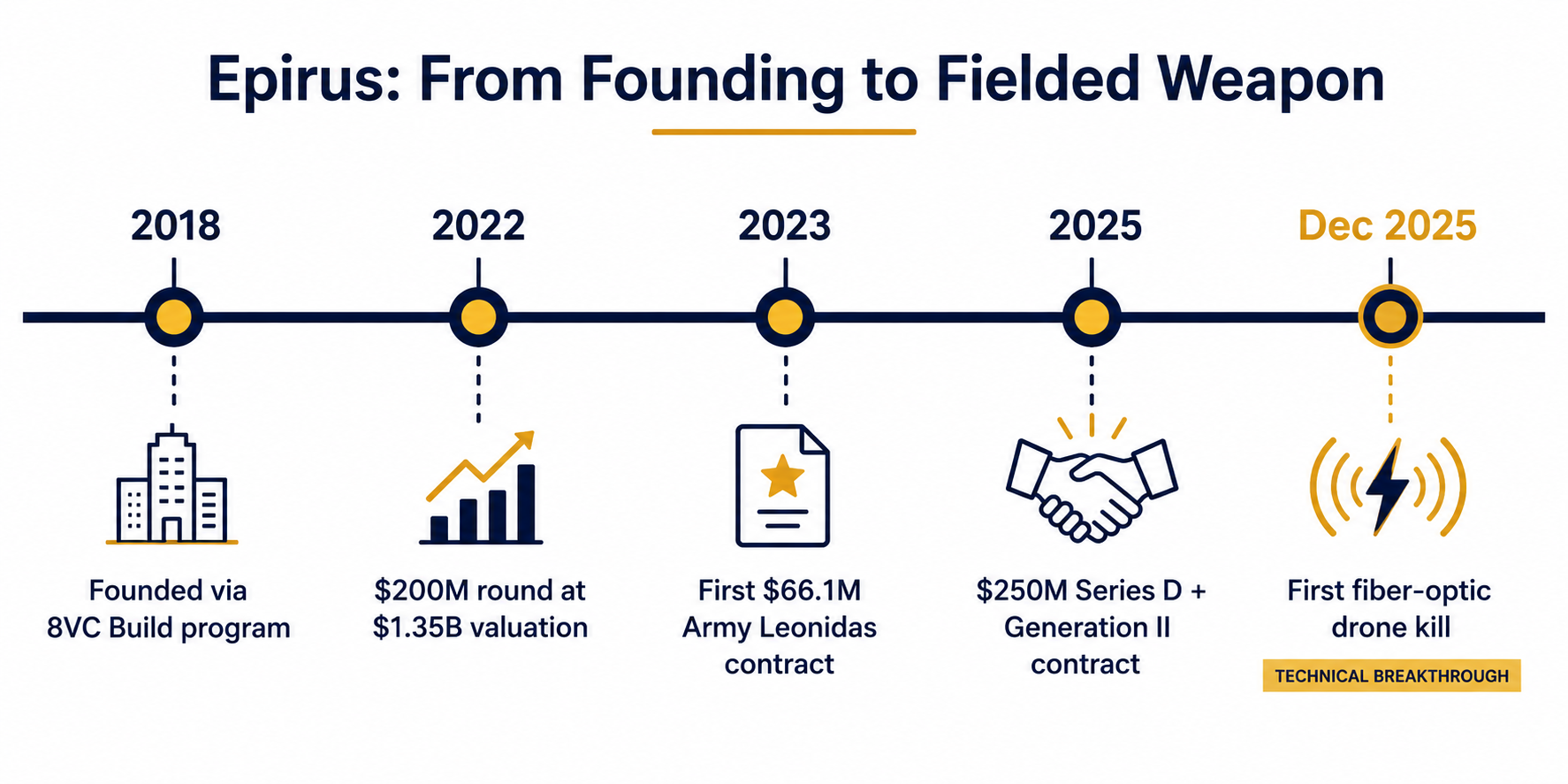
Leonidas is Epirus's flagship product line, but it now spans multiple form factors built around the same core high-power microwave technology:
- Leonidas (vehicle-mounted) — the primary system, mounted on tactical vehicles for mobile counter-swarm defense
- Leonidas POD — a smaller, deployable variant for platform integration
- IFPC-HPM (Generation I and II) — the Army-designated version developed under the Indirect Fire Protection Capability–High-Power Microwave program, with Generation II offering more than double the effective range and roughly 30% more power than the original
- ExDECS — a variant under evaluation for potential Marine Corps acquisition
All variants share Epirus's core differentiator: a software-defined architecture. Because the system's waveform, energy output, and safe-zone parameters are controlled by software rather than fixed hardware, Leonidas can be reconfigured or upgraded against new threat types through a software update rather than a hardware redesign — the same logic that makes consumer software easy to improve over time, applied to a directed-energy weapon.
Deep Dive: Leonidas
Leonidas works by emitting long-pulse, high-power microwave energy across a wide area, disabling the electronic components of any unshielded drone within range — a "swarm defeat" capability by design, since it doesn't need to individually target and track each drone the way a kinetic interceptor does. This is Epirus's central pitch against traditional air defense: Leonidas is described as costing "pennies per kill" compared to multi-million-dollar interceptor missiles, with a functionally unlimited magazine since it isn't ammunition-dependent.
The system uses commercial semiconductor technology (specifically gallium nitride components) to achieve significant reductions in size and weight compared to older-generation HPM systems, which historically were bulky, required extensive human operation, and weren't practical for mobile deployment. Leonidas's open system architecture is also built to integrate with existing command-and-control networks already fielded by the U.S. and NATO, including FAAD C2, rather than requiring operators to adopt an entirely separate control system — a deliberate choice to slot into existing air-defense infrastructure rather than replace it wholesale.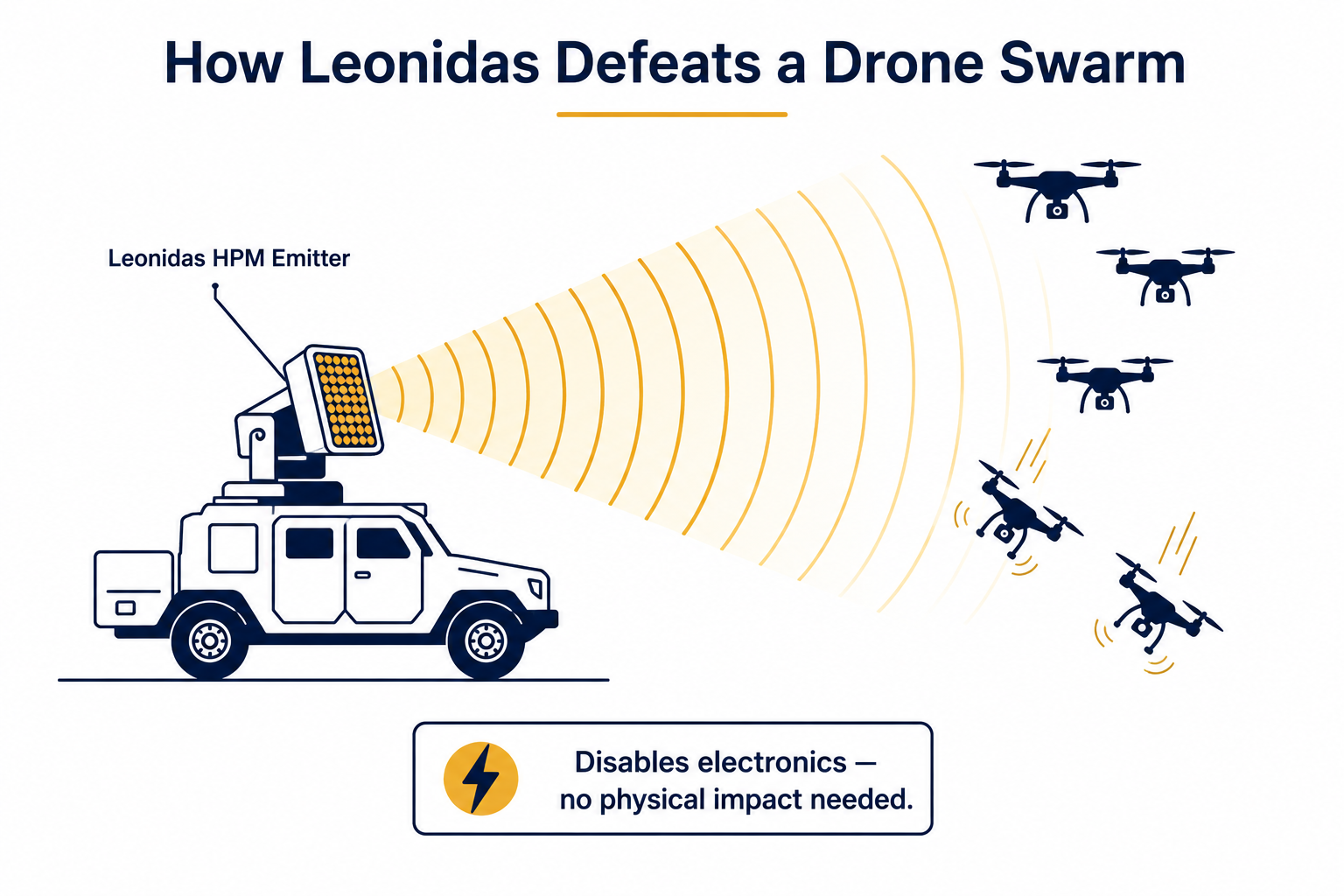
The Contracts, In Plain Terms
| Detail | Value |
|---|---|
| Cumulative Army contracts since 2023 | $120 million+ |
| Key contract (2023) | $66.1 million, RCCTO, first Leonidas prototypes |
| Key contract (2025) | $43.5 million, Generation II IFPC-HPM systems |
| Program | Indirect Fire Protection Capability–High-Power Microwave (IFPC-HPM) |
| Notable milestone | December 2025 — first known EMI-system defeat of a fiber-optic guided drone |
| Additional interest | U.S. Air Force (base/flightline point defense), U.S. Navy (counter-vessel prototype), U.S. Marine Corps (ExDECS, Leonidas POD), Australia (Project LAND 156 under AUKUS Pillar II) |
Recent Milestones (Last 18 Months)
- January 2025 — Reports emerge of a new funding round in progress, potentially at a valuation below the 2022 peak
- March 2025 — $250 million Series D closes, co-led by 8VC and Washington Harbour Partners
- July 2025 — $43.5 million Army contract for Generation II IFPC-HPM systems announced; first two units due by end of July and August
- October 2025 — Generation II testing and evaluation conducted at Naval Air Weapons Station China Lake, California
- December 2025 — Leonidas defeats a fiber-optic guided drone in testing — a first for the industry
- Ongoing 2026 — Air Force reportedly considering leasing IFPC-HPM systems for base point defense; Navy and Marine Corps demonstrations in progress
Competitive Landscape
| Company | Core Approach | Primary Differentiator |
|---|---|---|
| Epirus | Directed energy (high-power microwave) | Only major player with a demonstrated fiber-optic drone kill; software-defined, unlimited magazine |
| Anduril | Kinetic interceptors (Anvil, Roadrunner) + AI command software | Broadest integrated system — sensors, software, and physical interceptors together |
| DroneShield | RF detection and jamming | Lowest per-unit cost; large fixed-site protection contract base (e.g., $24.9M JIATF-401 award, June 2026) |
| Fortem Technologies / Hidden Level | Radar-based detection | Covers medium/high-altitude threats RF systems can't reliably detect |
| CHAOS Industries | Radar sensing + autonomous engagement | Fast-growing newer entrant focused on sensing momentum |
Why This Matters Beyond One Company
- Directed energy is emerging as the answer to the cost-asymmetry problem. When interceptors cost more than the drones they destroy, an unlimited-magazine, near-zero-marginal-cost weapon like Leonidas directly addresses the core economic vulnerability of traditional air defense.
- Fiber-optic and other jam-resistant drones are forcing a technology shift. As adversaries adopt guidance methods designed specifically to defeat RF jamming, directed-energy and other non-RF-dependent defeat mechanisms become structurally more important, not just a niche alternative.
- Strategic investors, not just financial ones, are backing this category. General Dynamics Land Systems' investment in Epirus signals that legacy primes see directed energy as complementary technology worth a stake in, rather than a threat to compete against from scratch.
- Software-defined weapons are becoming the norm even in hardware-heavy categories. Just as Anduril's Lattice treats hardware as an extension of software, Epirus's software-defined waveform control shows the same pattern extending into directed-energy weapons — a broader shift across defense-tech, not unique to one company.
The Takeaway
Epirus's bet is narrower than Anduril's but arguably more focused: that directed energy, not more missiles, is the only economically sustainable answer to mass drone-swarm attacks. The December 2025 fiber-optic drone kill is the clearest evidence yet that the technology works against the threats specifically designed to defeat older countermeasures — and with the Army, Air Force, Navy, and Marine Corps all now evaluating variants of Leonidas, 2026 is shaping up to be the year directed-energy counter-drone defense moves from promising demo to fielded program of record.
Sources
Contrary Research (Epirus founding story); LegalClarity (Epirus ownership/founders); Grokipedia (Epirus overview); TWZ/The War Zone (July 2025, Generation II coverage); The Defense Post (July 2025); Tectonic Defense (January 2026, fiber-optic drone test); TechCrunch (January 2025 funding coverage, 2022 Series C coverage); Epirus official press releases (2023 RCCTO contract). Funding and valuation figures are as publicly reported; the company has not confirmed a precise 2025 valuation figure.