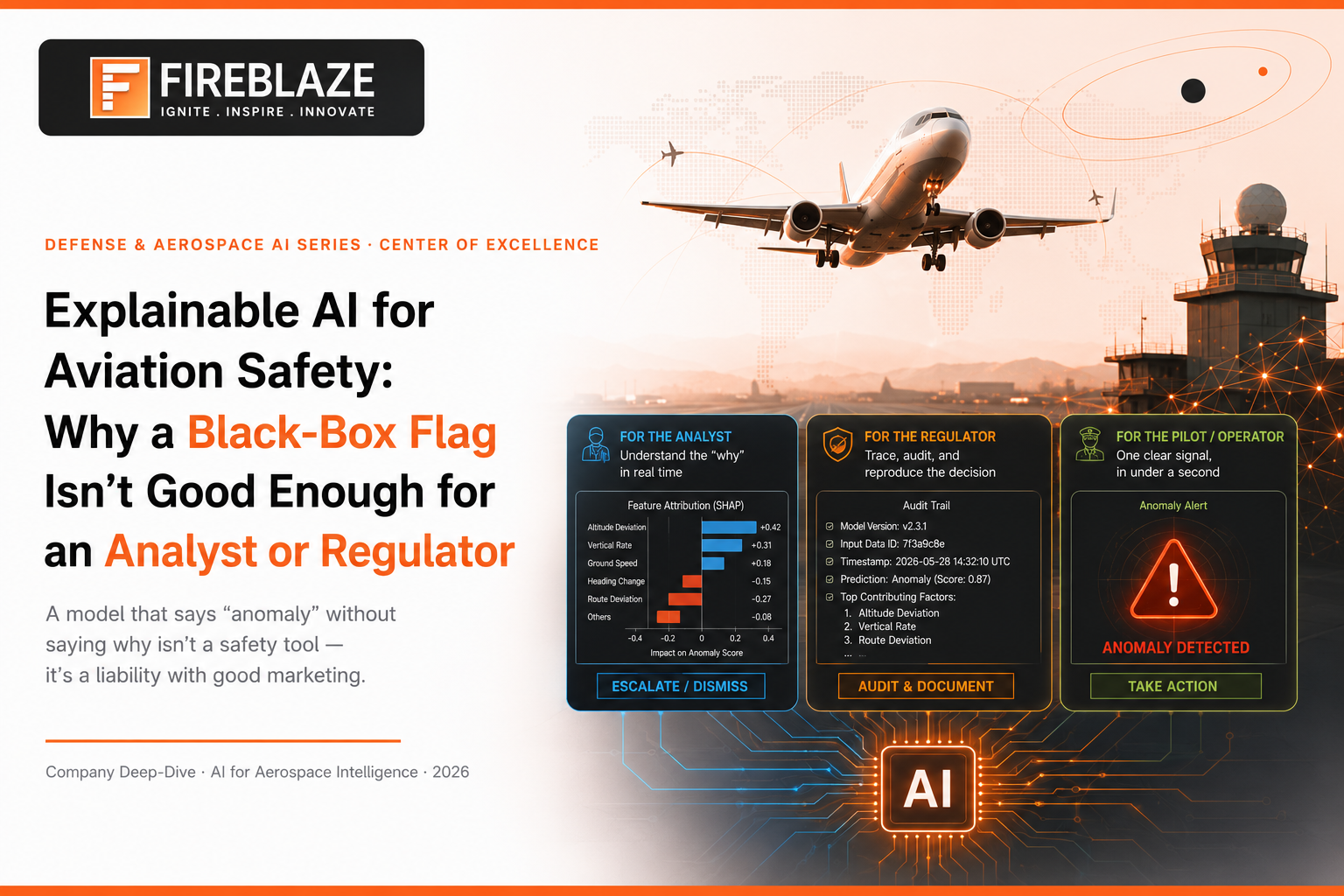
Explainable AI for Aviation Safety: Why a Black-Box Flag Isn't Good Enough for an Analyst or Regulator
Explainable AI for Aviation Safety: Why a Black-Box Flag Isn't Good Enough for an Analyst or Regulator
A model that says "anomaly" without saying why isn't a safety tool — it's a liability with good marketing.
1. Hook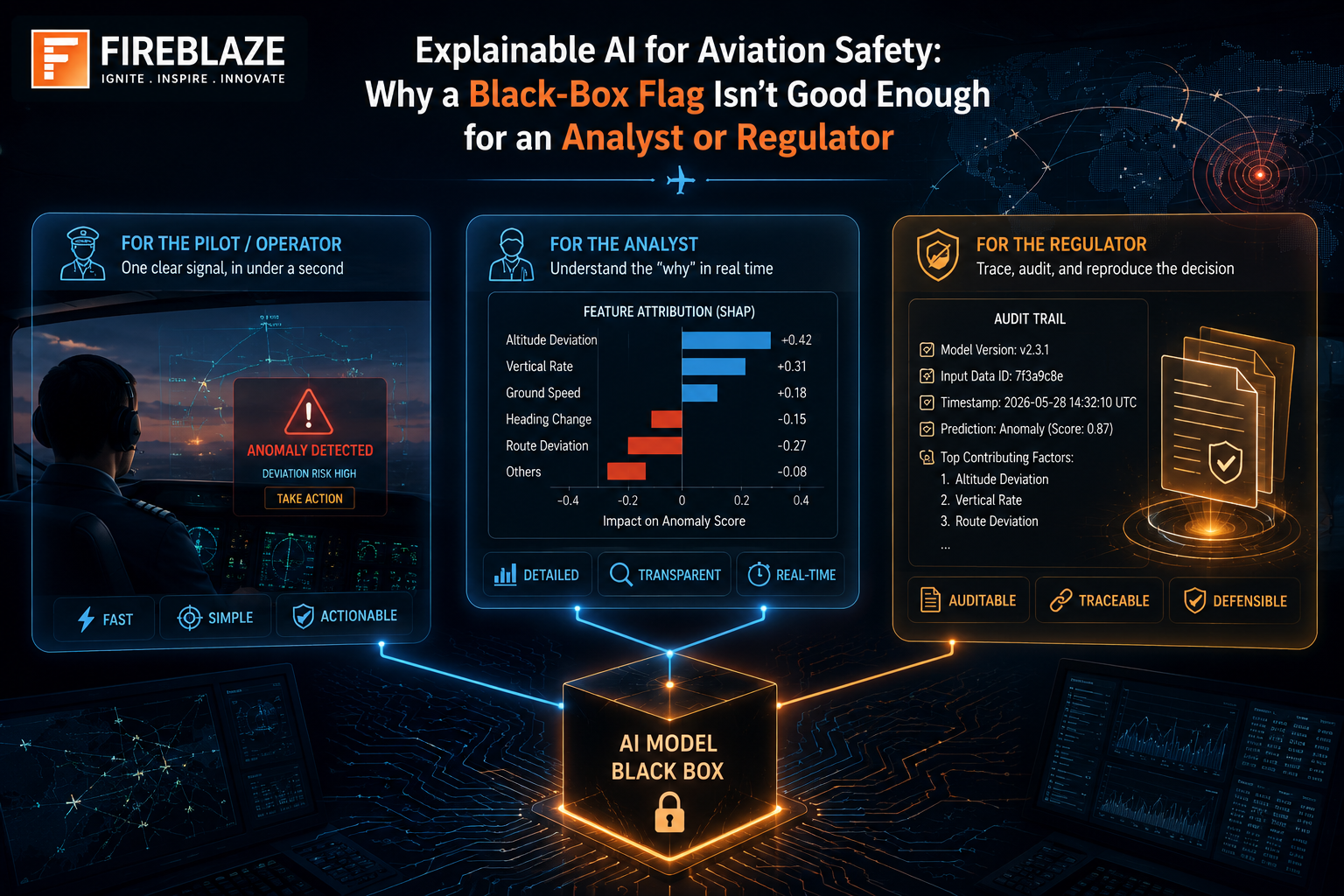
An AI system flags a flight as anomalous thirty seconds before an unusual descent. The alert is correct. It is also, on its own, almost useless — because the analyst staring at it, the regulator later auditing it, and the pilot who might act on it each need a completely different explanation of the same "why," and most explainable AI (XAI) tooling was never designed to serve more than one of them at once. That mismatch, not model accuracy, is quietly becoming the real bottleneck standing between promising aviation-safety AI and anything that actually gets certified or trusted.
2. Core Explanation
2.1 The Three-Audience Problem — A Framing Most XAI Discussions Skip
Most explainable AI writing treats "explainability" as one problem with one solution: pick a technique (SHAP, LIME, attention maps, whatever), bolt it onto the model, ship an explanation alongside the prediction, done. This framing quietly assumes there is one reader. In aviation safety, there are at least three, and they want structurally different things from the same underlying model decision.
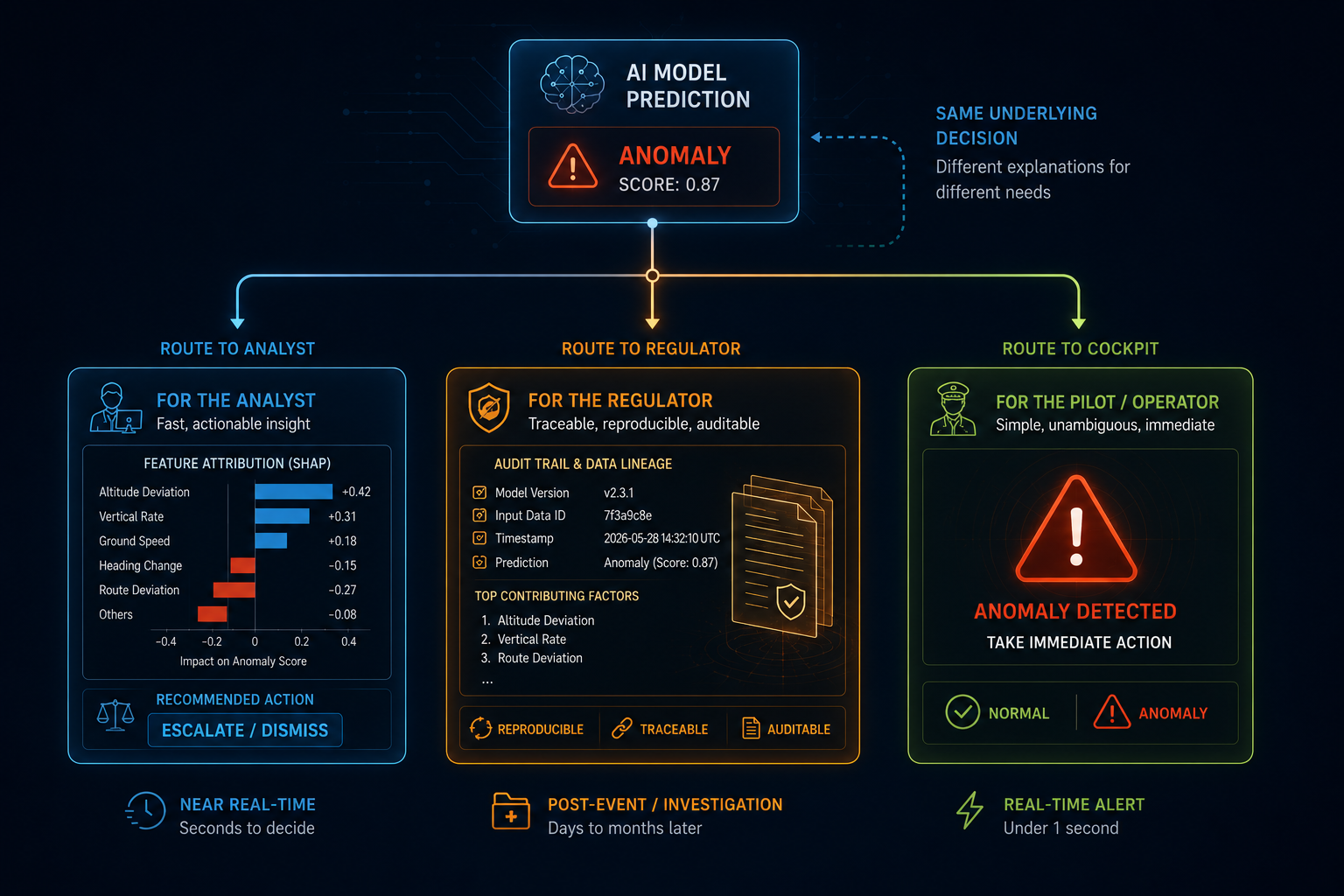
- The analyst, sitting in a monitoring center reviewing a flagged trajectory in near-real time, needs a fast, feature-level breakdown: which specific inputs drove this score, and by how much, so they can decide in seconds whether to escalate, dismiss, or investigate further.
- The regulator or accident investigator, reviewing the same flag months later as part of a certification review or post-incident inquiry, needs something closer to a legal standard of evidence: a stable, reproducible, auditable account of why the model behaved this way on this input, ideally traceable back to training data provenance and validated against known failure modes — not a live dashboard, but a defensible record.
- The pilot or operator, in the rare case an explanation needs to reach the cockpit at all, needs the opposite of detail: a single, unambiguous, low-cognitive-load signal delivered in under a second, because a wall of feature-attribution bars is actively dangerous in a time-critical moment.
This is the crux of a problem worth naming explicitly: explainability is not one deliverable, it's a routing problem. A system that generates one static SHAP plot and calls the job done has, at best, satisfied one of these three audiences — usually the analyst — while leaving the regulator without an audit trail and the pilot without anything usable at all. Most XAI literature optimizes for technique quality (is the explanation faithful to the model?) while badly underinvesting in audience-appropriate delivery (is the explanation usable by the person who actually receives it?). Both matter, and treating them as the same problem is where a lot of promising aviation-safety AI projects quietly stall before certification.
2.2 Why "Black-Box Flag" Fails a Regulator Specifically
Aviation is one of the most procedurally mature safety domains that exists, and that maturity is exactly why a bare anomaly score fails so completely here compared to, say, a recommendation engine flagging a suspicious purchase. Existing airworthiness and safety frameworks — such as DO-178C for software assurance and the newer DO-326A/ED-202A guidance extending into AI-relevant considerations — are built around the principle of traceability: every safety-relevant decision must be traceable back through a documented chain of requirements, design decisions, and verification evidence. A regulator isn't asking "was the model right?" — they're asking "can you prove, after the fact, exactly why the model produced this output, and can you show that this reasoning pattern was validated before deployment, not discovered afterward?"
A black-box flag fails this test not because it's inaccurate, but because it's non-reconstructable: if the same input were run again next year on a retrained version of the model, would it produce a consistent explanation, or would the "why" silently shift underneath an unchanged accuracy metric? Most standard XAI techniques — including popular ones like SHAP (SHapley Additive exPlanations) and LIME (Local Interpretable Model-agnostic Explanations) — were built to answer "what mattered for this one prediction," not "is this reasoning pattern stable, validated, and reproducible across model versions." That second question is precisely what a certification body cares about, and it is largely absent from mainstream XAI tooling, which is a genuine, underappreciated gap rather than a solved problem with an off-the-shelf fix.
This gap has produced a real regulatory shift worth naming: EASA's (European Union Aviation Safety Agency) AI roadmap work explicitly separates AI applications into assurance "levels," with human-AI teaming and full autonomy requiring progressively stronger explainability and traceability guarantees before certification credit is given — a tacit admission that explainability isn't a nice-to-have feature bolted onto a model, but a certification prerequisite with its own maturity ladder, distinct from the model's raw predictive performance.
2.3 A Novel Distinction: Explanation Latency Budget
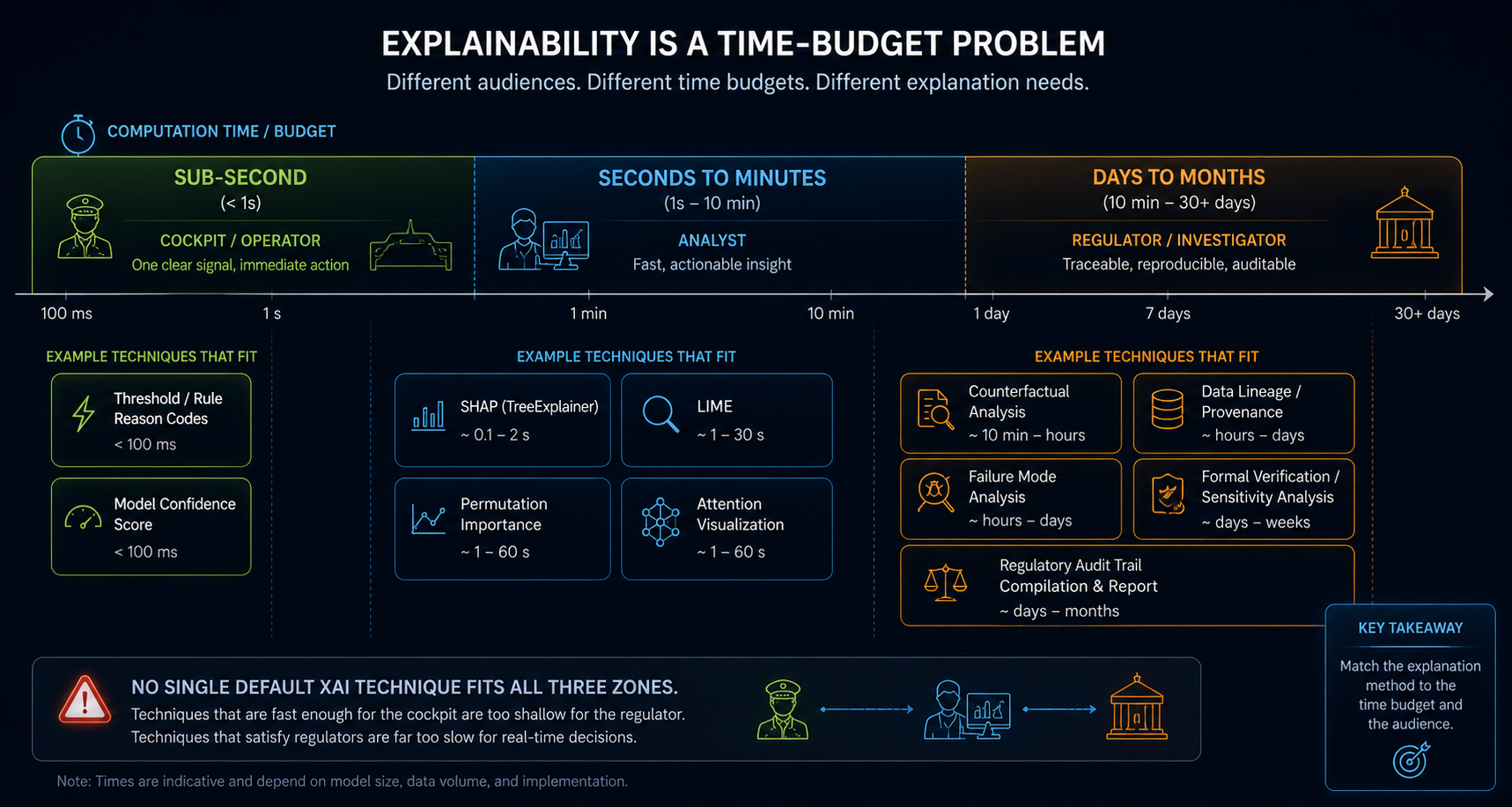
Here's a dimension almost entirely missing from general XAI discourse but critical in aviation: explanation latency budget — the maximum time available, given the operational tempo of the decision, to produce and deliver an explanation before it stops being useful.
Consider three latency budgets on the same trajectory-anomaly problem:
- Sub-second budget (cockpit alerting): there is no time for a computed feature-attribution breakdown; the explanation must be pre-baked into a small, validated taxonomy of alert types, each pre-mapped to a simple, tested phrase or icon, decided upon during design — not generated live.
- Seconds-to-minutes budget (analyst triage): enough time exists to compute a live, model-specific attribution (which features drove the score, ranked by contribution), but not enough time for a full retraining-stability audit.
- Days-to-months budget (regulatory review, post-incident investigation): the full weight of forensic techniques becomes available — counterfactual analysis, training-data lineage tracing, adversarial robustness testing, and cross-version consistency checks that would be far too slow for any real-time use.
Most published XAI research is implicitly written for the third budget — plenty of computational headroom, one static prediction to explain, no urgency — and then gets awkwardly retrofitted for the first two, often badly. A genuinely novel design principle for aviation-safety XAI is to decide the explanation format based on the latency budget before choosing the explanation technique, rather than picking a popular technique first and discovering afterward that it can't run fast enough, or isn't rigorous enough, for the audience that actually needs it.
2.4 Faithfulness vs. Plausibility — The Trap That Fools Everyone Equally
A subtler failure mode, worth calling out because it's genuinely easy to miss even for careful teams, is the gap between an explanation being plausible (it sounds reasonable to a human reading it) and an explanation being faithful (it actually reflects what the model computed internally). These are not the same property, and a dangerous amount of deployed XAI tooling optimizes for the former while quietly assuming it has delivered the latter.
A feature-attribution method can produce a clean, confident-looking chart — "altitude contributed 40%, speed contributed 35%, heading contributed 25%" — that reads as authoritative and satisfies an analyst's gut check, while actually being a post-hoc approximation that doesn't reliably reflect the model's true internal decision logic, especially for highly nonlinear models like deep sequence networks. The danger here is specific to safety-critical domains: a plausible-but-unfaithful explanation doesn't just fail to help — it actively builds misplaced trust, because it looks exactly like a rigorous justification while providing none of the reproducibility a regulator or investigator actually needs. Distinguishing faithfulness from plausibility, and being honest about which one a given technique is actually delivering, is arguably a more important skill for an aviation-safety AI team to develop than mastering any single XAI library.
3. Comparing Explanation Approaches Against What Each Audience Actually Needs
| Explanation Approach | What It Actually Provides | Best-Fit Audience | Key Limitation for Aviation Safety |
|---|---|---|---|
| Feature attribution (SHAP, LIME) | Ranks which input features drove a single prediction | Analyst (seconds-to-minutes budget) | Post-hoc approximation; faithfulness not guaranteed, especially on deep sequence models |
| Attention visualization | Shows which parts of an input sequence the model "focused on" | Analyst / model developer | Attention weight is not the same as causal importance — can be plausible without being faithful |
| Surrogate/interpretable model (e.g., decision tree approximating a neural net) | A simpler, inherently readable model trained to mimic the black box | Regulator (early review stage) | Approximation gap — the surrogate may diverge from the real model on edge cases, which are exactly the cases that matter most |
| Counterfactual explanation ("if altitude had been X instead, the flag would not have fired") | A minimal change that would have flipped the decision | Regulator / investigator | Computationally expensive; can be non-unique (multiple valid counterfactuals) |
| Pre-validated alert taxonomy | A small, fixed set of tested alert types mapped to simple phrases, decided at design time | Pilot / cockpit (sub-second budget) | Sacrifices per-instance nuance entirely — the "explanation" is really pre-baked design work, not live computation |
| Training-data lineage & version audit trail | Documents what data and model version produced this behavior, historically | Regulator (certification, post-incident) | Not really an "explanation" of the decision itself — it's an accountability record, and both are needed |
The table's real lesson: no single row solves the whole problem, and much of the current gap in aviation-safety AI comes from treating one row as if it were sufficient for every audience.
4. Worked Example / Analogy
Imagine a hospital where a diagnostic AI flags a patient's scan as concerning. Now imagine trying to serve three people with one printout: the radiologist reviewing dozens of cases per hour needs a quick heat-map showing where on the image the concern is, so they can glance and decide whether to look closer. The hospital's quality-assurance board, reviewing a malpractice claim eighteen months later, needs something else entirely — a documented, reproducible account of exactly which training cases and model version produced this specific judgment, defensible under scrutiny long after the original scan is forgotten. And the patient, if told anything at all, needs neither of those — they need one clear sentence a doctor can say out loud in the room.
Handing the quality-assurance board a heat-map, or handing the radiologist a legal audit document, technically counts as "providing an explanation" — but it's the wrong explanation for that reader, delivered on the wrong timescale, and it fails just as badly as providing no explanation at all. Aviation safety AI faces exactly this same three-way mismatch, just with an analyst, a regulator, and a pilot standing in for the radiologist, the board, and the patient.
5. Application to Defense & Aerospace
For a Defense & Aerospace AI Center of Excellence, the practical implication of this three-audience framing is architectural, not just philosophical: explainability needs to be designed as a routed output of the system from the start, not added as a single downstream module after the anomaly-detection model is built. A trajectory-anomaly pipeline (of the kind compared in our companion piece on Isolation Forest, Autoencoders, and LSTMs) should generate at minimum two distinct explanation artifacts per flagged event — a fast, feature-level attribution for the analyst on shift, and a slower, more rigorous audit record (model version, training data snapshot, counterfactual minimal-change analysis) generated asynchronously for anything that escalates toward regulatory or investigative review. If the system also feeds cockpit-facing alerting, that channel needs its own pre-validated, tested alert taxonomy decided during design — never a live-generated explanation squeezed into a sub-second budget it was never built to meet.
This also reframes model selection itself: a marginally less accurate model that produces stable, faithful, reproducible explanations across retraining cycles may be the safer institutional choice over a marginally more accurate model whose internal reasoning shifts unpredictably between versions — because in a certification-bound domain, explainability durability is not a cosmetic feature, it's a hard prerequisite for deployment credit.