From Man-Portable to Mass Production: Mapping the Counter-Drone Supply Chain
A Market Nobody Designed for Scale
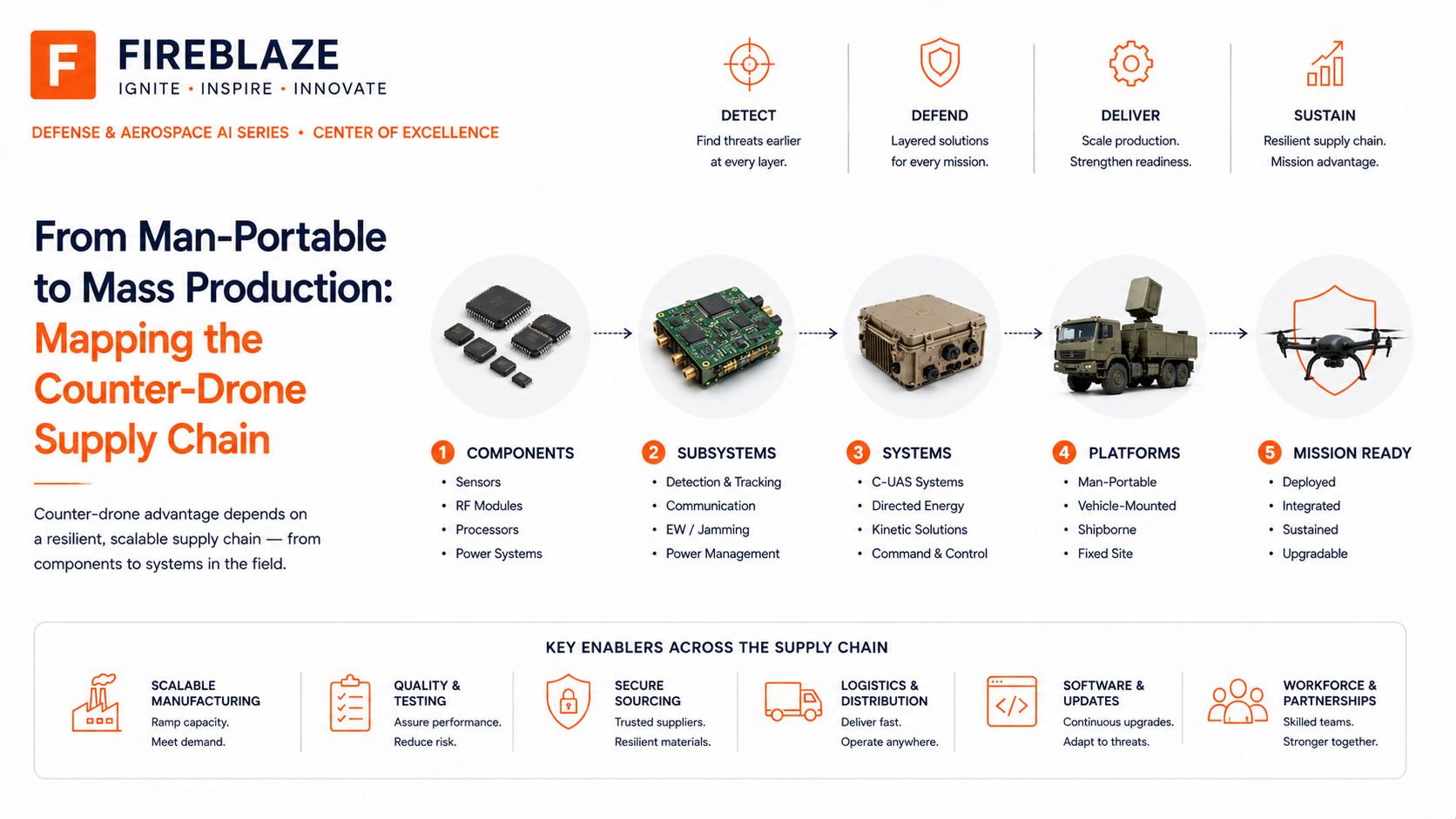
Most counter-drone systems were originally engineered as specialized, low-volume equipment — a handful of units protecting a base or a convoy. That design assumption has broken. With drone threats now arriving by the dozens or hundreds at once, the entire counter-UAS industry is being forced through a rapid, expensive transition: from bespoke, hand-built systems toward genuine mass production, the same shift the automobile industry went through a century ago, compressed into a few years.
The Vendor Landscape Is Bigger Than It Looks
There are at least 45 identifiable counter-drone companies operating across five broad categories: detection, RF/cyber defeat, directed energy, kinetic defeat, and command-and-control integration. That's a genuinely fragmented supply chain — no single company yet supplies a complete detect-and-defeat system end to end, which means most national procurement programs are effectively assembling systems from multiple vendors rather than buying one integrated product off the shelf
The Procurement Split That Matters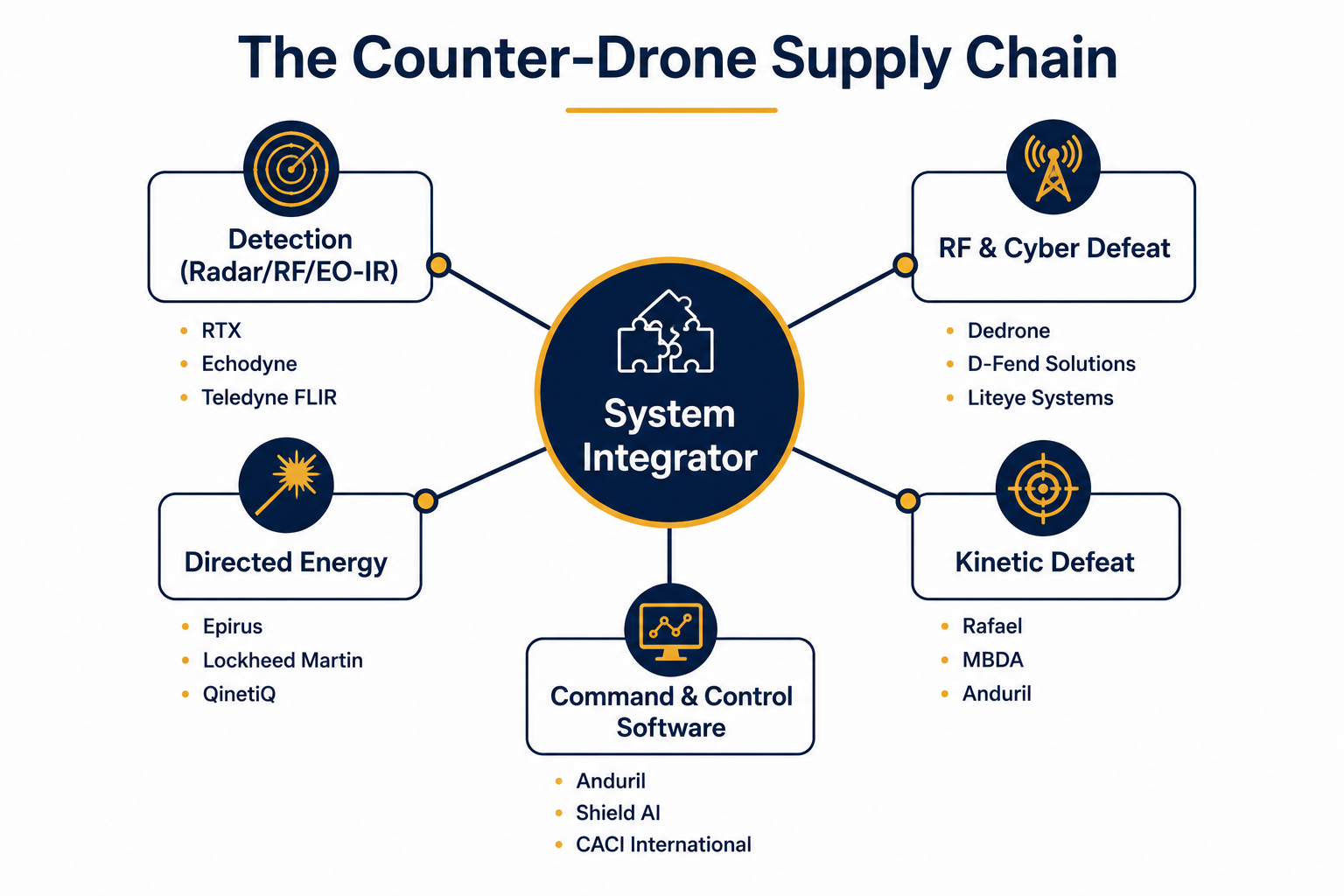
Not every country can buy from every vendor. NDAA (National Defense Authorization Act) compliance rules mean U.S. federal buyers are largely restricted to American vendors — RTX, Lockheed Martin, Northrop Grumman, L3Harris, Anduril, Epirus, Fortem Technologies, SRC, and Echodyne — plus allied firms available through U.S. subsidiaries, such as BAE Systems Inc, Leonardo DRS, Saab Inc, and Elbit America. Turkey's Aselsan is a notable exception, effectively restricted from U.S. federal procurement under CAATSA sanctions law. This creates parallel, semi-separate supply chains for U.S.-aligned buyers versus the rest of the world.
Scaling From Prototype to Factory Floor
Two examples show how differently companies are approaching the jump from prototype to mass production:
Anduril's Arsenal-1 — a large-scale manufacturing facility in Ohio, began production operations in 2026, purpose-built for the "intelligent mass" doctrine: fielding large numbers of relatively low-cost autonomous systems rather than a small number of exquisite, expensive ones.
DroneShield's production scale-up — the company's sales pipeline swelled to roughly A$2.3 billion (as of February 2026) across 295 deals in 50 countries, and it is scaling manufacturing capacity from A$500 million to A$2.4 billion by the end of 2026 — nearly a 5x increase in a single year.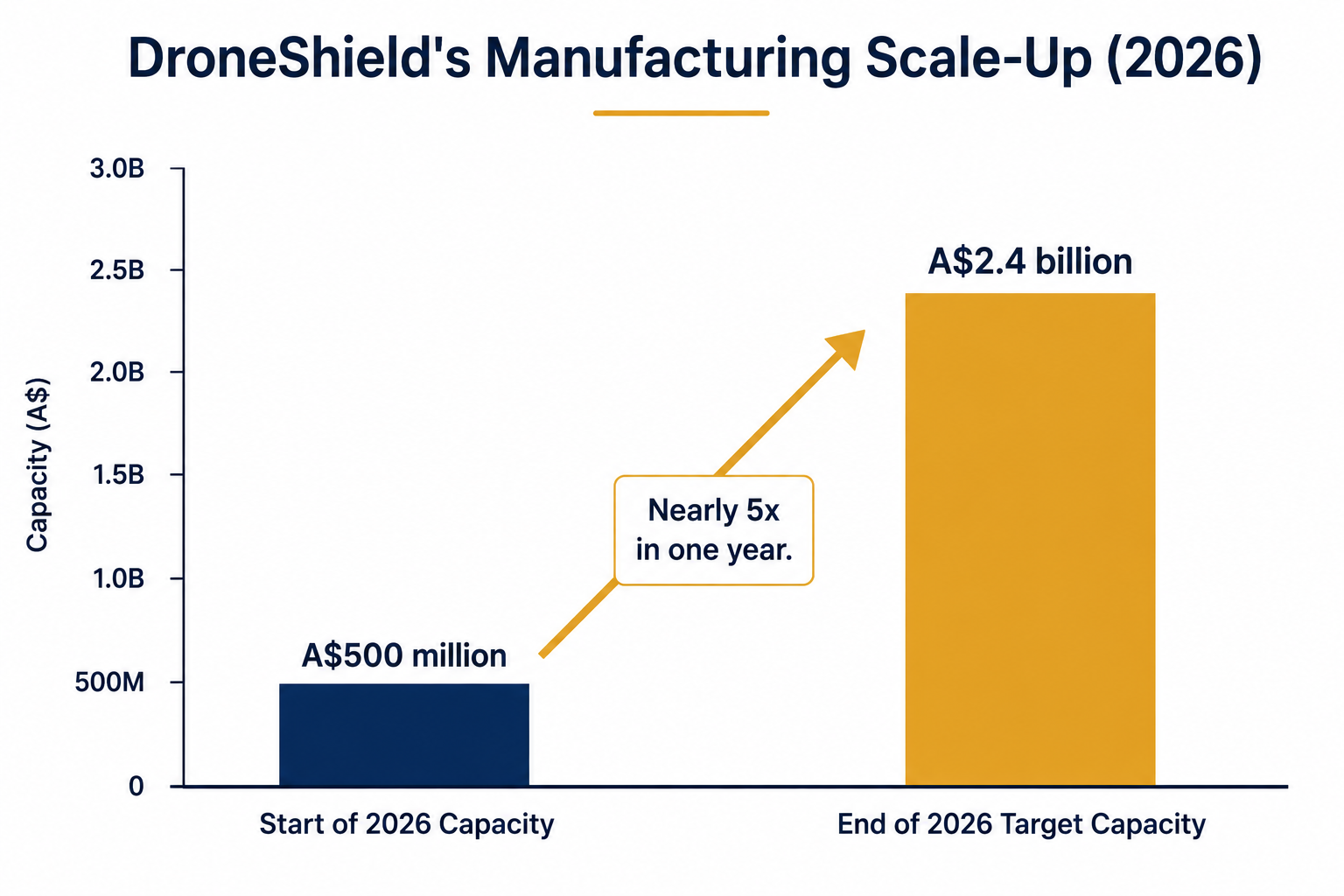
Man-Portable Still Matters
Even as mass production scales up for fixed-site and vehicle-mounted systems, man-portable counter-drone equipment remains a critical, separate category — infantry units need something a single soldier can carry and operate without a vehicle or a fixed installation. This segment sits at the opposite end of the supply chain from facilities like Arsenal-1: it's about miniaturization and ruggedization, not volume manufacturing, and it depends on a different set of suppliers who specialize in lightweight RF detection and jamming hardware rather than large directed-energy or missile-interceptor systems.
Why the Supply Chain Itself Is Now a Strategic Asset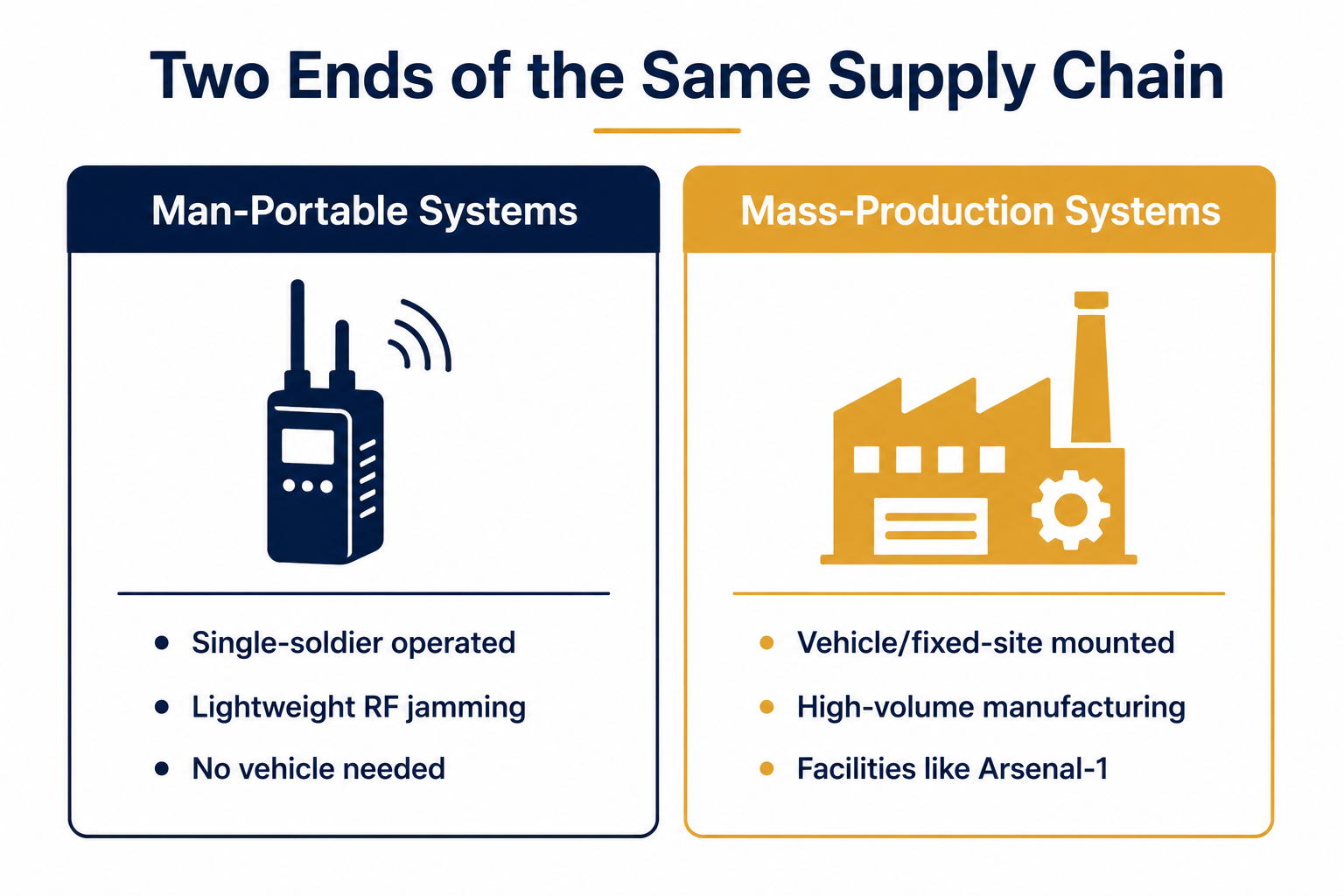
The lesson emerging across 2026 procurement decisions is that manufacturing capacity has become as strategically important as the underlying technology. A company with a brilliant detection algorithm but no ability to produce units at scale can't actually protect anything when a real, large-scale drone threat shows up — which is exactly why investment is flowing as heavily into factories like Arsenal-1 and DroneShield's production expansion as it is into new detection or defeat technology itself. In a market defined by cost-asymmetric, mass drone attacks, the side that can build faster and cheaper has a real structural advantage — independent of whose individual technology is more sophisticated on paper.
Sources
Drone Intelligence (Counter-Drone Companies: 45 C-UAS Vendors 2026); ExoSwan (Top Military Drone Stocks 2026); TOPONE Markets (Anduril Industries 2026 profile, Arsenal-1 coverage); Drone Intelligence (US Counter-UAS Market Forecast). Manufacturing capacity and pipeline figures are company-reported and not independently audited.