From Scheduled to Condition-Based: How Airlines Are Actually Adopting AI Maintenance in 2026
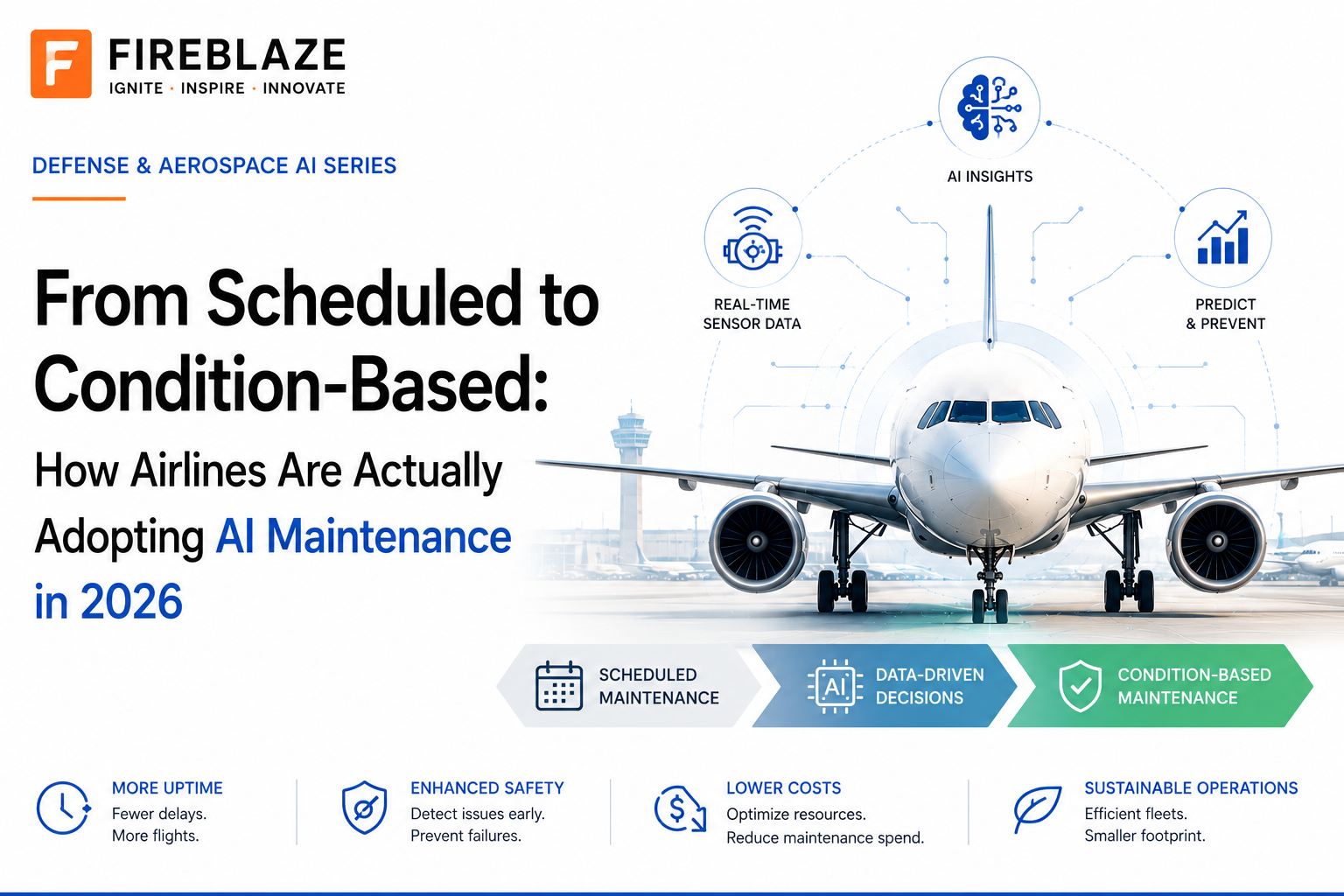
From Scheduled to Condition-Based: How Airlines Are Actually Adopting AI Maintenance in 2026
The industry-wide adoption number looks impressive. What airlines are actually doing with that AI, on the hangar floor, is a more uneven and more interesting story.
1. What Happened
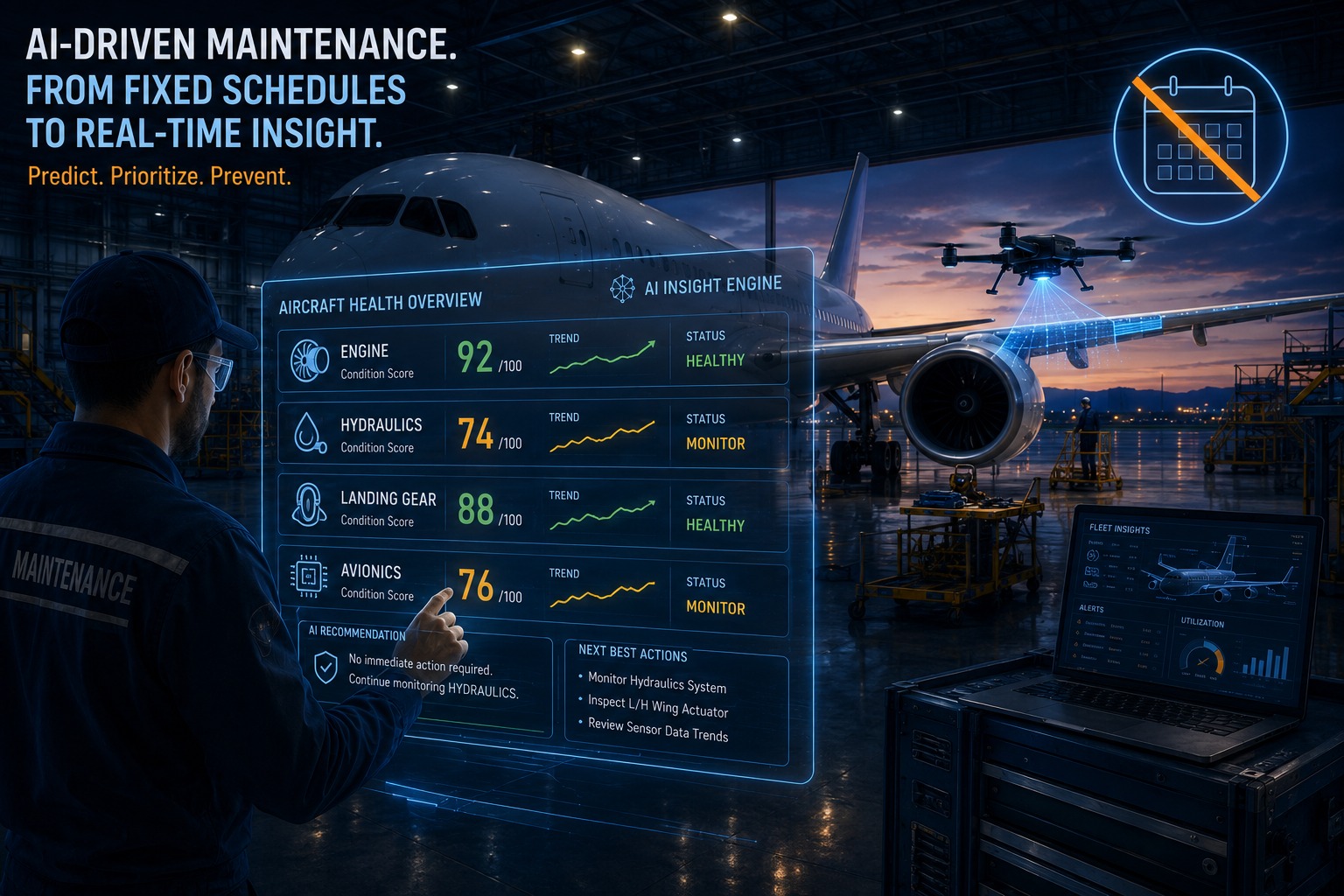
Oliver Wyman's 2025 MRO Survey — an annual, now second-decade-running poll of more than 150 senior aviation executives — found that 64% of respondents reported adopting AI in their maintenance operations, a sharp increase from the prior year's figure. At the same time, named deployments have moved from pilot programs to production use: Lufthansa Technik's AVIATAR platform, combining AI logbook analysis with cobot-assisted inspection, is now used across more than twenty airlines operating Airbus and Boeing aircraft, GE Aerospace has fielded a generative-AI tool built with Microsoft and Accenture to accelerate maintenance-record searches, and Boeing's Insight Accelerator is being positioned explicitly to help MRO teams "move beyond scheduled maintenance toward more predictive, condition-based approaches."
2. Why It Matters
2.1 The Headline Adoption Number Is Real, But It's Measuring Something Broader Than "Condition-Based Maintenance"
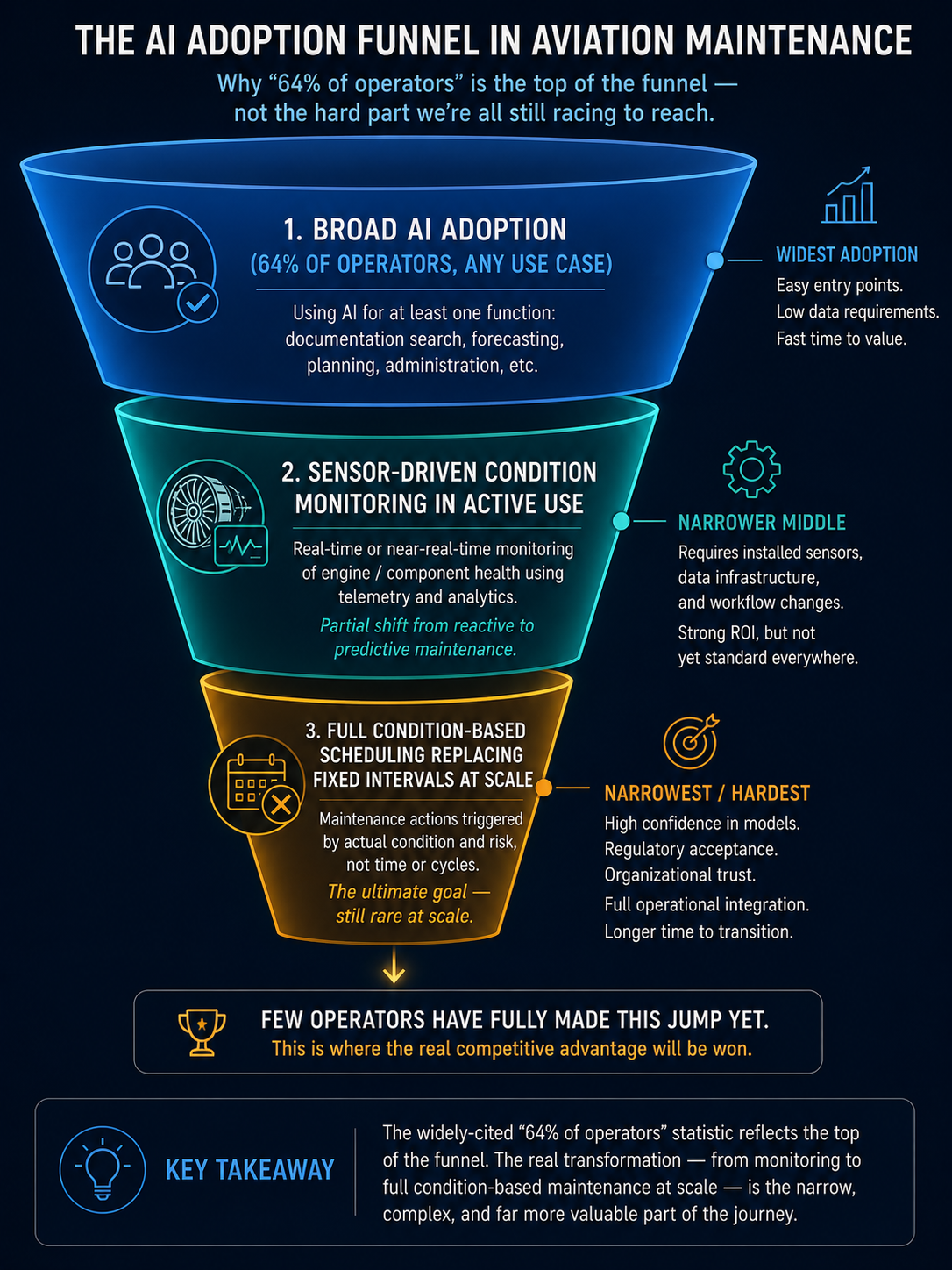
The Oliver Wyman survey's 64% adoption figure is one of the more credible data points in this space — it's a long-running, methodologically consistent, executive-level survey rather than a single vendor's marketing claim. But it's worth being precise about what "adoption" means in that figure: it captures AI use anywhere across maintenance operations, which spans a wide spectrum from full condition-based, sensor-driven predictive scheduling all the way down to narrower applications like AI-assisted document search or inventory forecasting. Conflating "64% have adopted AI somewhere in their MRO operation" with "64% have shifted to condition-based maintenance" overstates how far the industry has actually moved on the specific scheduled-to-condition-based transition this piece is about. The more honest read is that AI adoption is broad but shallow in many operations — present in some form almost everywhere, but only in a minority of cases has it actually replaced calendar- or cycle-based maintenance intervals with genuine condition-triggered scheduling for a meaningful share of fleet components.
2.2 What Real, Named Deployments Actually Look Like in Practice
Separating vendor marketing from verifiable, named programs is essential in this space, since a large share of the published "AI in MRO" content online comes from software vendors with an obvious incentive to inflate both the maturity and the results of AI adoption. A few deployments are well-documented enough to treat as genuine signal:
- Lufthansa Technik's AVIATAR platform combines AI-driven analytics and digital twins with cobot-assisted physical inspection — for example, robots that inspect threaded holes on engine casings and detect micro-cracks, integrated with the airline's broader "Technical Repetitives Examination" facility that pairs AI logbook analysis with engineering expertise. Its use across more than twenty airlines operating both Airbus and Boeing aircraft makes it one of the more genuinely multi-operator, cross-fleet AI maintenance deployments in commercial service today, rather than a single-airline pilot.
- GE Aerospace's GenAI maintenance-records tool, built in partnership with Microsoft and Accenture, targets a narrower but very concrete problem: helping airlines and aircraft lessors search critical maintenance records in minutes rather than hours — a mundane-sounding but operationally significant use case, since incomplete or slow-to-verify maintenance records are a genuine bottleneck in aircraft transactions and lease returns, distinct from the sensor-driven predictive-maintenance narrative that usually dominates AI-in-MRO coverage.
- Computer-vision-based visual inspection using drones has moved from novelty to genuine time-compression: autonomous drones equipped with high-resolution cameras, thermal imaging, and LiDAR can scan a fuselage, wings, and tail in under twenty minutes, compared to six to ten hours for the equivalent manual inspection — one of the clearer, more measurable "AI replacing manual labor at the same task" wins in this space, as opposed to the harder-to-verify predictive-scheduling claims discussed below.
2.3 The Real Barriers Slowing the Transition — Not Just Vendor Talking Points
The gap between broad AI "adoption" and genuine condition-based maintenance at scale is explained by a specific, well-documented set of structural barriers, not simply organizational inertia:
- Fleet age. The average age of many in-service commercial fleets now exceeds eleven years, and integrating older aircraft into a sensor-rich, condition-based monitoring architecture is materially more expensive than designing that architecture into new-build aircraft from the outset — a real, physical retrofit cost that no software purchase alone resolves.
- Infrastructure and cybersecurity investment. AI systems, digital twins, and cloud analytics require robust IT infrastructure, high-speed connectivity, and ongoing cybersecurity hardening, retraining, and system validation — none of which is inexpensive, and all of which competes for capital against other airline priorities in a period where, per the same Oliver Wyman survey series, material cost inflation and tariff impacts (affecting roughly 90% of surveyed operators) are already straining MRO budgets.
- The technician shortage — which AI is expected to offset, not replace. Boeing has projected the industry will need approximately 690,000 new maintenance technicians by 2041, a gap AI is being positioned to help close by amplifying existing technician capacity rather than substituting for it — an important distinction, since regulatory frameworks (FAA, EASA, and equivalent civil aviation authorities) require a certified, trained human to interpret AI-flagged anomalies and formally certify airworthiness. AI can show where a potential issue is; it cannot yet sign off on it.
- Trust and phased adoption requirements. Industry commentary consistently emphasizes that AI-driven MRO tools require consistent training and phased rollout to build technician and engineer trust — a softer but genuinely limiting factor, since a maintenance organization's willingness to act on an AI-generated condition flag depends on accumulated confidence in that specific tool's reliability, which takes real operational time to establish regardless of how capable the underlying model is.
2.4 A Necessary Caveat: Treat Vendor-Published ROI Figures With More Skepticism Than Primary Industry Surveys
A significant share of the readily available "statistics" on AI-driven MRO adoption in 2026 — figures like specific percentage reductions in AOG events, specific day-count advance-warning windows, or specific dollar-figure savings — originate from maintenance-software vendors marketing their own platforms, rather than from independent, audited industry sources. This doesn't mean these figures are fabricated, but it does mean they should be weighted differently than a source like the Oliver Wyman survey, IATA benchmarks, or a named airline's own disclosed results. A rigorous read of "how airlines are actually adopting AI maintenance in 2026" should lean most heavily on named, attributable deployments (Lufthansa Technik, GE Aerospace, Boeing) and independently conducted surveys (Oliver Wyman), and treat single-vendor efficiency claims as directional and self-reported rather than as established industry-wide benchmarks — a distinction this piece has tried to maintain throughout by naming sources explicitly rather than presenting vendor figures as settled fact.
| Adoption Signal | Source Type | Reliability Consideration |
|---|---|---|
| 64% of executives report AI adoption (up sharply YoY) | Independent industry survey (Oliver Wyman, 150+ respondents) | Strong — consistent methodology, senior-executive respondent base, second-decade-running survey |
| Lufthansa Technik AVIATAR used by 20+ airlines | Named, verifiable multi-operator deployment | Strong — publicly attributable, cross-fleet, cross-manufacturer usage |
| GE Aerospace GenAI records tool (with Microsoft, Accenture) | Named OEM deployment with named technology partners | Strong — specific, attributable, narrowly scoped claim (search time reduction) |
| Drone-based inspection: 20 minutes vs. 6–10 hours manual | Industry reporting, cross-referenced across multiple sources | Moderate-strong — consistent figure across independent coverage |
| Specific % reductions in AOG events, unscheduled removals, etc. from individual MRO software vendors | Vendor marketing material | Weaker — self-reported, not independently audited, often lacks methodology disclosure |
2.5 Adoption Looks Very Different by Maintenance Category — A Distinction the Headline Number Erases
The 64% figure also flattens a meaningful pattern: AI adoption is not evenly distributed across the different categories of aircraft maintenance work, and understanding where it's concentrated says more about the real 2026 state of play than the aggregate number does.
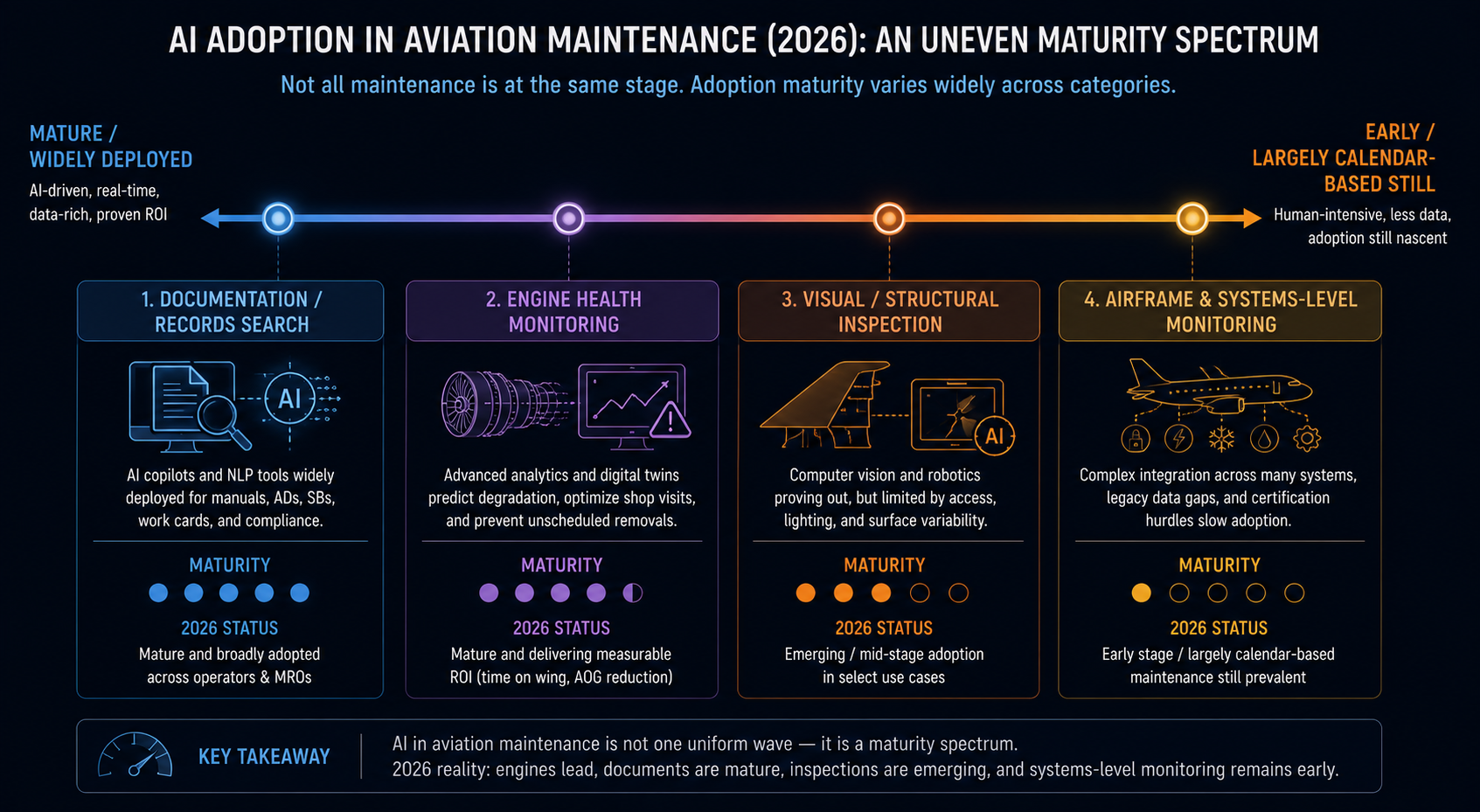
- Engine health monitoring is the most mature category by a clear margin. This is the area with the longest track record (GE, Rolls-Royce, and Pratt & Whitney have each run some form of engine health monitoring and analytics for over a decade, as detailed in our companion piece on the digital twin race among the three engine makers), the richest sensor data (engines are among the most heavily instrumented components on any aircraft), and the clearest, most direct cost justification (a single unscheduled engine removal is one of the most expensive maintenance events an airline can face). It's telling that essentially every credible, named AI-in-MRO success story cited in this piece and its companion pieces traces back to engine-specific programs.
- Visual and structural inspection is the fastest-growing category, but for a different reason. The drone- and computer-vision-based inspection wins described in Section 2.2 aren't primarily about prediction at all — they're about speed and consistency at an existing task (visual inspection), which sidesteps much of the trust-building challenge described in Section 2.3, since the AI isn't being asked to make a judgment call, only to flag anomalies for a human to then evaluate using the same visual evidence a technician would have gathered manually, just faster.
- Airframe and systems-level (hydraulics, avionics, APU) condition-based monitoring lags furthest behind. These systems are generally less densely instrumented than engines, generate more heterogeneous data across different subsystems and manufacturers, and — critically — often lack the decades of historical run-to-failure data that engine-monitoring programs have accumulated, which is precisely the data-scarcity and rare-failure-mode problem discussed in our companion domain piece on why rare failure modes break predictive maintenance models. This category is where the gap between "64% have adopted AI somewhere" and "genuine condition-based scheduling has replaced fixed intervals" is widest.
| Maintenance Category | Adoption Maturity | Primary Driver | Representative Example |
|---|---|---|---|
| Engine health monitoring | Most mature — over a decade of investment | Rich sensor data, extremely high per-event cost of failure | GE/Rolls-Royce/Pratt & Whitney digital twin and diagnostics programs |
| Visual/structural inspection | Fastest-growing | Speed and consistency gains at an existing task, lower trust barrier | Drone/computer-vision inspection (20 min vs. 6–10 hrs manual) |
| Airframe & systems-level (hydraulics, avionics, APU) | Least mature | Sparser instrumentation, heterogeneous data, limited historical failure data | Still largely calendar/cycle-based in most operations reviewed |
| Documentation & records search | Mature but narrow in scope | Clear, bounded problem with immediate time savings | GE/Microsoft/Accenture GenAI maintenance-records tool |
2.6 The Cost Case Is Real, But the Payback Period Varies Enormously by Operator Size
The economic argument for condition-based maintenance is not seriously disputed in the industry — predictive, condition-based approaches are widely understood to reduce unscheduled repairs and their associated cost premium relative to planned work. What's less often discussed is how unevenly the payback period on the necessary AI and sensor infrastructure investment falls across different sizes of operator. A major network carrier or large low-cost carrier — easyJet's maintenance spend alone reached £451 million in 2025, up from £390 million the year prior — has both the fleet scale to amortize a significant AI/infrastructure investment across many aircraft and the negotiating leverage to demand better data access from OEMs as part of its aircraft and engine purchase agreements. A smaller regional or charter operator faces the same fixed infrastructure and cybersecurity investment costs described in Section 2.3 but has far fewer aircraft to spread that cost across, which is a structural reason to expect condition-based maintenance adoption to continue concentrating among larger operators first, with smaller operators either lagging significantly or depending on third-party MRO providers and OEM-provided platforms (like Lufthansa Technik's AVIATAR, which serves other airlines as customers rather than requiring each to build in-house capability) to access these capabilities without bearing the full infrastructure cost themselves.
This also helps explain why platforms like AVIATAR, which is explicitly built to serve more than twenty airlines as a shared, OEM/MRO-provided service rather than requiring each airline to build proprietary AI infrastructure, may end up being the more representative model for how mid-sized and smaller carriers actually reach condition-based maintenance in practice — not by each independently crossing the investment threshold described above, but by buying into a shared platform where a maintenance provider or OEM has already amortized that cost across many customers.
3. What to Watch Next
- Whether Oliver Wyman's 2026 survey cycle shows adoption continuing to climb from 64%, or whether the rate of growth slows as the easier, lower-barrier AI use cases (document search, inventory forecasting) get exhausted and the remaining adoption requires the harder, more capital-intensive sensor and infrastructure investment described in Section 2.3.
- Whether more airlines beyond Lufthansa's AVIATAR network publish named, attributable condition-based maintenance results, which would meaningfully strengthen the evidence base beyond the current small set of well-documented deployments.
- Regulatory movement from FAA, EASA, and equivalent authorities on AI-assisted certification workflows — the human-certification bottleneck described in Section 2.3 is a structural, not merely technical, constraint, and any formal regulatory framework changes here would be a significant unlock for scaling condition-based approaches.
- Whether the technician shortage (690,000 needed by 2041, per Boeing) accelerates or slows AI adoption — a shortage could push airlines toward AI adoption faster out of necessity, or could slow it if there aren't enough trained technicians available to build and validate the AI systems themselves in the first place.
- Material cost inflation and tariff pressure's effect on MRO AI capital budgets, given roughly 90% of Oliver Wyman's 2026 survey respondents reported experiencing tariff impacts — a macro headwind that could compete directly with AI infrastructure investment for the same constrained capital.
4. Anchor Data Point
64% of aviation executives report their organizations have adopted AI in maintenance operations, per Oliver Wyman's 2025 MRO Survey — but the gap between that broad adoption figure and genuine, sensor-driven condition-based scheduling at scale is explained by a specific, well-documented set of barriers: aircraft averaging over eleven years old, a certified-human sign-off requirement that AI cannot yet satisfy, and a technician shortage projected at 690,000 by 2041.