Golden Dome and the Military Push Toward Jam-Proof Navigation
Golden Dome and the Military Push Toward Jam-Proof Navigation
A $175 billion missile shield is only as good as the position and timing data holding its command-and-control picture together — and that data currently runs almost entirely on GPS.
1. What Happened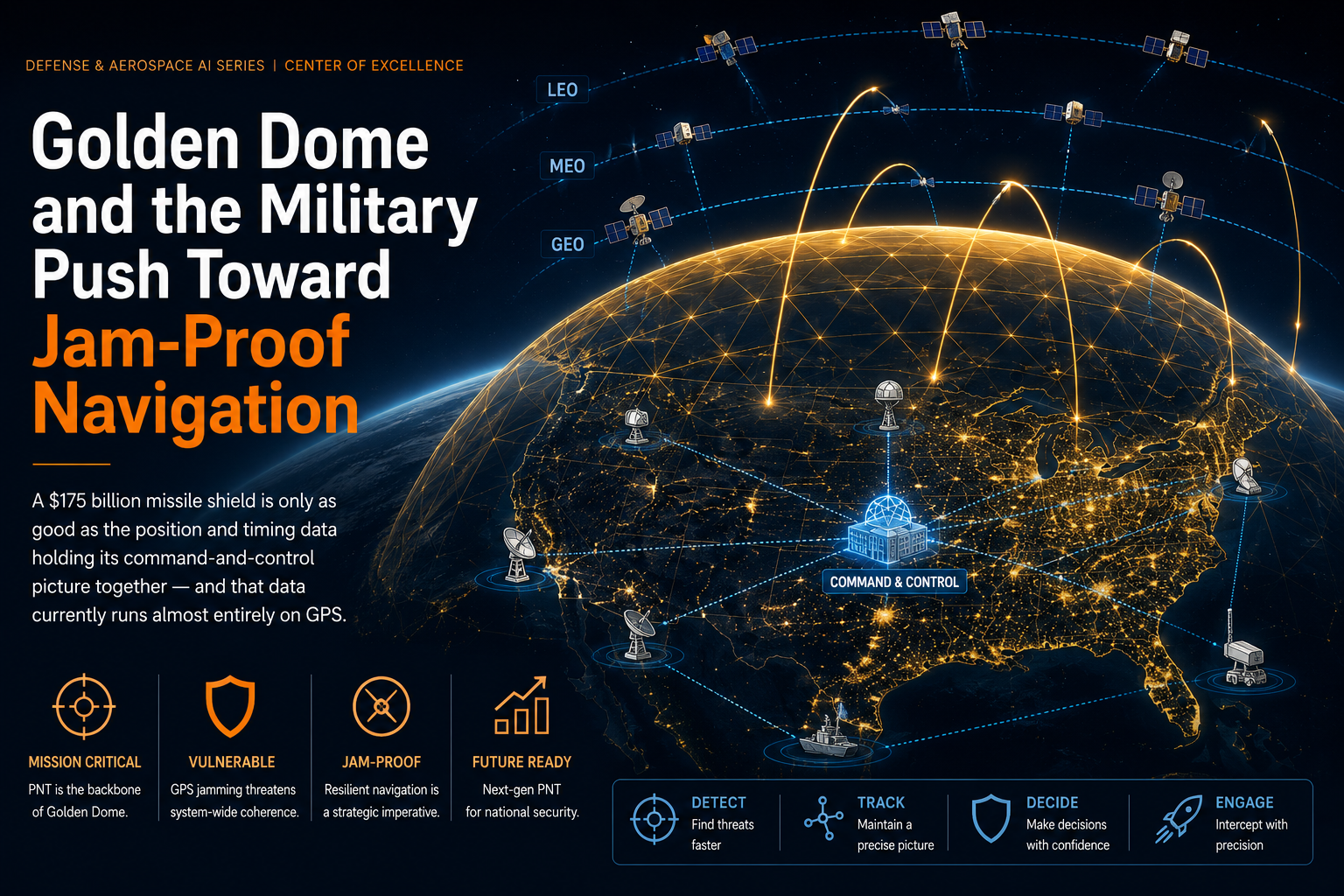
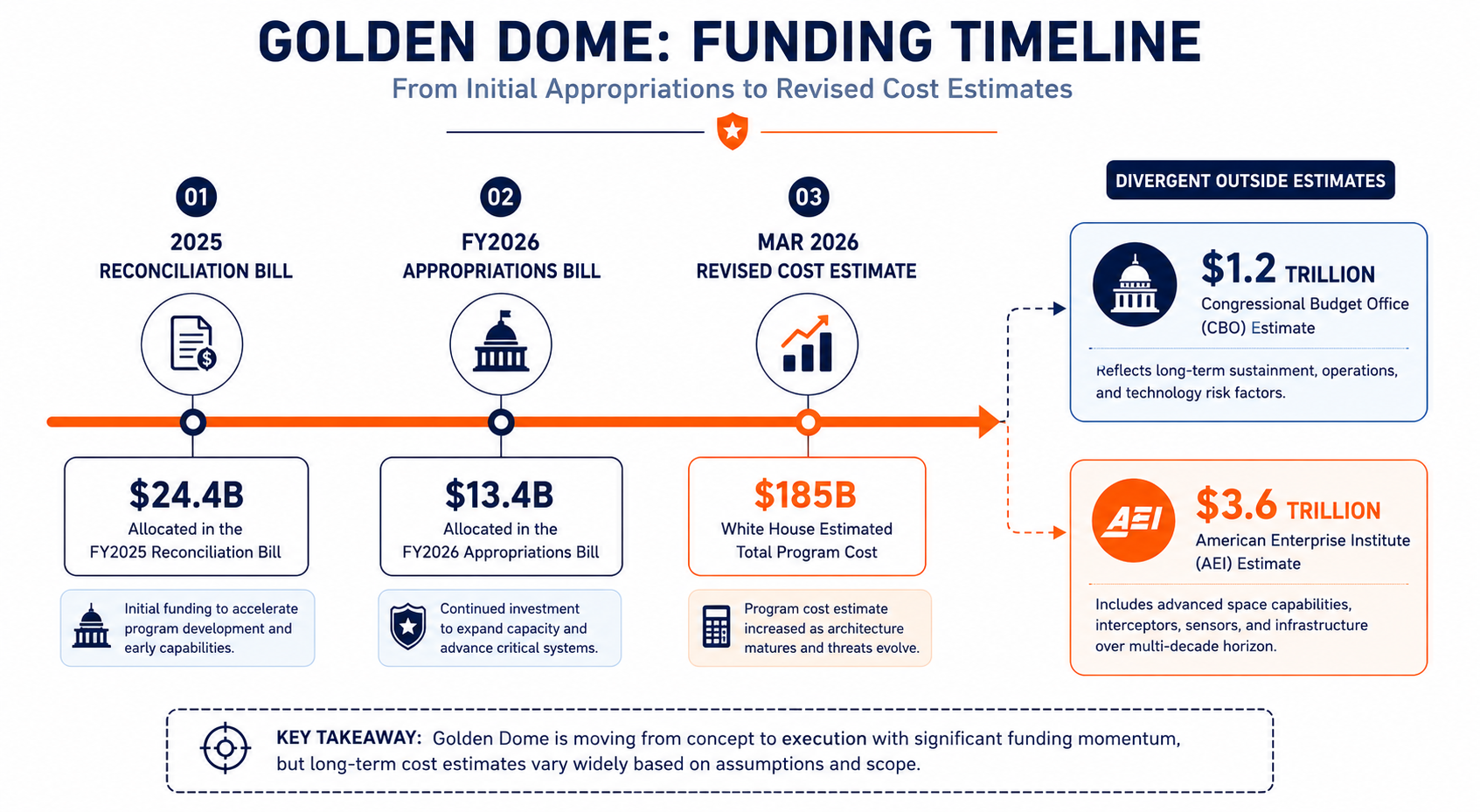
Golden Dome, the layered U.S. homeland missile defense system directed by Executive Order 14186 in January 2025, has moved from concept to funded program at remarkable speed. Congress allocated roughly $24.4 billion in the 2025 reconciliation bill and a further $13.4 billion in the fiscal 2026 defense appropriations bill, with the White House's own cost estimate rising to $185 billion as of March 2026 — a figure that still sits well below outside estimates from the Congressional Budget Office ($1.2 trillion) and the American Enterprise Institute ($3.6 trillion). In parallel, defense policy researchers — most notably a November 2025 National Security Space Association (NSSA) paper from its Moorman Center for Space Studies — have warned that Golden Dome's command-and-control, tracking, and interceptor-guidance functions all depend on GPS-derived position and timing, and that this dependency is currently an unaddressed vulnerability in the program's architecture. In late January 2026, Congress escalated its concern into a formal requirement, directing the Department of Defense to convert its approved funding into a detailed budget and system architecture plan.
2. Why It Matters
Golden Dome is useful as a case study precisely because it forces a question most PNT (Positioning, Navigation, and Timing) discussions leave abstract: what happens when the system that most needs to be jam-proof is also the single most attractive target for an adversary who understands that jamming it doesn't require destroying a single satellite or interceptor — it just requires degrading the shared timing and position picture the whole architecture depends on?
2.1 GPS Isn't a Peripheral Input to Golden Dome — It's Load-Bearing
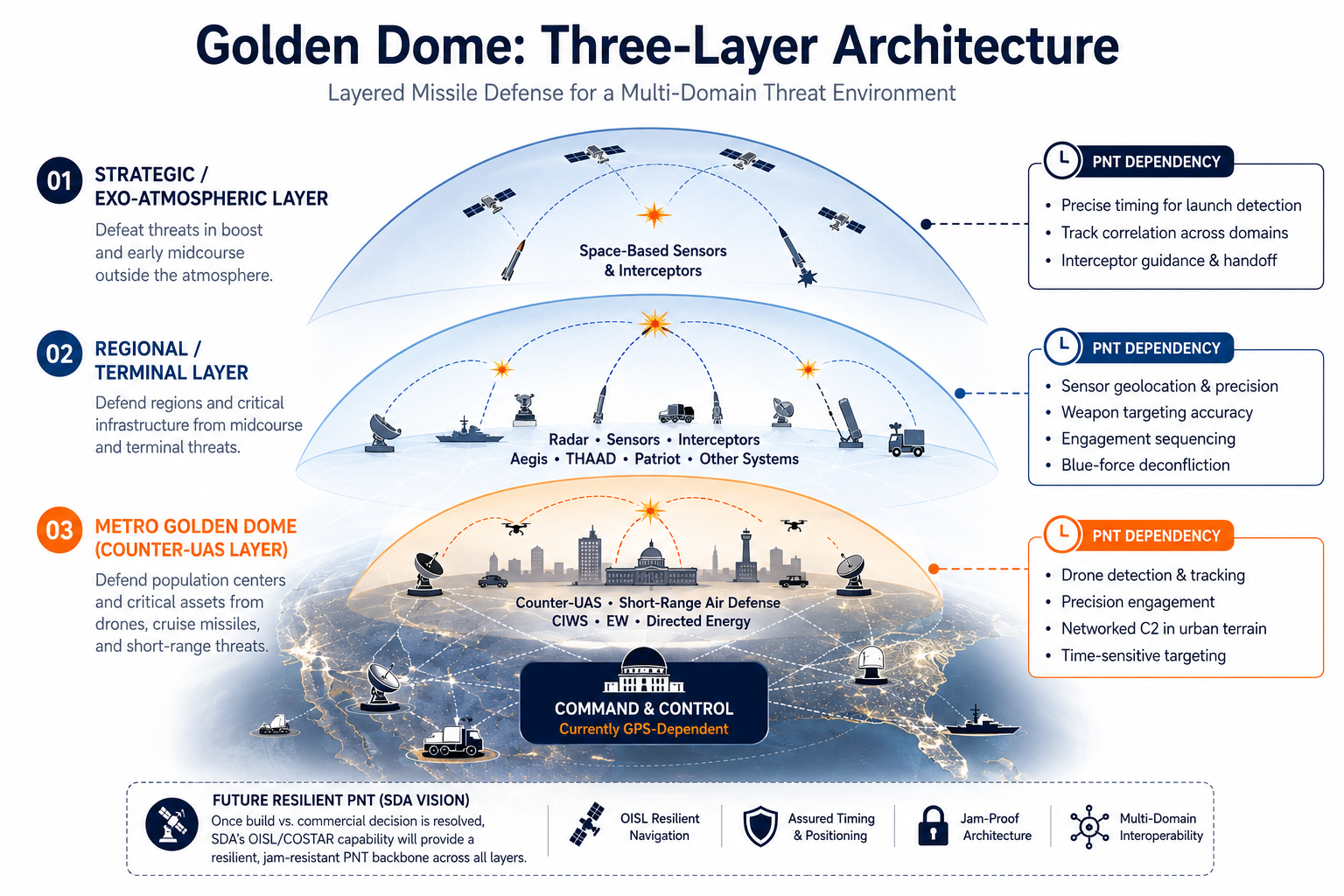
According to the NSSA's analysis, GPS/GNSS-generated timing and position data function as the shared coordinate reference that lets Golden Dome's Command and Control systems establish near-perfect situational awareness and coordinate defensive resources across air, land, sea, and space domains simultaneously. This is worth sitting with for a moment: Golden Dome is explicitly designed as a "system of systems," combining Ground-Based Midcourse Defense, Aegis Ballistic Missile Defense, THAAD, Patriot, and emerging space-based interceptor concepts into one unified engagement chain, with the ability to take sequential shots at the same target across boost, midcourse, and terminal phases. None of that layered, sequential engagement logic works unless every layer is operating from the same coordinate and timing reference. If PNT degrades unevenly across the architecture — one radar station losing precision timing while an interceptor battery loses none — the "coherent tactical picture" the whole system depends on for engagement sequencing and prioritization doesn't just get noisier, it can become actively misleading.
2.2 Three Specific Points of Failure
The NSSA analysis identifies three distinct places where PNT resilience determines whether Golden Dome functions as designed, and it's worth separating them because each fails differently:
- ISR and sensor platforms. Detecting and tracking adversarial systems in flight — whether an ICBM, a hypersonic glide vehicle, or a small drone — depends on PNT solutions to establish the "where and when" that make intercept information usable across every phase of a potential attack. A sensor platform with degraded timing doesn't just report a fuzzier position; it can report a position that's confidently wrong, which is worse for a fusion system than an honest gap.
- Precision-guided interceptors. The accuracy demands scale wildly depending on target: engaging a roughly 100-foot-long ICBM warhead is a fundamentally different guidance problem than engaging a small, maneuverable drone a few feet across. Both, however, ultimately depend on trustworthy PNT to translate a track into a successful intercept geometry.
- Command and control fusion. This is the layer that weaves disparate systems and elements into a cohesive missile defense command-and-control capability — and it is precisely the layer most exposed if an adversary can degrade PNT broadly rather than attacking any single sensor or interceptor directly.
Degrade PNT precision across any two of these layers simultaneously — which is exactly what a coordinated jamming or spoofing campaign would attempt, rather than a single-point attack — and the system doesn't lose one sensor. It loses coherence across the shared picture the entire engagement sequence depends on, at the exact moment that coherence matters most.
2.3 The Space Development Agency Is Already Building a GPS-Independent Backbone — But It's Incomplete
SDA officials have described plans for the Proliferated Warfighter Space Architecture (PWSA) to establish resilient navigation using optical inter-satellite links (OISL) and optical space-to-ground links, combined with a clock and orbit-determination algorithm called COSTAR (Constellation, Speed, Time, and Range) that fuses measurements across the entire satellite constellation to generate a robust PNT solution independent of GPS signals-in-space entirely. This is a genuinely different architectural approach from simply hardening GPS receivers against jamming — it's building a parallel timing-and-ranging system that never touches GPS at all, deriving position and time from the relative geometry and optical-link measurements between PWSA satellites themselves. According to SDA's design description, this capability creates two vital space-based services simultaneously: situational-awareness monitoring of terrestrial GPS radio-frequency-interference emitters (in effect, using the constellation itself to help locate jammers), and an alternative PNT service that doesn't depend on GPS being available at all.
However, this work is currently on pause. Reporting from Air & Space Forces Magazine notes the effort is paused while the Space Force decides whether to build out the SDA transport-layer constellation itself or instead lean on existing commercial systems like SpaceX's Starlink — a decision with direct, unresolved implications for which PNT architecture Golden Dome ultimately inherits. This is not a minor procurement detail: a government-owned optical-mesh constellation and a commercially-leased broadband constellation retrofitted for PNT are structurally different assets, with different upgrade cycles, different vendor lock-in risk, and different resilience characteristics against a sophisticated adversary.
2.4 The Policy Debate Has Shifted From "Should We Diversify" to "How Many Independent Failure Modes Do We Need"
The NSSA paper's central recommendation is explicit: Golden Dome needs a resilient PNT architecture built from at least two or three sources with markedly different failure modes — not simply redundant GPS receivers layered on top of each other, but genuinely independent technologies that a single jamming or spoofing technique cannot defeat simultaneously. The paper points specifically to terrestrial options worth reconsidering, including Loran-derived systems and the Broadcast Positioning System (which piggybacks on existing television broadcast infrastructure), alongside space-based alternatives and onboard inertial or celestial methods. This is the same "layered PNT" logic covered in our companion piece on chip-scale atomic clocks, LEO-PNT constellations, and celestial navigation — Golden Dome is simply the highest-stakes, most visible program forcing that logic into a concrete, funded procurement decision rather than a slide in a resilience briefing.
2.5 The China Comparison Is Doing a Lot of Quiet Work in This Debate
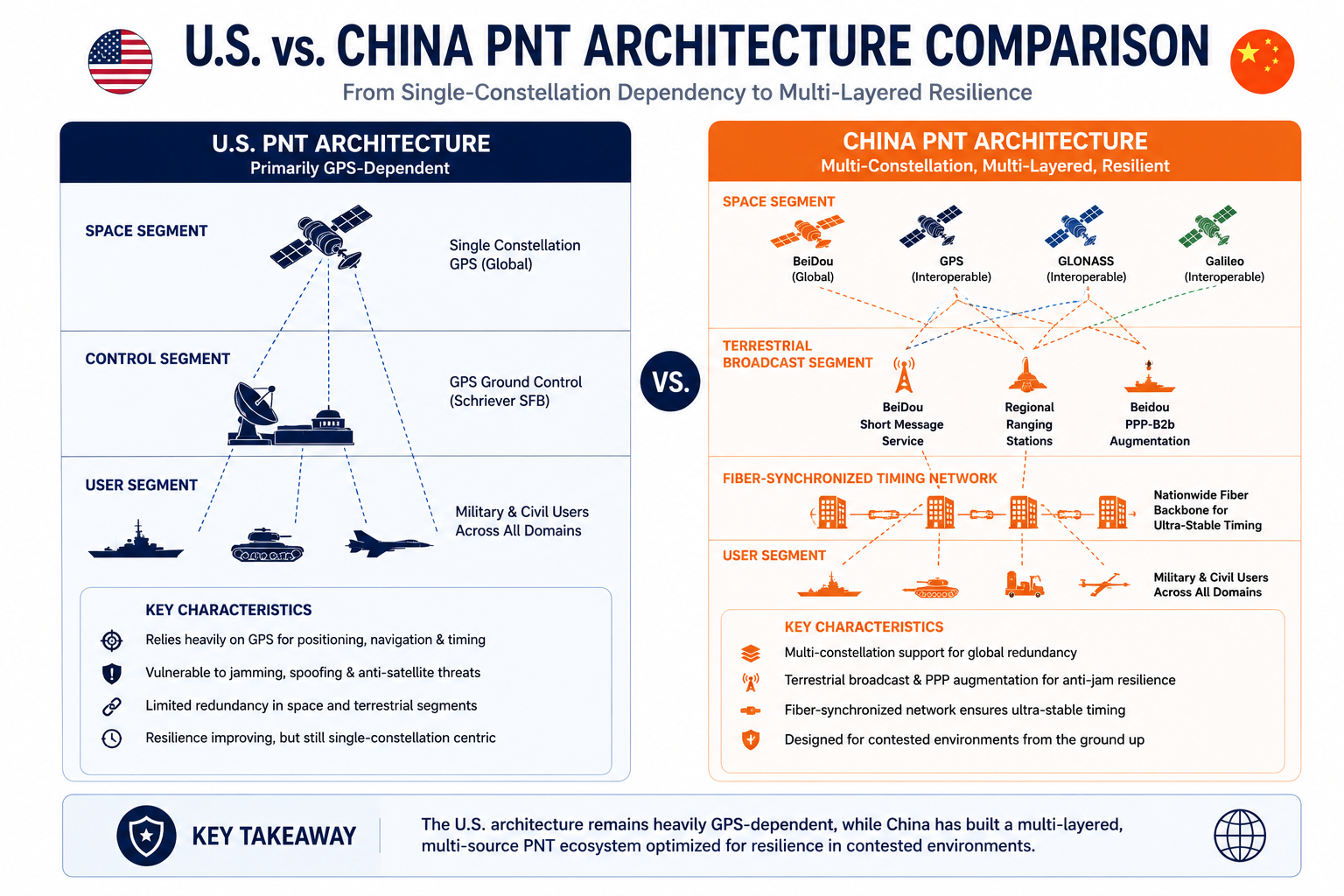
One detail from the Inside GNSS and Inside Unmanned Systems coverage of the NSSA paper deserves more attention than it typically gets: the paper explicitly contrasts America's current PNT posture with China's, describing a Chinese architecture that includes multiple satellite constellations, terrestrial broadcast systems, and hundreds of synchronized timing stations connected by roughly 20,000 kilometers of fiber. The implicit argument is pointed — while the U.S. debate has spent years discussing resilient PNT largely in white papers, a strategic competitor has already built a multi-layered, terrestrially-anchored architecture that doesn't share GPS's single-constellation failure mode. Golden Dome, in this framing, isn't just a missile-defense program that happens to need better PNT; it may be the forcing function that finally gets the U.S. to build the multi-layer PNT architecture that's been recommended, but under-resourced, for years.
2.6 The Domestic "Metro Golden Dome" Angle Changes the Political Calculus
Beyond the exo-atmospheric shield most coverage focuses on, Golden Dome includes a smaller, cheaper "inner, limited area" layer — informally called "Metro Golden Dome" — intended to protect specific metropolitan areas and critical infrastructure from drone (UAS) threats launched from domestic soil or just beyond U.S. borders. Analysts argue this counter-UAS layer will require resilient PNT just as urgently as the strategic missile-defense layer, since detecting and defeating a small, maneuverable drone over a city depends on precise, trustworthy position and timing data just as much as intercepting an ICBM does — arguably more, given the tighter engagement timelines and denser surrounding infrastructure. Because Metro Golden Dome protects domestic infrastructure rather than purely military assets, it may end up being the more politically tractable entry point for funding a broader resilient-PNT investment that the Department of Defense has historically been reluctant to prioritize on its own, since DoD is not otherwise responsible for, or budgeted to protect, civilian infrastructure and applications.
2.7 Funding Reality Check: Appropriated Dollars Aren't Yet an Architecture
It's worth being precise about what Golden Dome's funding actually represents at this stage. A $24.4 billion allocation, on its own, does not automatically translate into operational capability without a target architecture, layer prioritization, defined test milestones, and a budget breakdown by subprogram — which is exactly why Congress's late-January 2026 directive matters: lawmakers are explicitly pressing the Pentagon to convert appropriated funding into a concrete, executable plan rather than allowing it to be absorbed into existing programs without measurable deliverables. As of that directive, key details on system design, integration, and acquisition sequencing reportedly remained undefined more than a year after the program's initial executive order — a gap that applies with particular force to PNT, since it is the one dependency that cuts across literally every other subsystem in the architecture, and therefore the one most likely to be treated as someone else's problem if no single owner is designated for it.
3. Comparing the Two Paths Golden Dome's PNT Architecture Could Take
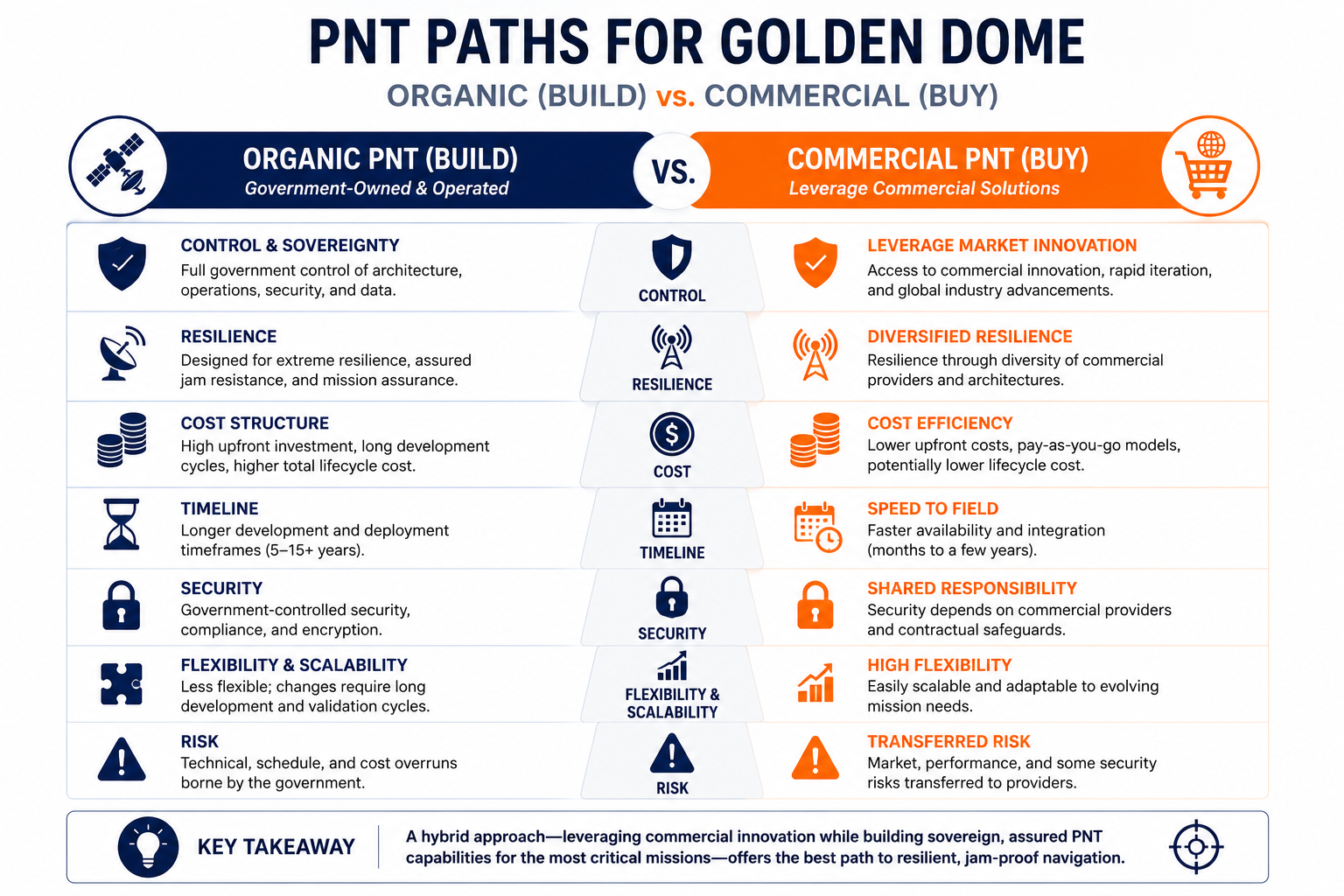
| Dimension | SDA-Built PWSA / COSTAR (organic optical-mesh PNT) | Commercial LEO Lean-In (e.g., Starlink-based) |
|---|---|---|
| Core mechanism | Optical inter-satellite links + COSTAR clock/orbit algorithm generating PNT independent of GPS | Retrofitting or augmenting an existing commercial broadband constellation for PNT signals |
| Ownership/control | Fully government-owned and operated | Dependent on a commercial operator's infrastructure and business priorities |
| Development timeline | Currently paused pending a Space Force build-vs-lean decision | Could leverage a constellation already in orbit at scale |
| Resilience characteristic | Purpose-built for military-grade PNT resilience from inception | PNT capability added onto a system designed primarily for broadband, not navigation assurance |
| Vendor/dependency risk | Lower external dependency, higher program cost and schedule risk | Higher reliance on a single commercial partner's constellation and roadmap |
| Precedent cited | SDA's stated design goals for the PWSA transport layer | House Armed Services Committee amendments pushing the Space Force toward more commercial technology and services |
Neither path is without risk, and the decision between them is arguably the single most consequential unresolved PNT question in the entire Golden Dome program — more consequential, in practice, than any individual interceptor or sensor contract, because it determines the resilience characteristics of the coordinate reference every other subsystem will trust.
4. What to Watch Next
- Whether the Pentagon delivers the detailed budget and system architecture plan Congress ordered in late January 2026, converting broad appropriations into a program with defined subprograms — this document, when public, should reveal how seriously PNT resilience has been architected in versus bolted on after the fact.
- The Space Force's decision on SDA's transport-layer constellation — build organically versus lean on Starlink or other commercial providers — since this single choice will determine whether Golden Dome's GPS-independent backbone is government-owned or commercially sourced, with materially different resilience and vendor-lock implications either way.
- Whether a Golden Dome PNT lead is formally designated, as recommended by the NSSA paper, to own PNT resilience across the program's many service and contractor stakeholders rather than leaving it diffused across existing GPS program offices that were never chartered to think about missile-defense-scale resilience requirements.
- Contract awards to LEO-PNT, CSAC, and alternative-PNT vendors specifically tied to Golden Dome or Metro Golden Dome requirements — this would be the clearest signal that the policy recommendations are translating into procurement dollars rather than remaining in white papers and conference abstracts.
- Progress on the Navigation Technologies Satellite-3 experiment, launched to geosynchronous orbit to test whether a multi-orbit PNT capability can meaningfully improve resilience beyond GPS's current medium-Earth-orbit-only architecture — an early, concrete data point on whether disaggregating PNT across orbital regimes actually delivers the resilience benefit its proponents claim.
- Whether Metro Golden Dome becomes the near-term proving ground for resilient PNT investment, given its lower cost, clearer domestic political constituency, and tighter engagement timelines that may surface PNT resilience gaps faster than the slower-moving strategic missile-defense layer.
5. Anchor Data Point
A program with a White House cost estimate of $185 billion — and outside estimates ranging as high as $3.6 trillion — currently has no publicly designated single owner for the resilient PNT architecture its own command-and-control system depends on to function under attack.