Google DeepMind: GraphCast, GenCast & the Future of AI Weather Forecasting
Google DeepMind — GraphCast, GenCast, and the Diffusion-Ensemble Bet Reshaping Operational Forecasting
1. Company Snapshot
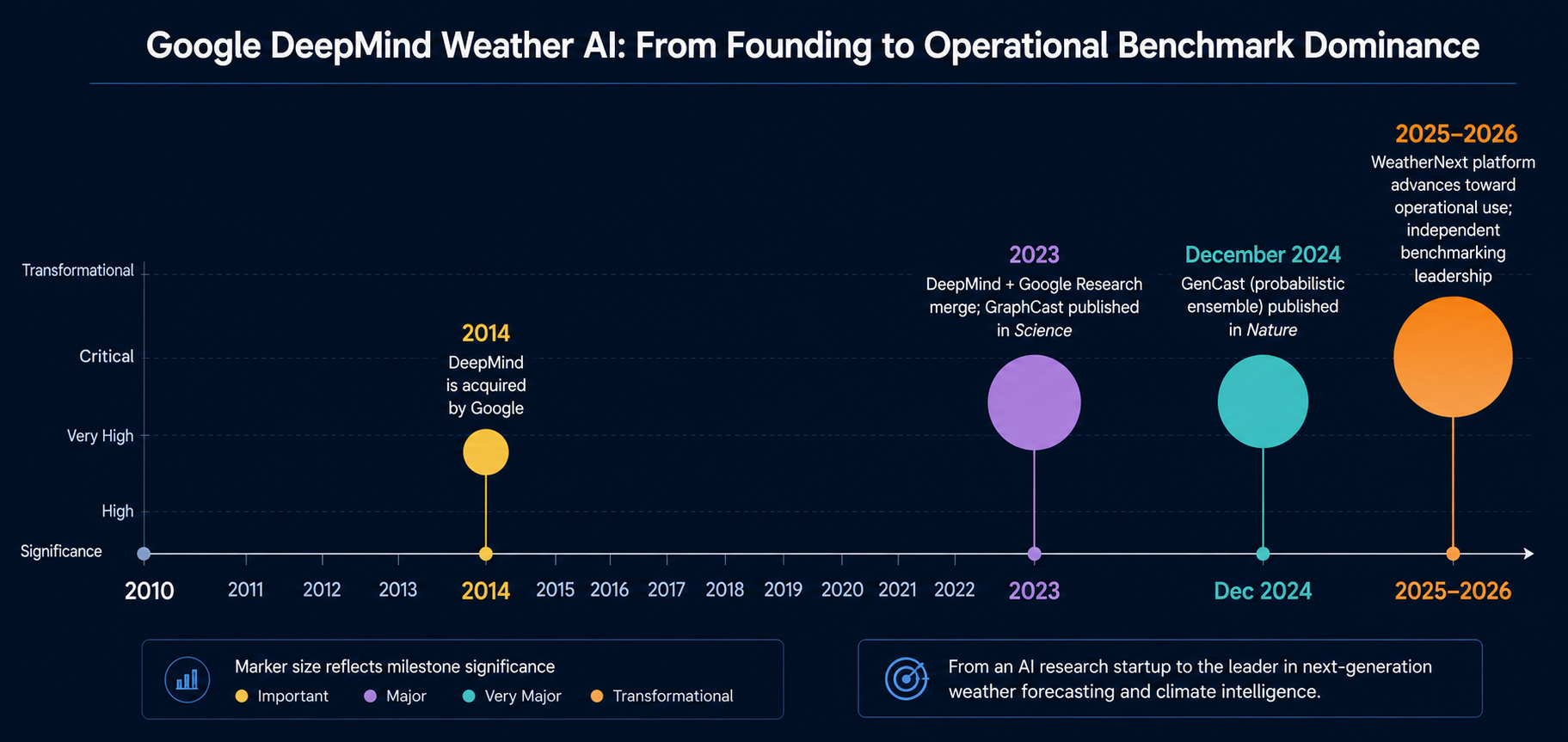
Google DeepMind is Alphabet's consolidated AI research laboratory — the entity behind both of the two architectures covered in our companion technical piece on Fourier Neural Operators and graph neural networks in weather AI. It was formed in April 2023 by merging the original DeepMind (founded in London in 2010, acquired by Google in 2014) with Google Brain, Google's other major AI research division, under a single leadership structure headed by co-founder Demis Hassabis. While DeepMind is best known publicly for AlphaGo, AlphaFold, and the Gemini model family, its weather-forecasting work — GraphCast (2023) and GenCast (2024) — represents one of the clearest, most rigorously benchmarked cases of an AI lab's research output directly and repeatedly outperforming a decades-old, physics-based operational system (ECMWF's forecasting suite) on head-to-head, publicly verifiable metrics.
| Attribute | Detail |
|---|---|
| Founded | DeepMind founded 2010 in London by Demis Hassabis, Shane Legg, and Mustafa Suleyman; re-formed as Google DeepMind in April 2023 via merger with Google Brain |
| HQ | London, United Kingdom (with offices in Canada, France, India, Japan, Switzerland, and the United States) |
| Founders/CEO | Founders: Demis Hassabis, Shane Legg, Mustafa Suleyman; current CEO: Demis Hassabis (also CEO of Isomorphic Labs; shared the 2024 Nobel Prize in Chemistry for AlphaFold) |
| Total Funding | Acquired by Google in January 2014 for approximately $400–500M [VERIFY: exact disclosed figure, sources vary]; has operated as a wholly owned Alphabet subsidiary since, with no independent funding rounds |
| Latest Valuation | Not applicable/disclosed separately — Google DeepMind is a fully owned Alphabet Inc. subsidiary and does not carry an independent public valuation [VERIFY: any third-party analyst valuation estimate specific to the AI division, if one exists] |
| Employee count | Approximately 6,000 (2025) |
| Reported financials (2024) | Revenue of £1.33 billion; operating income of £217 million; net income of £174 million (Google DeepMind entity-level, as filed in the UK) |
2. What They Actually Build
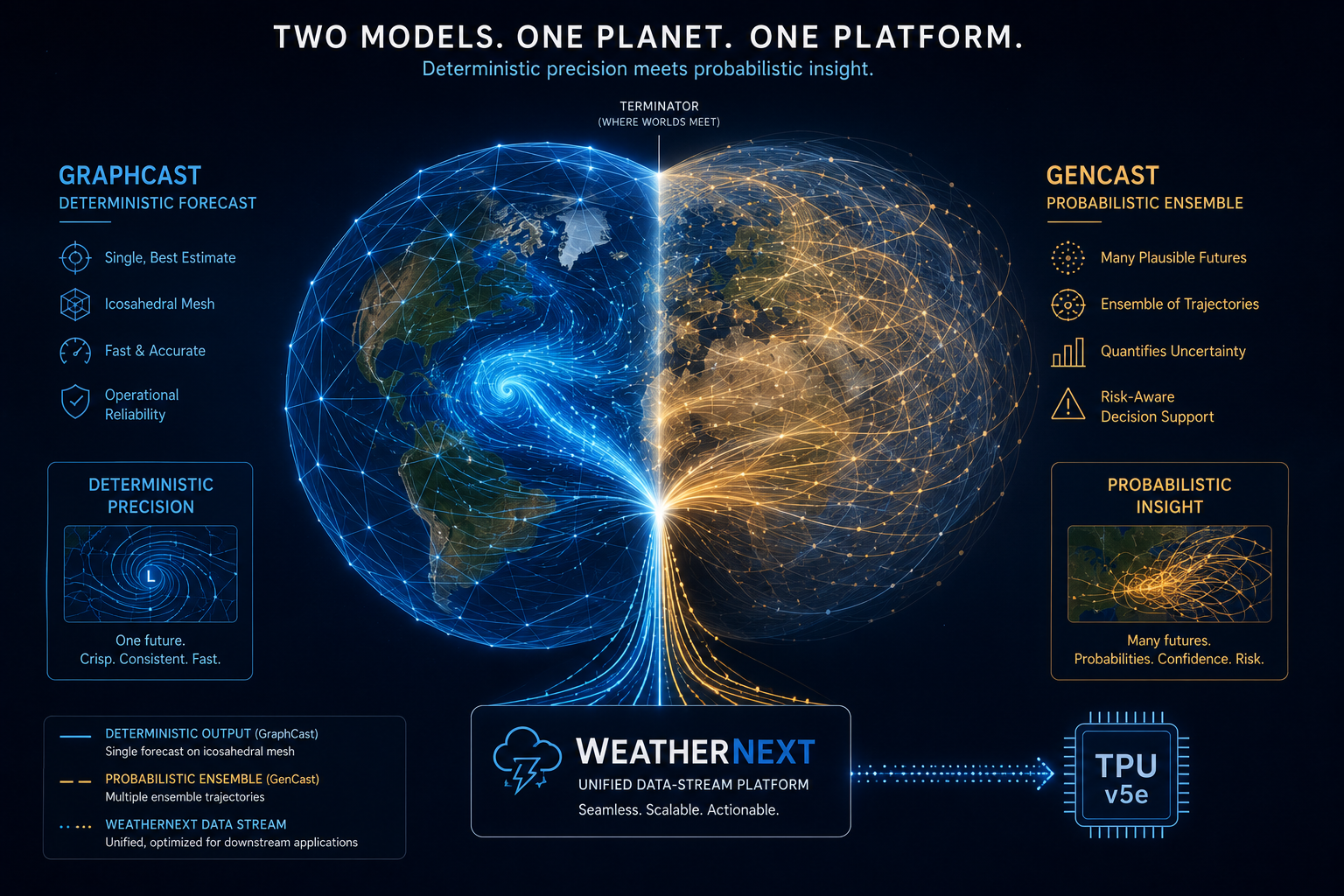
Google DeepMind's weather-forecasting portfolio centers on two architecturally distinct models plus a delivery platform, and the distinction between the two models is the actual substance of this report's title.
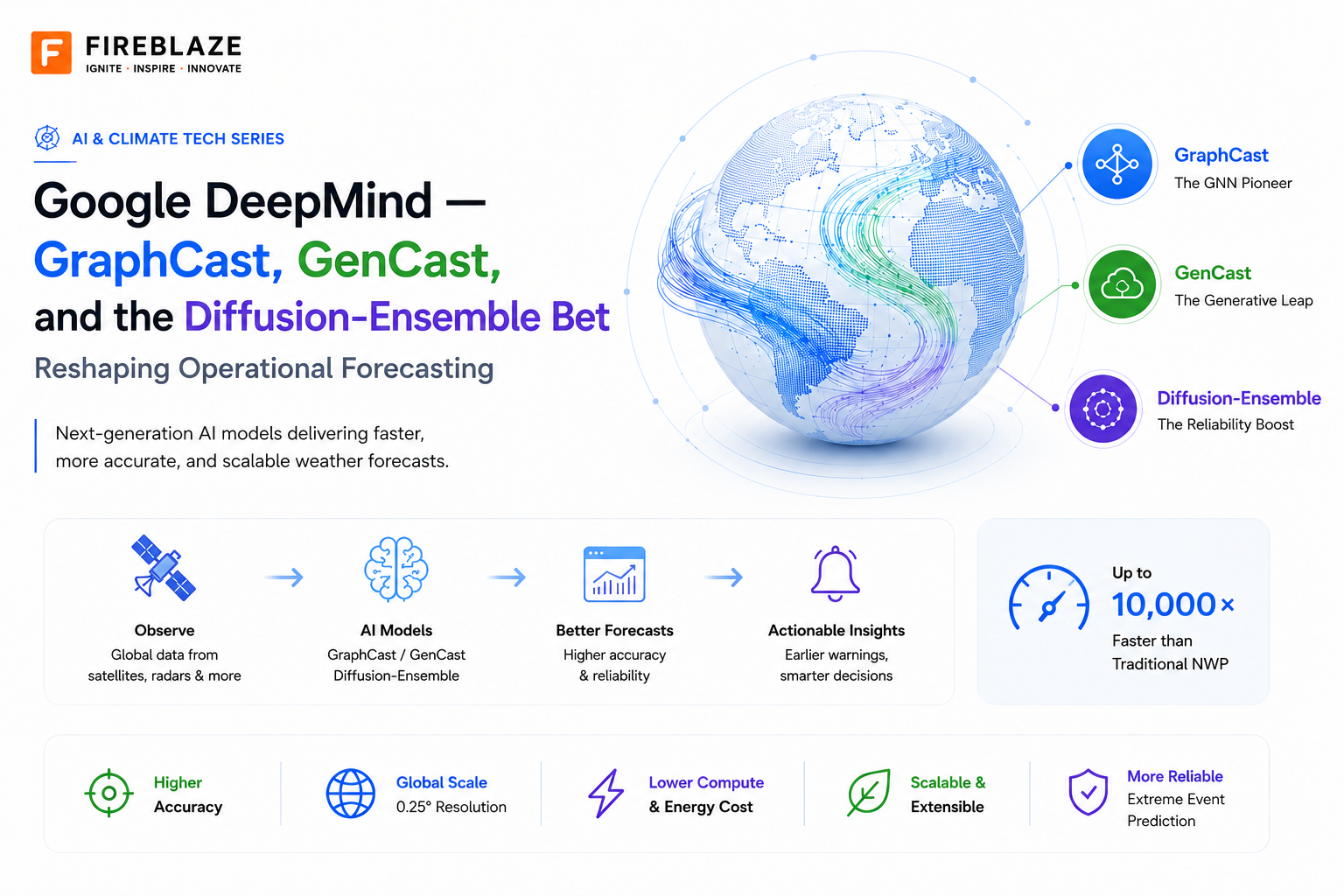
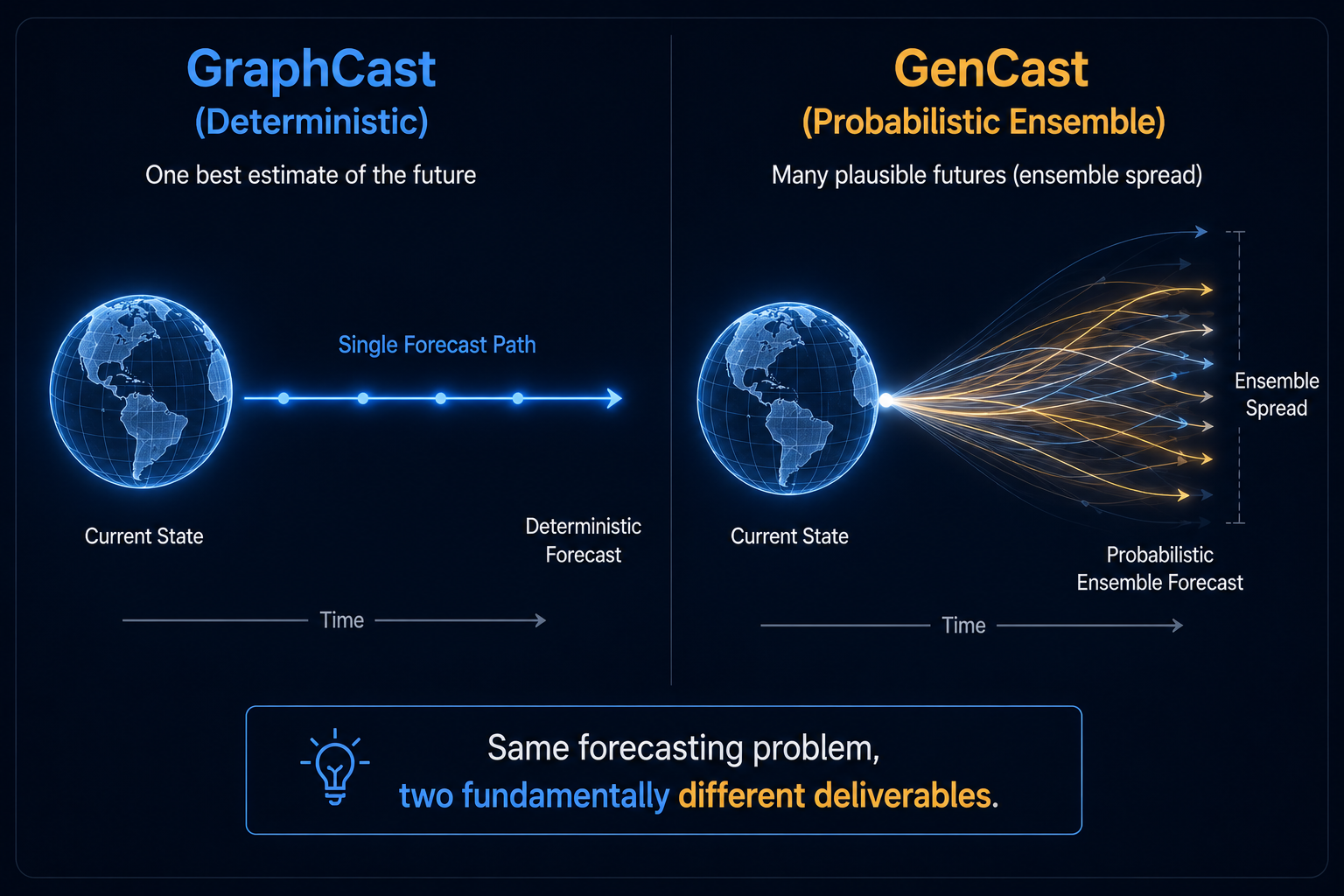
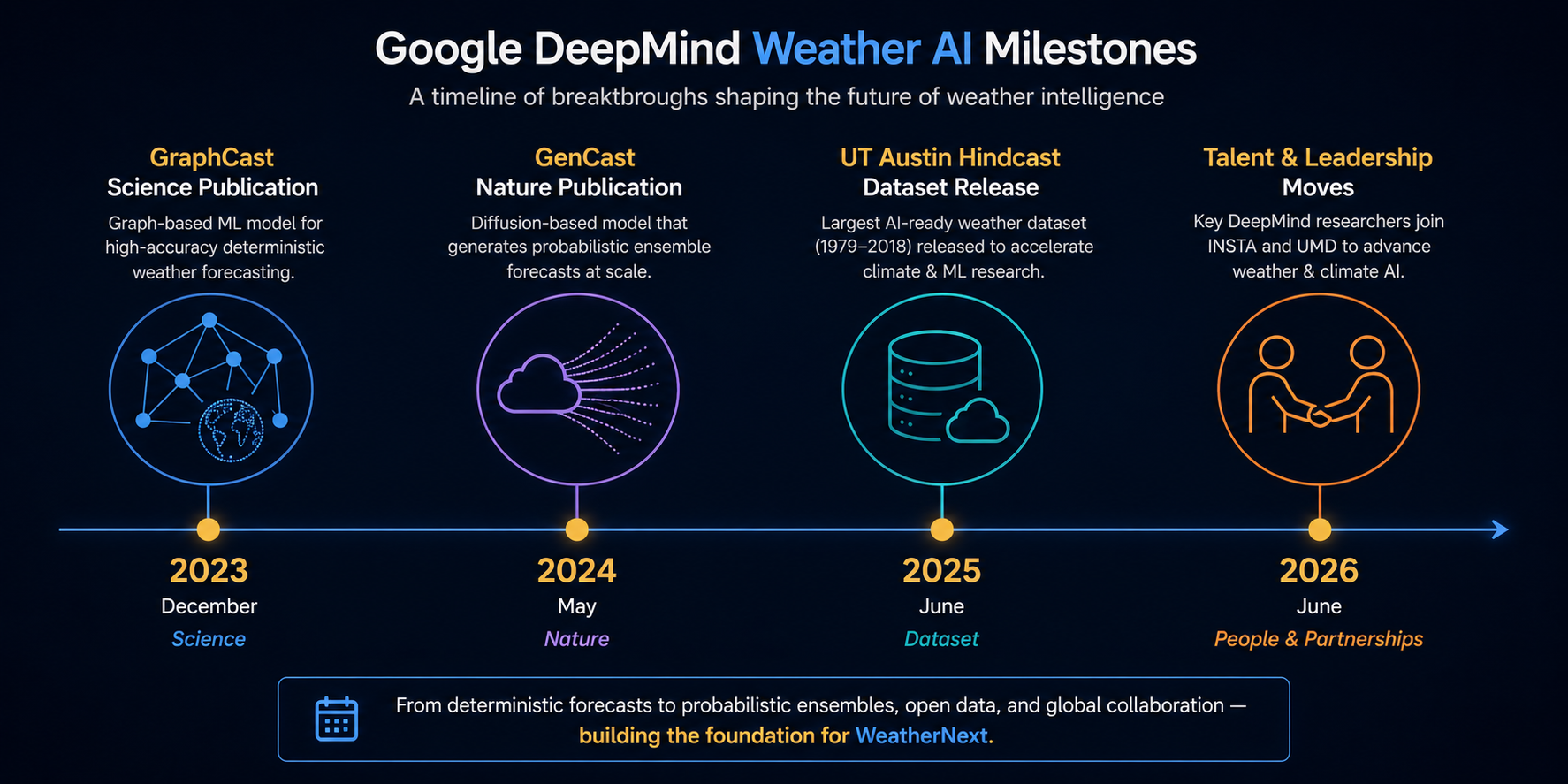
GraphCast, published in Science in 2023, is a graph neural network built on an icosahedral mesh wrapped around the globe (covered in mechanical detail in our companion architecture piece) — a deterministic model that produces a single, most-likely forecast trajectory. It was trained on the ECMWF ERA5 reanalysis dataset (1979–2018) and fine-tuned on ECMWF's operational HRES data (2016–2021), generating 10-day, 6-hourly global forecasts across more than a dozen atmospheric and surface variables at 0.25° resolution in under one minute on modern hardware.
GenCast, published in Nature in December 2024, takes a fundamentally different approach to the same forecasting problem: it is a conditional diffusion model — the same class of generative architecture behind image-generation tools like Imagen, adapted to atmospheric variables — that produces not one forecast but a full probabilistic ensemble, sampling many plausible future weather trajectories by iteratively denoising each one step by step, the way a diffusion model generates an image from noise. This is a categorically different deliverable from GraphCast's single deterministic trajectory: GenCast directly replaces the ensemble-generation role that traditional NWP systems fill by re-running a physics simulation dozens of times with slightly perturbed initial conditions, doing the equivalent job with a single trained neural network instead.
WeatherNext is the delivery layer that wraps both models into an actual accessible product: WeatherNext Gen, distributed via Google Earth Engine and BigQuery, provides operational-configuration forecasts generated by GenCast, while a parallel operational GraphCast pipeline (initialized from ECMWF's real-time HRES first-guess field rather than only historical reanalysis) has been used by outside researchers — notably a University of Texas at Austin team that built a 45-year, daily, 15-day-ahead GraphCast hindcast archive spanning 1979–2024 — as a genuine research and forecasting resource, not just a benchmark demonstration.
| Component | Architecture | What It Delivers | Publication |
|---|---|---|---|
| GraphCast | Graph neural network, icosahedral multi-mesh, encode-process-decode | Single deterministic 10-day forecast trajectory | Science, 2023 |
| GenCast | Conditional diffusion model, iterative denoising | Full probabilistic ensemble of 15-day forecast trajectories | Nature, December 2024 |
| WeatherNext (Gen) | Delivery platform on Google Earth Engine / BigQuery | Operational-configuration forecast data access for researchers and developers | Ongoing product, data-request-gated as of this writing |
3. Recent Moves (Last ~12–18 Months)
The period since GenCast's publication has been the most consequential stretch yet for Google DeepMind's weather-AI credibility, moving the story from "impressive research paper" toward "independently scrutinized, semi-operational system."
GenCast published in Nature (December 4, 2024). This was the first time an AI weather model systematically outperformed ECMWF's own operational ensemble system (ENS) — long regarded as the world's best — across nearly all verification metrics, immediately positioning Google as a credible competitor not just to legacy commercial weather providers but to ECMWF's own forecasting suite.
Independent, third-party benchmarking against ECMWF's own AI model. A 2026 study on conformal-prediction-based uncertainty quantification directly compared GenCast (via WeatherNext Gen), Google Research's NeuralGCM, and ECMWF's own AIFS-ENS — ECMWF's in-house machine-learning ensemble system, developed specifically in response to competitive pressure from GraphCast and GenCast — indicating the field has moved into a phase of direct, apples-to-apples, multi-model competitive benchmarking rather than single-paper claims.
A 45-year operational GraphCast hindcast archive (2025). Researchers at the University of Texas at Austin, published under the World Climate Research Programme umbrella, built a daily, 15-day-ahead GraphCast forecast archive spanning 1979–2024 using the operational (HRES-initialized) version of GraphCast — a strong signal that outside academic and operational meteorology communities are treating GraphCast as a legitimate long-term research resource, not a one-off demo.
Talent and licensing moves reshaping Google DeepMind's broader research base (2026). Separately from the weather-forecasting line specifically, Google DeepMind brought in more than 20 researchers from Contextual AI via an $80–90 million non-exclusive licensing deal (with Contextual AI co-founder Douwe Kiela joining), while Nobel laureate John Jumper (AlphaFold) departed for Anthropic in June 2026 — both relevant context for evaluating the depth and stability of the research bench behind DeepMind's broader AI portfolio, including its Earth-sciences work.
4. Competitive Position
Google DeepMind's most consequential competitor in this specific space is not another AI lab — it's ECMWF itself, the European Centre for Medium-Range Weather Forecasting, which both supplied the ERA5 training data underlying nearly every AI weather model in existence and has now built its own in-house machine learning ensemble system, AIFS-ENS, in direct competitive response.
| Dimension | Google DeepMind (GraphCast/GenCast) | ECMWF (HRES/ENS + AIFS-ENS) |
|---|---|---|
| Core approach | Pure data-driven (GraphCast: GNN; GenCast: diffusion), trained on ECMWF's own ERA5/HRES data | Traditional physics-based NWP (HRES/ENS) plus a newer in-house ML system (AIFS-ENS) built in response to AI competition |
| Deterministic benchmark result | GraphCast outperformed HRES on 90% of 1,380–2,760 verification targets | HRES remains the physics-based reference standard AI models are benchmarked against |
| Probabilistic/ensemble benchmark result | GenCast outperformed ECMWF's ENS on 97.2% of 1,320 verification targets (99.8% beyond 36-hour lead times; 97.6% specifically on ~900 extreme-event test cases) | ENS was, prior to GenCast, widely regarded as the best operational ensemble system in the world |
| Compute cost | A full 15-day ensemble forecast in ~8 minutes on a single Google Cloud TPU v5 | Traditional ensemble NWP requires hours on a large supercomputer, consuming substantially more energy |
| Extremes performance caveat | Strong on GenCast's own reported extreme-event benchmark, though separate independent research (covered in our companion FNO/GNN piece) has found AI models broadly underestimate the most unprecedented, record-breaking extremes relative to physics-based HRES | HRES has been found to retain an edge specifically on record-breaking, out-of-distribution extreme events |
| Commercial/access model | WeatherNext Gen distributed via Google Earth Engine/BigQuery, gated by a data-request form; code and model weights open-sourced on GitHub | ECMWF Copernicus operates its own commercial and open-data arms; national meteorological services remain ECMWF's core institutional customer base |
Beyond ECMWF specifically, Google DeepMind's weather models also sit in a competitive field alongside Huawei's Pangu-Weather (3D Earth-Specific Transformer), NVIDIA's Earth-2 platform (built substantially on FourCastNet/AFNO, covered in our companion architecture piece), Microsoft's Aurora foundation model, and commercial weather intelligence providers like Tomorrow.io, IBM/The Weather Company, and DTN — a field one industry commentary characterized as heading toward a hybrid physics-plus-AI consensus by 2026 rather than a single winning paradigm, a framing consistent with ECMWF's own move to build AIFS-ENS rather than simply defend HRES/ENS unchanged.
5. Why It Matters
Google DeepMind's GraphCast-to-GenCast progression matters to the broader defense-AI and Earth-system-AI industry for a reason distinct from either model's individual benchmark numbers: it is the clearest publicly documented case of an AI system directly, repeatedly, and verifiably outperforming a mature, decades-refined physics-based operational system that national governments actually rely on for public safety — not a lab benchmark against a weaker baseline, but a head-to-head result against the specific system (ECMWF's ENS) that European national meteorological services use to issue real warnings. That has two significant implications worth naming precisely rather than glossing into a general "AI beats physics" narrative. First, it validates the architectural bets — graph-neural-network mesh representations and diffusion-based ensemble generation — that a project like a climate digital twin's forecasting layer should take seriously as proven, not speculative, approaches. Second, and more cautionary, WeatherNext Gen's own dataset documentation explicitly states the experimental data is "not intended, validated, or approved for real world use" — a reminder that a benchmark win against ECMWF's published verification suite and a fully validated, liability-bearing operational forecasting product are two different bars, and the gap between them is exactly where institutional caution (and, per Section 2.4's own caveat, genuine remaining physics-based strength on record extremes) still matters most for any safety-critical downstream application.
6. Chart Data Table
(Note: Google DeepMind is a wholly owned Alphabet subsidiary with no independent funding rounds or public valuation — there is no "Funding Timeline" in the traditional startup sense. The table below is adapted to track the corporate and benchmark milestones most relevant to this report's thesis.)
Funding Timeline Data (Adapted: Corporate & Benchmark Milestone Timeline)
| Milestone | Date | Detail |
|---|---|---|
| DeepMind founded | 2010 | London, by Hassabis, Legg, and Suleyman |
| Acquired by Google | January 2014 | Approximately $400–500M [VERIFY: exact disclosed figure] |
| Merger with Google Brain → Google DeepMind formed | April 2023 | Single unified AI research entity under Demis Hassabis |
| GraphCast published | 2023 | Science; outperformed ECMWF HRES on 90% of verification targets |
| GenCast published | December 4, 2024 | Nature; outperformed ECMWF ENS on 97.2% of 1,320 targets (99.8% beyond 36 hrs) |
| UT Austin GraphCast hindcast archive published | 2025 | 45-year (1979–2024), daily, 15-day-ahead operational GraphCast dataset |
| Reported 2024 entity-level financials | Filed 2025 | £1.33B revenue; £217M operating income; £174M net income |
| Latest available employee count | 2025 | ~6,000 |