HENSOLDT — Europe's EW/Sensor Specialist at the Center of the Eurofighter EK Program

HENSOLDT — Europe's EW/Sensor Specialist at the Center of the Eurofighter EK Program
An independent analyst read on Germany's sensor and electronic-warfare champion, its Helsing partnership, and where the signal-integrity opportunity actually sits.
1. Company Snapshot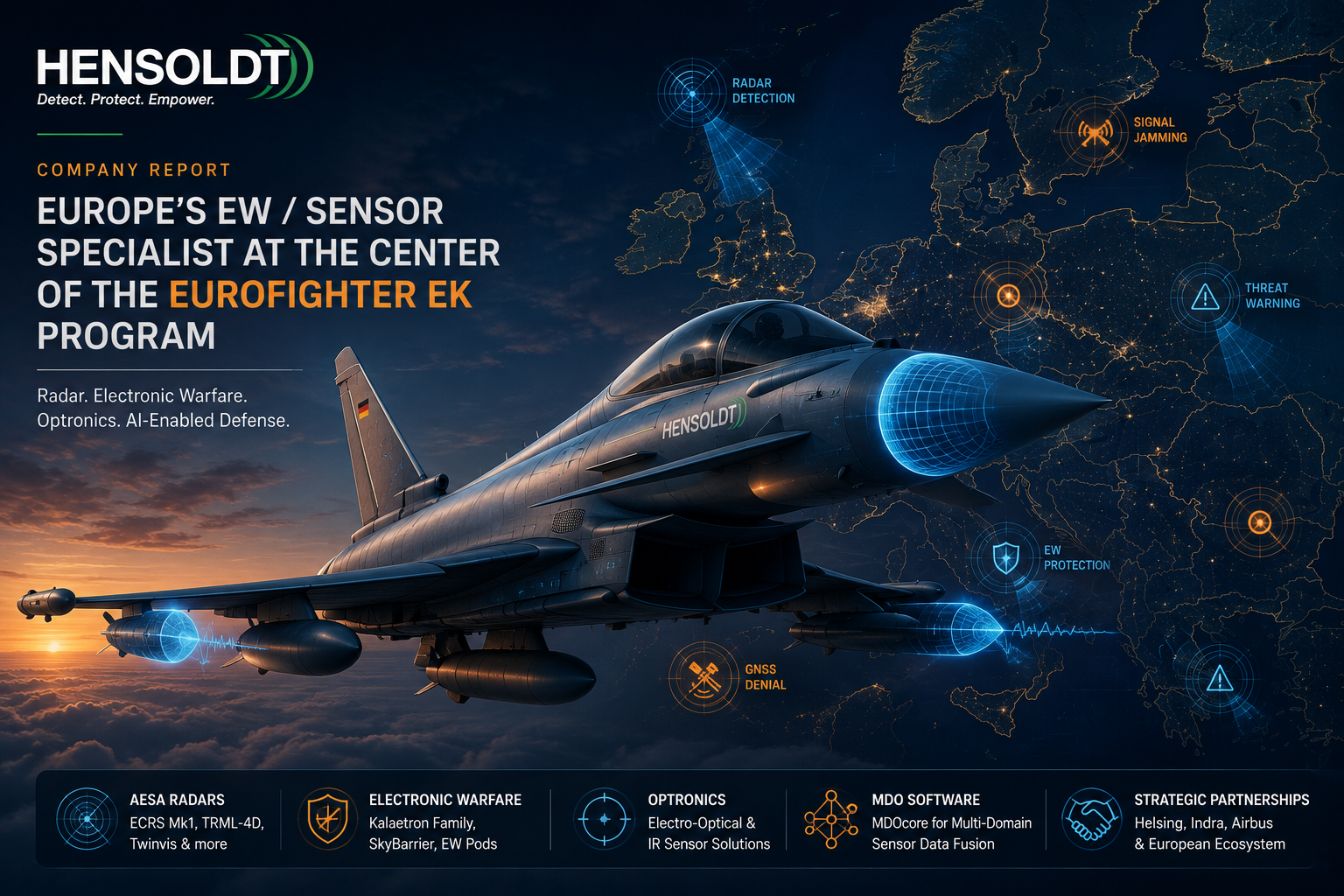
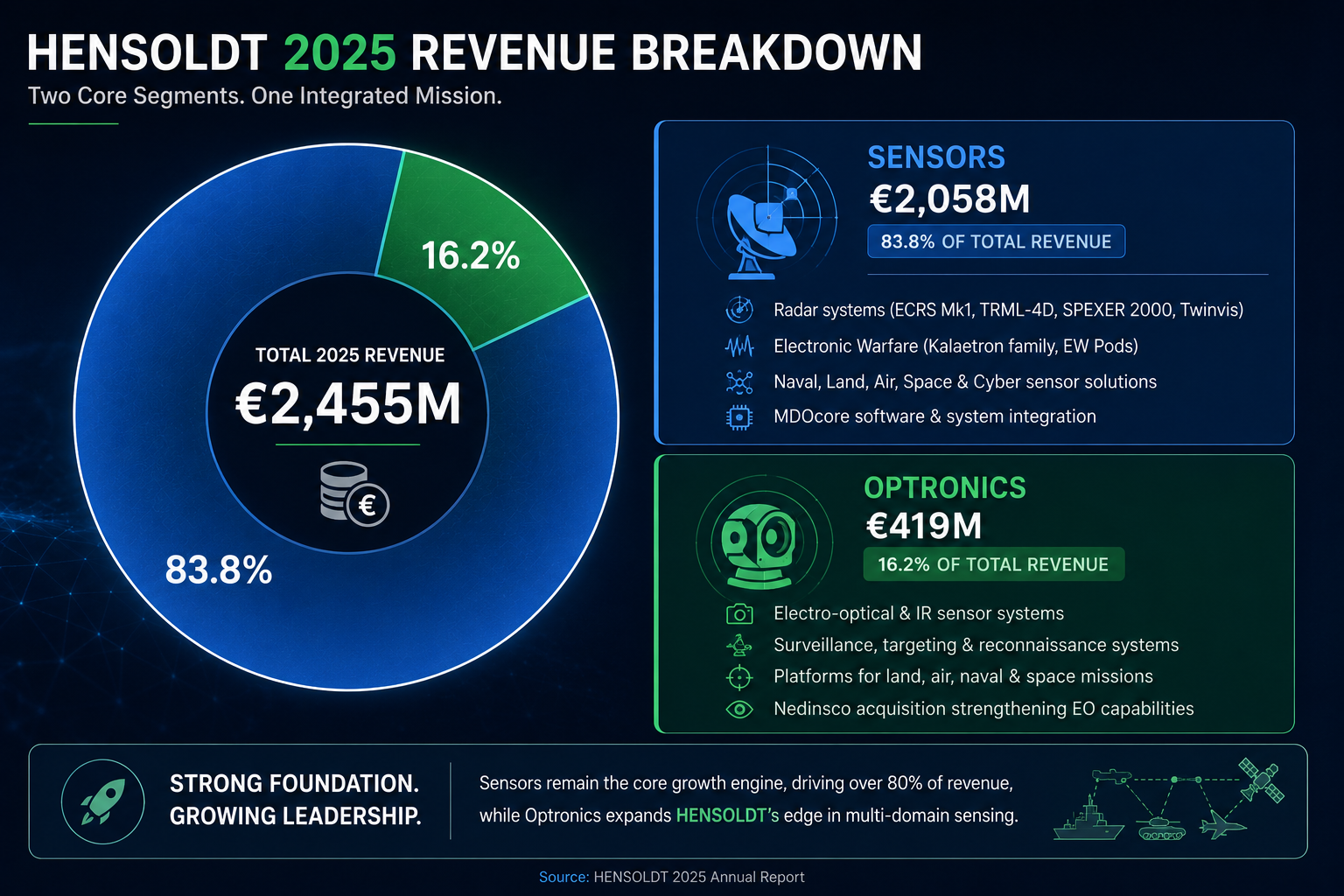
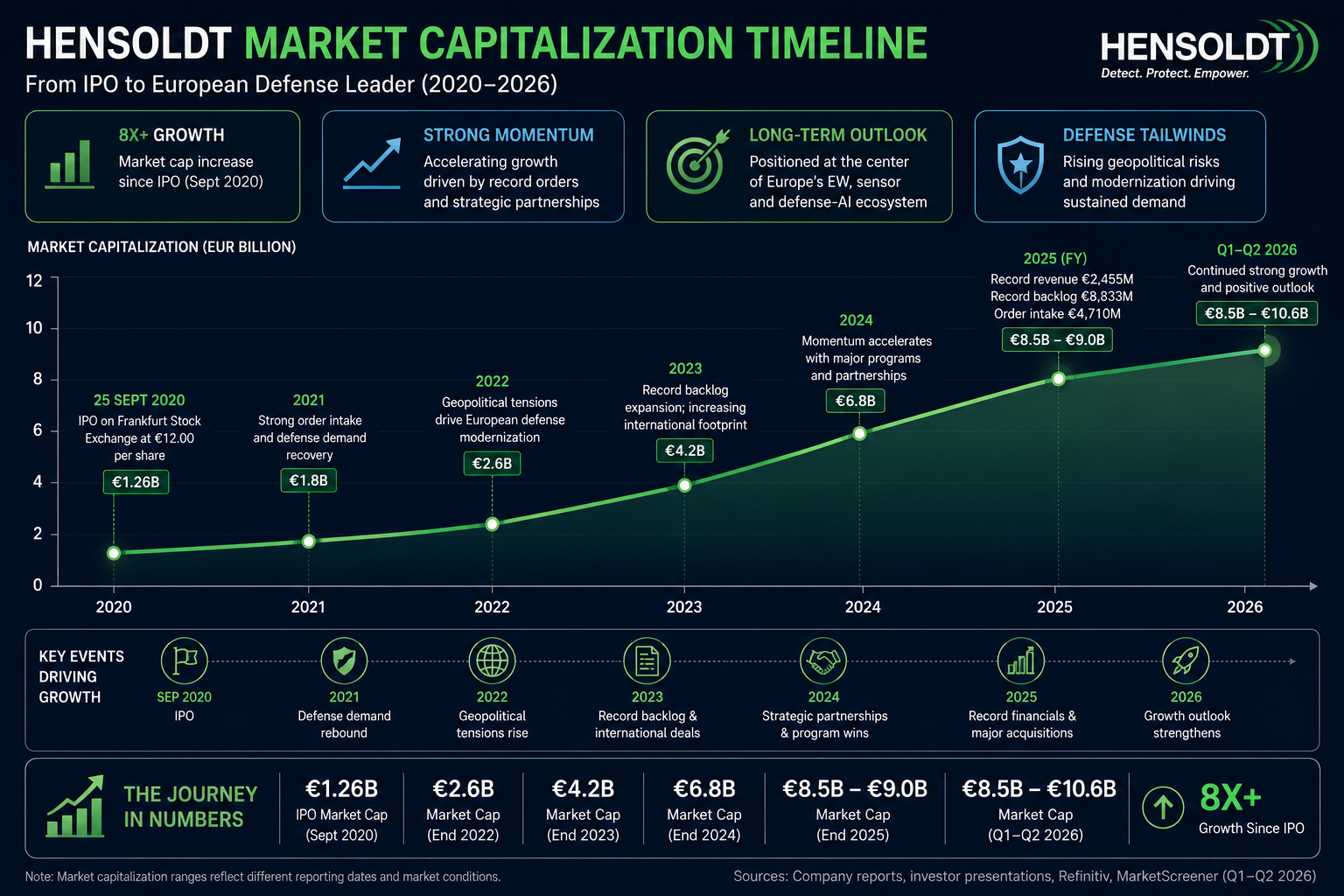
HENSOLDT is a German defense electronics company headquartered in Taufkirchen, near Munich, specializing in radar, electronic warfare (EW), and optronics (electro-optical/infrared sensor) systems for air, land, sea, cyber, and space domains. The company was carved out of the former Airbus Defence Electronics business in 2017, backed by private equity investor KKR, and listed on the Frankfurt Stock Exchange in September 2020. It has since become one of the best-performing stocks in the European defense sector, with its market capitalization rising roughly eightfold since IPO. As of its 2025 full-year results, HENSOLDT reported revenue of €2,455 million (up nearly 10% year-on-year), a record order backlog of €8,833 million, and order intake of €4,710 million — a 62% increase over 2024.
| Attribute | Detail |
|---|---|
| Founded | 2017 (carved out of Airbus Defence Electronics; predecessor technology dates to Zeiss/Cassidian lineage) |
| HQ | Taufkirchen, near Munich, Germany |
| CEO | Oliver Dörre |
| Ownership structure | Publicly listed (Frankfurt Stock Exchange, ticker HAG; MDAX-listed); German government holds a strategic minority stake; KKR is a major shareholder following IPO |
| IPO | September 25, 2020, Deutsche Börse Prime Standard, issue price €12.00, initial market cap ≈ €1.26 billion |
| Latest market capitalization | Approximately $8.5–10.6 billion as of Q1–Q2 2026 (figures vary by reporting date and source — see Chart Data Table) |
| 2025 Revenue | €2,455 million |
| 2025 Order Backlog | €8,833 million |
| Employee count | Approximately 9,000–9,360 (reported figures vary slightly by source and date) |
2. What They Actually Build
HENSOLDT organizes its business into two core segments — Sensors and Optronics — and increasingly positions itself as a systems integrator rather than a pure component manufacturer. In plain terms: the company builds the equipment that lets a military platform see, detect, and either avoid or jam an adversary's own sensors.
On the Sensors side, its flagship product is the ECRS Mk1, a next-generation Active Electronically Scanned Array (AESA) radar being developed with Indra and Airbus for German and Spanish Eurofighter Typhoons — an AESA radar uses many small transmit/receive modules instead of one mechanically steered dish, giving it faster scanning, better resolution, and the ability to perform electronic warfare functions alongside traditional radar detection. HENSOLDT also produces ground-based air-defense radars (TRML-4D, SPEXER 2000), the Twinvis passive radar (which detects targets by listening for reflections of existing signals rather than transmitting its own, making it inherently harder to detect or jam), and naval and submarine sensor systems.
On the electronic warfare side, HENSOLDT's Kalaetron product family covers self-protection, electronic support measures (detecting and classifying enemy emissions), and offensive jamming — including Kalaetron Attack, a digitally-controlled AESA jamming pod. The company also recently unveiled SkyBarrier, a mobile ground-based jammer explicitly designed to deny GPS, GLONASS, Galileo, and BeiDou satellite navigation signals simultaneously, including their encrypted military variants — a direct commercial response to the GNSS-jamming and signal-integrity themes covered elsewhere on this blog. Layered on top of the hardware, HENSOLDT's MDOcore (Multi-Domain Operations Core) software suite is the company's push into software-defined defense: fusing sensor data across platforms and domains into a shared operational picture, positioning HENSOLDT less as a radar vendor and more as the data-fusion layer other primes and AI partners plug into.
3. Recent Moves
The past six to twelve months have been unusually dense for HENSOLDT, spanning financial results, a major AI partnership, and new product launches.
Financially, HENSOLDT closed 2025 with record order intake (€4,710 million, +62% year-on-year) and raised its 2026 guidance to approximately €2,750 million in revenue with an adjusted EBITDA margin of 18.5–19%. The company also completed a corporate refinancing in April 2025 and agreed to acquire Dutch electro-optical sensor provider Nedinsco, a deal that closed around March 2026.
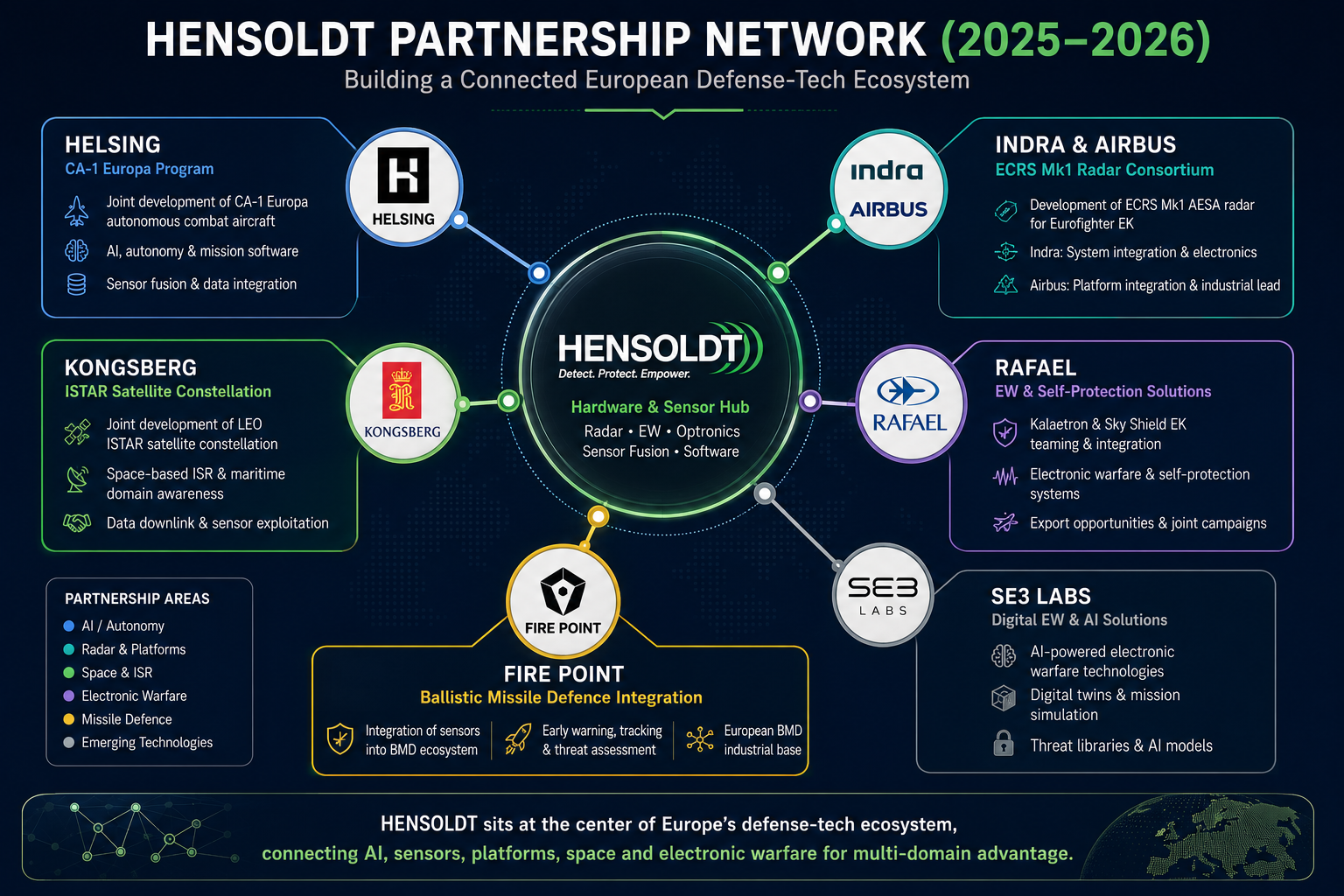
On partnerships, the most strategically significant move was the February 2026 announcement that HENSOLDT and Helsing — the German defense-AI company — would jointly develop Helsing's CA-1 Europa autonomous combat aircraft, with HENSOLDT supplying radar, optronics, self-protection, and electromagnetic warfare sensor technologies integrated via its MDOcore software, and Helsing contributing its Centaur AI agent for autonomous mission execution. The two companies, alongside Norway's Kongsberg, are also collaborating on a planned European satellite constellation for intelligence, surveillance, and target acquisition (ISTAR), targeting a networked communications layer by 2029. Separately, HENSOLDT signed a memorandum of understanding with SE3 Labs (a Munich spatial-AI and autonomous systems firm) at ILA Berlin in June 2026, and a Ballistic Missile Defence integration MoU with Ukrainian firm Fire Point at Eurosatory 2026.
On the Eurofighter EK (Elektronischer Kampf) program specifically — the electronic-combat variant intended to replace Germany's retiring Tornado ECR fleet — HENSOLDT has pursued this opportunity primarily through its Kalaetron Attack technology, teamed with Rafael's Sky Shield escort-jamming pod. However, more recent 2026 reporting on Germany's Tranche 4/Quadriga Eurofighter program describes the EK variant's core electronic warfare suite as based on Saab's Arexis system rather than HENSOLDT's offering — [VERIFY: which specific electronic-attack payload/vendor has been formally selected for the German Eurofighter EK program, and HENSOLDT's confirmed current role, if any, versus its earlier Rafael-teamed bid]. What is confirmed is that HENSOLDT continues to see a broader opportunity here: Aviation Week has reported the company sees a potential $1 billion opportunity tied to Germany's ambition to field an airborne electronic-attack capability, with a competition expected soon under the LuWES (airborne standoff jammer) program.
On products, HENSOLDT unveiled SkyBarrier at Eurosatory 2026 and, alongside Indra, began live-flight testing of the ECRS Mk1 Step 1 radar in June 2026, with first deliveries to German and Spanish Eurofighters expected around 2027.
4. Competitive Position
HENSOLDT's most directly comparable named competitor in European sensor and electronic-warfare systems is Thales, the much larger French aerospace, defense, and cybersecurity group. The two overlap directly in radar, electronic warfare, and optronics, though Thales operates across a far broader portfolio spanning civil aerospace, space, and digital identity.
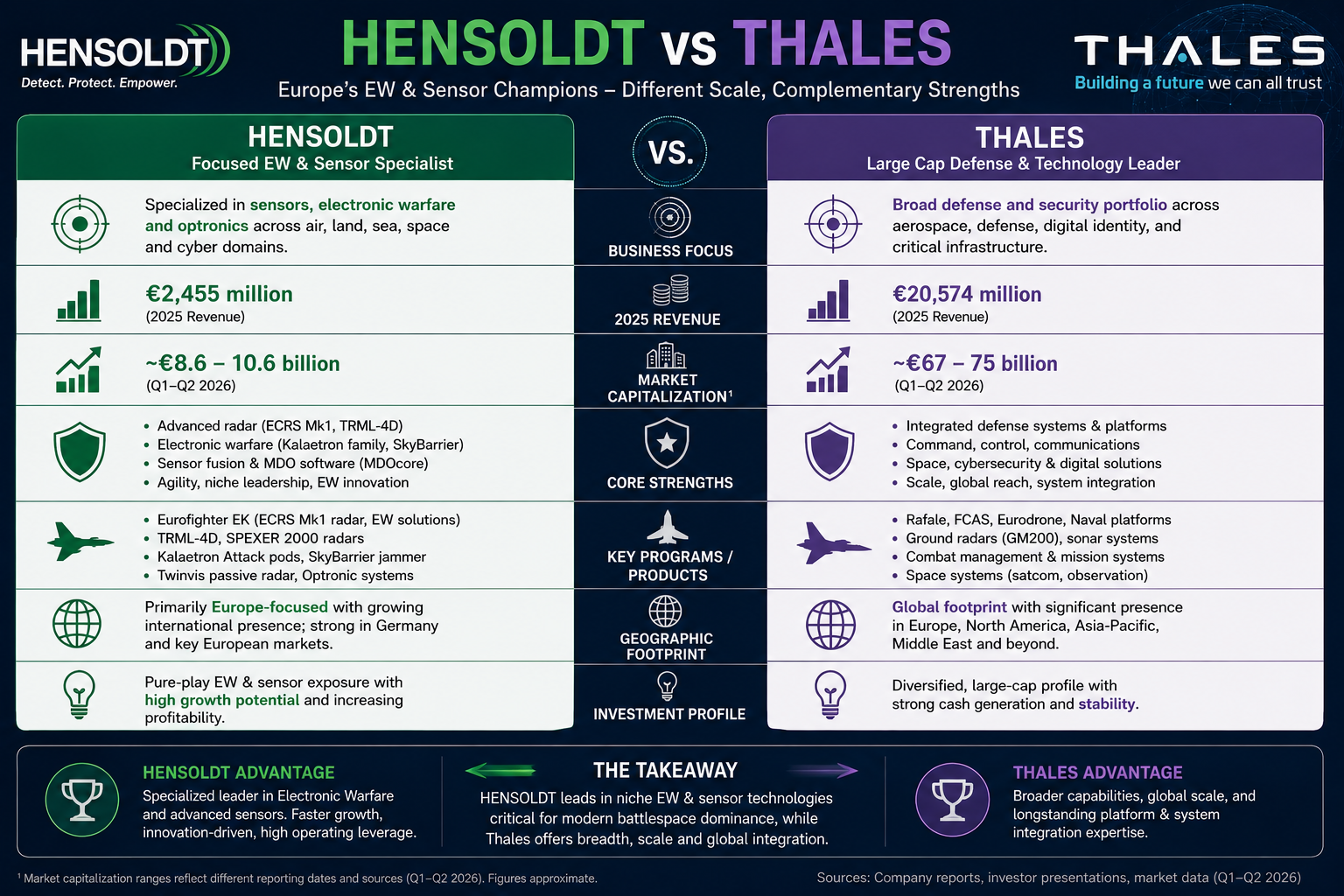
HENSOLDT's stated edge is less about outright technology superiority and more about sovereignty positioning — being the "national champion" supplier that German and allied European governments can procure from without third-country export-control entanglements, a point HENSOLDT's own executives and partners (including Helsing's Gundbert Scherf) have emphasized explicitly in recent announcements.
5. Why It Matters
HENSOLDT's trajectory over the past year is a useful proxy for a broader shift in European defense-tech: legacy sensor and electronic-warfare manufacturers are no longer treated as hardware suppliers to be integrated by others — they are actively partnering with defense-AI startups (Helsing being the clearest example) to co-own the software and autonomy layer rather than cede it. The HENSOLDT-Helsing tie-up, plus the Kongsberg satellite collaboration, signals that "sovereign European defense-AI stack" is becoming a real procurement category, not just a talking point, and that incumbents with certified hardware and established government relationships have a genuine seat at that table alongside venture-backed AI-native entrants. For anyone tracking where GNSS-resilience and signal-integrity capital is headed, HENSOLDT's SkyBarrier launch and its ongoing pursuit of Germany's airborne electronic-attack requirement are concrete signals that the jamming/counter-jamming market isn't just a U.S. and startup story — established European primes are moving into it with fielded, government-backed products.
6. What to Watch Next
- Formal resolution of the Eurofighter EK electronic-attack payload competition under the LuWES program — this will clarify whether HENSOLDT's Kalaetron/Rafael teaming, Saab's Arexis, or another combination ultimately wins the roughly $1 billion opportunity HENSOLDT has cited.
- Early results and demonstration milestones from the Helsing CA-1 Europa partnership, given both companies have flagged initial joint demonstrations for "coming months" as of the February 2026 announcement.
- SkyBarrier's first confirmed customer or contract, which would validate HENSOLDT's push into the GNSS-jamming countermeasure market commercially rather than as a trade-show demonstrator.
- Progress on the HENSOLDT/Helsing/Kongsberg ISTAR satellite constellation, targeted for a networked layer by 2029.
- HENSOLDT's FY2026 results, given guidance of ~€2,750 million revenue and a raised EBITDA margin target of 18.5–19%, as a test of whether record order intake is converting into delivered, billed revenue at the pace management has projected.
7. Chart Data Table
Note: HENSOLDT is a publicly listed company, not a venture-funded startup, so there are no discrete "funding rounds" in the traditional sense. The table below substitutes its IPO and subsequent public market-capitalization milestones, which is the analogous public-market data available and suitable for charting a valuation trajectory over time.
Funding Timeline Data
| Round | Date | Amount Raised ($B) | Post-Money Valuation ($B) |
|---|---|---|---|
| IPO (Frankfurt Prime Standard) | Sept 25, 2020 | [VERIFY: IPO gross proceeds figure] | ≈ $1.4B (€1.26B at listing) |
| Market cap snapshot | Mar 4, 2026 | N/A (secondary market, not a raise) | $10.27B–$10.58B (sources diverge; see note below) |
| Market cap snapshot | Jun 18–26, 2026 | N/A (secondary market, not a raise) | $8.52B–$9B |