How to Become an AI Engineer in India: Complete Roadmap (2026) AI Engineer Roadmap
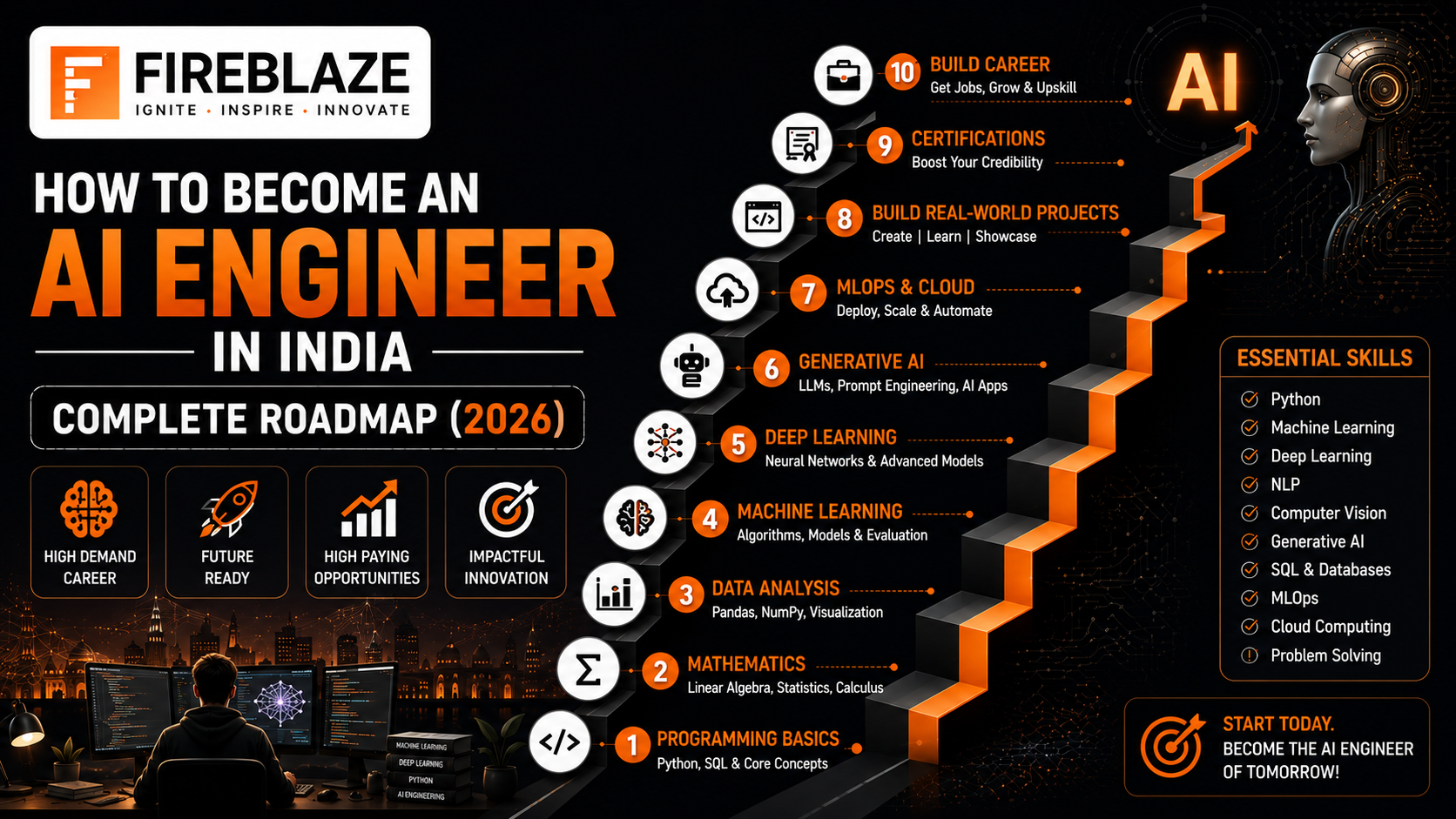
How to Become an AI Engineer in India: Complete Roadmap (2026)
Artificial Intelligence (AI) is reshaping industries across the globe, and India is at the forefront of this technological revolution. From healthcare and banking to manufacturing, e-commerce, and cybersecurity, organizations are investing heavily in AI-powered solutions. As a result, the demand for skilled AI Engineers has never been higher. According to industry reports, AI-related job openings in India are expected to grow significantly in the coming years, making it one of the most promising career paths for students and working professionals.
If you're wondering how to become an AI Engineer in India in 2026, this complete roadmap will guide you through the skills, tools, certifications, projects, and career opportunities required to succeed.
Who is an AI Engineer?
An AI Engineer is a technology professional who designs, develops, trains, tests, and deploys artificial intelligence models that enable machines to learn, reason, and make decisions. AI Engineers work with machine learning, deep learning, natural language processing (NLP), computer vision, robotics, and Generative AI to build intelligent applications that solve real-world business problems.
Whether it's creating chatbots, recommendation systems, fraud detection models, autonomous vehicles, or AI-powered healthcare solutions, AI Engineers play a crucial role in driving innovation.
Why Choose AI Engineering as a Career?
AI Engineering is one of the highest-paying and fastest-growing careers in India. Companies across every industry are actively hiring AI professionals to automate processes, improve customer experiences, and make data-driven decisions.
Benefits of Becoming an AI Engineer
- High salary packages
- Huge demand across industries
- Opportunity to work on cutting-edge technologies
- Global career opportunities
- Flexible remote and hybrid work options
- Continuous learning and innovation
Step 1: Build a Strong Programming Foundation
Programming is the backbone of Artificial Intelligence. Python is the most widely used language due to its simplicity and extensive AI libraries.
Languages to Learn
- Python
- SQL
- Java (Optional)
- C++ (Optional)
Development Tools
- VS Code
- Jupyter Notebook
- Google Colab
- Git & GitHub
Step 2: Learn Mathematics for AI
A solid understanding of mathematics is essential for building AI models.
Focus on:
- Linear Algebra
- Probability
- Statistics
- Calculus
- Optimization Techniques
These concepts form the foundation of machine learning algorithms and neural networks.
Step 3: Master Data Analysis
AI begins with data. Learn how to collect, clean, analyze, and visualize datasets.
Essential Libraries
- NumPy
- Pandas
- Matplotlib
- Seaborn
You'll also need to understand:
- Data Cleaning
- Exploratory Data Analysis (EDA)
- Feature Engineering
- Data Visualization
Step 4: Learn Machine Learning
Machine Learning enables systems to learn from data without explicit programming.
Topics to Cover
- Supervised Learning
- Unsupervised Learning
- Regression
- Classification
- Clustering
- Decision Trees
- Random Forest
- Support Vector Machines
- Gradient Boosting
- XGBoost
Popular Libraries
- Scikit-learn
- TensorFlow
- PyTorch
Step 5: Learn Deep Learning
Deep Learning powers advanced AI applications like image recognition, speech processing, and autonomous systems.
Study:
- Artificial Neural Networks (ANN)
- Convolutional Neural Networks (CNN)
- Recurrent Neural Networks (RNN)
- LSTM Networks
- Transformers
Step 6: Learn Generative AI
Generative AI is transforming software development and automation. Mastering these technologies is essential for future AI Engineers.
Learn About
- Large Language Models (LLMs)
- Prompt Engineering
- Retrieval-Augmented Generation (RAG)
- AI Agents
- LangChain
- Hugging Face
- OpenAI API
Step 7: Learn MLOps and Cloud Computing
Deploying AI models into production requires cloud platforms and MLOps practices.
Cloud Platforms
- Amazon Web Services (AWS)
- Microsoft Azure
- Google Cloud Platform (GCP)
MLOps Tools
- Docker
- Kubernetes
- MLflow
- FastAPI
- CI/CD Pipelines
Step 8: Build Real-World AI Projects
Employers value practical experience more than theoretical knowledge.
Project Ideas
- AI Chatbot
- Face Recognition System
- Resume Screening Tool
- Recommendation Engine
- Fraud Detection System
- Predictive Sales Forecasting
- Sentiment Analysis
- AI Document Assistant
Publish your projects on GitHub and create a portfolio website to showcase your work.
Step 9: Earn Industry Certifications
Professional certifications strengthen your resume and validate your skills.
Recommended Certifications
- Google Professional Machine Learning Engineer
- Microsoft Azure AI Engineer Associate
- AWS Certified Machine Learning
- IBM AI Engineering Professional Certificate
- DeepLearning.AI Specializations
Step 10: Prepare for AI Interviews
Practice both technical and practical interview questions.
Focus on:
- Python Programming
- SQL Queries
- Machine Learning Algorithms
- Deep Learning Concepts
- Data Structures and Algorithms
- AI Case Studies
- System Design Basics
Mock interviews and coding challenges on platforms like LeetCode and HackerRank can help improve confidence.
Essential Skills Every AI Engineer Needs
Technical Skills
- Python
- SQL
- Machine Learning
- Deep Learning
- Natural Language Processing (NLP)
- Computer Vision
- Generative AI
- MLOps
- Cloud Computing
- Git & GitHub
Soft Skills
- Problem-solving
- Critical thinking
- Communication
- Collaboration
- Continuous learning
Career Opportunities in AI
After completing your AI learning journey, you can apply for roles such as:
- AI Engineer
- Machine Learning Engineer
- Data Scientist
- NLP Engineer
- Computer Vision Engineer
- Generative AI Engineer
- AI Research Engineer
- MLOps Engineer
- AI Consultant
Salary of an AI Engineer in India (2026)
Approximate annual salary ranges:
| Experience | Salary (LPA) |
|---|---|
| Fresher | ₹6–12 LPA |
| 2–5 Years | ₹12–25 LPA |
| 5–8 Years | ₹25–45 LPA |
| Senior AI Engineer | ₹45+ LPA |
Note: Salaries vary based on company, location, skills, and experience.
Tips to Become a Successful AI Engineer
- Practice coding every day.
- Build at least 8–10 AI projects.
- Contribute to open-source AI projects.
- Participate in Kaggle competitions.
- Stay updated with the latest AI research and tools.
- Build a strong LinkedIn and GitHub profile.
- Network with AI professionals and communities.
Conclusion
Becoming an AI Engineer in India in 2026 is an exciting and rewarding career choice. With the rapid growth of Artificial Intelligence, Machine Learning, and Generative AI, skilled professionals are in high demand across industries. By following a structured roadmap—starting with programming and mathematics, progressing through machine learning and deep learning, and gaining hands-on experience with real-world projects—you can build the expertise needed to thrive in this competitive field. Stay curious, keep learning, earn relevant certifications, and continuously improve your portfolio. With dedication and practical experience, you can successfully launch a high-paying and future-ready career as an AI Engineer in India.