Kinetic vs. Directed Energy: Inside the AI Deciding How to Defeat a Drone Swarm
The Real Decision Isn't "Can We Hit It" — It's "What Should We Use"
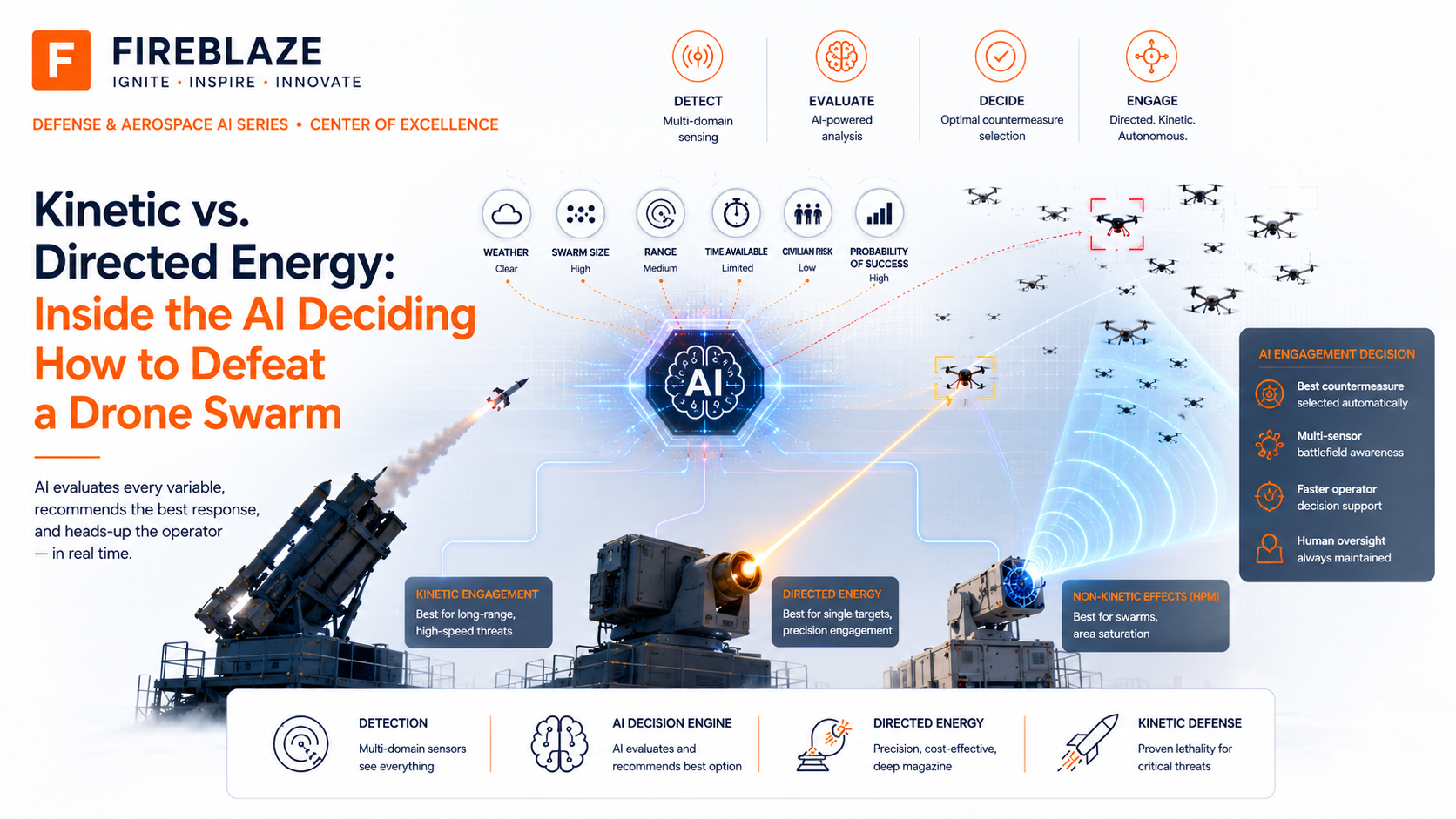
By the time a counter-UAS system has detected, tracked, and classified an incoming drone (the subject of this series' previous article), a second, less obvious decision has to happen almost instantly: how should it be defeated? That choice — kinetic interceptor, jamming, laser, or high-power microwave — has real consequences for cost, effectiveness, and how many more threats the system can handle right after this one. Increasingly, that decision is being handed, at least partially, to AI.
Kinetic: The Original Answer, and Its Ceiling
Kinetic interceptors — missiles, guided rockets, autocannon rounds, and purpose-built interceptor drones — remain the most mature and battle-proven way to physically destroy a hostile drone. Systems like the Coyote interceptor family (now in its second and third generations) were specifically designed as lower-cost, reusable-launcher counter-drone weapons, a deliberate step down in cost from full air-defense missiles.
But kinetic defeat has a structural ceiling that no amount of engineering can fully erase: every shot consumes a physical, manufactured object that has to be restocked. Against a single drone or a small raid, that's a manageable cost. Against a saturating swarm, it becomes the exact cost-asymmetry trap described in this series' first article — magazines run dry, resupply takes time, and each interceptor still typically defeats only one target.
Defeat Method
Engagement Model
Marginal Cost per Shot
Best Suited For
Kinetic interceptor (missile/rocket)
One-to-one
High (thousands to millions)
Single high-value or fast-moving targets
Kinetic gun/autocannon
One-to-one, rapid fire
Low per round, limited magazine
Close-range last-ditch defense
High-energy laser
One-to-one, precision
Very low per shot once built
Single target, clear conditions, time to dwell on target
High-power microwave (HPM)
One-to-many
Very low per shot once built
Saturating swarms, multiple simultaneous targets
Directed Energy, Part One: Lasers
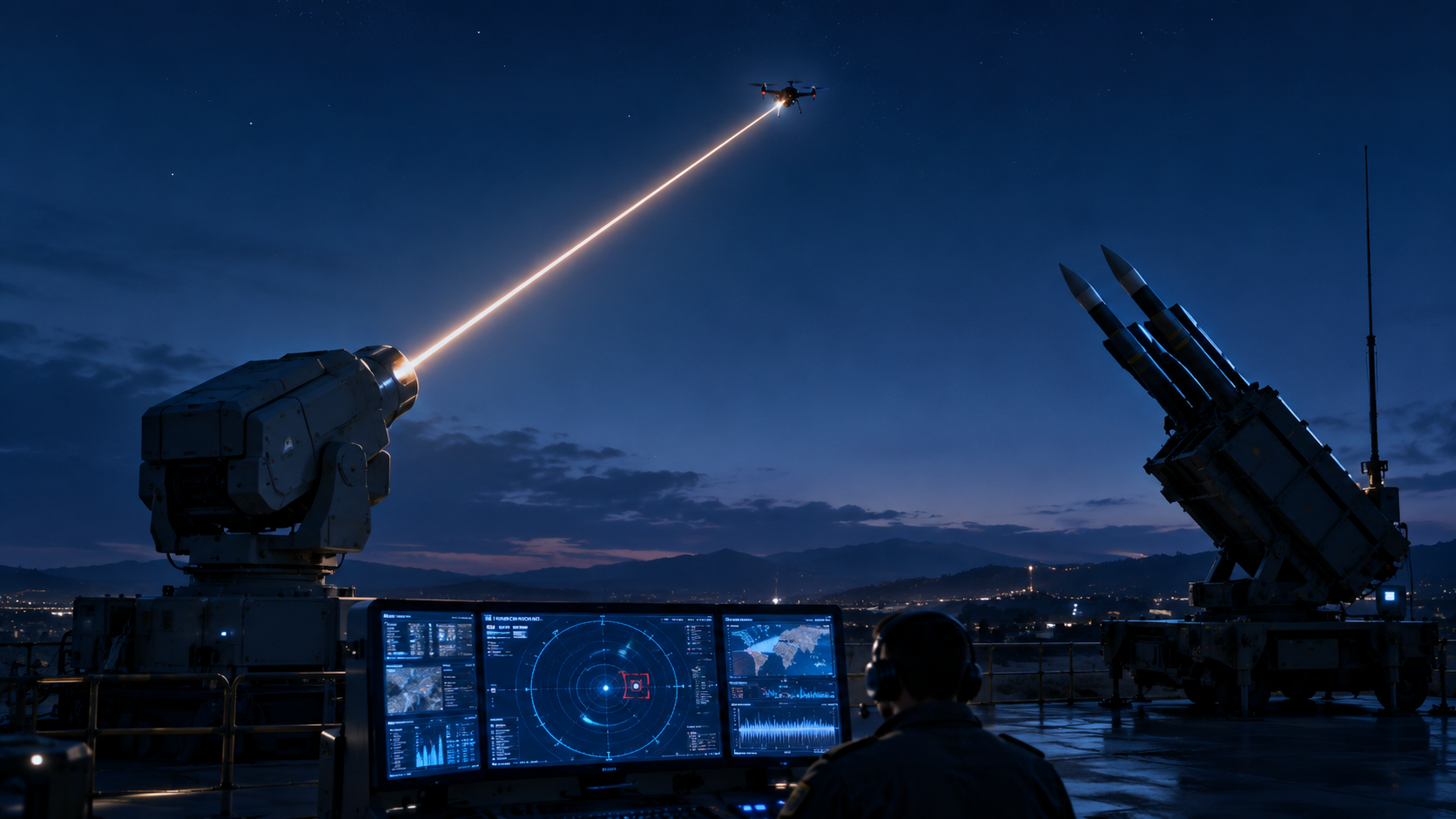
High-energy laser weapons — systems like Israel's Iron Beam and the U.S. Navy's HELIOS — work by concentrating light energy on a target long enough to physically burn through its structure. Once the system is built and powered, the marginal cost of each engagement is dramatically lower than firing a missile, which is precisely the economic argument driving heavy investment in the technology.
But lasers have real physical constraints that don't disappear no matter how advanced the underlying optics get. As one industry summary of Leonidas (a competing HPM system) put it bluntly: laser-based counter-UAS systems "demand perfect conditions — clear skies, uninterrupted line of sight, and sustained tracking." Fog, rain, dust, and smoke all degrade beam effectiveness, and because a laser needs to dwell on a single point long enough to do damage, it remains fundamentally a one-to-one weapon — excellent against a single high-value target, much less efficient against dozens of targets arriving at once.
Directed Energy, Part Two: High-Power Microwave (HPM)
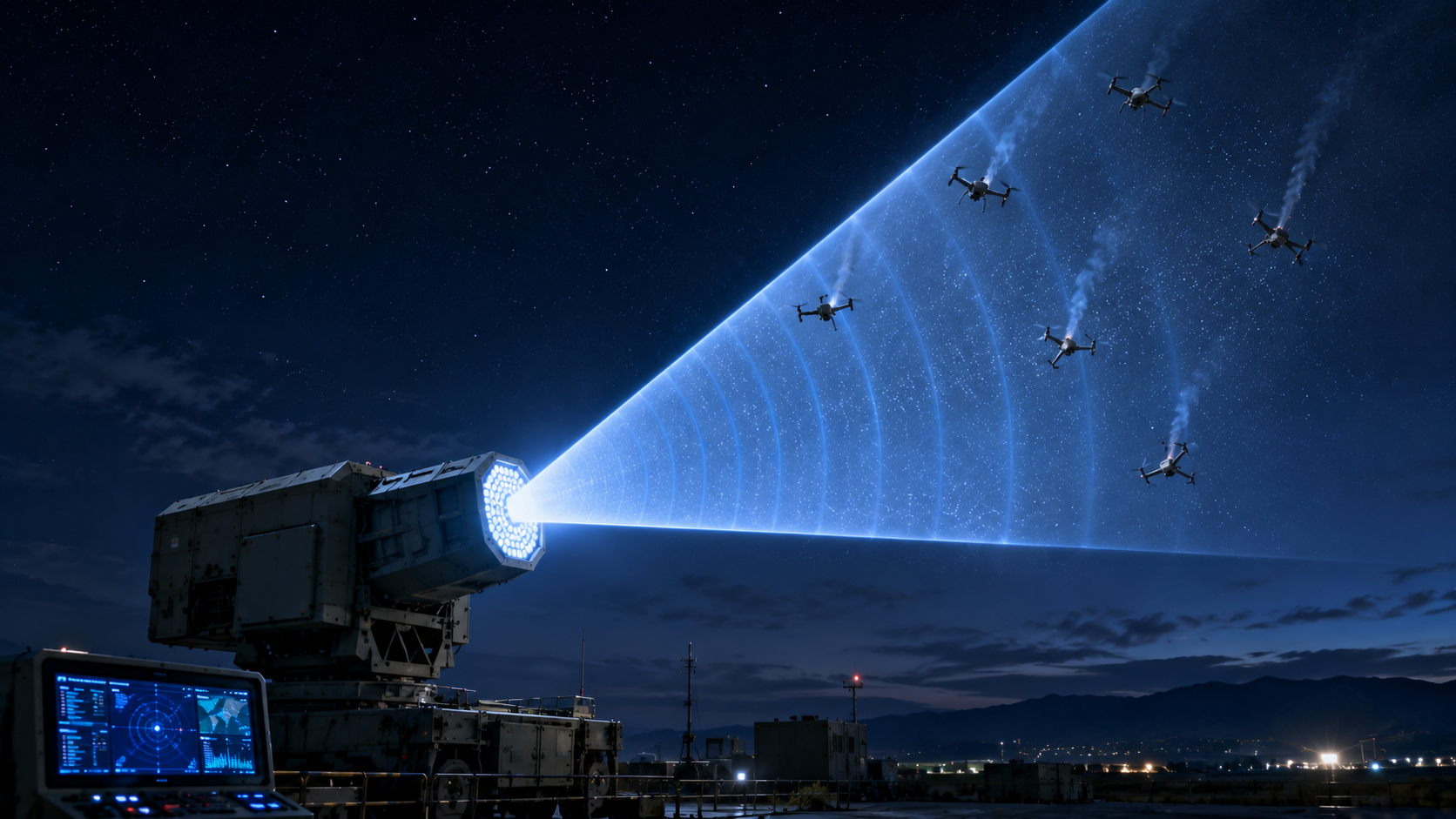
High-power microwave weapons — systems like the U.S. Air Force Research Laboratory's THOR, Epirus's Leonidas, and Raytheon's Phaser — take a fundamentally different approach. Rather than concentrating light energy to physically burn a target, HPM systems emit a broad burst of electromagnetic energy that disrupts or "fries" a drone's onboard electronics and flight-control systems, causing it to lose control or crash without any need for precise, sustained tracking of a single object.
That broad-beam approach is exactly what makes HPM systems different from every other entry in this comparison: they can disable multiple drones within the beam simultaneously, a genuine one-to-many capability that neither kinetic interceptors nor lasers can match. The U.S. Army has explicitly framed its Leonidas-based IFPC-HPM program as the first fielded directed-energy weapon system built specifically to counter groups and swarms of drones, rather than individual targets one at a time.
Comparing the Three Approaches Directly
Factor
Kinetic
Laser
HPM
Targets per engagement
One
One
Many (area effect)
Marginal cost per shot
High
Very low (after build cost)
Very low (after build cost)
Weather dependency
Low
High (needs clear line of sight)
Low
Precision
High (physical destruction)
Very high (pinpoint)
Lower (broad area effect)
Best against
Single high-value target
Single target, good weather
Saturating swarms
Magazine depth concern
Yes — physically limited
No — power-limited, not ammo-limited
No — power-limited, not ammo-limited
No single method wins across every column — which is exactly why modern C-UAS doctrine treats kinetic, laser, and HPM as complementary layers rather than competing replacements for one another.
Where AI Actually Enters the Decision
Choosing between these options, and executing the chosen one, used to be an entirely manual process — an operator manually cueing a sensor, confirming a target, slewing a weapon, and firing, one careful step at a time. Research teams from the Naval Postgraduate School, the Naval Surface Warfare Center Dahlgren Division, Lockheed Martin, Boeing, and the Air Force Research Laboratory have been developing AI systems specifically to automate and accelerate that targeting sequence for laser weapon systems.
Their framing of the problem is direct: defending against a single drone isn't especially hard, but once multiple drones are inbound, manually sequencing missile-grade interceptors against every one becomes both slow and prohibitively expensive given how cheap the drones themselves are. Their proposed solution shifts the operator from being "in-the-loop" — manually controlling each step of the engagement — to being "on-the-loop" — supervising and able to intervene, while the AI system handles the fast mechanical work of tracking and cueing.
This distinction matters enormously, and it's the same one running through nearly every serious military AI program in this space: the goal described in public materials is consistently to compress decision speed, not to remove human authorization from the use of force.
What the AI Is Actually Weighing
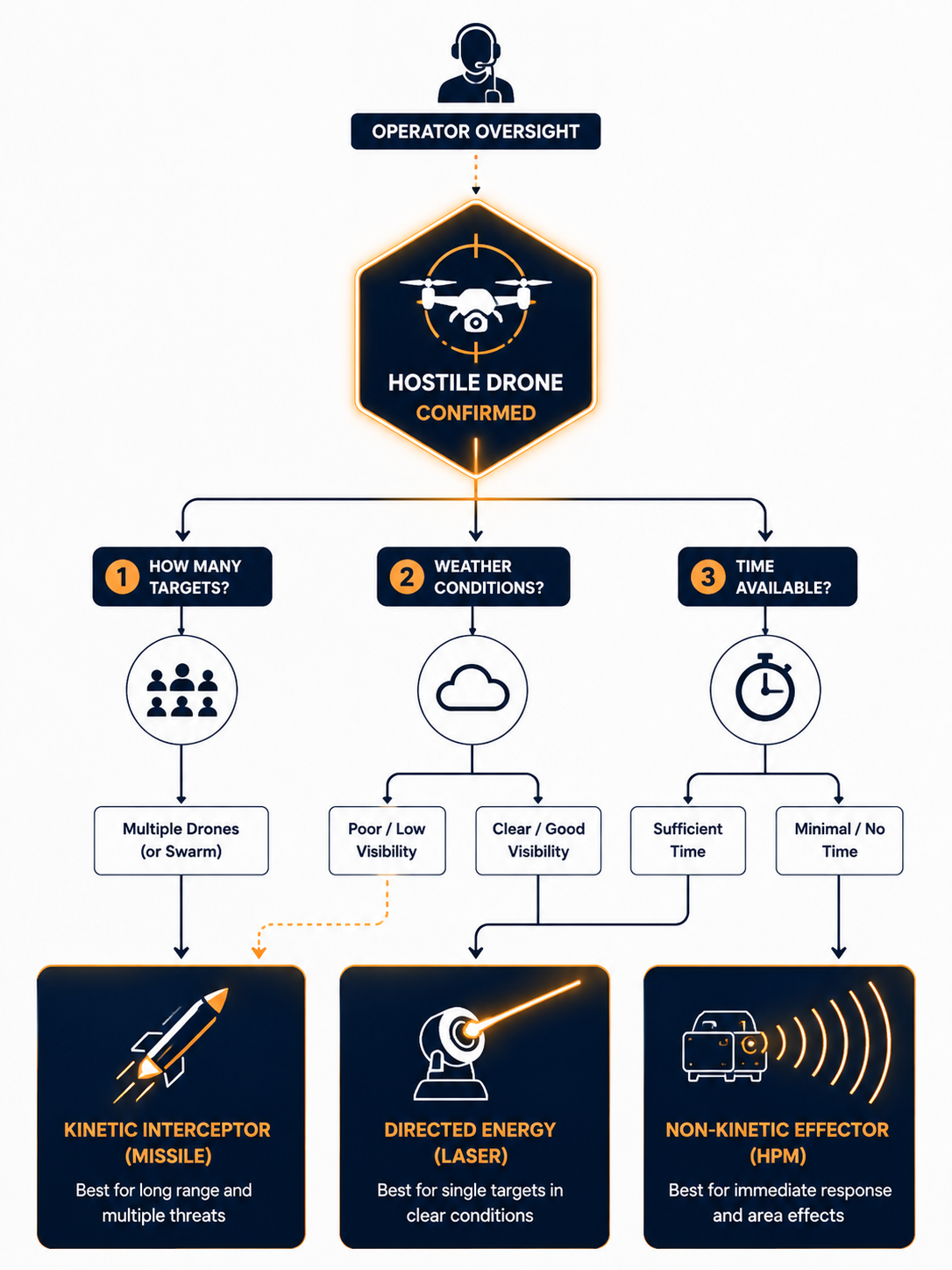
While specific fielded algorithms are naturally not published in detail, the publicly described logic behind these systems generally weighs a consistent set of factors:
Number of simultaneous targets — a single drone favors precision (laser or kinetic); multiple simultaneous drones favor broad-area effect (HPM).
Environmental conditions — degraded visibility pushes the decision away from optical, line-of-sight-dependent lasers.
Remaining magazine depth — if kinetic interceptor stock is running low, the system has strong incentive to reserve it for targets directed-energy weapons can't handle as well.
Value and behavior of the target — a single fast, evasive, high-value threat may still warrant a precise kinetic shot even amid a broader engagement.
Time available before impact — closer, faster-moving threats compress the decision window, favoring whichever effector can respond fastest.
The Ethical Conversation This Forces
Automating the targeting sequence for any weapon system inevitably raises the broader, unresolved debate around lethal autonomous weapons systems (LAWS). Industry commentary has been candid that the reality of drone swarms operating faster than human reaction times is forcing that ethical conversation to accelerate, even as the controversial nature of full autonomy continues to slow actual deployment of systems that remove a human from final engagement authority. Every program referenced in this article is explicitly built around keeping a human supervising or authorizing engagement — but the pressure to compress that human's decision window further is not going away as swarm sizes grow.
The Bottom Line
There is no single "best" way to defeat a drone anymore — there's a portfolio of options, each with a different cost curve, weather sensitivity, and target capacity, and an increasingly urgent need for something faster than a human working through a mental checklist to choose between them in real time. AI's role here isn't to replace the missile, the laser, or the microwave emitter — it's to make the choice of which one to use, and how fast to use it, keep pace with a threat that no longer waits for one target at a time. The final article in this series tackles the problem that makes all of this so much harder in the first place: why detecting and tracking a whole swarm is a fundamentally different challenge than detecting one drone.
Sources referenced: Naval Postgraduate School research on AI-enabled high-energy laser weapon systems, DroneLife reporting on Leonidas and IFPC-HPM, Milivox reporting on THOR high-power microwave trials, Jerusalem Post and ASPI Strategist reporting on directed-energy counter-drone systems, and industry reporting on Coyote and APKWS kinetic interceptor programs.