LeoLabs' Answer to Slingshot: Inside Delta, the Radar-Based Threat Detection System
If Slingshot Aerospace is teaching the Space Force to fight against a thinking AI enemy, LeoLabs is answering a different but related question: how do you actually see that enemy clearly enough to act, no matter the time of day or weather? LeoLabs' answer is radar not telescopes and in April 2026 it turned that radar network into its own AI-powered threat detection platform called Delta.
1. Who is LeoLabs?
LeoLabs was founded in 2016 as a spin-off from SRI International by Edward Lu, Daniel Ceperley, and John Buonocore. The company is headquartered in Menlo Park, California. It has raised about $129 million in funding across five rounds, including a $65 million round in June 2021 and another $29 million round in February 2024, from investors including Insight Partners, Horizons Ventures, and WERU Investment.
In February 2024, LeoLabs named Tony Frazier as its new CEO. Frazier is a well-known figure in the space and geospatial intelligence industry. Under his leadership, the company has pushed hard into building out its own hardware something most competitors don't do.
What makes LeoLabs different from the start is its choice of sensor: ground-based radar instead of optical telescopes. Radar has one big advantage it works day and night, through clouds, without needing sunlight to bounce off an object. As of late 2025, LeoLabs operated 11 radar installations across seven sites around the world, including the United States, New Zealand, Costa Rica, Australia, the Azores in Portugal, and Argentina, tracking a catalog of more than 26,000 objects.
2. What is Delta?
Delta is LeoLabs' AI-powered, advanced threat detection and characterization system, launched on April 8, 2026. It replaces the company's earlier product, LeoGuard, and is built specifically for U.S. and allied national security customers rather than just commercial satellite operators.
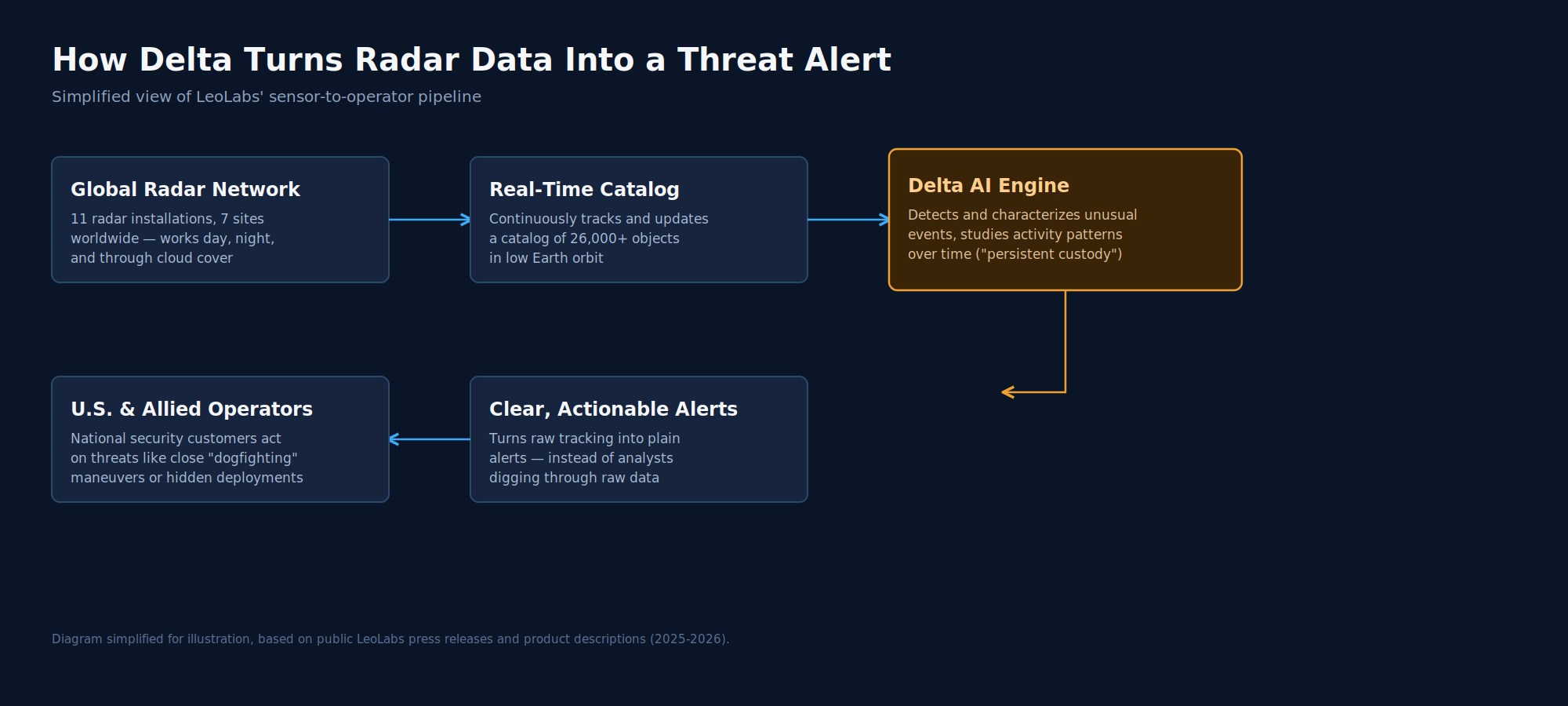
Delta works on top of LeoLabs' existing radar network and its real-time catalog of tracked objects. It continuously monitors satellites and other objects that matter for a mission, automatically detects and characterizes unusual events, studies patterns of activity over time, and turns all of that into clear, actionable alerts for operators instead of leaving analysts to manually dig through raw tracking data themselves.
LeoLabs' CEO Tony Frazier explained the thinking behind it simply: today's threats, like satellites performing close, aggressive maneuvers that resemble "dogfighting," or deployments that are deliberately hidden or unclear, need more than passive tracking. Delta is meant to help operators understand what's happening, not just see that something happened.
3. From radar network to AI-powered threat detection
Delta didn't appear out of nowhere it's the product of years of LeoLabs building out physical infrastructure before layering AI on top:
In June 2021, LeoLabs raised a $65 million Series B round to expand its radar network.
In March 2025, SpaceWERX, the Space Force's innovation arm, awarded LeoLabs a $60 million STRATFI contract to build a new radar site in the Indo-Pacific region, expected to be completed around 2026 to 2027.
In April 2025, LeoLabs unveiled Scout, a new mobile, container-sized radar designed to be quickly deployed anywhere in the world.
The company closed out 2025 with more than $60 million in total contract bookings, including 186% year-over-year growth specifically in U.S. government business.
In June 2026, LeoLabs deployed its first Scout-S mobile radar in the Indo-Pacific region, where it took part in the U.S. Indo-Pacific Command's Valiant Shield 2026 military exercise, tracking objects within hours of being switched on.
In December 2025, LeoLabs also received a joint license from the Department of Commerce and U.S. Space Force to feed its tracking data into the government's official space traffic coordination system described as the first agreement of its kind.
4. Why LeoLabs' approach is different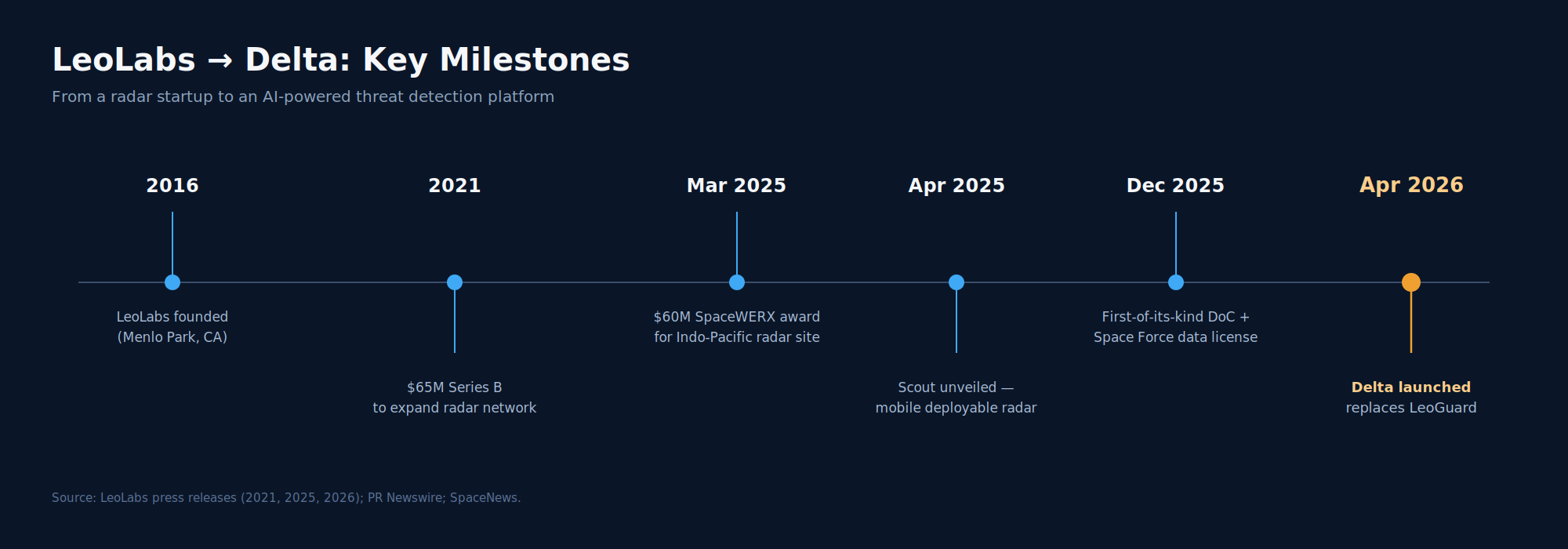
LeoLabs is, in practice, the only major commercial space domain awareness company that builds and runs its own dedicated radar network for tracking objects in low Earth orbit. Most competitors either use optical telescopes, which need clear skies and sunlight, or don't own sensor hardware at all and instead build software on top of other companies' data.
That radar-first approach matters most in exactly the situations that count: an adversary might deliberately choose to maneuver a satellite during a period when it would be hard for optical sensors to see it behind the Earth's shadow, or under heavy cloud cover, for example. Radar doesn't have that blind spot, which is a real, structural advantage for LeoLabs over sensor networks that depend on sunlight.
5. Who else is doing similar work?
LeoLabs sits in the same competitive space as Slingshot Aerospace, which takes the opposite technical approach ground optical telescopes plus an AI agent (TALOS) built to simulate realistic adversary behavior for training, rather than radar-based real-time detection.
ExoAnalytic Solutions runs a large optical telescope network, especially strong in tracking objects in geostationary orbit. It was acquired by Anduril Industries in March 2026, bringing a much larger, better-funded player into the market.
COMSPOC focuses on data fusion software, combining data from multiple different sensor providers into a single operating picture, rather than owning its own sensors.
Kratos Space takes yet another approach, tracking satellites passively by listening to the radio signals they emit during normal operations, adding a layer of information that neither radar nor optical sensors can provide on their own.
What sets LeoLabs apart isn't just its radar network by itself it's owning the entire pipeline, from physical sensor to AI-driven alert, in a market where most competitors specialize in just one part of that chain.
6. Why this matters, even outside LeoLabs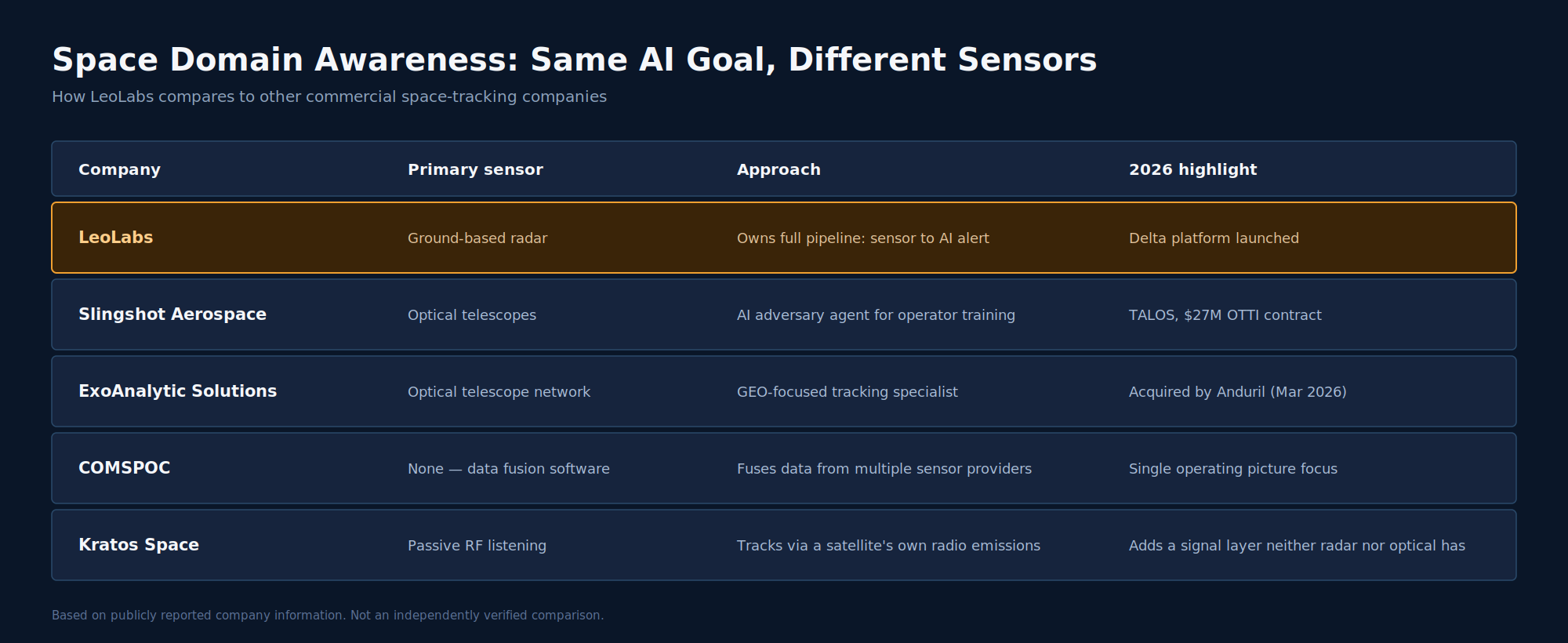
Delta is a useful case study for a few reasons that go beyond LeoLabs as a single company:
Different sensors, same AI destination. Whether a company tracks objects with radar (LeoLabs) or optical telescopes (Slingshot, ExoAnalytic), nearly every serious player in this market is now building an AI layer on top to turn raw tracking into behavior analysis and threat characterization. The sensor type is becoming a technical detail, not the main competitive advantage.
Persistent custody is the new standard. LeoLabs describes its own shift as moving "beyond periodic object detection and tracking toward persistent custody, characterization, and timely operational awareness" in plain terms, watching an object continuously and understanding it, rather than just checking in on it occasionally.
Defense contract growth is a real, broad market trend. LeoLabs' 186% growth in U.S. government business, alongside similar contract growth at Slingshot, shows this isn't one company's lucky year it's a wider increase in how much militaries are willing to spend on commercial space tracking and AI.
Numbers should be read carefully. Bookings figures and growth percentages discussed here come from LeoLabs' own announcements. No independent audit, contract duration breakdown, or revenue-recognition detail has been made public, which is worth keeping in mind whenever evaluating growth claims across this entire industry, not just for LeoLabs.
Sources: LeoLabs press releases (April 2026, March 2025, April 2025, June 2026); PR Newswire; ExecutiveBiz; SpaceNews; Wikipedia; Orbital Today. This piece reflects publicly reported information only; company performance claims are attributed to LeoLabs and have not been independently verified.