Passive vs. Active Sonar: How AI Actually "Hears" a Submarine
Introduction
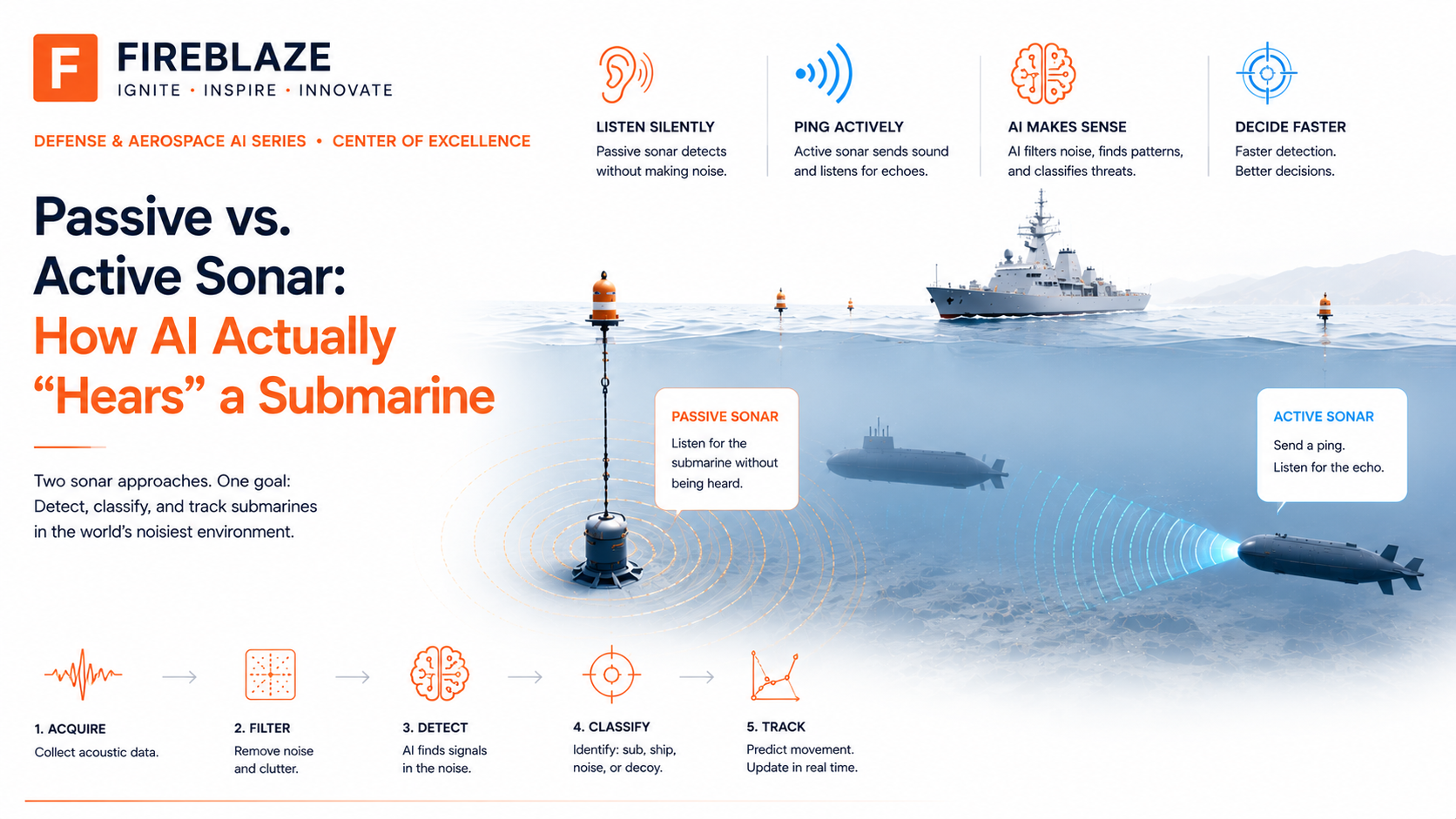
Every underwater detection system, no matter how advanced the AI behind it, ultimately comes down to one of two fundamentally different approaches: listen, or shout and wait for an echo. These are passive and active sonar, and the difference between them shapes everything downstream — what kind of AI model you need, what data it has to work with, what an operator has to give up in exchange for what they gain, and ultimately, how an entire underwater search is planned and executed. This piece is the second in a four-part series on underwater domain awareness; the first covered what UDA is and why the ocean breaks the usual rules of domain awareness.
1. A Brief History Before the Physics
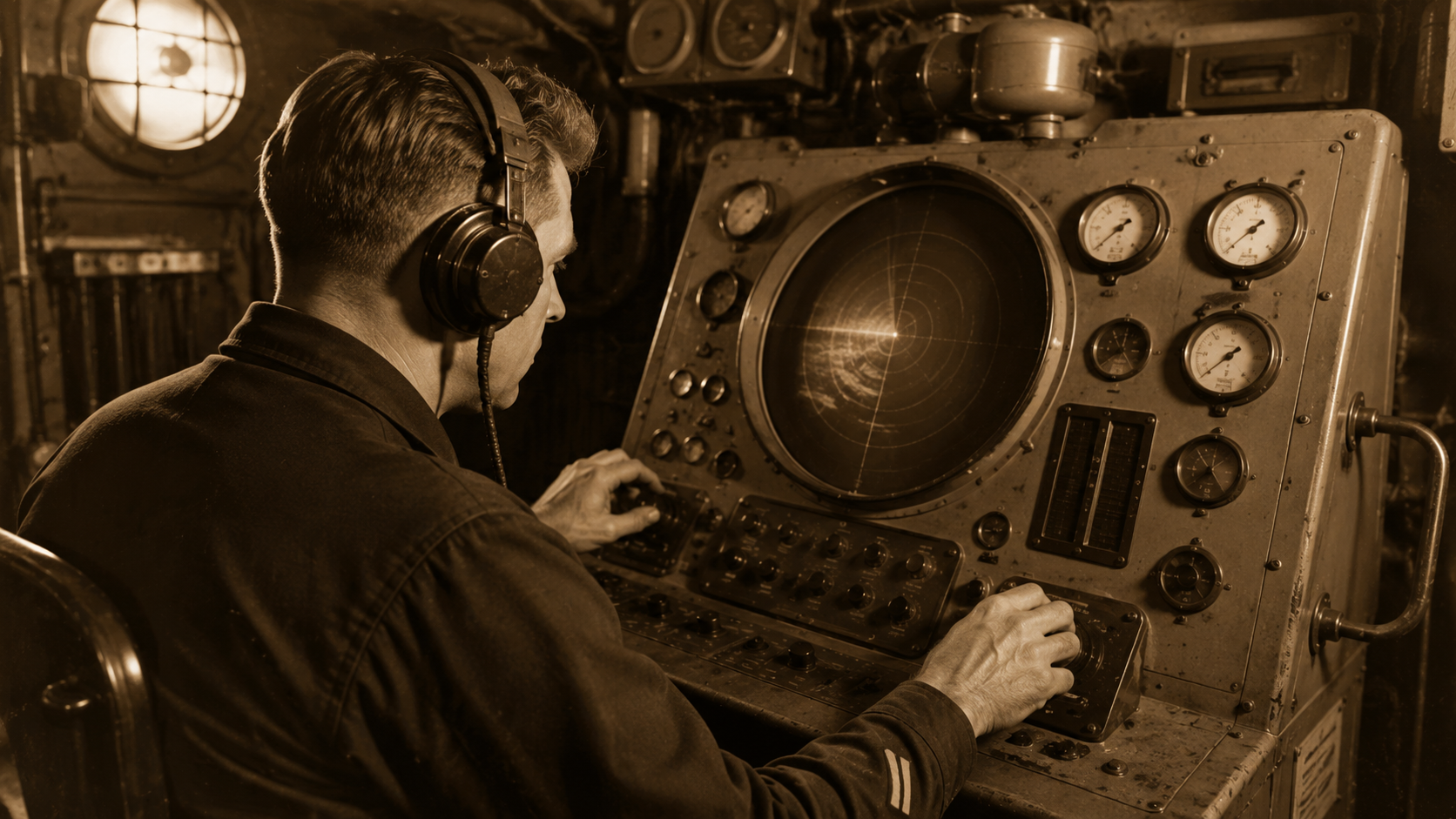
Sonar's origins trace back to the First World War, when Allied navies raced to develop a way of detecting submerged U-boats. The British called their early active system ASDIC; the term "sonar" (SOund Navigation And Ranging) came into wider use around the Second World War, modeled deliberately on "radar." What's worth noting is that passive listening actually came first, historically — early hydrophone systems that simply listened for engine noise predate reliable active ranging systems by years, precisely because the electronics needed to generate, time, and interpret a return echo were harder to build than a basic listening device. That historical order — listen first, ping later — still roughly mirrors the operational logic navies use today: passive search as the default, active transmission as the deliberate exception.
2. The Physics Underneath Both
Sound in water behaves very differently than in air. It travels roughly four times faster — about 1,500 meters per second, versus around 340 in air — and its speed changes with temperature, salinity, and pressure, in ways air's speed of sound largely doesn't vary with under normal atmospheric conditions.
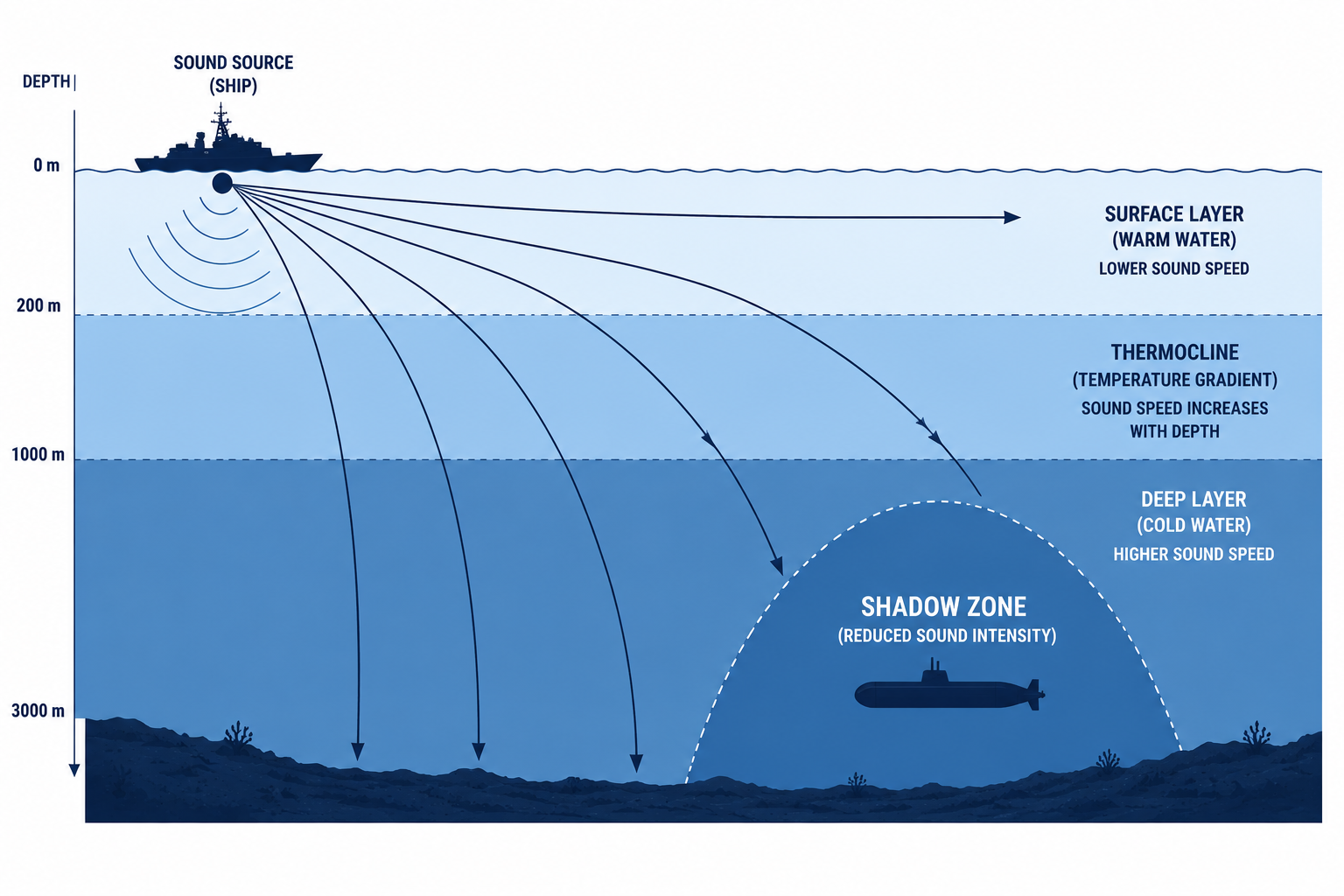
This creates layered structures in the ocean, the most operationally important of which is the thermocline: a boundary between warmer surface water and colder deep water where the speed of sound changes sharply enough that sound waves bend rather than travel straight through it. This bending — refraction — matters enormously for detection. A submarine operating just below a thermocline can be effectively hidden from a sonar system positioned above it, because sound rays curve away rather than reaching the target directly, creating what's often called a "shadow zone." Submariners have exploited this for decades; it's one of the oldest tricks in underwater warfare, and it's also exactly the kind of environmental variable that makes underwater sensing so much harder to model reliably than radar in open air, where the atmosphere is comparatively uniform.
Depth itself compounds this. Sound speed in the open ocean typically decreases with depth near the surface (as temperature drops), reaches a local minimum, and then increases again with depth further down due to rising pressure — this minimum is the core of the SOFAR channel discussed in the first piece of this series, and its exact depth shifts with season, latitude, and local water conditions, meaning the "shape" of the underwater acoustic environment is never quite the same twice.
3. Passive Sonar: Listening
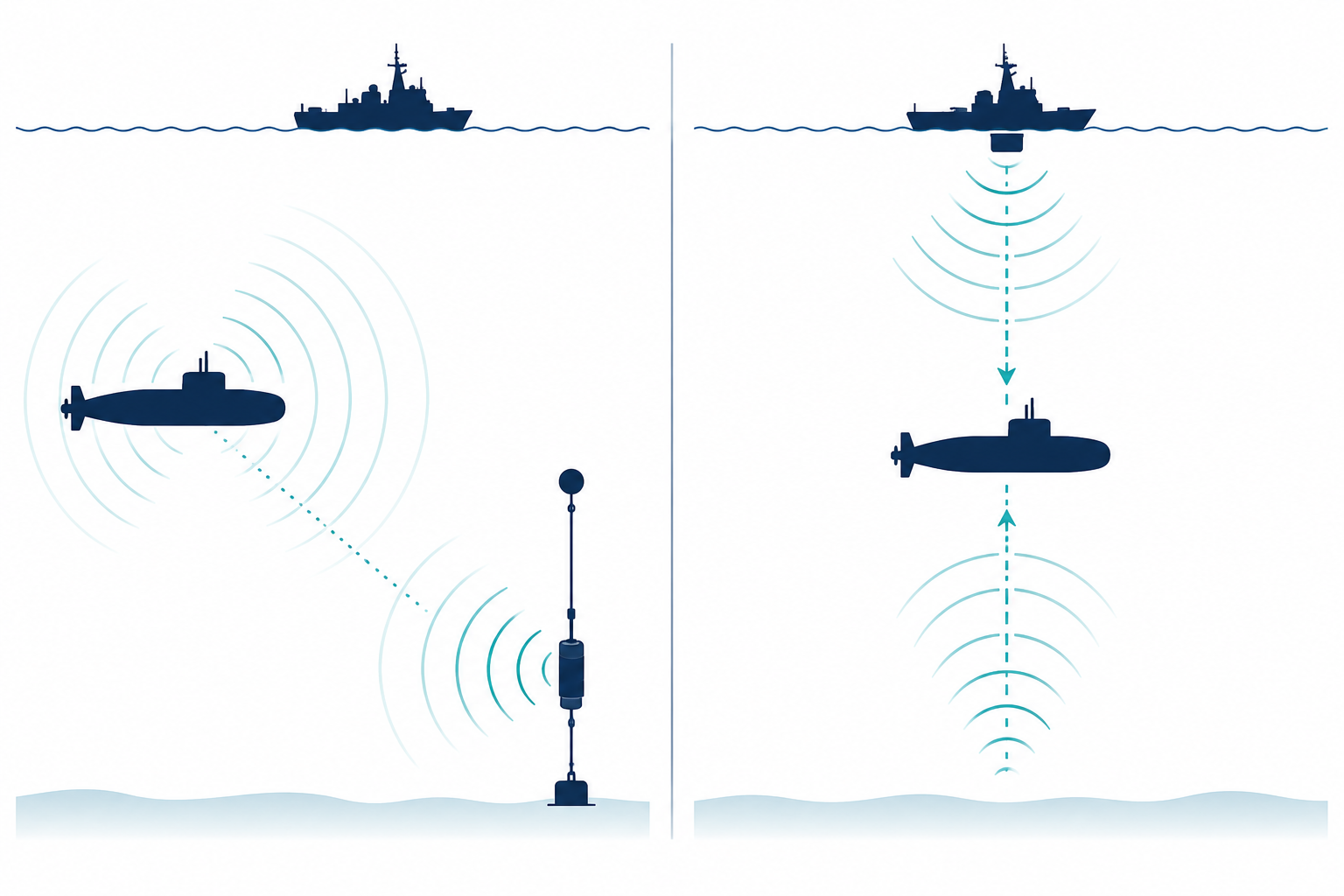
Passive sonar does exactly what the name suggests — it listens, using hydrophones (underwater microphones) mounted in one of several configurations, each with different tradeoffs:
Hull-mounted arrays — compact, always available, but affected by the host vessel's own machinery and flow noise, limiting sensitivity
Towed arrays — long cables of hydrophones streamed hundreds of meters behind a ship or submarine, getting well clear of self-noise and achieving much better sensitivity, at the cost of maneuverability while deployed and a lengthy retrieval process
Conformal and flank arrays — hydrophones mounted along the sides of a hull, offering broader coverage angles than a single bow-mounted array
Sonobuoy fields — patterns of expendable passive listening buoys dropped by aircraft, allowing rapid coverage of a wide search area
What it picks up. Every vessel underwater radiates sound — engine and gearbox noise, propeller cavitation, pumps, generators, flow noise across the hull. Each of these has a distinctive acoustic signature, sometimes precise enough to identify not just the type of vessel but the individual ship or submarine, the way a fingerprint identifies a person. This individual-level identification is exactly what a lot of underwater acoustic target recognition research (covered in depth in the next piece in this series) is trying to automate.
Why it's preferred operationally. Passive sonar reveals nothing about the listener's own position. A submarine running passive sonar can search for hours, or days, without ever broadcasting where it is — which is a decisive tactical advantage in a domain where being detected first is often the difference between winning and losing an engagement.
Why it's harder. A passive system can typically tell you the bearing (direction) to a contact fairly reliably from signal timing differences across an array, but determining range (distance) is much harder — a single passive sensor generally cannot measure range directly at all. Range typically requires triangulating bearings from multiple hydrophone positions over time, or from multiple platforms working together and comparing their respective bearing lines — a technique sometimes called Target Motion Analysis, which can take anywhere from minutes to hours to converge on a reliable position estimate, depending on how the target is maneuvering.
4. Active Sonar: Pinging
Active sonar transmits a sound pulse — a "ping" — and listens for the echo that bounces back off a target. By measuring the time delay between transmission and return, and the direction the echo arrives from, an active sonar system can calculate both bearing and range directly and immediately, in a single transmission cycle.
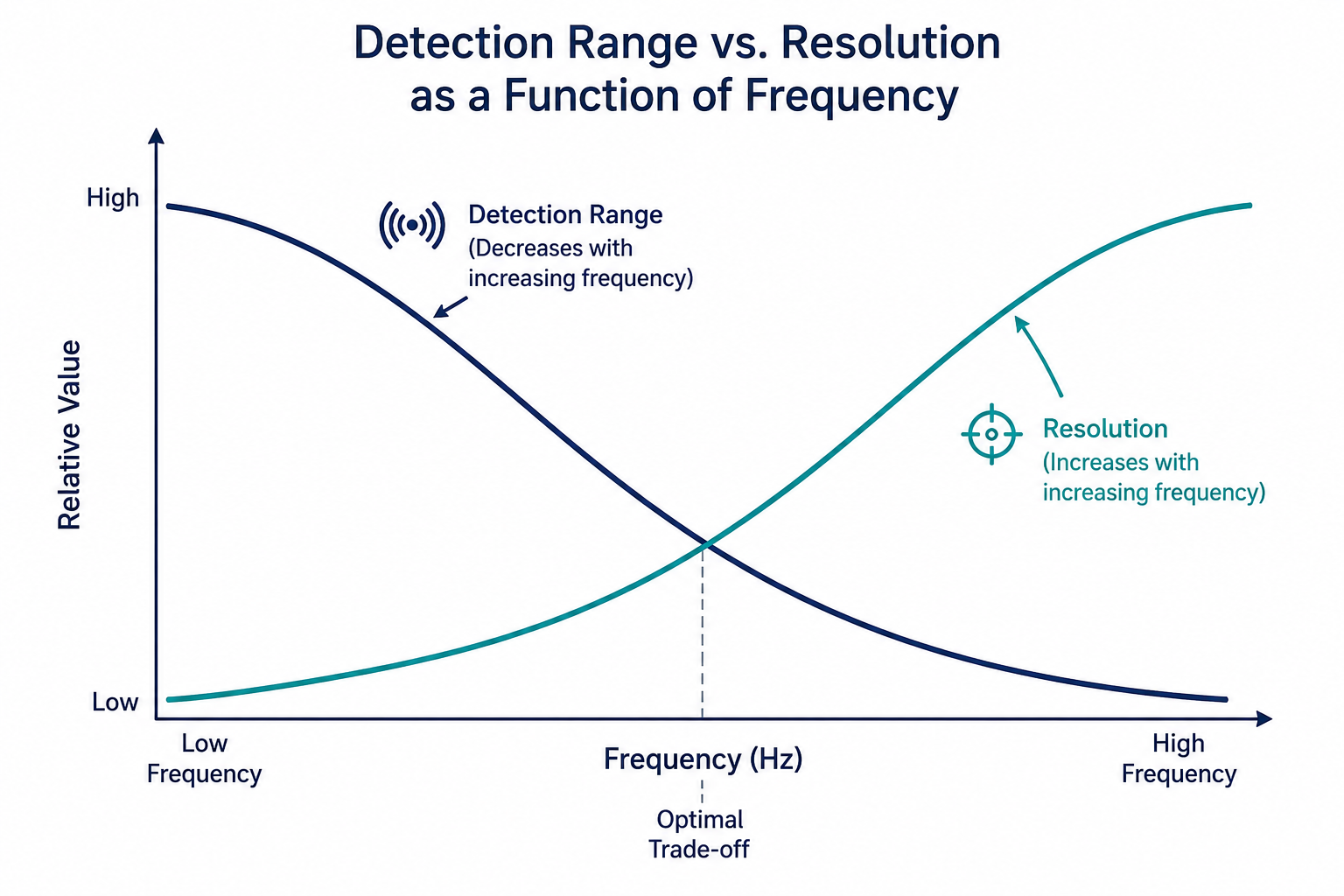
Frequency tradeoffs matter enormously here. Lower-frequency active sonar travels further with less absorption loss, making it useful for long-range search, but produces coarser resolution — it's harder to distinguish fine detail or discriminate a genuine target from clutter. Higher-frequency active sonar gives much sharper resolution and better target discrimination, but the signal attenuates far more quickly, limiting effective range to a fraction of what a low-frequency system can achieve. Real systems typically carry multiple frequency modes specifically to trade off between these two regimes depending on the tactical situation.
Why it's powerful. Active sonar gives an operator fast, precise range and bearing data in a single transmission, which passive listening alone often cannot achieve without extended observation time.
Why it's risky. The ping is audible to everyone within range — including the target, and including any other vessel that happens to be listening. Using active sonar announces the searcher's own position, roughly proportional to the same range at which the ping itself is useful for detection. This is why active sonar is typically used selectively, once a contact has already been suspected through other means, rather than as a default search method across an entire patrol.
5. Side-by-Side Comparison
Passive Sonar
Active Sonar
Method
Listens for radiated noise
Transmits a pulse, listens for echo
Reveals own position?
No
Yes
Range accuracy
Weak alone; needs triangulation or multiple platforms
Strong, immediate, from a single transmission
Bearing accuracy
Good
Good
Frequency tradeoff
N/A — receives whatever the target radiates
Low freq = long range, poor resolution; high freq = short range, fine resolution
Vulnerable to thermocline shadow zones?
Yes
Yes, differently — the outbound ping and the return echo can both be deflected
Typical use case
Continuous wide-area search, covert tracking
Precision localization once a contact is suspected
Data an AI model works with
Continuous raw acoustic stream, radiated signatures
Discrete return-echo pulses, timing and Doppler data
6. A Worked Scenario
It's worth walking through how these two methods typically combine in practice, because neither is normally used entirely in isolation.
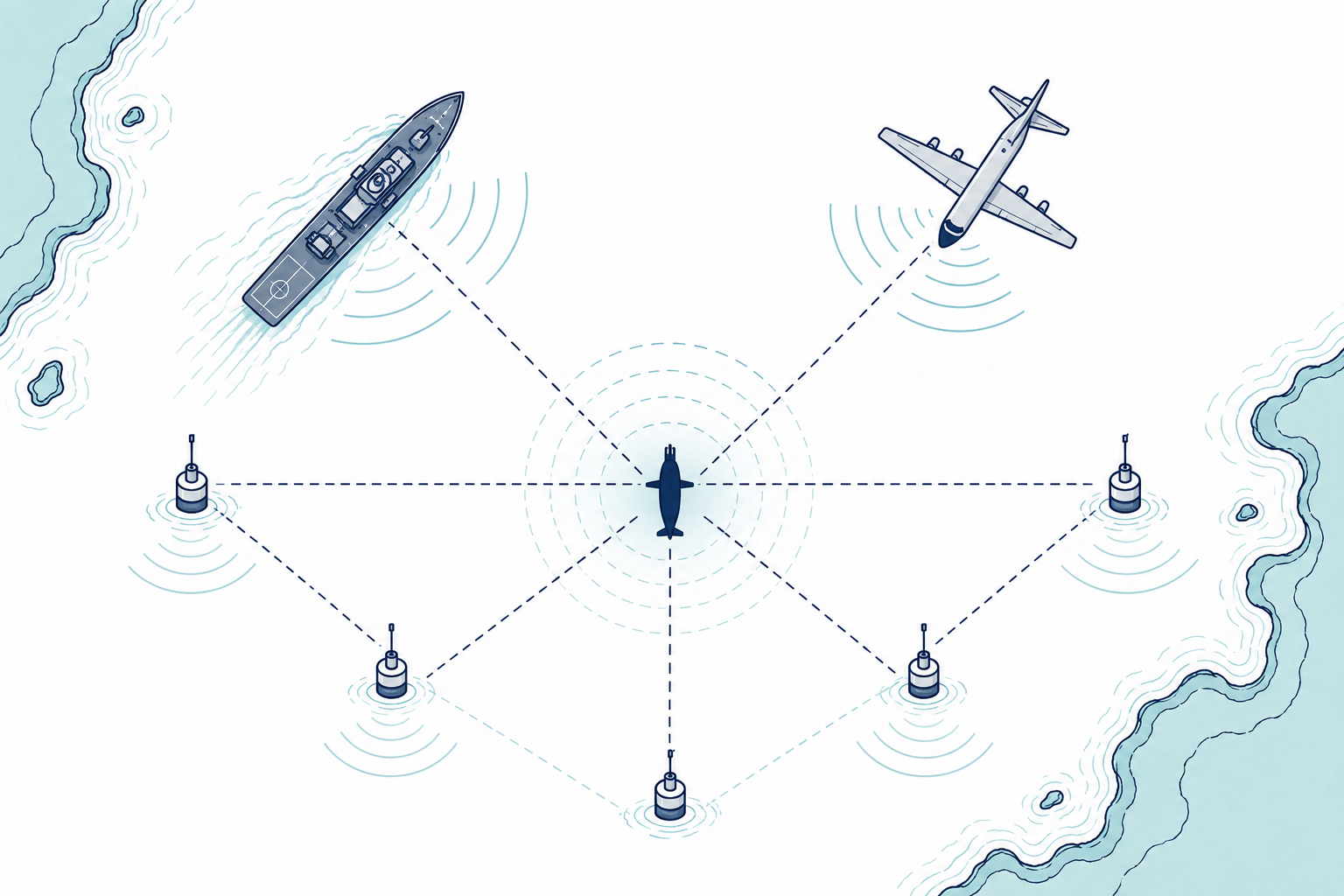
A maritime patrol aircraft seeds a suspected search area with a pattern of passive sonobuoys. For an extended period, the aircraft (or a shore station relaying the buoy data) listens passively, using automated classification to sift genuine vessel signatures from biological and environmental noise. Once a contact is classified with reasonable confidence as a submarine and a rough bearing is established from multiple buoys, a decision point arrives: continue passive tracking to refine the position over time, accepting the delay, or transition to active sonar — either from the aircraft itself, a nearby surface ship, or a dipping sonar lowered from a helicopter — to get a precise range and bearing immediately, accepting that the target (and anyone else listening) now knows roughly where the searcher is.
This is precisely the kind of decision that multistatic sonar is designed to make less costly: rather than one platform pinging and giving away one position, multiple sources — ships, buoys, even other aircraft — transmit or receive in a coordinated pattern, so that a single ping's exposure risk is spread across a network rather than concentrated on one obvious source, while the combined bearing and range data from multiple receivers produces a more reliable fused position than any single platform could achieve alone. Multistatic approaches have become increasingly important precisely because modern submarines are quieter than ever, which pushes detection strategy away from passive listening alone and toward more active, networked sensing that trades a higher individual exposure risk for a much lower total number of transmissions needed to achieve a confident detection.
7. Where AI Changes the Equation
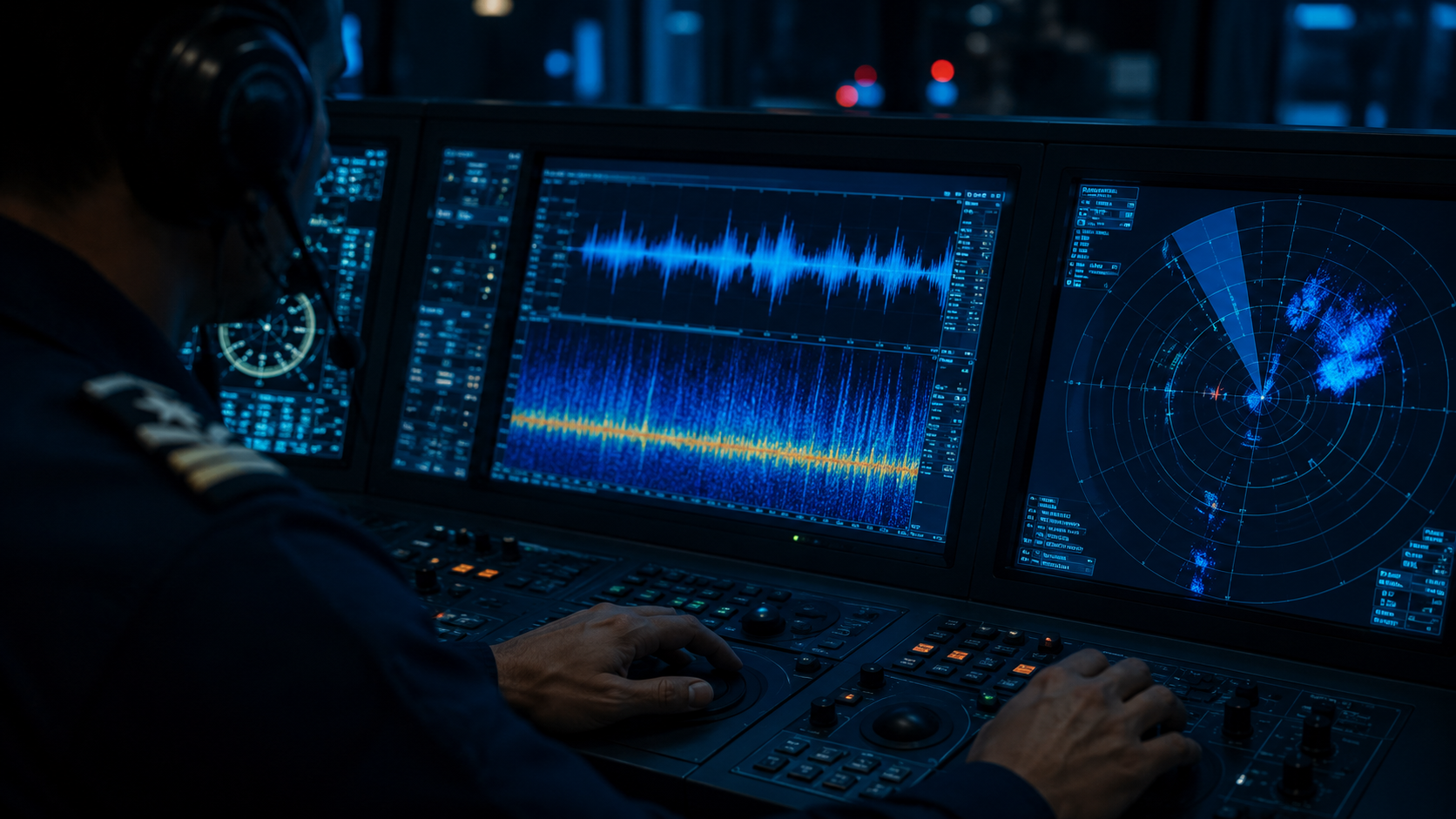
Historically, both passive and active sonar depended heavily on a trained human operator's ear and experience — sonar operator training has traditionally taken years to reach proficiency, and even experienced operators fatigue and vary in performance across a long watch.
On the passive side, machine learning models — typically convolutional neural networks trained on spectrogram representations of the acoustic signal — take over the job of pattern recognition: is this contact biological (a whale, a school of fish), a commercial vessel, or something that matches known submarine acoustic signatures? Because passive sonar produces a continuous stream of data rather than discrete events, these models generally need to process long, overlapping time windows and are evaluated as much on false-alarm rate over hours of continuous listening as on raw classification accuracy on a single clip.
On the active side, AI is increasingly used for automated target detection within the return echo — separating a genuine target echo from clutter, seabed reflections, and biologics — and, more recently, in coordinating multistatic sonar networks: fusing the multiple return angles and timing data from several receivers into a single, more reliable detection and track, a data-fusion problem that is architecturally quite different from passive classification, since it's combining structured geometric measurements from multiple sources rather than classifying a single continuous audio stream.
8. The Practical Tradeoff AI Can't Remove
No amount of AI sophistication eliminates the fundamental tradeoff between passive and active sonar — it just makes each side of it more effective. A better passive classification model still can't give you precise range without multiple sensors or extended observation time. A better active detection model still gives away your position the moment it pings. What AI does change is the threshold at which each becomes viable: better passive classification means fewer speculative active pings are needed to confirm a contact in the first place, and better multistatic fusion means active sonar can be used more precisely and more sparingly, trading fewer transmissions for more confidence per transmission.
That's the real story of AI in sonar — not a replacement for the physics, but a way of extracting more certainty out of every piece of acoustic data the physics allows anyone to collect, on both sides of the passive/active divide.
Sources
Academic and naval-technology literature on sonar fundamentals, thermocline propagation, and frequency-dependent sonar performance
Historical literature on the development of ASDIC and early sonar systems
Public reporting on multistatic sonar deployment trends in modern anti-submarine warfare, 2026