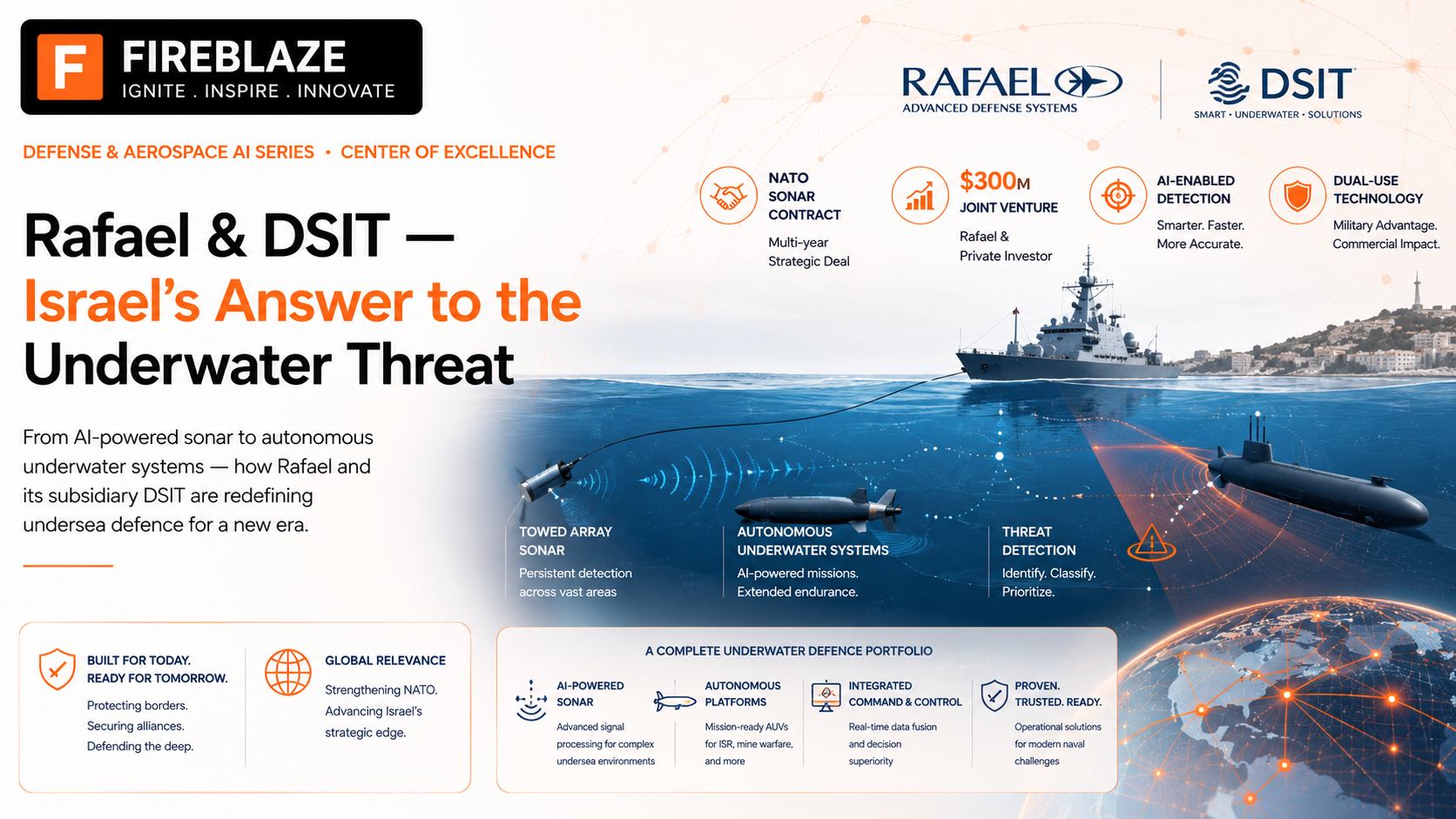
Rafael & DSIT — Israel's Answer to the Underwater Threat
Executive Summary
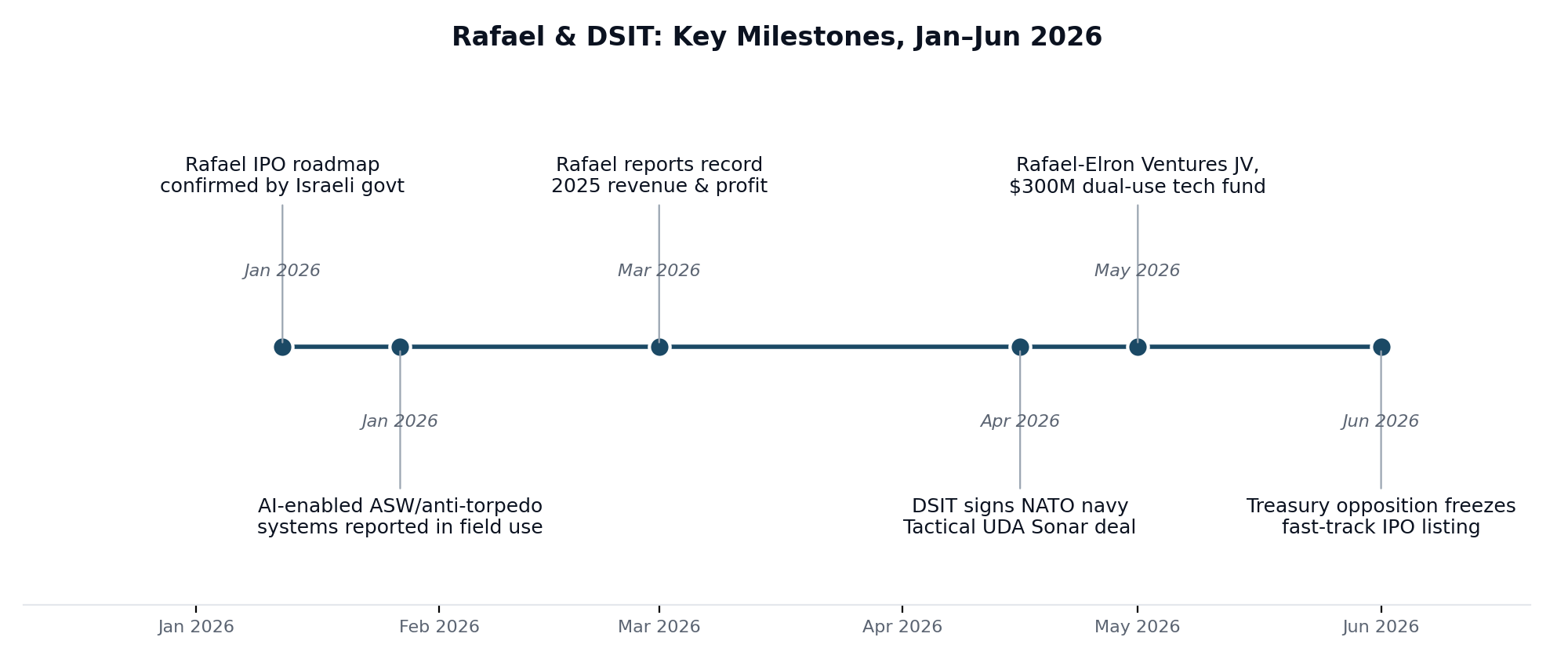
Israel's Rafael Advanced Defense Systems and its subsidiary DSIT Solutions have spent the last year expanding one of the most complete AI-enabled underwater defence portfolios in the world. Between January and June 2026 alone, the pair moved through a NATO sonar contract, a $300 million joint venture for dual-use technology acquisition, a record revenue year, and the early stages of a long-debated privatization. This report walks through what Rafael and DSIT actually build underwater, how AI fits into it, and why 2026 has become such an active year for both companies.
1. Company Overview: Rafael Advanced Defense Systems
Rafael began in 1948 as Israel's National R&D Defense Laboratory, operating for decades as a state-owned enterprise before incorporating as a limited company in 2002. Today it is one of Israel's three major defence primes, alongside Elbit Systems and Israel Aerospace Industries (IAI), and employs more than 2,000 people out of its Haifa headquarters.
Rafael's portfolio spans air, land, sea, and space systems: air defence (including Iron Dome and the Iron Beam laser interceptor), missile and targeting systems, electronic warfare, guided weapons, armoured vehicle protection (Trophy active protection system), and — the focus of this report — underwater and anti-submarine warfare systems. In January 2026, the Israeli government confirmed a roadmap to partially privatize Rafael via an IPO on the Tel Aviv Stock Exchange, floating an initial 25–30% minority stake. That process has since hit friction: by June 2026, Treasury opposition to a fast-track listing had reportedly frozen dividend payments, leaving the privatization timeline unsettled even as the company posted record 2025 revenue and profit.
2. DSIT Solutions: The Underwater Specialist
DSIT Solutions is Rafael's dedicated underwater-systems subsidiary, and has spent close to three decades building sonar and acoustic-analysis technology across six solution areas:
Underwater Coastal Terrain Dominance
Underwater Security
Anti-Submarine Warfare (ASW)
Acoustic Analysis & Trainer Systems
Sonar Systems for Submersible Platforms
Underwater Communication Systems
Where Rafael brings scale, integration, and platform-level systems (like the combined Torpedo Defense Solution described below), DSIT brings the sonar and signal-processing depth that sits underneath most of Rafael's underwater offerings.
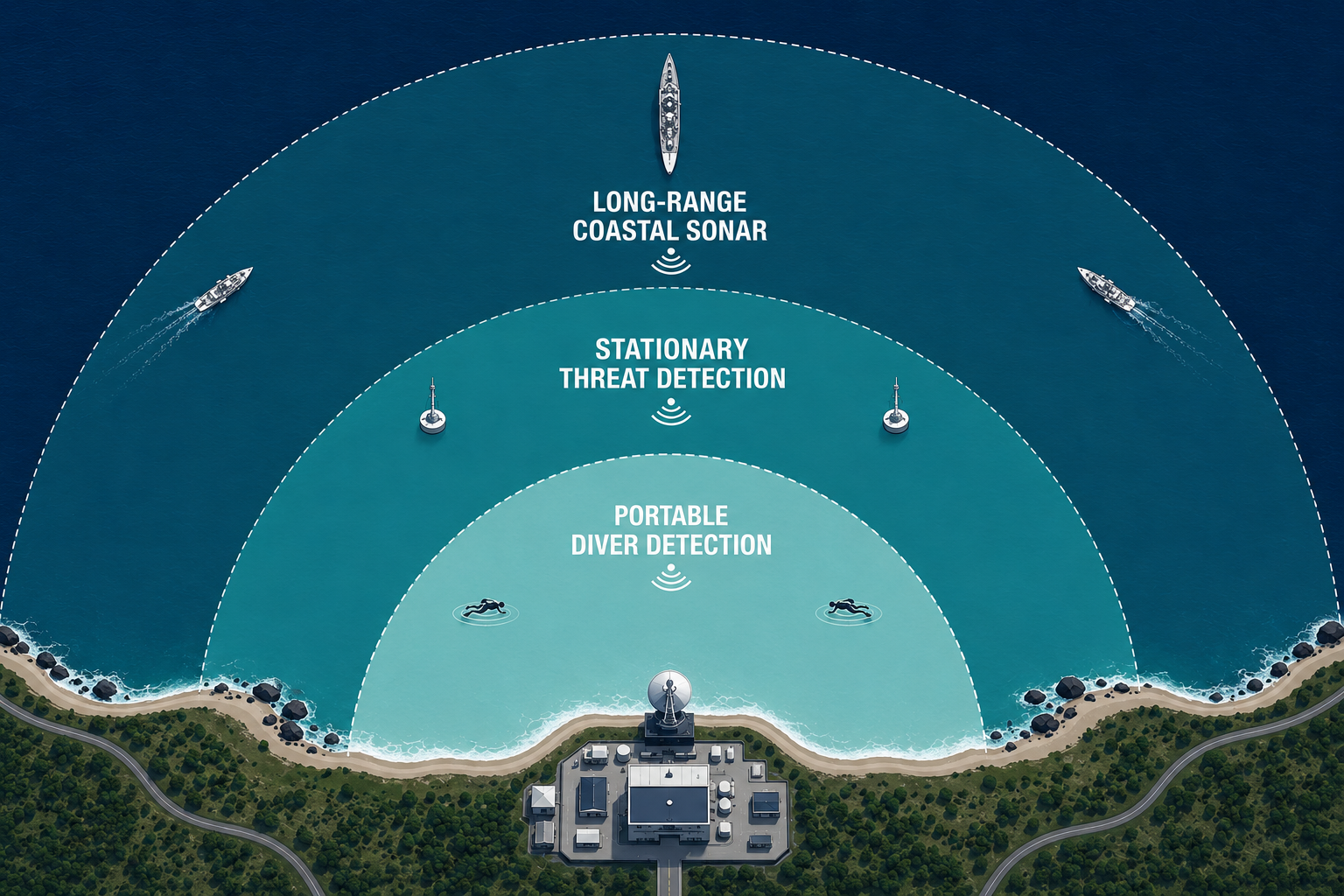
Shorter-range diver and threat detection, optimized for ports and offshore platforms
Stationary
PointShield
DSIT
Portable underwater threat detection
Portable
BlackFish (HMS)
DSIT
Medium-frequency Hull Mounted Sonar for surface-vessel self-protection in littoral and deep-water ASW
Hull-mounted
WhitePointer (UCS)
DSIT
Underwater Communication System — voice/data between surface vessels, submarines, other underwater users
Integrated
Torpedo Defense Solution
DSIT + Rafael
Combines DSIT torpedo detection/classification/tracking sonar with Rafael's Anti-Torpedo Defense System (ATDS)
Surface vessel-installed
TORBUSTER SP
Rafael
Hard-kill torpedo countermeasure
Component of ATDS
Scutter Mk3
Rafael
Soft-kill torpedo decoy (optional)
Component of ATDS
Across this portfolio, the throughline is the same: reduce the time and expertise it takes a human sonar operator to tell the difference between background ocean noise and an actual threat.
4. The AI Layer: How Machine Learning Powers These Systems
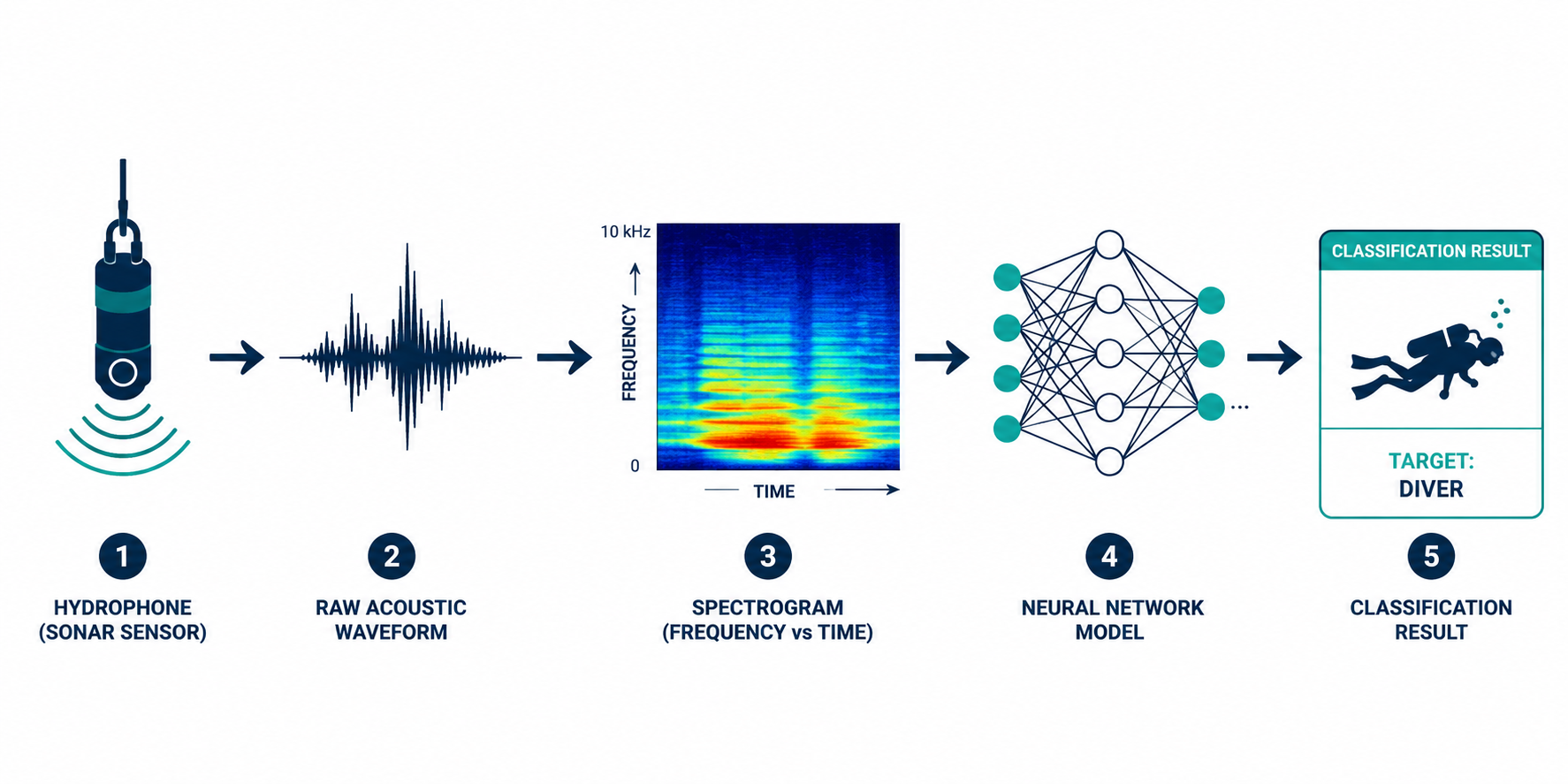
DSIT's own product messaging is specific about where machine learning sits in the pipeline: automation algorithms embedded in the sonar systems handle contact classification, reducing both operator workload and the level of specialist expertise needed to run them. Convolutional neural networks process acoustic signatures and, where relevant, underwater video feeds in real time — turning a raw hydrophone signal into a classified, labelled contact with an associated confidence level.
The practical goal stated by DSIT leadership is a low false-alarm rate without sacrificing sensitivity — this is the same precision/recall tradeoff familiar from any anomaly-detection system, just with much higher operational stakes: a missed detection can mean an undetected submarine or diver near critical infrastructure, while a high false-alarm rate burns out operator attention and trust in the system.
5. Recent Milestones & Contracts
Date
Event
Jan 12, 2026
Israeli government confirms roadmap for partial Rafael privatization (IPO)
Jan 27, 2026
Reporting details Rafael/DSIT fielding AI-enabled ASW and anti-torpedo systems amid rising concern over Iranian undersea activity
Mar 2026
Rafael reports record 2025 revenue and profit
Apr 16, 2026
DSIT signs deal to supply Tactical Underwater Domain Awareness (UDA) Sonar systems to a NATO navy
May 2026
Rafael and Elron Ventures announce joint venture, allocating up to $300M to acquire dual-use defence technology companies
Jun 2026
Treasury opposition to a fast-track IPO listing reportedly freezes dividend payments
(Earlier in 2026, DSIT's ASW suite was also selected by a European shipyard for a new vessel construction program — timing not independently pinned down beyond "earlier this year" per company statements.)
6. The Geopolitical Backdrop
Three separate regional dynamics are driving demand for exactly this kind of system in 2026:
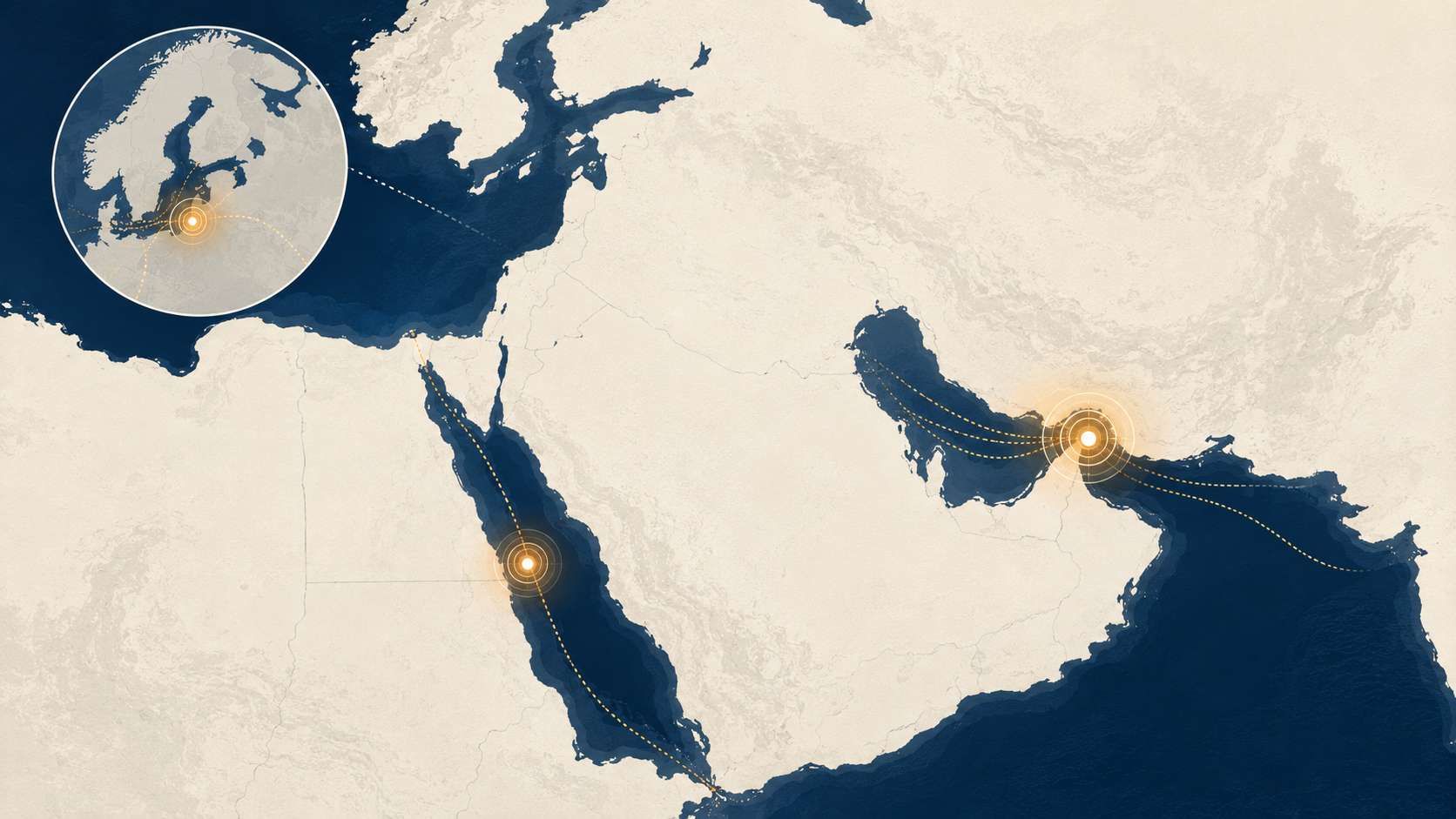
Iran and the Strait of Hormuz — Israeli officials increasingly cite Iranian undersea capabilities and proliferating underwater platforms as a strategic concern, in both shallow coastal waters and deep water.
Red Sea disruption — Houthi attacks on commercial shipping lanes have elevated the importance of maritime domain awareness well beyond Israel's immediate coastline.
Undersea infrastructure sabotage — The Russia-Ukraine war has repeatedly exposed the vulnerability of undersea pipelines and communication cables, pushing subsea warfare and surveillance up the priority list for NATO navies generally, not just Israel's.
That last point is almost certainly what's behind DSIT's April 2026 NATO contract — a Western navy buying Israeli-built underwater domain awareness technology is a direct signal of how seriously undersea infrastructure protection is now being taken outside Israel's immediate neighbourhood.
7. Corporate Context: IPO, Expansion, Investment
Rafael's privatization story is worth watching independent of the underwater business specifically. The company's leadership has reportedly pushed for the IPO for years, arguing that full state ownership created a "bureaucratic glass ceiling" that made it harder to compete with publicly traded rivals Elbit and IAI for engineering talent. The May 2026 Elron Ventures joint venture — a $300M vehicle aimed at acquiring dual-use defence technology companies — suggests Rafael is already positioning for a more acquisitive, market-facing posture regardless of how the IPO timeline resolves.
For DSIT specifically, none of this is directly about underwater systems, but it matters for the same reason funding history matters for any advanced-tech supplier: a well-capitalized, increasingly market-oriented parent company is more likely to keep investing in R&D for a product line (underwater AI/sonar) that, until recently, sat somewhat outside the headline-grabbing parts of Rafael's business (Iron Dome, Iron Beam, air defence).
8. Strategic Outlook
A few things are worth watching from here:
Whether the NATO deal is a one-off or a pattern. One NATO navy contract doesn't establish a trend, but given the Baltic Sea undersea sabotage concerns raised elsewhere in NATO discourse, DSIT is well positioned if more Western navies start procuring underwater domain awareness sonar rather than building it in-house.
Whether the IPO actually happens on the stated timeline. The Treasury pushback reported in June 2026 suggests this isn't a settled question, and a delayed or scaled-back IPO could affect how aggressively Rafael invests in less-visible product lines like DSIT's.
Whether the false-alarm-rate claims hold up at scale. DSIT's stated selling point — high sensitivity with low false alarms — is the central promise of every AI-based detection system. It's also the hardest claim to independently verify from public reporting alone, since these numbers rarely get published outside vendor statements and customer testimonials.
Sources
Rafael Advanced Defense Systems — Wikipedia
"AI-Powered Underwater Warfare: Rafael and DSIT Deploy Next-Generation Submarine Defense and Surveillance Systems," Autonomy Global, Jan 27, 2026
"DSIT Solutions Secures NATO Sonar Deal for Underwater Threat Detection," Israel Defense, Apr 16, 2026
Rafael Advanced Defense Systems company profile — GlobalData
Rafael Advanced Defense Systems — Finder / StartupNation Central
DSIT Solutions Ltd. — company profile (The Org, LinkedIn)