RF Detection vs. Radar vs. EO/IR: How AI Actually Spots a Small Drone
The Uncomfortable Truth: Every Sensor Has a Blind Spot
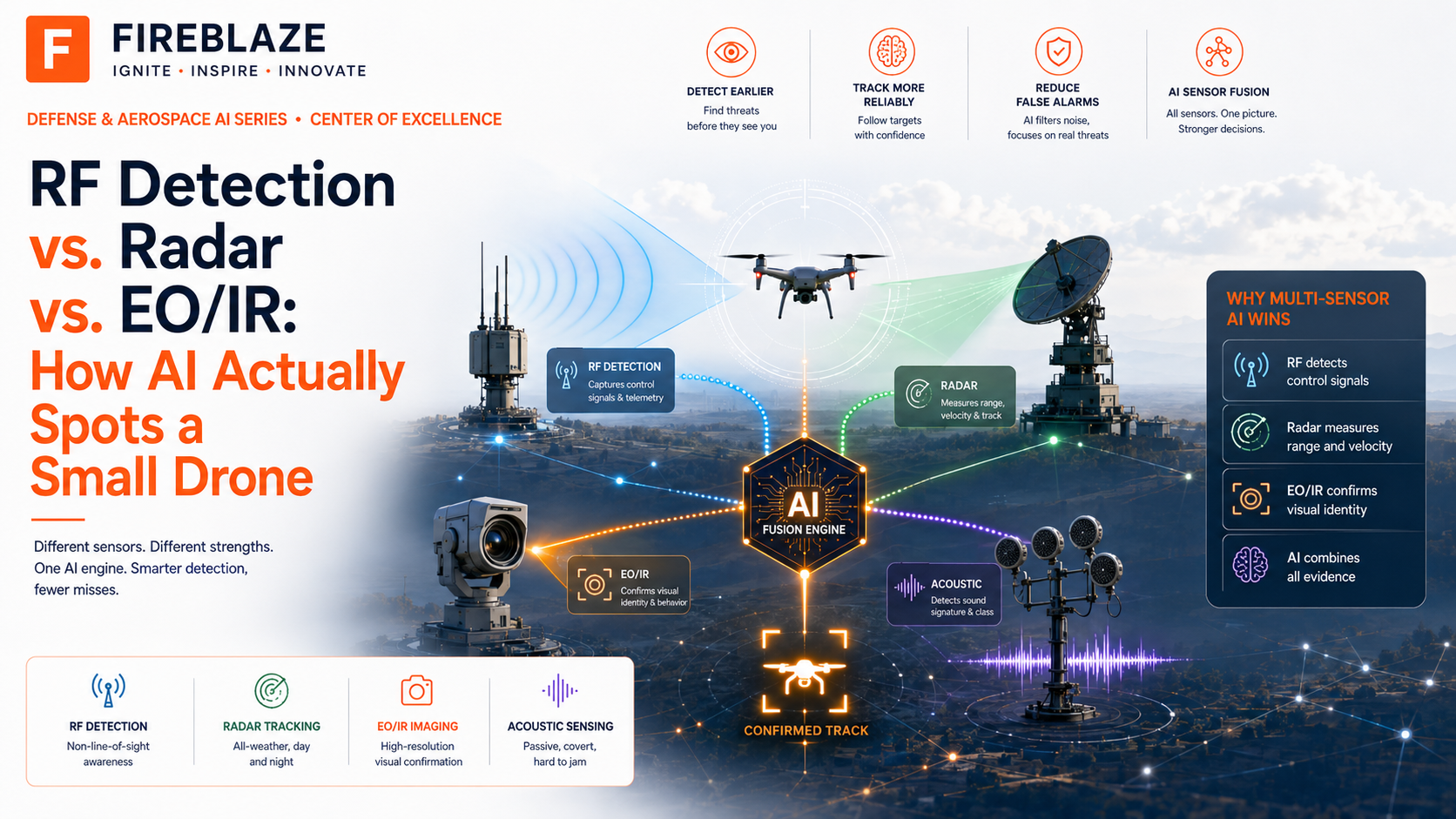
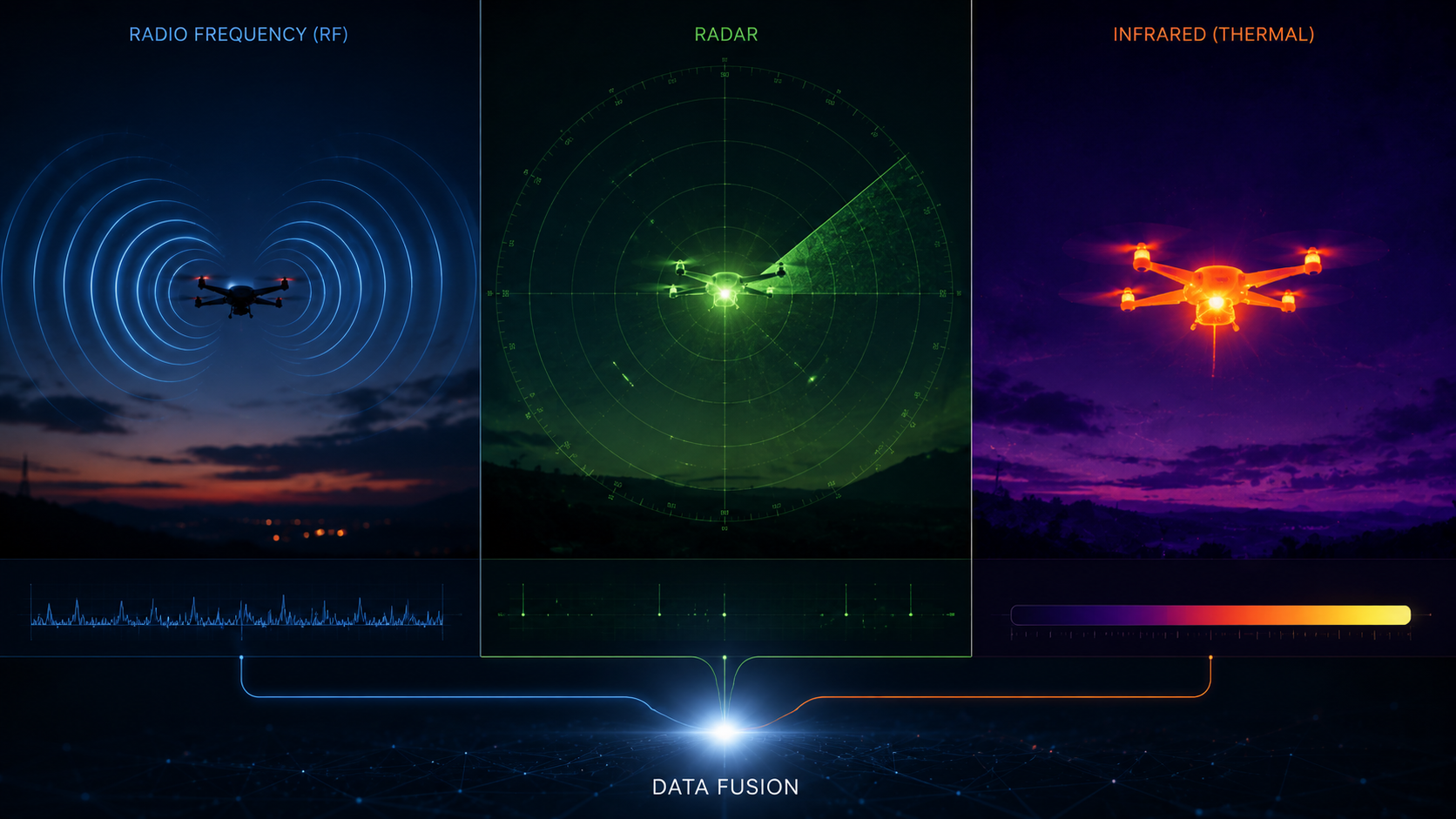
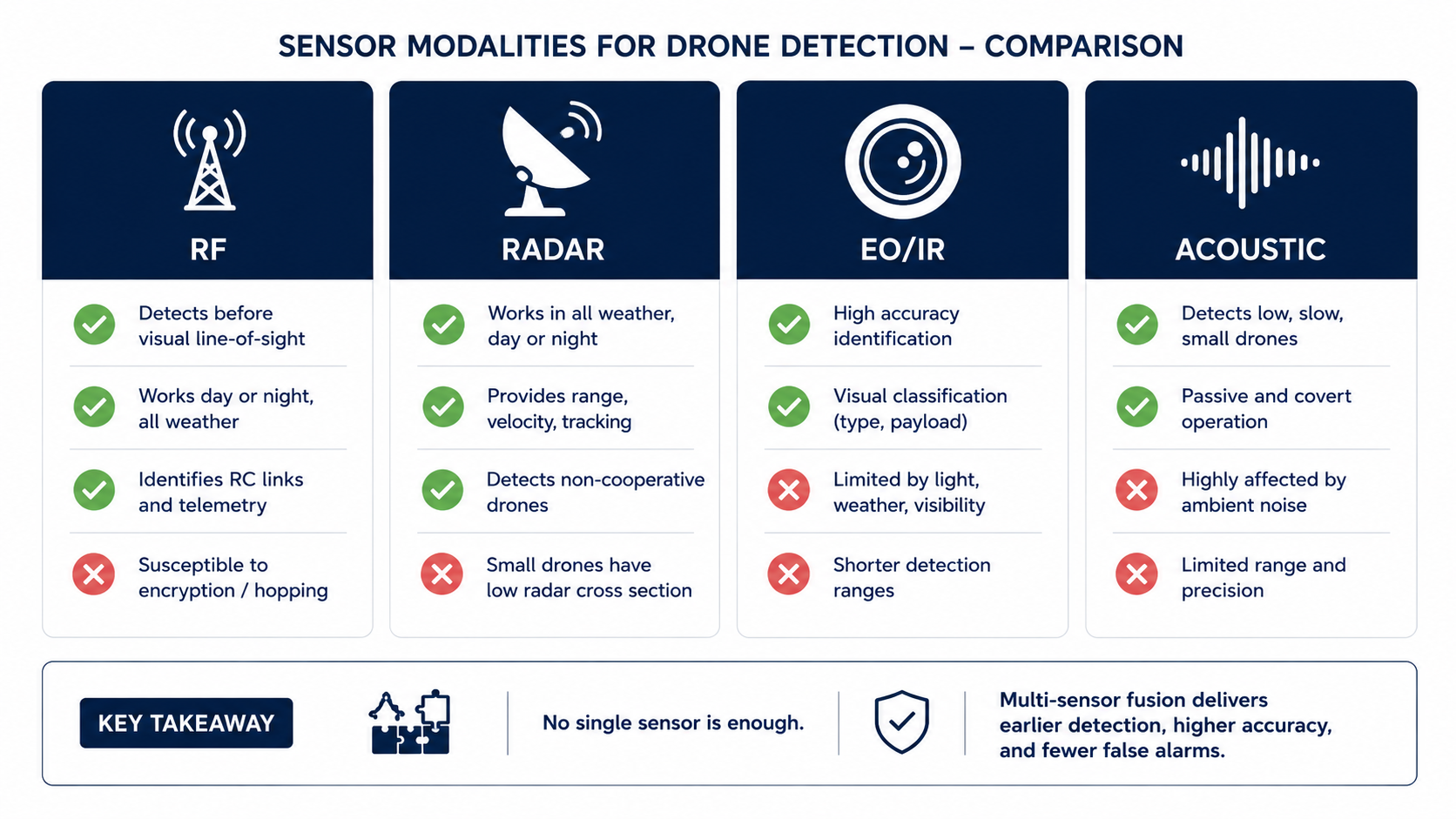
If there were one perfect way to detect a small drone, counter-UAS systems wouldn't need three or four different sensor types stacked together. But small drones are, by design or by accident, extremely good at exploiting the specific weaknesses of any single detection method. That's why modern systems universally rely on sensor fusion — combining radio-frequency (RF) detection, radar, electro-optical/infrared (EO/IR) cameras, and often acoustic sensors — with AI doing the work of reconciling what each one reports.
Understanding why fusion is mandatory, not optional, starts with understanding exactly where each modality on its own falls apart.
RF Detection: Hears the Conversation, Not the Drone
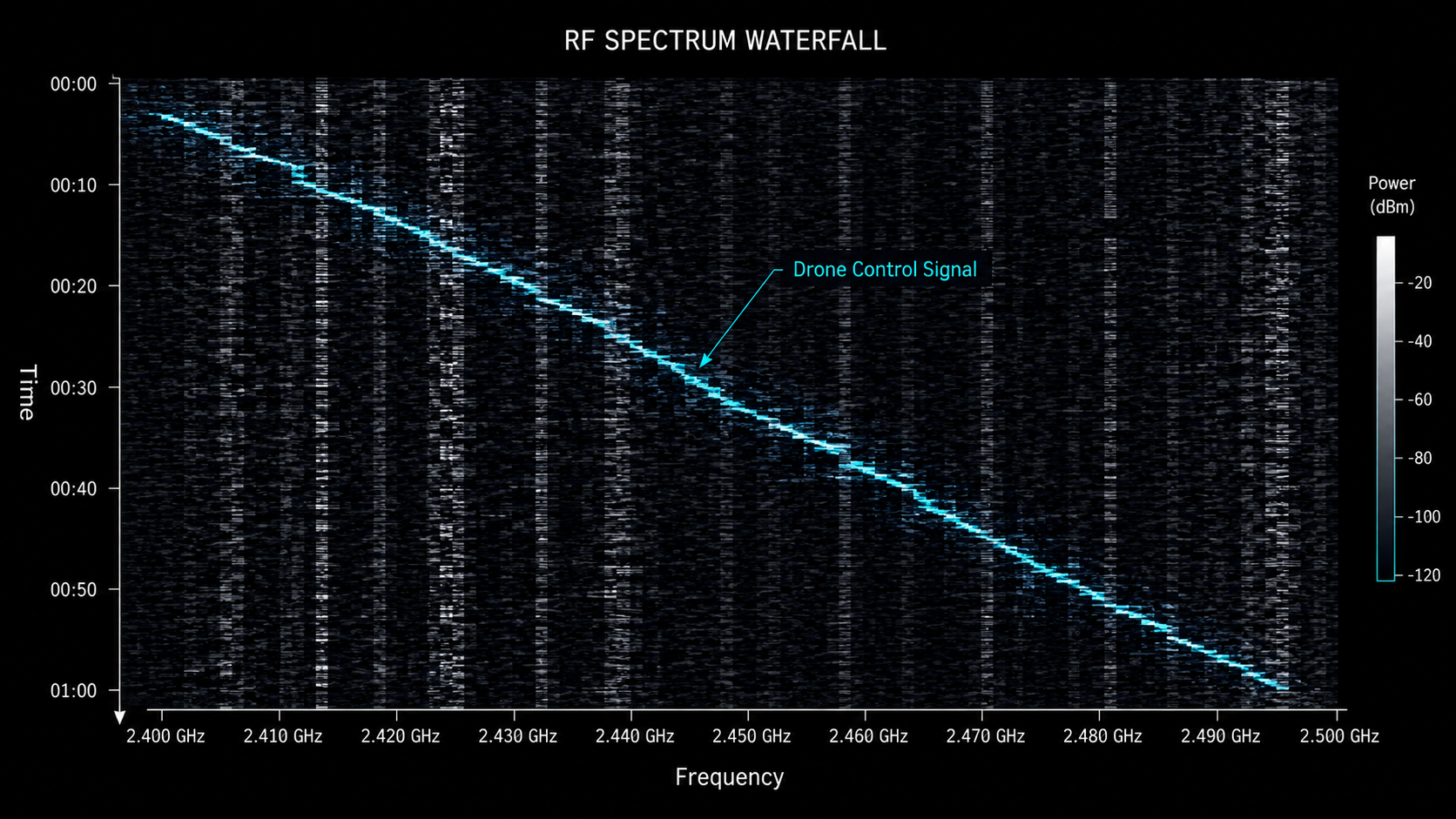
RF sensors listen for the radio communication between a drone and its operator — control signals, video downlink, telemetry. Done well, RF detection is uniquely valuable because it can locate not just the drone but the operator controlling it, sometimes before the drone itself is even visible or in range of radar.
But RF detection has a fundamental ceiling: it can only hear a drone that's talking. A fully autonomous drone flying a pre-programmed route with no active radio link is functionally invisible to RF sensors — a growing category of threat as GPS-denied and pre-programmed autonomous navigation become more common in adversary systems.
The signal-processing challenge is also harder than it sounds. Field measurements show small UAS can generate RF signatures as faint as -110 dBm at operational range, often buried inside ambient electromagnetic noise floors averaging around -90 dBm in urban settings — meaning the signal a system is trying to catch can be twenty decibels quieter than the noise surrounding it, across frequency bands spanning 400 MHz to 5.8 GHz. And because a drone can close distance at over 15 meters per second, detection systems typically need to process that faint signal and return a usable answer in well under 100 milliseconds to leave any time for a response.
Radar: Sees the Object, Not the Signal
Where RF fails against a silent, autonomous drone, radar succeeds — because radar detects the physical object itself, not any signal it emits. A drone with no radio link at all is just as visible to radar as one broadcasting constantly.
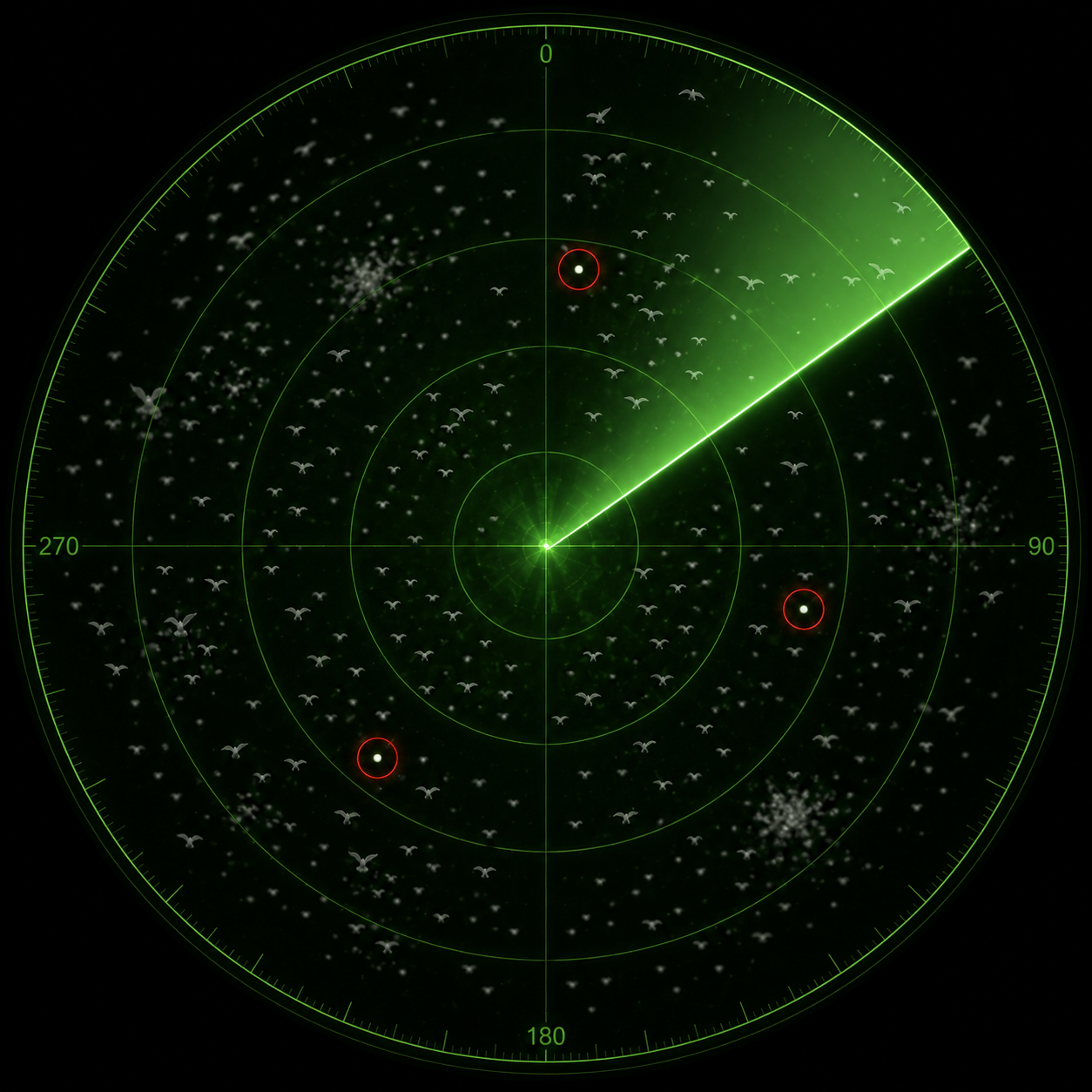
The catch is that small drones present a genuinely difficult radar target. Their radar cross-section (RCS) is tiny, they fly slowly, and they typically operate at low altitude — exactly the flight profile that classic radar filtering was designed to ignore as clutter (birds, insects, wind-blown debris, ground reflections). Traditional Doppler-based filtering, tuned to separate fast-moving aircraft from a stationary background, often fails to reliably separate a slow-moving drone from that same background clutter.
This gets dramatically worse with multiple drones. Individually low-RCS returns from several drones flying close together can blend into what looks like a single clutter cluster rather than distinct tracked objects — a problem the fourth article in this series covers in depth.
Newer 4D radar systems (measuring range, azimuth, elevation, and Doppler velocity simultaneously) with faster update rates and adaptive signal processing are the current answer, but even these perform best when corroborated by another sensor type.
EO/IR: The Eyes That Need a Pointing Finger
Electro-optical (visible light) and infrared (thermal) cameras provide something neither RF nor radar can: actual visual confirmation. In the counter-UAS kill chain, EO/IR is often described as the system's "eyes" — the sensor that turns an ambiguous radar blip or RF alert into a confirmed drone, ideally with enough detail to distinguish a harmless commercial quadcopter from one modified to carry a payload.
The tradeoff is that EO/IR sensors are narrow-field and need to be pointed at the right patch of sky to be useful — they're built to slew toward a location cued by radar or RF detection, rather than scan the whole sky continuously on their own. They're also, unsurprisingly, affected by weather and lighting: fog, rain, and darkness all degrade EO performance, though thermal IR holds up better at night.
AI's role here is direct and mature: convolutional object-detection models (the YOLO family being a common backbone) run on the video feed to automatically classify what the camera sees, rather than relying solely on a human operator squinting at a screen.
Acoustic: The Cheap, Short-Range Backstop
Acoustic sensors — essentially sensitive microphones tuned to rotor and motor sound signatures — round out the fusion stack. They're inexpensive (on the order of a few hundred dollars per sensor station) and passive, making mass deployment practical in a way more sophisticated sensors aren't.
Ukraine's Zvook acoustic sensor network is a striking real-world example of this approach at scale: reportedly over 9,500 acoustic sensors covering roughly 20,000 square kilometers, detecting drones at up to 4.8 km and cruise missiles at up to 6.9 km, with average processing time of about 12 seconds from detection to alert and a reported false-positive rate around 1.6% — evidence that a cheap, low-tech-sounding sensor type can deliver genuinely mature performance when deployed at scale with good signal processing behind it.
The Comparison, Side by Side
Sensor Type
Detects
Key Strength
Key Weakness
RF
Communication/control signals
Can locate the operator, not just the drone
Blind to silent, autonomous, or fiber-optic-controlled drones
Radar
The physical object itself
Works regardless of communication or lighting/weather
Small RCS and clutter make detection and discrimination hard
EO/IR
Visual/thermal appearance
Only sensor providing true visual confirmation
Narrow field of view; needs cueing; weather/lighting sensitive
Acoustic
Motor/rotor sound signature
Very cheap, passive, easy to deploy at scale
Short range; degraded by ambient noise and wind
No row in that table is a complete answer by itself. That's the whole reason fusion architectures exist.
Why Fusion, Not Just More Sensors, Is the Real Innovation
Simply bolting four sensor types onto one platform doesn't automatically solve the problem — it can just produce four unreliable opinions instead of one. The actual AI innovation is in how these inputs are reconciled:
Evidence-weighted fusion, where the system doesn't treat every sensor's report equally but weighs each input by how reliable it tends to be in current conditions.
Decision-level and pixel-level fusion of EO/IR streams, combining visible and infrared imagery either after independent detections or earlier in the processing pipeline, depending on which approach a given system's designers found more robust.
Track correlation across sensor handoffs, so a target first flagged by RF, then confirmed by radar, then visually verified by EO/IR, is understood by the system as one continuous track rather than three separate, disconnected alerts.
Research comparing fused versus single-sensor processing has reported roughly 70% faster drone classification when multiple sensor types are combined through AI-driven correlation compared to relying on any one sensor alone — a meaningful gap when the entire kill chain may only have seconds to spare.
The Persistent Challenge: False Alarms vs. Missed Threats
Every fusion system has to walk a tightrope between two failure modes. Tune detection too sensitively, and birds, insects, and weather clutter trigger constant false alarms — inducing "alarm fatigue" in operators, which paradoxically makes them more likely to ignore a real threat when it finally appears. Tune it too conservatively, and small, slow, quiet drones slip through undetected. This tradeoff, more than any single sensor's raw specifications, is what separates a mature fielded C-UAS system from an impressive-looking prototype.
The Bottom Line
Spotting a small drone was never really a single-sensor problem, and treating it that way is exactly why early counter-drone systems built around one dominant technology kept underperforming in the field. The real work — and the real AI — is in fusion: taking a faint radio whisper, an ambiguous radar blip, a narrow camera glimpse, and a rotor hum, and turning all four into one confident, fast, actionable answer. The next article in this series picks up exactly where this one leaves off: once a drone is confidently detected and classified, how does an AI system decide whether to defeat it kinetically or with directed energy?
Sources referenced: TTMS analysis on AI in counter-drone systems, Quickset counter-UAS technical overview, Airsight sensor-type guide, Drone Warfare RF detection technical guide (2026) including Ukraine's Zvook acoustic network data, and peer-reviewed research on multi-sensor drone tracking and fusion.