Why the U.S. Space Force Just Signed a $27M Contract for an AI That Trains Against Fake Enemies
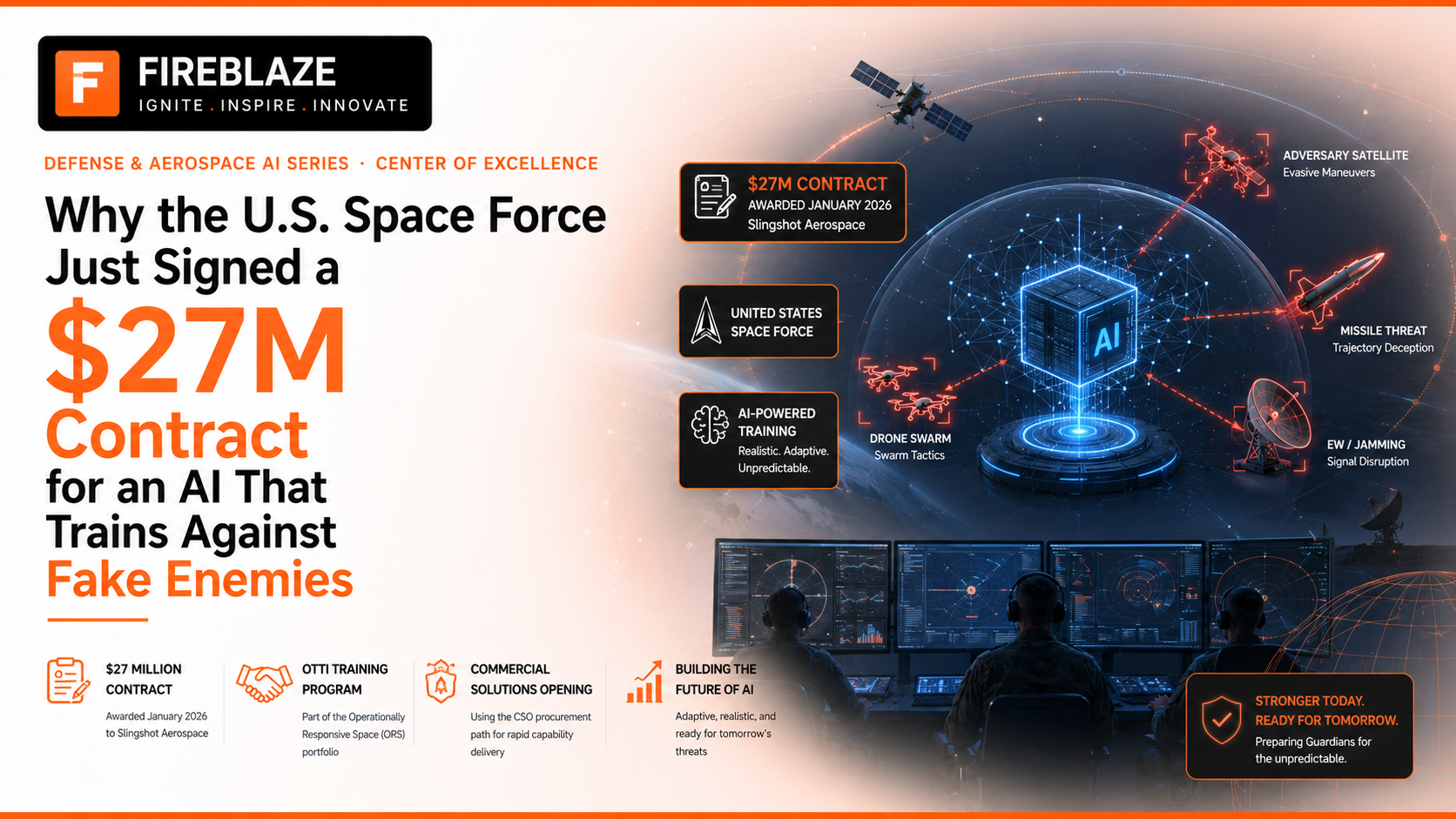
In January 2026, the U.S. Space Force signed an 18-month, $27 million contract with Slingshot Aerospace to help build an AI-driven training environment where operators practice against a synthetic, adaptive adversary instead of a fixed script. On its own, that's one company's win. Zoom out, and it's a clear signal of exactly how the U.S. military is now choosing to fund and buy AI capability — and that procurement pattern matters more than the dollar figure itself.
1. The mechanism: what is a Commercial Solutions Opening?
The contract was awarded through something called a Commercial Solutions Opening (CSO) — a streamlined, faster procurement path designed to let the military buy commercially developed technology without going through the traditional, years-long defense acquisition process. It works in a similar spirit to the Defense Innovation Unit's (DIU) model: instead of writing a detailed, rigid specification and asking companies to bid on building exactly that, a CSO invites companies with existing commercial technology to propose how their product solves a stated military problem.
This matters because traditional defense procurement is famously slow — it can take years to move from an identified need to a signed contract, by which point the technology involved may already be outdated. A CSO can compress that timeline dramatically, which is part of why a relatively young space AI company was able to win a Space Force production contract just a few years after being founded.
2. The customer: what is OTTI?
The contract sits inside the Space Force's Operational Test and Training Infrastructure (OTTI) program — the broader system responsible for building realistic training environments for space operators. In simple terms, OTTI is the "training range" for space warfare, similar in spirit to how the military runs live-fire exercises or flight simulators for other domains, except this range exists mostly in software and simulation because you obviously can't run live-fire exercises in actual orbit.
Slingshot's role within OTTI is specific: its TALOS AI agent plays the "thinking enemy" — sometimes referred to as the Red Cell — inside a larger training system that likely also includes tools from other vendors. The goal is realistic, unscripted adversary behavior available on demand, rather than requiring a team of human analysts to manually script every new training scenario.
3. The dollar figure in context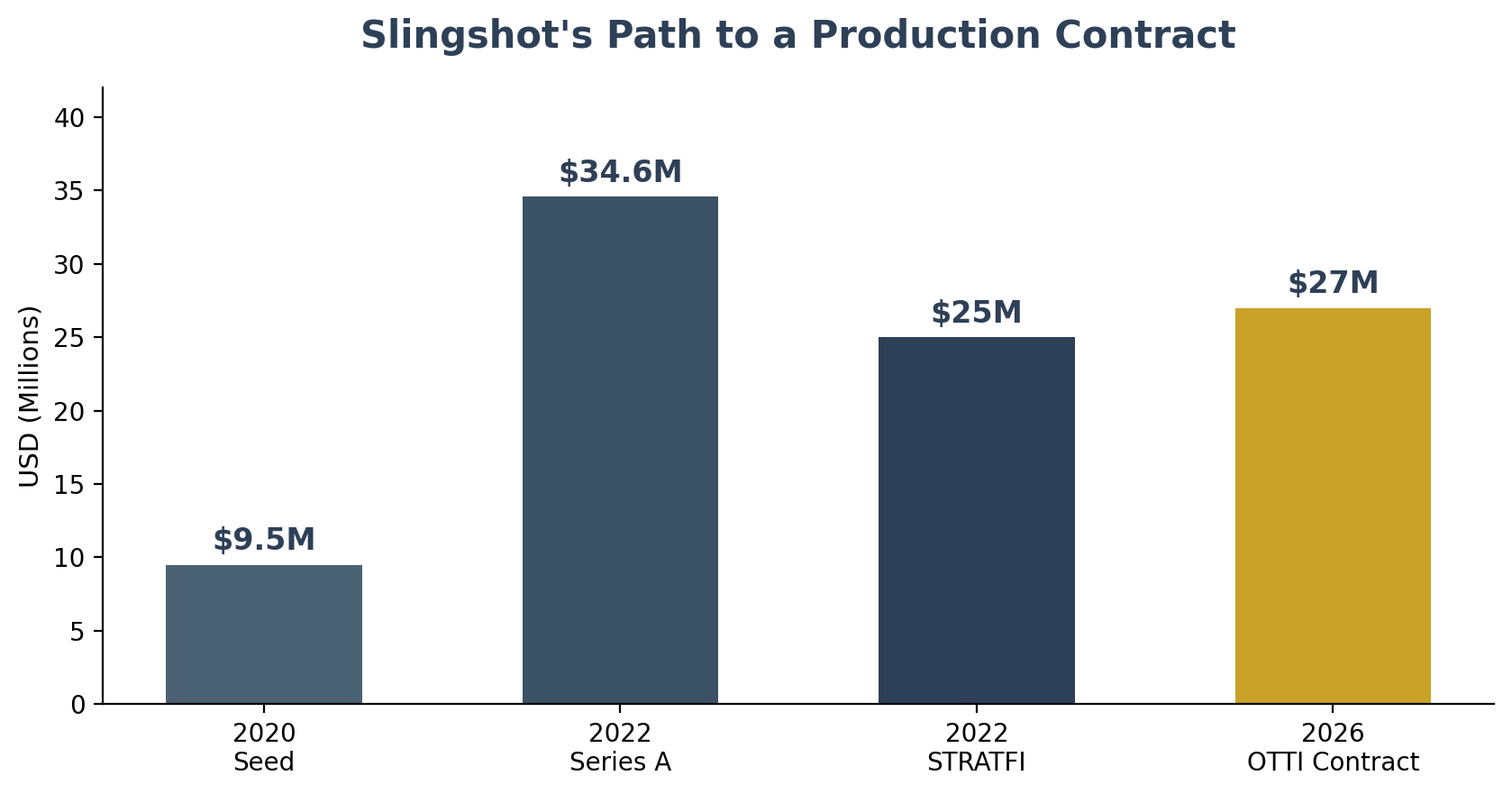
$27 million is a meaningful contract, but it's important to size it correctly. It's not a huge sum by big-defense-prime standards — a single fighter jet can cost more — but it's a serious, credible production contract for a company that started with an $8 million seed round in 2020. The contract also isn't Slingshot's first Space Force relationship: it builds on an earlier $25 million STRATFI award from SpaceWERX in 2022, plus a separate $25.2 million SpaceWERX contract for Slingshot's Digital Twin product that same year.
That progression — seed-stage award, mid-size award, then a full production contract — is a recognizable, repeatable funding path for defense AI startups right now (covered in more depth in a separate piece in this series). The Space Force isn't just funding one company's idea; it's running a now-familiar playbook for de-risking new commercial technology before committing serious production dollars to it.
4. Why the Space Force wants this specific capability now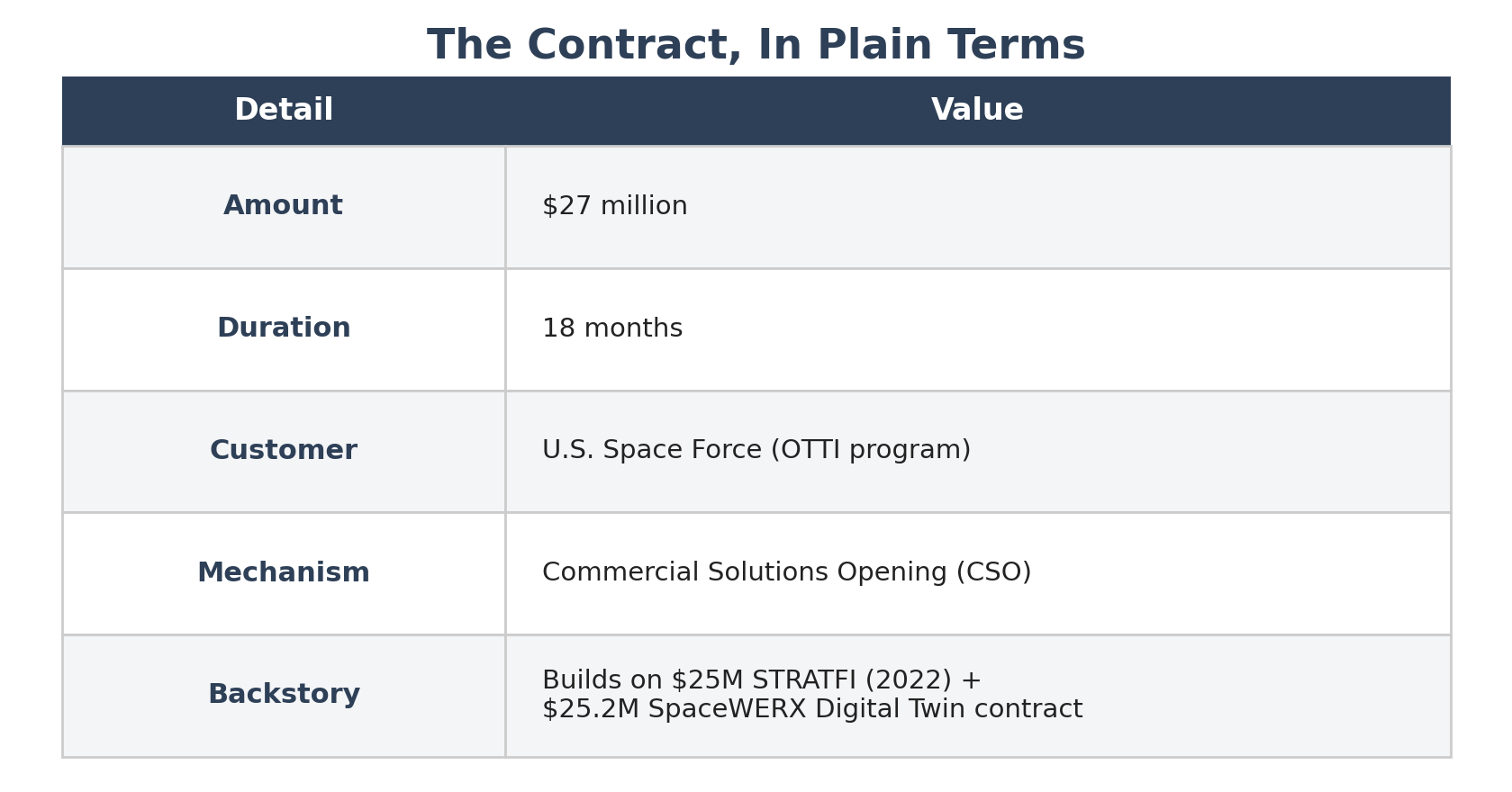
Two forces are pushing this decision. First, orbit has gotten more crowded and more adversarial — near-peer competitors are increasingly operating satellites that maneuver in ways that evolve during an engagement, rather than following fixed, predictable paths. A training system built on scripted, predictable "enemy" behavior simply can't prepare operators for that.
Second, U.S. national defense strategy has explicitly identified space as a priority domain, citing rival nations' growing counter-space and satellite capabilities as a driving concern. Programs like OTTI, and contracts like this one, are a direct, visible response to that strategic priority — not an isolated procurement decision made in a vacuum.
5. What this signals for the broader market
This contract is a useful example of a few bigger shifts happening in defense AI procurement in 2026:
Commercial-first is becoming the default posture for new capability. Rather than the Space Force building this kind of AI training tool in-house or through a traditional prime contractor, it bought an existing commercial capability and adapted it — a pattern increasingly common in defense AI generally.
AI companies with a staged government-funding history are winning bigger contracts faster. Slingshot's path from SBIR-adjacent seed funding to a full production award took a few years, not a decade — a timeline that would have been unusual for defense technology a decade ago.
Training and simulation are becoming a real, fundable AI category on their own — not just detection or targeting. Historically, defense AI investment conversations focused heavily on detection and autonomous weapons; this contract is a reminder that training environments and synthetic adversary generation are just as real a market, arguably an easier one to fund and deploy responsibly, since the AI's output stays inside a simulation rather than making real-world decisions.
Sources: Slingshot Aerospace press releases (January 2026, July 2025); SpaceNews; DefenseScoop; Via Satellite. Contract figures and program details are as publicly reported; deeper contract terms not disclosed in public sources are not claimed here.