Stationkeeping, Drift, or Maneuver? A Plain-English Guide to Satellite Pattern-of-Life
Why This Matters Right Now
Space is getting crowded, and adversary satellite behavior is getting harder to predict. China alone plans to launch huge groups of satellites possibly tens of thousands in total making it almost impossible for human analysts to track and understand what each one is doing without serious AI help. At the same time, rival-country satellites are no longer moving in simple, predictable ways; their tactics can change mid-event, something a scripted training exercise simply cannot replicate.
That's the gap Slingshot Aerospace's TALOS is built to fill: an AI agent trained on real satellite behavior data that plays the role of a realistic, unpredictable "enemy" inside U.S. Space Force training simulations.
What "TALOS" Actually Means
TALOS stands for Thalos Agent for Logical Operations and Strategy an AI agent that copies how real satellites behave, built for training and practice rather than live operations. It was launched in July 2025.
The name borrows from Greek mythology: Talos was a giant bronze robot built to guard the island of Crete, one of the oldest stories about a machine built to protect. Slingshot's version flips that role for training purposes it plays the enemy, not the guardian.
Two things worth knowing upfront:
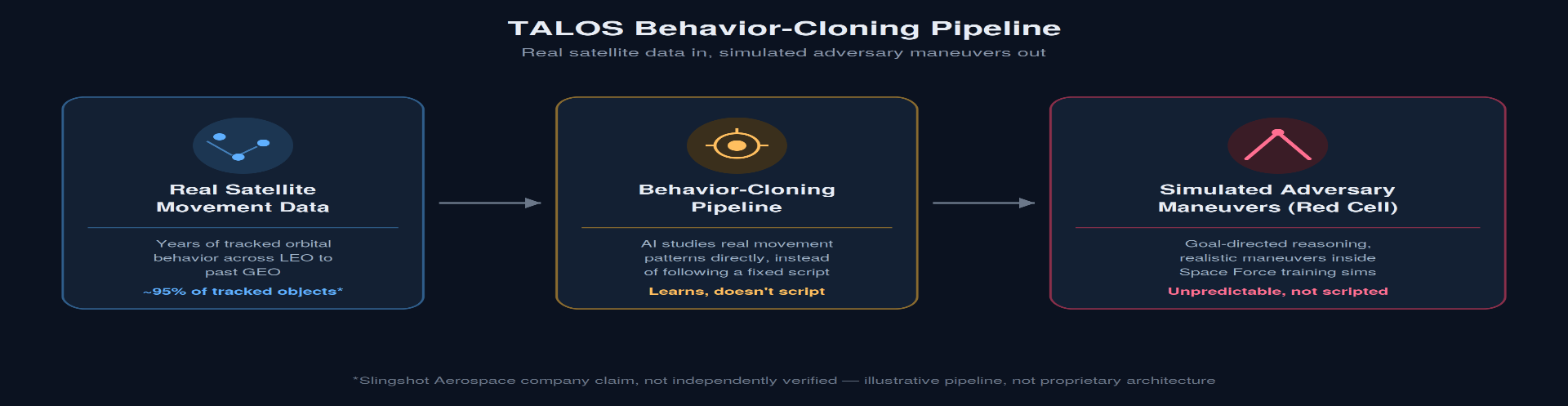
• Behavior cloning pipeline — the core technique behind TALOS. Instead of following a fixed script written by a human, the AI studies a huge volume of real satellite movement data and learns to copy those patterns directly.
• Red Cell — the military training term for the "thinking enemy" role TALOS plays inside larger exercises.
How TALOS Actually Works
Most training tools of the past relied on human-scripted "attack" scenarios useful, but limited and predictable. TALOS is different because of how it learns.
Using its behavior cloning pipeline, TALOS studies years of real satellite movement data and learns to replicate realistic patterns instead of following a fixed script. The company says TALOS can be given a goal, assess its surroundings, reason through different strategies, and then execute maneuvers inside a realistic space simulation including what Slingshot describes as "space warfare maneuvers and dogfighting strategies."
Slingshot also says its broader tracking systems can observe about 95% of all satellite-sized objects across every orbit type, from low Earth orbit past geostationary orbit. This is the data scale the company points to as what makes TALOS's behavior realistic. It's worth noting this is a company claim that hasn't been independently verified by outside sources, though it does roughly match the scale of Slingshot's publicly reported sensor network.
Who Built This, and How It Reached the Space Force
TALOS didn't appear overnight it grew through a multi-year government-backed pipeline:
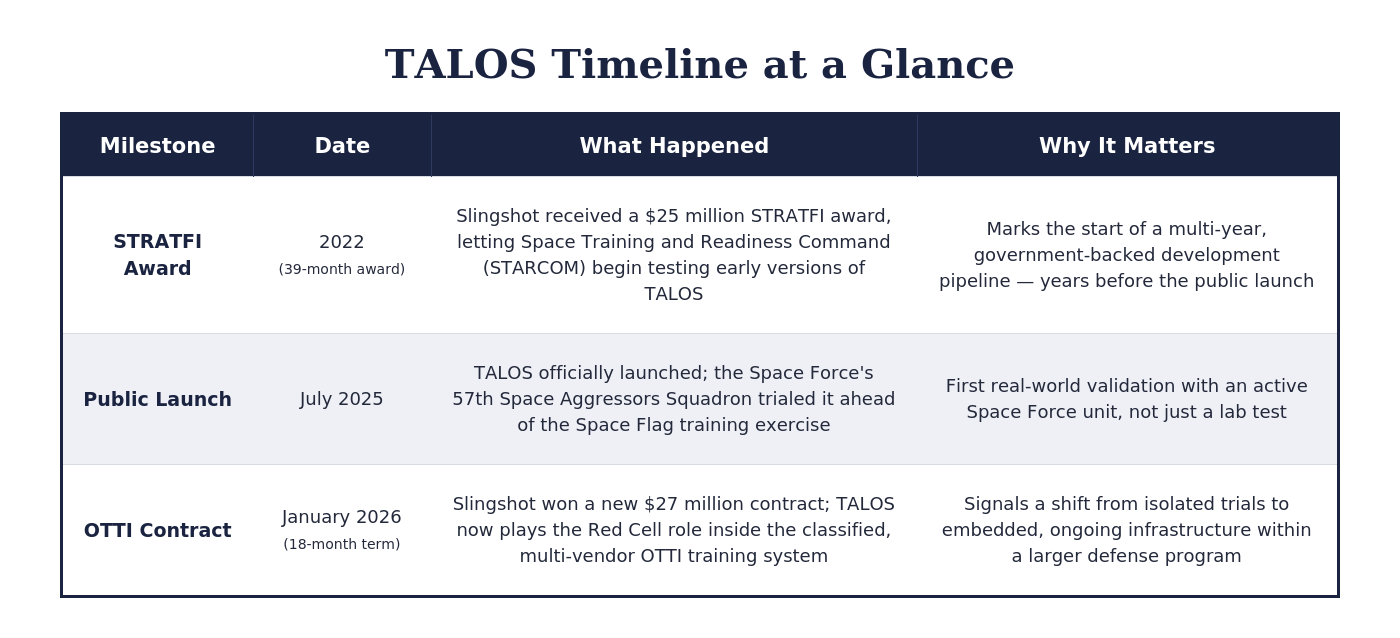
• 2022: Slingshot received a $25 million STRATFI award over 39 months, letting Space Training and Readiness Command (STARCOM) begin testing early versions of TALOS.
• July 2025: TALOS officially launched. The Space Force's 57th Space Aggressors Squadron trialed it ahead of a training exercise called Space Flag.
• January 2026: Slingshot won a new $27 million, 18-month contract tied to the Space Force's Operational Test and Training Infrastructure (OTTI) program, where TALOS plays the Red Cell role inside a larger, classified training system that also includes other companies' tools.
Slingshot has said TALOS is designed to work alongside other tools, not replace them — it uses open APIs so new sensors and AI tools can be added later. This fits into the bigger picture: the U.S. 2026 National Defense Strategy has made space a top national defense priority, citing rival countries' growing satellite and space-weapon capabilities as the reason the U.S. needs stronger, better-tested space systems. Programs like OTTI, and tools like TALOS, exist to support that goal.
A Bit of Background: Who Is Slingshot Aerospace?
Slingshot Aerospace was founded in 2017 by Melanie Stricklan, David Godwin, and Thomas Ashman, headquartered in El Segundo, California, with additional offices in Windsor, Colorado and Austin, Texas. The company has raised roughly $120 million from investors including ATX Venture Partners, TAcc+, and Gaingels.
Slingshot's core business is collecting space-tracking data from multiple sources its own ground telescope network, a satellite/launch history database called Seradata, and third-party data and fusing it into a single clear picture. One of its earliest products, Slingshot Beacon, helps satellite operators avoid collisions and is already used by companies operating most active LEO satellites, including OneWeb and Spire Global.
In August 2022, Slingshot acquired Numerica's Space Domain Awareness team, gaining tracking and behavior-analysis tools that later became the foundation for TALOS. In 2023, the company hired Audrey Schaffer formerly of the White House National Security Council, where she helped craft an international rule against destructive anti-satellite (ASAT) missile tests as VP of Strategy and Policy, signaling deep ties to U.S. government space policy.
Why the Space Force Needs an AI Enemy at All
Two core reasons drive this need:
Scale. With rival nations potentially deploying tens of thousands of satellites, human teams alone cannot track and interpret that volume of activity AI assistance becomes necessary, not optional.
Unpredictability. Rival satellites no longer follow simple, predictable movement patterns, and tactics can shift mid-event exactly what a scripted exercise can't replicate. A human training team can only build a limited number of scenarios; an AI agent can generate many different, changing scenarios quickly.
This connects to a broader trend: agentic AI in space warfare the idea that satellites and ground systems could eventually run their own AI agents that sense, decide, and act autonomously, far faster than a human could. Even so, humans are expected to remain in charge of the most consequential decisions.
Who Else Is Working on Similar Tools
Slingshot isn't alone in the space domain awareness (SDA) market the broader category of companies that track and interpret orbital activity. Several other players approach the problem differently, though most focus on detection and cataloging rather than generating realistic adversary behavior for training.
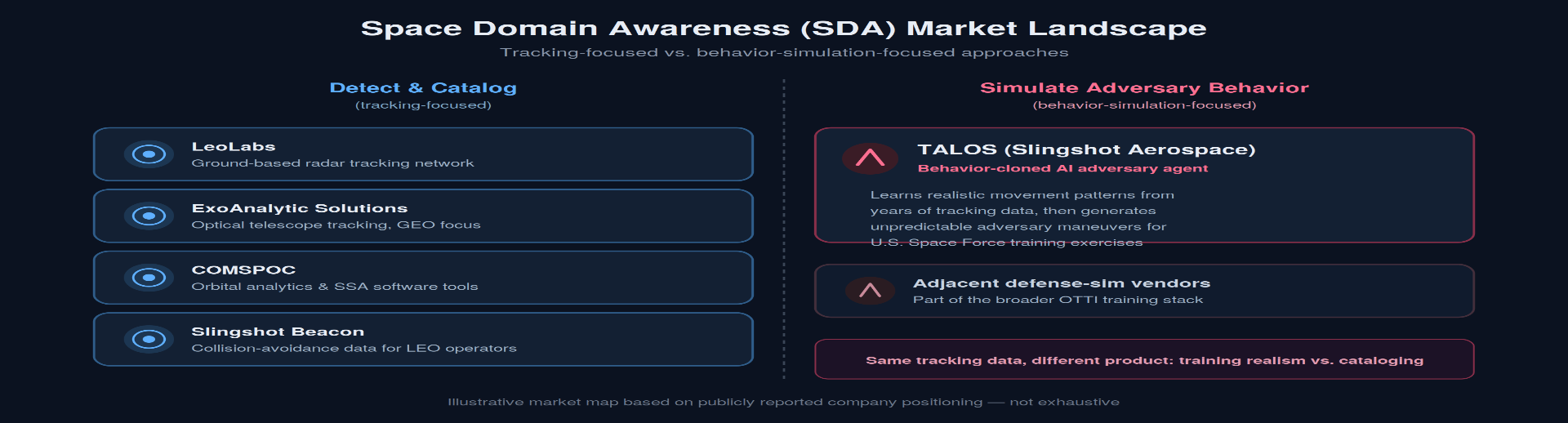
What sets Slingshot apart isn't just tracking volume competitors track a lot too. It's the decision to turn that tracking data into a tool that generates realistic enemy behavior for training, rather than just detecting and listing objects. That's a different kind of product, and it matches what the Space Force says it actually needs: more realistic, dynamically changing training environments.
Why This Matters, Even Outside Slingshot
TALOS is a useful case study for anyone learning about AI in defense, for a few reasons:
• Learning from real data instead of writing rules. Rather than hand-writing "attack scripts," Slingshot let the AI learn realistic behavior directly from years of real satellite data an approach that works well anywhere there's abundant past data but no clear rulebook.
• Simulation first, real action later. TALOS is currently used only for training, not live decision-making a careful, incremental way of introducing AI into a high-risk domain.
• Testing your own defenses. By generating realistic enemy behavior, TALOS also stress-tests the Space Force's own detection systems a "red team your own system to find its weak points" approach common across defense AI, cybersecurity, and AI research generally.
Why This Matters for Defence & Aerospace
• Training realism is the bottleneck. Scripted adversary behavior has long been the limiting factor in space warfare training; behavior-cloned AI agents directly address that gap.
• Data volume becomes a competitive moat. TALOS's realism is directly tied to the scale of tracking data behind it a reminder that SDA infrastructure and AI training data are inseparable.
• Simulation-first deployment is a deliberate risk-management choice. Any program introducing AI into high-stakes defense decisions should note the incremental, training-only rollout path TALOS has taken so far.
• Interoperability matters. Slingshot's open-API design signals that no single AI tool is expected to cover the full training picture a pattern likely to repeat across future defense AI programs.
Takeaway
TALOS represents a clear shift in how the U.S. Space Force approaches adversary training: instead of scripted, predictable exercises, it now has access to an AI agent that learns realistic enemy behavior directly from years of real satellite movement data. Backed by government funding since 2022 and now embedded in a classified, multi-vendor training infrastructure program, TALOS is still limited to training not live operations reflecting a cautious, step-by-step approach to bringing AI into space warfare. As satellite constellations grow and rival tactics become harder to predict, tools like TALOS are likely just the beginning of a broader trend toward agentic AI in space defense.
Sources: Slingshot Aerospace press releases (July 2025, January 2026); Breaking Defense; DefenseScoop; SatNews; SpaceNews; Military.com; PitchBook, Tracxn and Crunchbase company data.