The Neural Data Assimilation Shift: Why AI Emulators Are Replacing Decades-Old 4D-Var Systems
The Neural Data Assimilation Shift: Why AI Emulators Are Replacing Decades-Old 4D-Var Systems
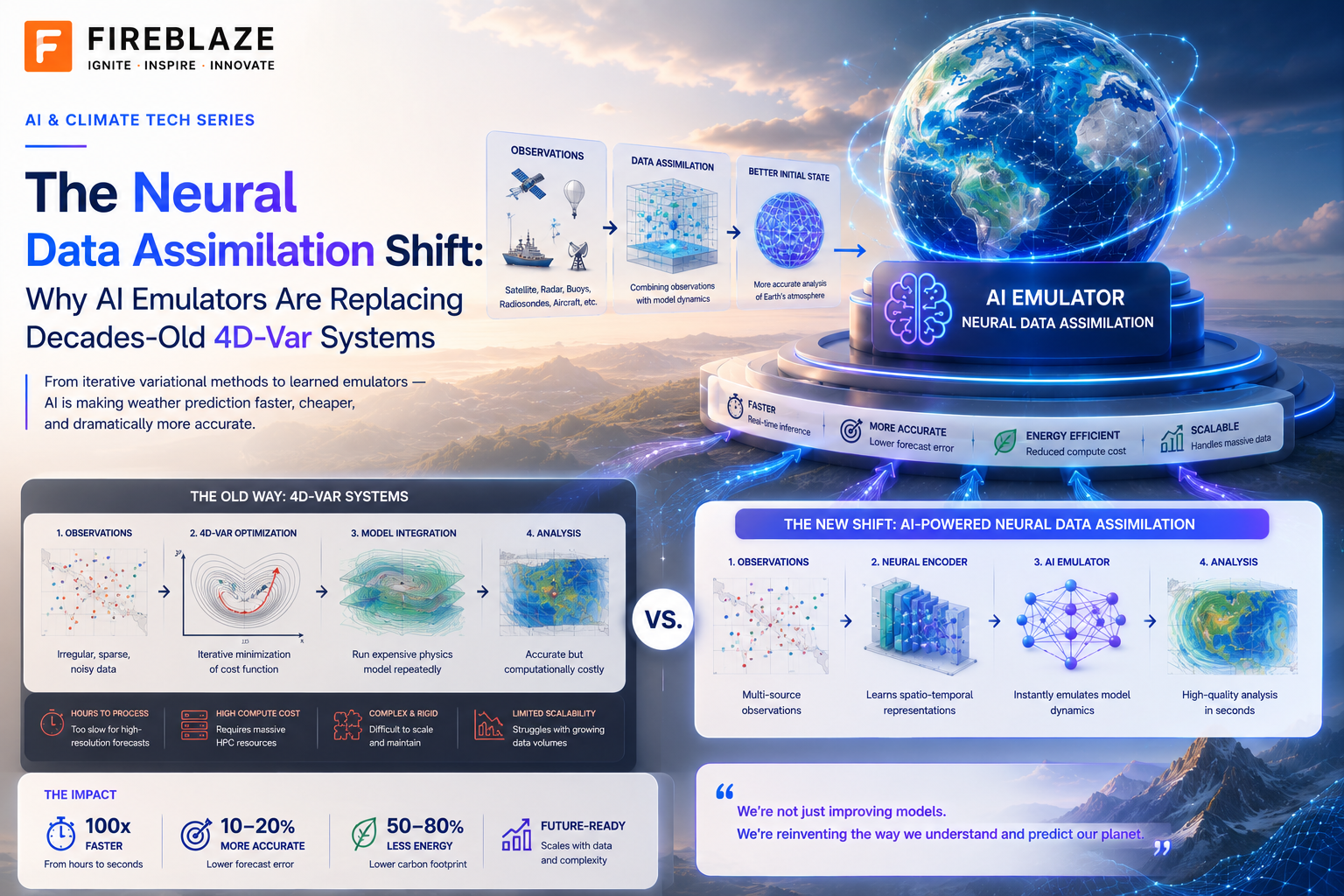
A domain-knowledge piece on the least-covered, most consequential shift in weather AI right now — not the forecasting model itself, but the step before it, where a satellite scatter of noisy observations becomes a clean starting snapshot of the atmosphere, a step that has quietly consumed roughly half of operational weather forecasting's total supercomputing budget for decades and that AI is only now starting to touch.
1. Hook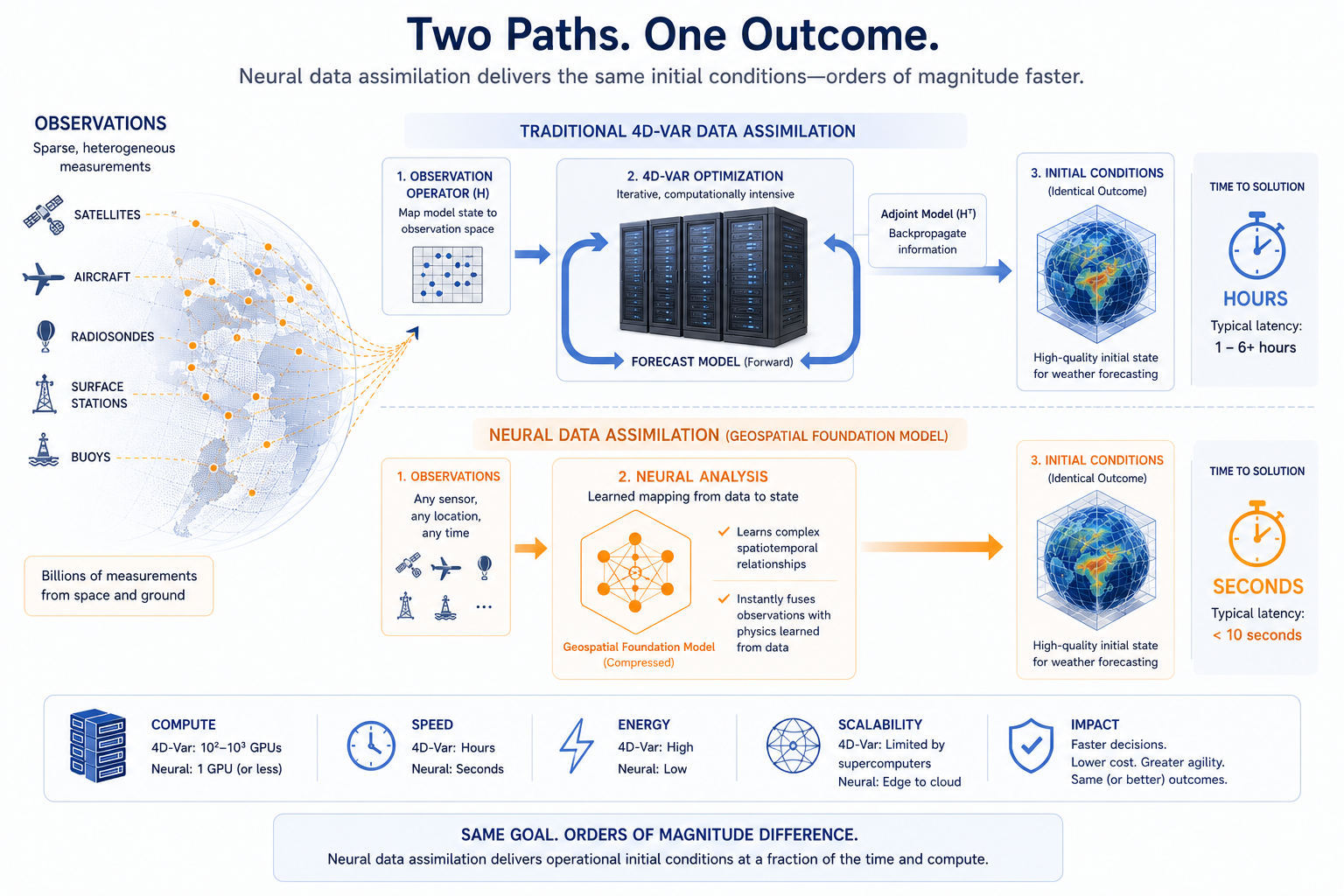
Every architecture covered earlier in this series — FourCastNet's AFNO layers, GraphCast's icosahedral mesh, GenCast's conditional diffusion — answers the same underlying question: given a snapshot of today's atmosphere, what happens next. None of them answer a quieter, more foundational question that has to be solved first, every single day, before any forecast can even begin: given a scattered, noisy, incomplete set of satellite and ground-station observations, what does today's atmosphere actually look like right now? That problem — data assimilation — is the one part of the operational weather pipeline AI had mostly left untouched, even as it rewrote the forecasting step itself. As Mike Pritchard, NVIDIA's director of climate simulation, put it when announcing an open ML-based assimilation system in January 2026: while the AI and research community spent the past five years focused heavily on prediction models, this state-estimation task "has remained largely unsolved by AI, yet it consumes roughly 50 percent of the total supercomputing loads of traditional weather" forecasting. That single statistic is the entire argument for why this piece exists: an AI system that only speeds up the forecast half of the pipeline is only ever going to save half the compute bill and half the wall-clock time. The other half — decades-old 4D-Var (four-dimensional variational) data assimilation — is now facing its own generation of neural challengers, and NVIDIA's HealDA, released in January 2026, is the clearest, most concretely benchmarked example of what that replacement actually looks like in practice.
2. Core Explanation
2.1 What 4D-Var Actually Does, and Why It's So Expensive
Data assimilation solves a fusion problem: combine an imperfect short-range forecast (the "background," typically a 6-to-12-hour-old prior forecast) with a scattered, noisy set of real observations — satellite radiances, ground stations, weather balloons, aircraft reports — to produce the best possible estimate of the atmosphere's actual current state (the "analysis"), which then becomes the starting point for the next forecast cycle. 4D-Var, the method operational centers including NCEP, ECMWF, and the UK Met Office have relied on for decades, formulates this as an optimization problem across a time window: find the atmospheric state that, when evolved forward through the full physical numerical model across that window, best matches all the observations taken during it, while staying consistent with the background forecast and its estimated error statistics.
The expense is structural, not incidental. Solving this optimization problem requires repeatedly running the full physical forecast model forward and running its adjoint — a linearized, backward-in-time version of the same model — many times per assimilation cycle to compute the gradients the optimizer needs. Every one of those forward-and-adjoint passes is, computationally, a full numerical weather simulation, and the process has to run before every single forecast, every few hours, forever. This is precisely the mechanism behind the 50%-of-total-compute figure: 4D-Var isn't a cheap preprocessing step bolted onto the front of a forecast, it's roughly an entire second forecasting-model's worth of computation, repeated as often as the forecasting model itself runs.
2.2 The Neural Alternative: Learn the Mapping Directly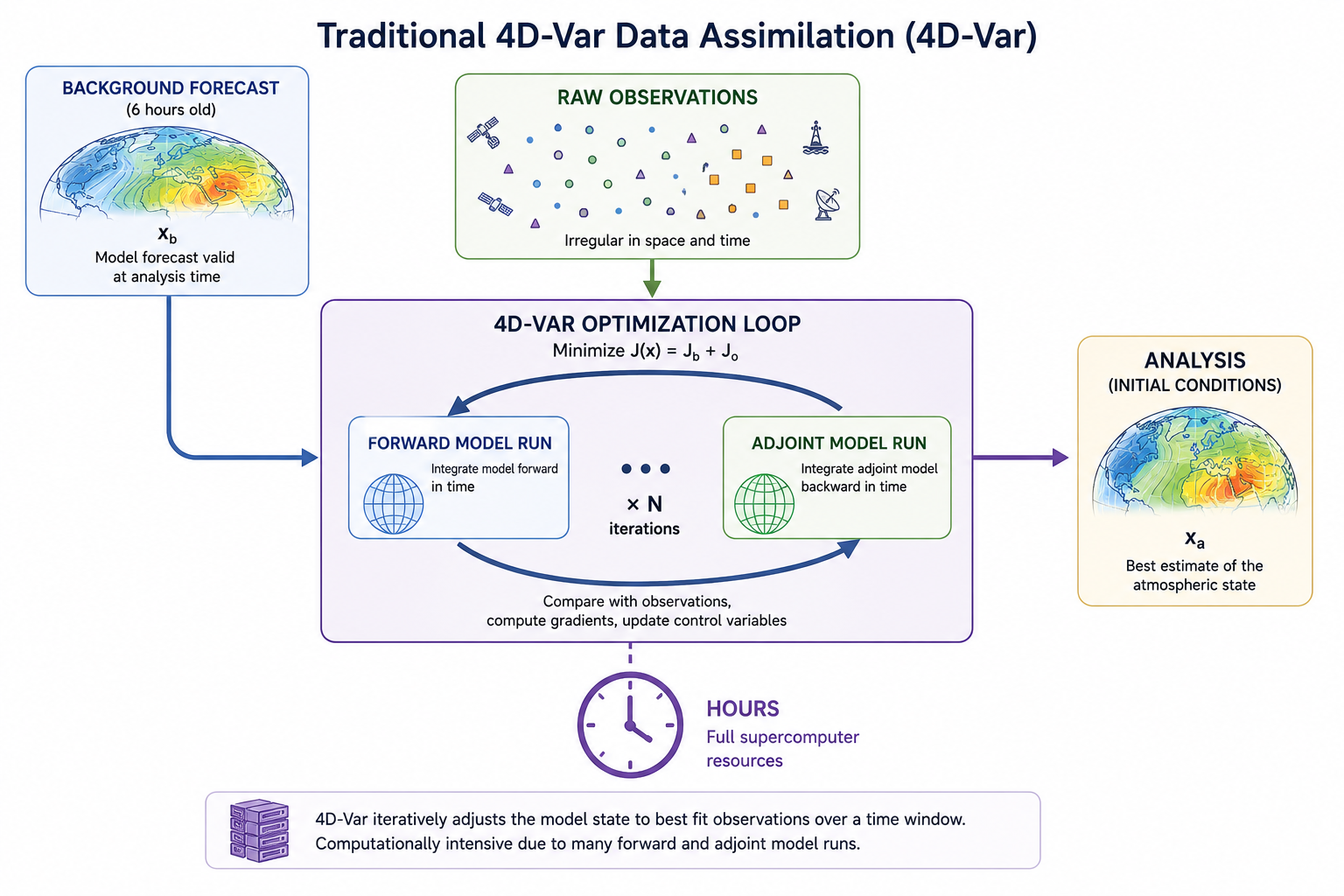
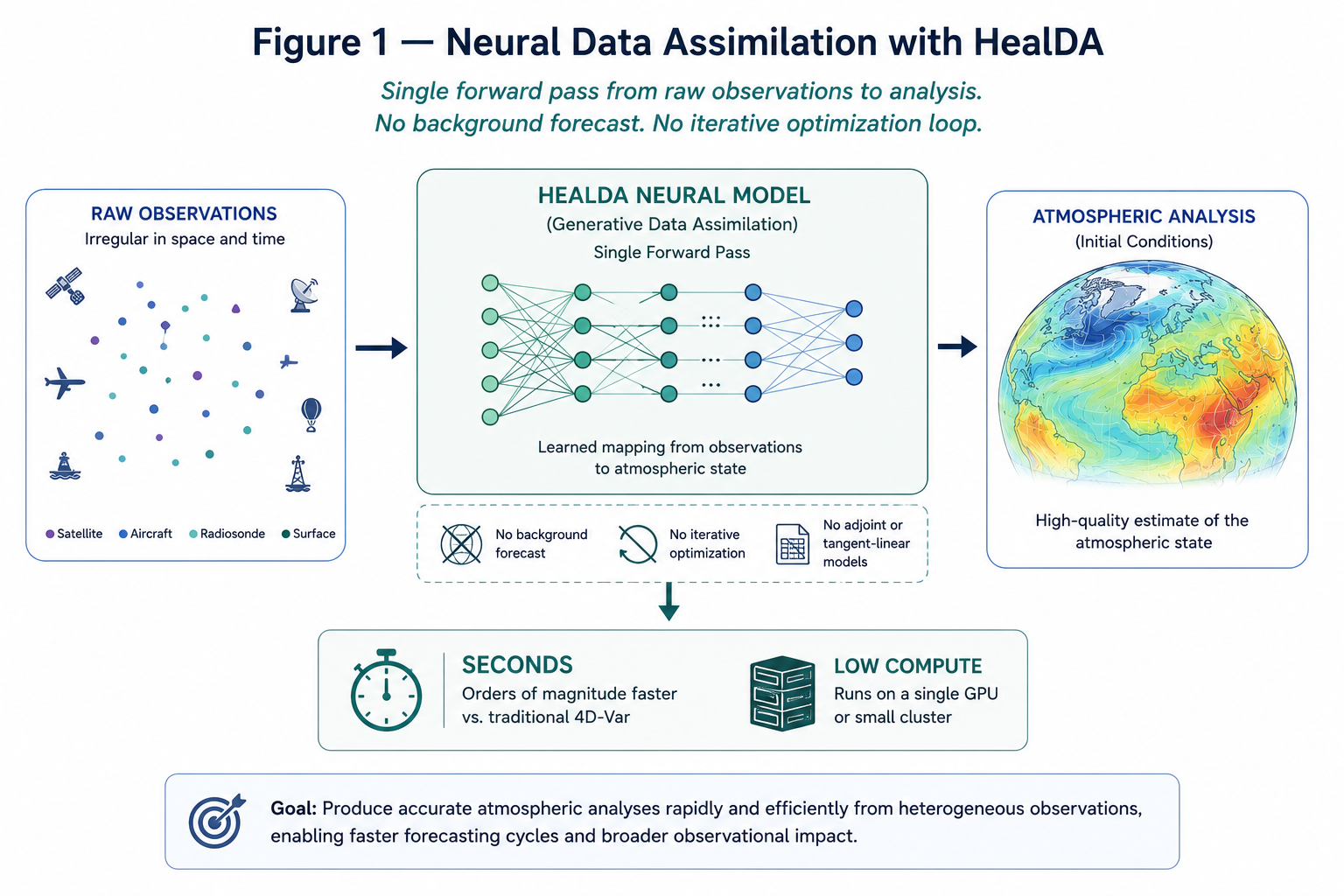
The core idea behind neural data assimilation is to stop treating analysis generation as an optimization problem solved fresh every cycle, and instead treat it as a learned mapping: train a neural network, once, offline, to go directly from a window of raw observations to an atmospheric analysis, using historical reanalysis data (like ERA5) as the training target. Once trained, producing a new analysis is a single forward pass through the network — no iterative optimization loop, no repeated forward-and-adjoint model runs, no supercomputer.
This is exactly the design NVIDIA's HealDA ("Heal" from HEALPix, its underlying grid system) implements: a global, ML-based data assimilation system that maps a short window of satellite and conventional observations directly to a one-degree atmospheric state on the Hierarchical Equal Area isoLatitude Pixelation (HEALPix) grid — notably, using a smaller sensor suite than operational NWP centers rely on, and requiring no background forecast at runtime at all, which is a meaningfully different design choice from most earlier hybrid ML-DA approaches that still lean on a physics-based background. HealDA's own research description is explicit that it is treated strictly as a standalone DA module — its analyses are used to initialize off-the-shelf ML forecast models (like NVIDIA's FourCastNet3) with no fine-tuning of either component — specifically so the quality of the analysis itself can be evaluated independently, rather than blurred together with end-to-end forecast skill the way many earlier ML-DA systems were.
2.3 The Benchmark Numbers, Stated Precisely
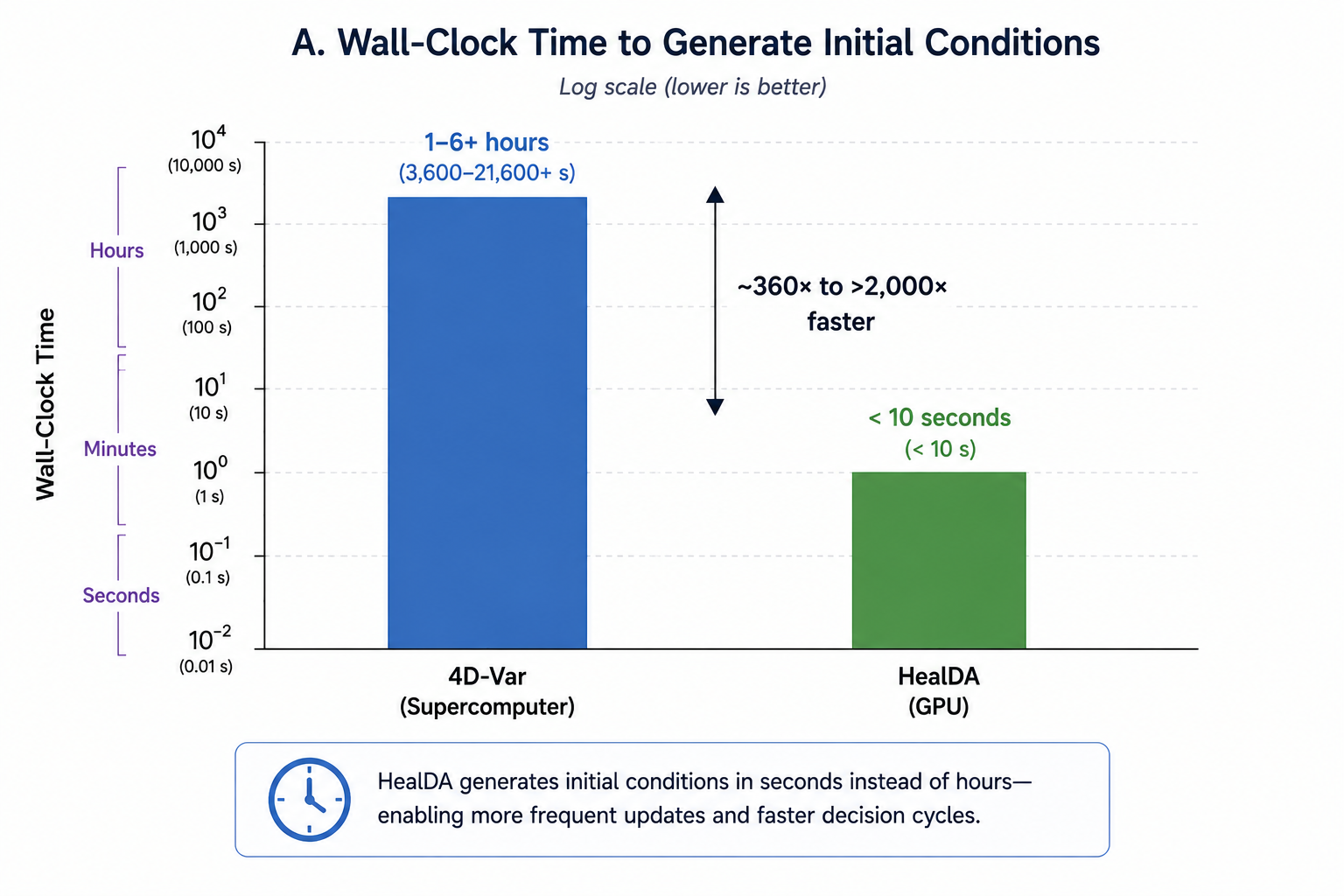
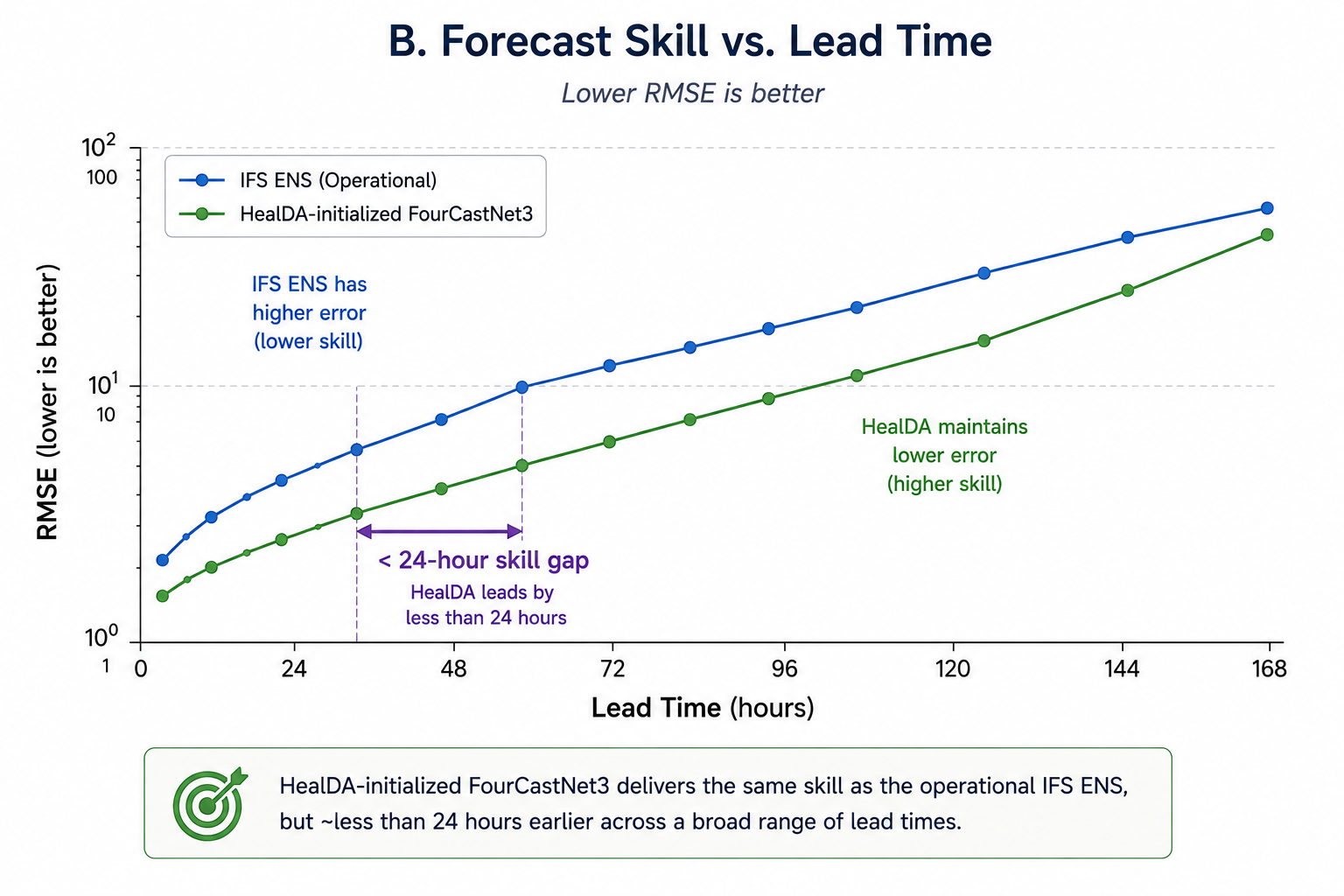
Because the earlier pieces in this series have insisted on precise figures over vague superlatives, the same discipline applies here, and it's especially important in this case because the honest result is a genuine gap, not a clean win. NVIDIA reports that Earth-2 Global Data Assimilation, powered by HealDA, generates initial conditions in seconds on GPUs rather than the hours a supercomputer requires for equivalent 4D-Var processing. On skill, HealDA's own published evaluation is direct: HealDA-initialized FourCastNet3 ensembles trail the operational benchmark — ECMWF's Integrated Forecasting System Ensemble (IFS ENS) — by less than 24 hours of effective forecast skill. The same evaluation traces why that gap exists: forecast error growth downstream of HealDA initialization is largely unchanged from HealDA's own initialization error, meaning the skill gap originates almost entirely in the quality of the analysis itself, not in how the forecast model handles it — and spectral analysis of that error pinpoints the specific mechanism, showing HealDA analyses overfit to large spatial scales and upper-tropospheric fields specifically, leaving smaller-scale and lower-atmosphere structure comparatively underrepresented. One further methodological finding is worth flagging on its own: the same evaluation found that small changes in how forecast skill is verified can shift the apparent skill gap by 12 to 24 hours, which the researchers explicitly call out as underscoring the need for consistent, standardized scoring when comparing ML-based and physics-based assimilation systems — a caution this piece returns to in Section 2.6.
2.4 Direct Comparison: 4D-Var vs. Neural Emulator-Based Assimilation
| Dimension | Traditional 4D-Var | Neural Emulator-Based DA (HealDA-style) |
|---|---|---|
| Core mechanism | Iterative optimization: repeated forward + adjoint model runs to minimize a cost function over a time window | Single learned forward pass mapping observations directly to an analysis |
| Compute per cycle | Full numerical model run, many times per cycle — reported to consume roughly 50% of total operational weather compute | Seconds on a single GPU, no supercomputer required |
| Background forecast dependency | Required — the "background" prior forecast is a core input to the cost function | Not required in HealDA's specific design — a deliberate architectural choice to enable standalone evaluation |
| Observation volume used | Full operational sensor suite, assimilated at high density | Smaller sensor suite than operational NWP in HealDA's current release |
| Grid / resolution | Native model grid, often sub-degree resolution operationally | HEALPix grid at 1° resolution in HealDA's current release |
| Benchmark skill vs. IFS ENS | The operational reference standard itself | Trails by less than 24 hours, per HealDA's own published evaluation |
| Known weak spot | Extremely expensive; requires a differentiable adjoint for every model component, which is difficult to construct and maintain for complex physics parameterizations | Overfits to large spatial scales and upper-tropospheric fields; verification-methodology sensitivity of 12–24 hours in apparent skill |
| Maturity / rollout status | Decades of operational use at NCEP, ECMWF, UK Met Office and others | Released January 2026 as part of NVIDIA's open Earth-2 model family; explicitly framed as an early, benchmarkable standalone module rather than a finished operational replacement |
2.5 It's Not Just One Player: The Broader Neural-DA Research Landscape
HealDA is the most concretely benchmarked and most publicly visible example, but it sits inside a wider, multi-year research trend rather than standing alone, which matters for reading this as a genuine field shift rather than one vendor's product launch:
- Adjoint-free surrogate approaches. Earlier work at Virginia Tech explicitly tackled the hardest structural piece of 4D-Var — the need for an accurate adjoint model — by training neural network surrogates specifically matched against adjoint (gradient) information during training, not just forward predictions, since the accuracy of any 4D-Var solution depends on how well a surrogate captures both the forward and adjoint dynamics.
- End-to-end learned assimilation. A 2024 approach termed AI-Var integrates the entire variational data assimilation process directly into a neural network architecture, aiming to replace classical methods outright rather than accelerating one component of them.
- Latent-space and autoencoder-based assimilation. One line of work reformulates the assimilation cost-function minimization to happen inside a reduced-order latent space discovered by a variational autoencoder rather than in the full physical state space, and separate 2025 work on physically consistent atmospheric assimilation explicitly operates machine learning in a learned latent space rather than raw grid space.
- Operational hybrid approaches already in production-adjacent use. Rather than replacing 4D-Var outright, ECMWF's own research has developed a neural-network variant of weak-constraint 4D-Var specifically to correct model error terms within the existing variational framework — an incremental, hybrid path toward the same destination that coexists with, rather than replaces, the classical optimization core.
- Domain-specific emulator-driven 4D-Var. Beyond the atmosphere, the same pattern has been demonstrated for sea-ice: training a neural emulator (which conveniently comes with an automatically differentiable adjoint, unlike the mesoscale physics simulator it replaces) and building a full 4D-Var system on top of it, which was shown to reduce sea-ice thickness root-mean-square error by 0.8 meters compared to a free-running forecast with no assimilation at all, while being reported as significantly more computationally efficient than the ensemble Kalman filter systems it was compared against.
2.6 A Caveat Worth Taking Seriously: A Skill Gap Is Still a Skill Gap
This is the section that keeps "AI emulators are replacing 4D-Var" from overstating where the field actually is today. HealDA's own published result is not a benchmark win — it's a documented, honestly reported gap, and the paper's title itself foregrounds this: "Highlighting the Importance of Initial Errors in End-to-End AI Weather Forecasts." Less-than-24-hours-of-skill-behind-IFS-ENS is a genuinely strong result for a first-generation, standalone, background-free system using a smaller sensor suite and coarser resolution than the operational system it's compared against — but it is still behind, not ahead, and the specific failure mode identified (overfitting to large scales and the upper troposphere, at the expense of smaller-scale and lower-atmosphere structure) is exactly the kind of detail that matters enormously for applications sensitive to fine-scale, near-surface conditions — precipitation, low-level wind, boundary-layer processes — rather than for applications dominated by large-scale, upper-level flow. The verification-sensitivity finding in Section 2.3 compounds this caution: if the apparent skill gap between two systems can shift by 12 to 24 hours depending on scoring methodology choices, any single reported "gap" number, including the one this piece has just cited, needs to be read as coming from one specific, stated verification setup rather than as a universal, methodology-independent constant.
It's also worth being precise about what "replacing" means here in practice as of 2026: NVIDIA explicitly ships HealDA as one open, swappable module inside a broader Earth-2 stack (paired with forecasting models like FourCastNet3 and downscaling tools like CorrDiff) rather than as a finished, operationally deployed substitute for the assimilation systems running at ECMWF or NCEP today. The realistic near-term picture, consistent with the hybrid weak-constraint 4D-Var work referenced in Section 2.5, is a period of coexistence — neural DA systems maturing rapidly on cost and speed, incrementally closing the skill gap, likely first displacing 4D-Var in contexts where its compute cost is the binding constraint (research, reanalysis production, resource-limited forecasting centers) before it displaces the most compute-rich operational centers' primary systems.
2.7 Common Pitfalls
- Treating "seconds instead of hours" as the whole story. Section 2.3 and 2.6 both make clear that the speed and compute advantage is real and already demonstrated, but it currently comes with a measurable skill cost relative to the operational benchmark — the two facts have to be reported together, not separately.
- Assuming a single reported skill gap is a fixed, universal number. The 12–24 hour verification-methodology sensitivity documented in HealDA's own evaluation is a direct warning against treating any one comparative benchmark figure as the final word.
- Missing that "no background forecast required" is a deliberate design trade-off, not an unqualified advantage. It's what makes HealDA cleanly evaluable as a standalone module and removes a costly dependency, but it also means the system isn't using information a background-forecast-dependent system has access to — the large-scale-overfitting weakness in Section 2.3 is plausibly connected to this design choice.
- Conflating research-stage neural DA with operational deployment. As Section 2.6 notes, HealDA and its research-landscape peers in Section 2.5 are, as of 2026, benchmarkable open modules and active research directions — not yet the primary assimilation systems running at the world's major operational forecasting centers.
3. Worked Example / Analogy
Picture two different ways a detective might reconstruct exactly what happened at a crime scene from a handful of scattered witness statements and physical clues. The traditional 4D-Var approach is like a detective who, for every single case, builds and runs a full physical re-enactment: constructs a detailed simulation of the room, plays it forward and backward repeatedly, adjusting the reconstructed sequence of events each time until the simulation's predictions line up as closely as possible with every witness statement and physical clue simultaneously — rigorous, physically grounded, and enormously time-consuming, because the entire simulation has to be rebuilt and re-run from scratch for every new case. The neural emulator approach is like a detective who has instead spent years studying thousands of solved past cases, and has learned, directly and intuitively, the general pattern connecting "this specific combination of scattered clues" to "this is what most likely happened" — for a new case, this detective doesn't re-run a simulation at all; they look at the clues and produce their best reconstruction almost instantly, because the hard work of learning the underlying pattern already happened, once, during training on the historical case archive. The catch, and it's the same catch HealDA's own evaluation is honest about, is that the fast, pattern-matching detective's reconstruction is measurably less precise on certain kinds of detail — particularly the fine-grained, close-up specifics — than the slow detective who re-derives everything from physical first principles every time, even though the fast detective is right often enough, and fast enough, to be genuinely useful for a large share of cases where speed matters more than getting the very last detail exactly right.
4. Application to Defense & Aerospace
For a Defense & Aerospace AI Center of Excellence, the data assimilation layer is arguably a more direct strategic bottleneck than any single forecasting architecture covered elsewhere in this series, precisely because of the compute-share statistic that opened this piece: if assimilation consumes roughly half of total operational weather compute, then any deployment scenario constrained by compute, power, or access to a supercomputer — a forward-deployed unit, a contested or degraded communications environment, a platform running Earth-2-style tooling on local GPU hardware rather than phoning home to a national forecasting center — cannot fully benefit from fast AI forecasting models like FourCastNet3, GraphCast, or GenCast (all covered in earlier pieces) unless the initial-conditions problem is also solved locally and cheaply. A seconds-not-hours, GPU-only assimilation system is what actually makes an end-to-end, self-contained weather-AI stack deployable at the tactical edge rather than dependent on a data feed from a centralized operational center — directly relevant to platforms operating in denied or bandwidth-constrained environments where waiting on a downlinked analysis from a national center is itself an operational vulnerability. At the same time, Section 2.6's caveat is the specific operational discipline this application demands: HealDA's documented weakness — overfitting to large scales and upper-tropospheric structure at the expense of fine-scale, near-surface detail — is precisely the regime that matters most for low-altitude flight operations, precipitation-sensitive logistics, and boundary-layer-dependent sensor performance, meaning a defense deployment adopting this technology needs to explicitly validate performance in that regime rather than assuming the encouraging aggregate less-than-24-hour skill gap applies uniformly across all the variables and altitudes a specific mission actually depends on.
5. Quick-Reference Glossary
| Term | Meaning |
|---|---|
| Data assimilation | The process of fusing a short-range background forecast with real, noisy, scattered observations to produce the best estimate of the atmosphere's current state (the "analysis"), used to initialize the next forecast |
| 4D-Var | Four-dimensional variational data assimilation — the decades-old operational method that finds the best atmospheric state by iteratively minimizing a cost function using repeated forward and adjoint model runs across a time window |
| Adjoint model | A linearized, backward-in-time version of a forecast model, used to compute the gradients 4D-Var's optimization requires; historically difficult and expensive to build and maintain for complex physics |
| Background forecast | The short-range (often 6–12 hour) prior forecast used as a starting point and error-covariance reference in traditional data assimilation |
| Analysis | The output of data assimilation — the best estimate of the atmosphere's current state, used as initial conditions for the next forecast |
| HealDA | NVIDIA's open, GPU-based neural data assimilation model, released January 2026, that maps observations directly to a HEALPix-grid analysis in a single forward pass with no background forecast required |
| HEALPix grid | Hierarchical Equal Area isoLatitude Pixelation — an alternative to a flat lat/lon grid used by HealDA for its output analysis |
| Weak-constraint 4D-Var | A variant of 4D-Var that explicitly models and corrects for model error over the assimilation window, rather than assuming the forecast model is perfect |
| Latent-space assimilation | An approach that performs the assimilation optimization inside a compressed, learned representation of the atmospheric state rather than the full physical grid |