Top 10 AI Tools Every Data Analyst Should Learn in 2026
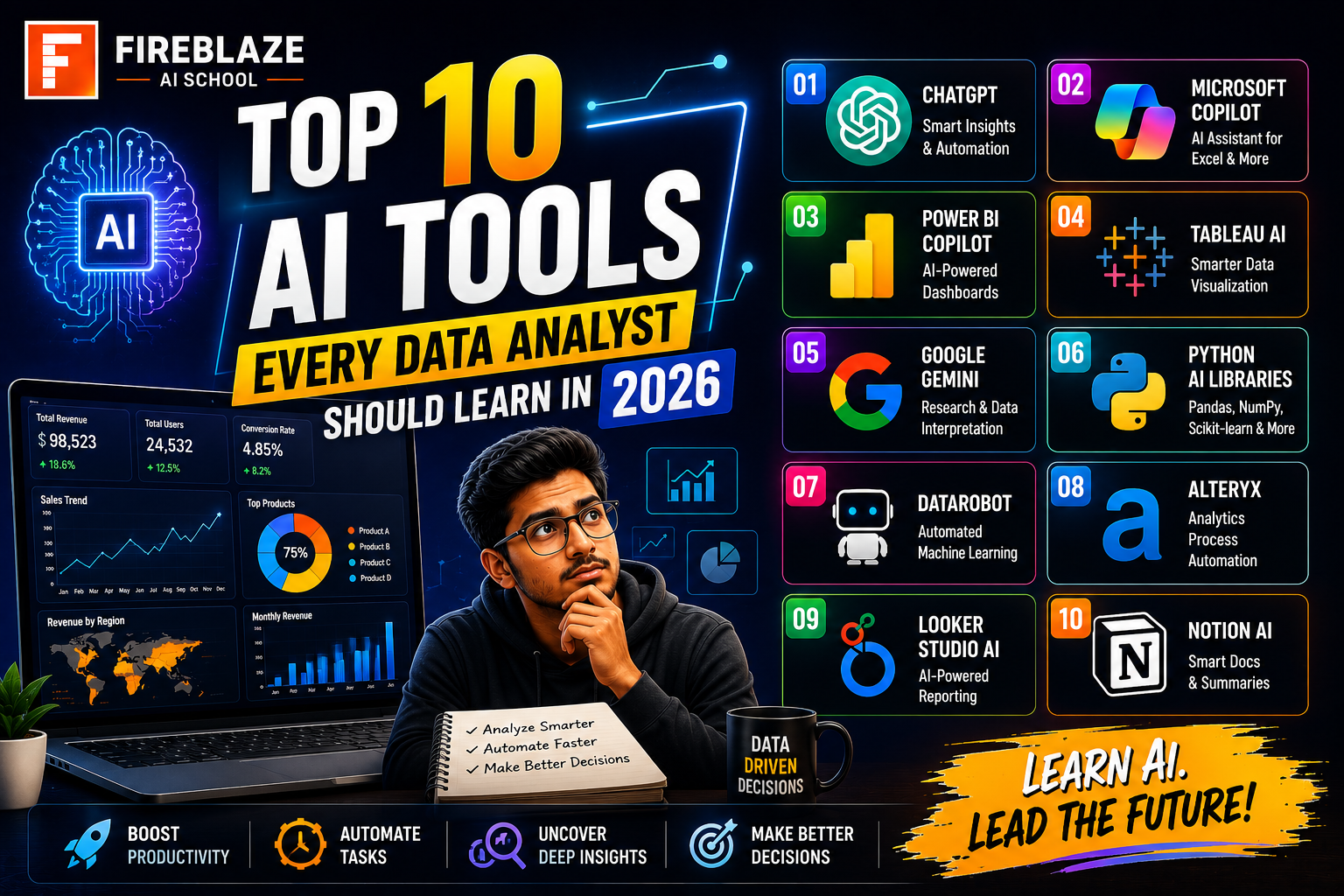
Top 10 AI Tools Every Data Analyst Should Learn in 2026
Artificial Intelligence is no longer a futuristic concept—it's already changing how businesses analyze data, make decisions, and generate insights.
Today's Data Analysts are expected to do more than create reports and dashboards. They must leverage AI-powered tools to automate repetitive tasks, uncover deeper insights, and improve productivity.
If you want to stay competitive in the job market, learning AI tools is becoming just as important as learning SQL, Power BI, and Excel.
In this guide, we'll explore the top AI tools every Data Analyst should learn in 2026.
Why AI Matters for Data Analysts
AI helps analysts:
- Automate repetitive tasks
- Generate reports faster
- Analyze large datasets
- Identify hidden trends
- Improve forecasting accuracy
- Enhance business decision-making
Instead of replacing Data Analysts, AI is making them more efficient and valuable.
1. ChatGPT
ChatGPT has become one of the most powerful productivity tools for Data Analysts.
How Data Analysts Use ChatGPT
- Generate SQL queries
- Explain complex datasets
- Create report summaries
- Automate documentation
- Learn new concepts quickly
Benefits
- Saves time
- Improves productivity
- Enhances learning speed
2. Microsoft Copilot
Microsoft Copilot integrates AI directly into Microsoft products.
Use Cases
- Excel formula generation
- Data analysis assistance
- Report creation
- Business presentations
For analysts who work extensively with Excel, Copilot can be a game changer.
3. Power BI Copilot
Power BI now includes AI-powered features that simplify dashboard development.
Features
- Natural language queries
- Automated insights
- Dashboard suggestions
- Data summarization
This helps analysts build dashboards more efficiently.
4. Tableau AI
Tableau has introduced AI-driven analytics capabilities.
Benefits
- Automated trend analysis
- Predictive insights
- Natural language reporting
It allows businesses to understand data without requiring deep technical expertise.
5. Google Gemini
Google Gemini helps analysts work with data, research information, and generate business insights.
Popular Uses
- Research assistance
- Data interpretation
- Documentation support
- Content generation
Gemini is particularly useful for productivity and business analysis tasks.
6. Python with AI Libraries
Python remains one of the most important tools for Data Analytics.
Popular AI libraries include:
- Pandas
- NumPy
- Scikit-Learn
- TensorFlow
These tools help analysts perform advanced data analysis and machine learning tasks.
7. DataRobot
DataRobot simplifies machine learning and predictive analytics.
Advantages
- Automated Machine Learning
- Faster model creation
- Business forecasting
It enables analysts to build predictive models without extensive coding.
8. Alteryx
Alteryx combines automation, analytics, and AI.
Key Features
- Workflow automation
- Data preparation
- Predictive analytics
It is widely used in enterprise analytics environments.
9. Looker Studio AI Features
Google's Looker Studio helps analysts create interactive reports and dashboards.
Benefits
- Easy visualization
- Data integration
- Business reporting
Its AI capabilities help uncover patterns more efficiently.
10. Notion AI
Documentation is an essential part of Data Analytics.
Notion AI helps:
- Summarize reports
- Create project documentation
- Organize analytics workflows
It saves significant time for analysts working on multiple projects.
Essential Skills Data Analysts Still Need
Even with AI tools, core analytics skills remain important.
Every Data Analyst should learn:
SQL
For querying and managing data.
Power BI
For dashboard creation and business intelligence.
Excel
For reporting and data cleaning.
Python
For automation and advanced analysis.
Statistics
For accurate interpretation of business data.
AI tools work best when combined with these foundational skills.
Will AI Replace Data Analysts?
This is one of the most common concerns among students.
The answer is no.
AI can automate repetitive tasks, but businesses still need professionals who can:
- Understand business goals
- Interpret results
- Make strategic recommendations
- Communicate insights effectively
Data Analysts who use AI will outperform those who don't.
How to Become an AI-Powered Data Analyst
A modern Data Analyst should focus on:
- Excel
- SQL
- Power BI
- Python
- Statistics
- AI Tools
- Real-World Projects
Combining analytics and AI skills will significantly improve career opportunities in the coming years.
Why Learn Data Analytics with AI?
The future belongs to professionals who can combine traditional analytics skills with Artificial Intelligence.
Companies increasingly seek candidates who can:
- Analyze data
- Build dashboards
- Use AI tools effectively
- Improve business performance
This combination creates a powerful competitive advantage in the job market.
Frequently Asked Questions
Which AI tool is best for Data Analysts?
ChatGPT, Power BI Copilot, Microsoft Copilot, and Tableau AI are among the most popular tools currently used by analysts.
Should beginners learn AI tools?
Yes. Learning AI tools early can improve productivity and accelerate learning.
Is SQL still important in the AI era?
Absolutely. SQL remains one of the most important skills for Data Analysts.
Can AI replace Power BI?
No. AI enhances Power BI but does not replace the need for dashboard creation and business intelligence skills.
Conclusion
Artificial Intelligence is transforming the analytics industry, and Data Analysts who embrace AI tools will have a significant advantage in the job market. By combining traditional skills such as SQL, Excel, Power BI, and Python with modern AI-powered tools, professionals can increase productivity, improve decision-making, and accelerate career growth.
The best time to start learning AI-powered analytics is now.