Underwater Acoustic Target Recognition Explained: From Spectrograms to Classification
Introduction
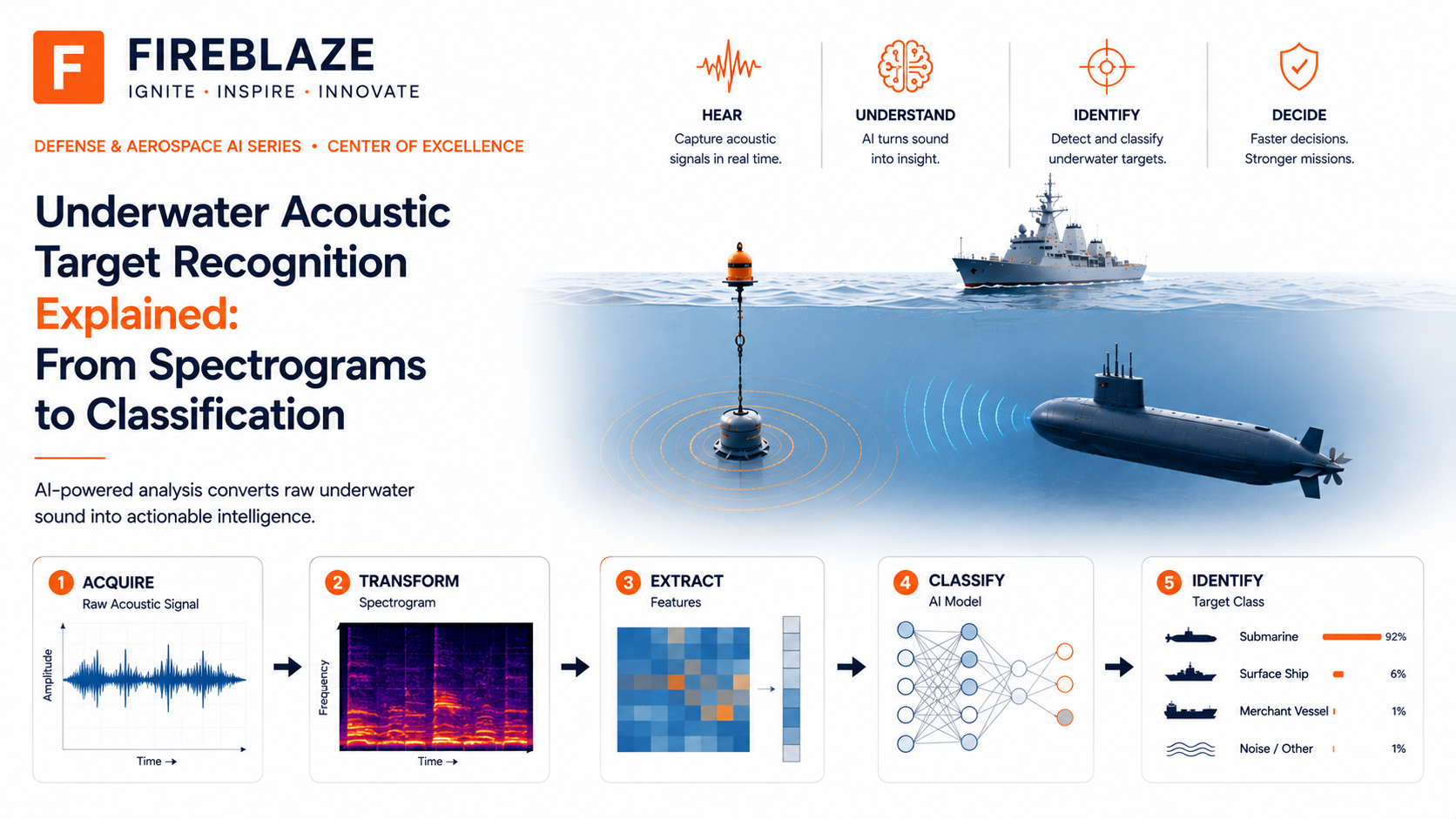
Underwater Acoustic Target Recognition — UATR in the research literature — is the specific machine learning problem of taking a raw hydrophone recording and answering a deceptively simple question: what made this sound? A whale, a fishing trawler, a container ship, a specific class of submarine? This piece, the third in a four-part series on underwater domain awareness, walks through the actual technical pipeline, from raw audio to classified output, why it remains one of the harder classification problems in applied machine learning, and where the research is actually headed.
1. The Pipeline, Step by Step
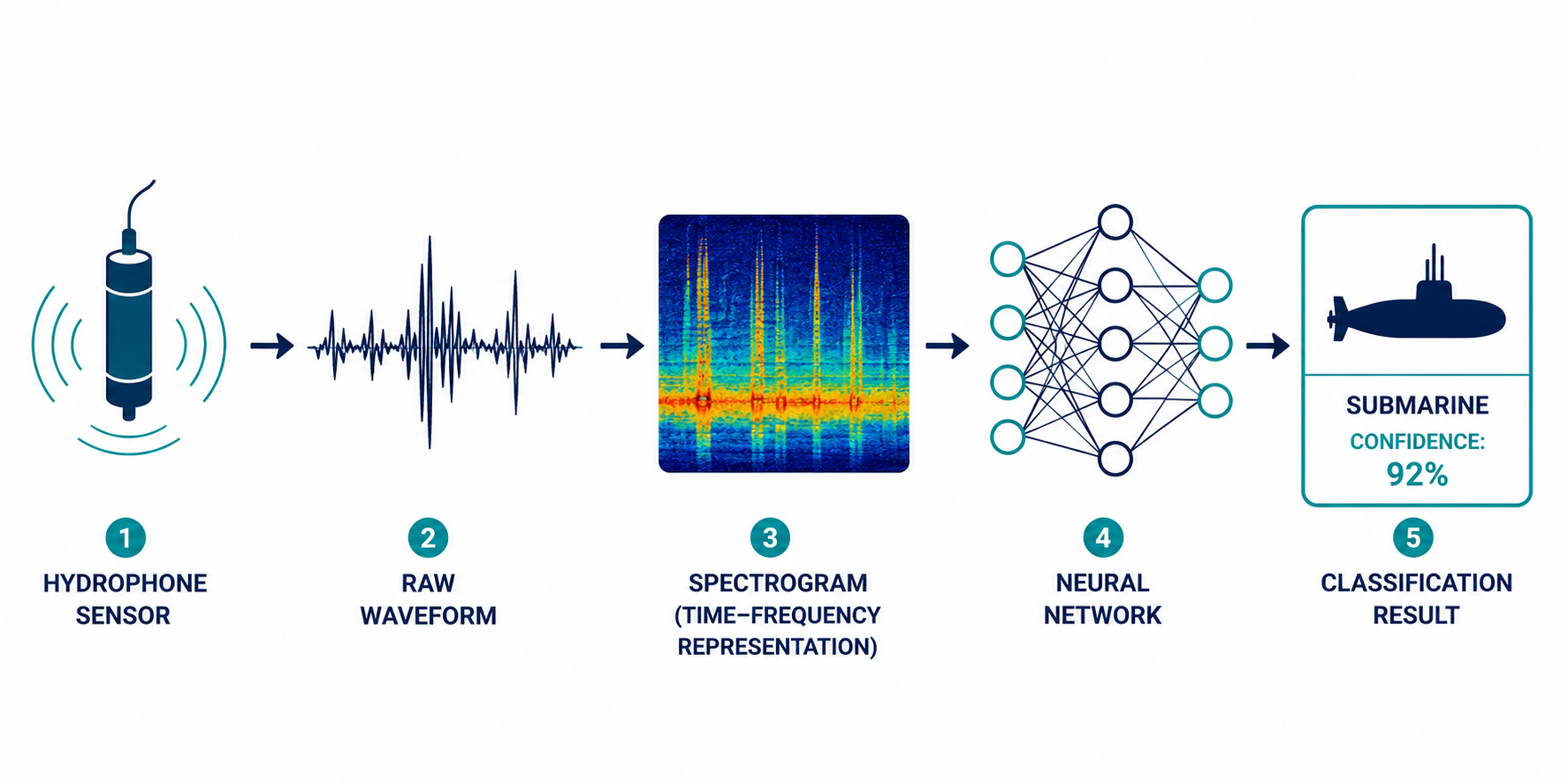
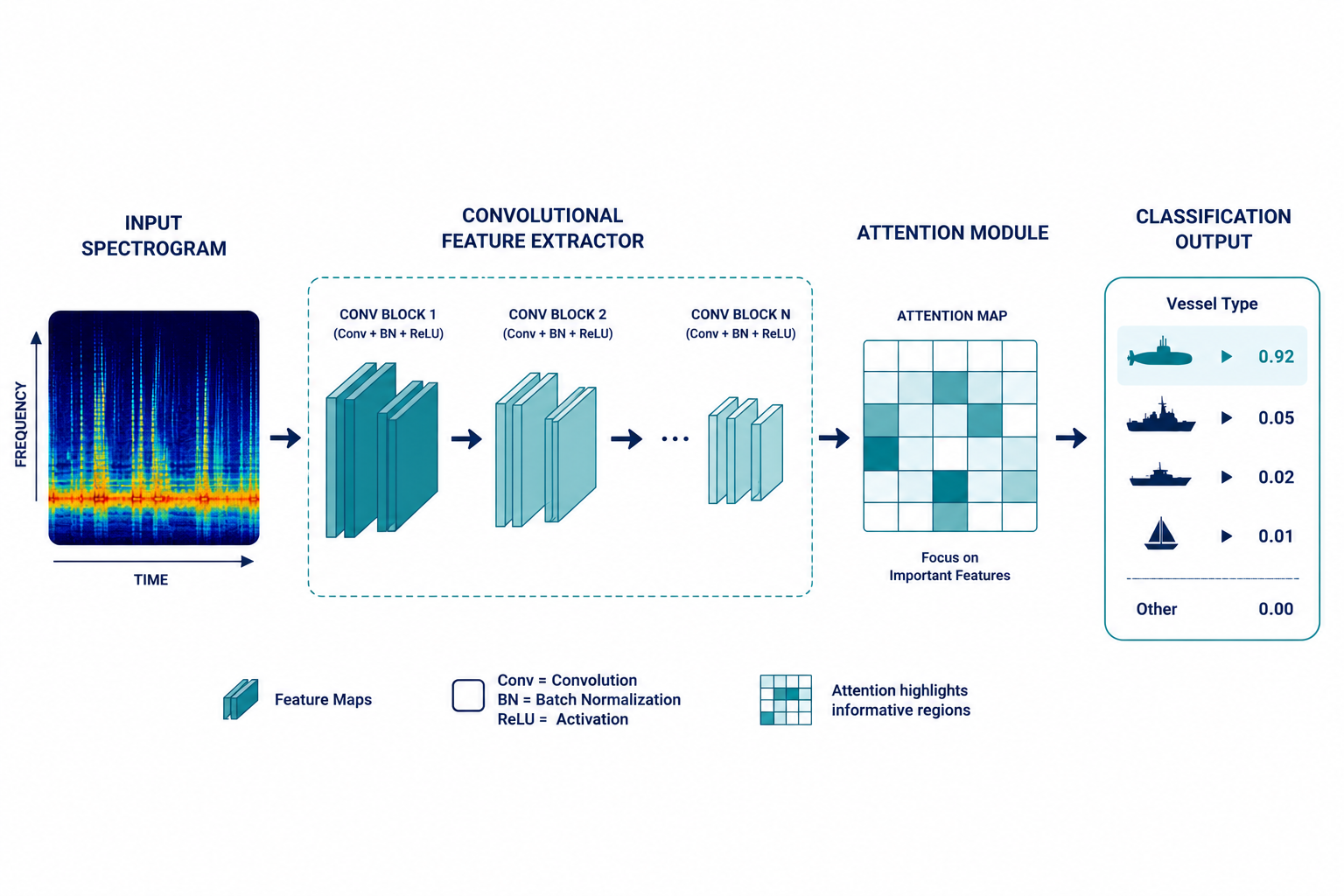
At a high level, every UATR system follows roughly the same structure, regardless of the exact architecture used underneath.
Step 1 — Raw acoustic signal. A hydrophone captures continuous underwater sound as a raw time-domain waveform — pressure variations over time, no different in principle from a microphone recording, just underwater and picking up a very different mix of sources: biological noise, distant shipping, weather, and — occasionally — the actual target of interest.
Step 2 — Preprocessing. The raw signal is filtered to remove obvious non-target noise, such as flow noise across the sensor itself or electrical interference from onboard equipment, and segmented into fixed-length analysis windows, typically a few seconds each, since most classification architectures need a bounded input size rather than an indefinitely long stream.
Step 3 — Feature extraction. This is where most of the technical differentiation between UATR approaches actually happens. The raw waveform is transformed into a representation that a neural network can learn from more effectively than raw audio alone.
2. The Feature Extraction Toolbox
No single feature representation captures everything a target signal contains, which is why current UATR research spends so much attention on this stage specifically.
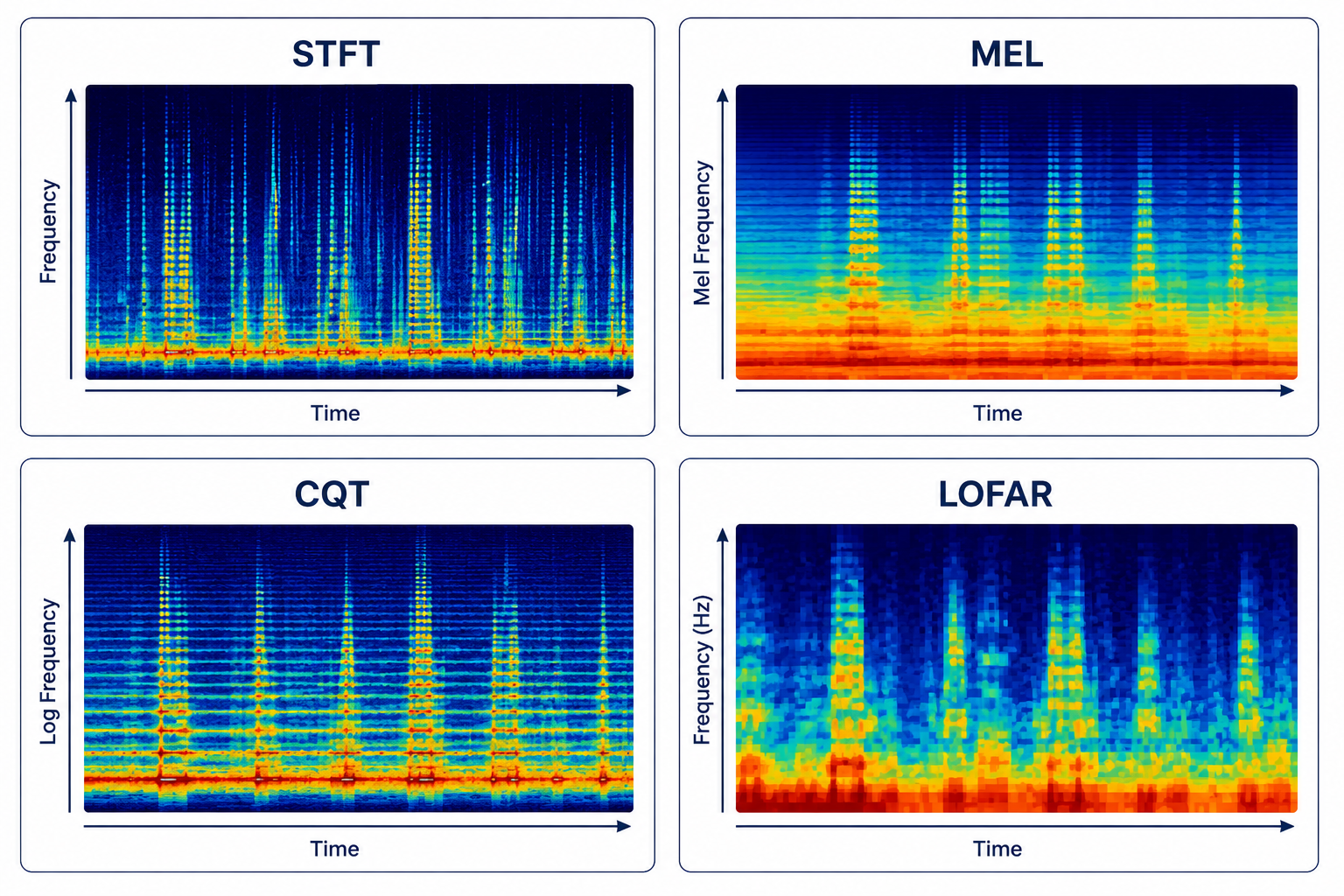
STFT (Short-Time Fourier Transform). Converts the signal into a standard spectrogram, showing frequency content over time using a sliding analysis window. It offers a solid general-purpose time-frequency view, but its fixed window size creates an inherent tradeoff — a window short enough to resolve fast time-domain changes is too short to resolve fine detail in low-frequency bands, which matters because a lot of vessel machinery noise (engine tonals, gearbox harmonics) sits specifically in the low-frequency range.
Mel-spectrograms. A frequency-warped version of STFT, originally designed around human auditory perception — compressing the frequency axis to match how human hearing is more sensitive to changes at lower frequencies than higher ones. Useful and computationally efficient, but not perfectly matched to how underwater acoustic signatures actually distribute across frequency, since the perceptual assumptions baked into the Mel scale were designed for speech, not ship-radiated noise.
CQT (Constant-Q Transform). Offers better frequency resolution at low frequencies than STFT, at the cost of worse time resolution — a tradeoff that runs in the opposite direction of STFT's own weakness, which is part of why combining the two is common in recent work rather than treating either as a universal default.
LOFAR (Low Frequency Analysis and Recording). A longstanding, sonar-specific technique — distinct from the general-purpose transforms borrowed from speech and music processing — that reflects power spectrum distribution and changes across both time and frequency, tuned specifically for the narrowband engine and propeller tonals that dominate a vessel's low-frequency acoustic signature. LOFAR-style analysis predates modern deep learning by decades and remains a standard reference technique that newer methods are frequently benchmarked against.
Cepstral coefficient families (MFCC, GFCC, GWCC). Borrowed and adapted from speech processing, these represent the "spectral envelope" of a signal in a compressed form. Mel-Frequency Cepstral Coefficients (MFCC) are the most widely known; Gammatone Frequency Cepstral Coefficients (GFCC) and Gammatone Wavelet Cepstral Coefficients (GWCC) — both based on an auditory filter bank model called the Gammatone filter — have specifically gained favor in recent UATR research for their noise-suppression properties, since they were designed to model auditory processing under exactly the kind of noisy conditions the ocean provides.
Because none of these fully captures the signal alone, current research increasingly favors multi-feature fusion — combining several of the above (for instance, STFT plus Mel plus CQT together) into a richer, higher-dimensional representation before classification, rather than committing to just one transform and accepting its particular blind spots.
3. Classification Architectures
Step 4 — Classification. The extracted features feed into a neural network. The main architecture families in current use:
Convolutional Neural Networks (CNNs) — treat the spectrogram like an image, learning spatial patterns across frequency and time using convolutional filters. This remains the most common baseline architecture in the field.
Long Short-Term Memory networks (LSTMs) — model the signal's evolution over time explicitly, capturing sequential dependencies a purely spatial CNN might miss, and are often combined with spectral features (log-mel spectrograms plus phase information, for example) to capture complementary information a magnitude-only spectrogram discards.
Residual Networks (ResNets) — enable much deeper networks by allowing gradients to skip across layers, generally improving how much fine-grained detail a model can learn from limited training data without the network becoming unstable to train.
Dense CNN variants — architectures that reuse feature maps across layers rather than discarding them, aimed specifically at optimizing classification performance under noisy, degraded conditions while keeping computational cost manageable — a meaningful consideration for any system that might eventually need to run on a power- and compute-constrained UUV rather than a shore-based server.
Attention-based and hybrid architectures — increasingly common in 2025–2026 research, letting a model learn to weight the most informative frequency bands or time windows dynamically rather than treating an entire spectrogram uniformly, and often combined with the multi-feature fusion approach described above into what recent papers describe as "heterogeneous spectral attention" architectures.
Step 5 — Output. A classified label — vessel type, or in research settings, sometimes individual vessel identity — with an associated confidence score, which downstream systems (and human operators) use to decide how much weight to put on any given detection.
4. Why This Is Genuinely Hard
Two problems dominate the UATR research literature, and they compound each other in a way that's specific to this domain.
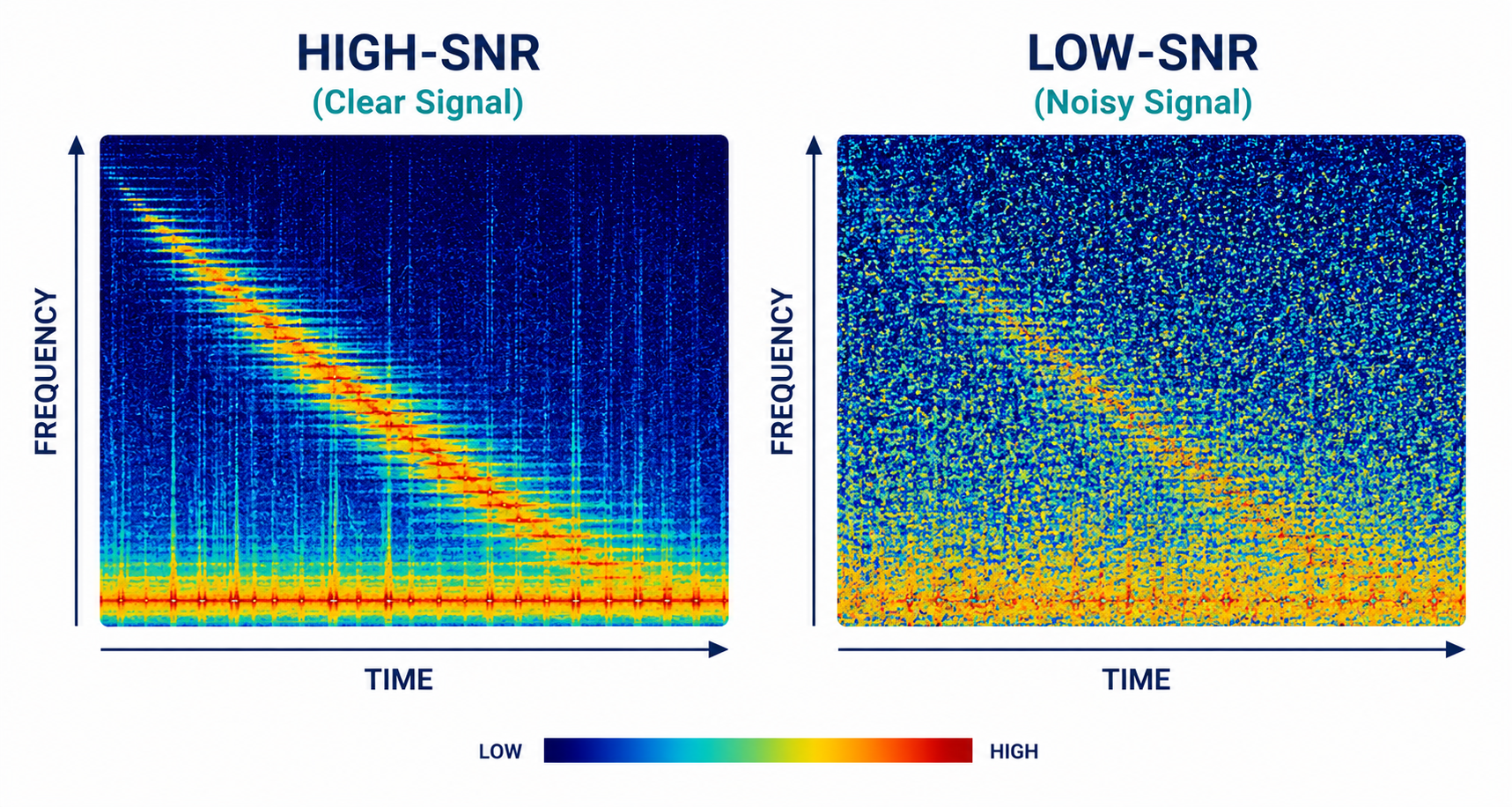
Low signal-to-noise ratio (SNR). The ocean is loud. Biological noise, weather, distant shipping, and the target's own faintness at range all combine to bury the actual signal of interest in background noise. Published research is explicit about this being a central bottleneck: under low-SNR conditions, the very process of suppressing background noise often ends up distorting or destroying the fine spectral features a classifier needs to tell targets apart. In other words, denoising and preserving signal fidelity pull in opposite directions, and there's no free way to have both — you can't clean the signal without risking cleaning away the thing you're trying to detect.
Generalization to real-world conditions. Most UATR models are trained and validated on relatively limited public datasets, recorded in specific waters, under specific conditions. A model that performs well on its training distribution can fail badly when deployed in different waters, different noise environments, or against vessel types underrepresented in training data. This generalization gap is one of the most consistently cited limitations across recent published UATR research, and it's a structurally different problem from simply "needing more data" — even large-scale datasets still only sample a narrow slice of the ocean's actual acoustic diversity.
5. Public Datasets: What's Actually Available
Dataset
Scope
Common Use
ShipsEar
Recordings of various vessel types in Spanish coastal waters
Benchmark for vessel-type classification
DeepShip
Larger-scale recordings across multiple vessel classes
Benchmark for deep-learning UATR models
Public UATR datasets remain much smaller and less diverse than what's needed for models to generalize robustly across the full range of real-world ocean conditions — a gap that shows up repeatedly in the research literature as a stated limitation rather than a solved problem. This is structurally similar to a pattern seen in other defence-AI domains: the most operationally useful data (military vessel signatures, classified detection logs) is the data least likely to ever become publicly available, which keeps academic UATR research a step behind what fielded military systems can actually do, and means published benchmark accuracy figures should generally be read as a floor on real-world difficulty rather than a ceiling on it.
6. How UATR Models Are Actually Evaluated
Beyond raw classification accuracy, UATR research typically reports a handful of metrics that matter more in an operational context:
Per-class precision and recall — since misclassifying a submarine as a fishing trawler is a very different kind of error than misclassifying one trawler as another, and aggregate accuracy alone can hide exactly this kind of asymmetric failure
Confusion matrices — showing which specific classes get mistaken for which others, which is often more diagnostically useful than any single summary number
Performance degradation curves across SNR levels — since a model's accuracy at high SNR says relatively little about how it will behave in the noisy, low-SNR conditions that dominate real deployment
Cross-dataset generalization tests — training on one dataset and testing on another, specifically to surface the generalization gap discussed above, which same-dataset train/test splits tend to mask
7. Where Research Is Headed
Recent published work (2025–2026) points toward a few consistent directions:
Multi-feature fusion architectures — rather than relying on one spectral representation, combining several into a richer, more redundant feature space that degrades more gracefully under noise than any single feature type would alone
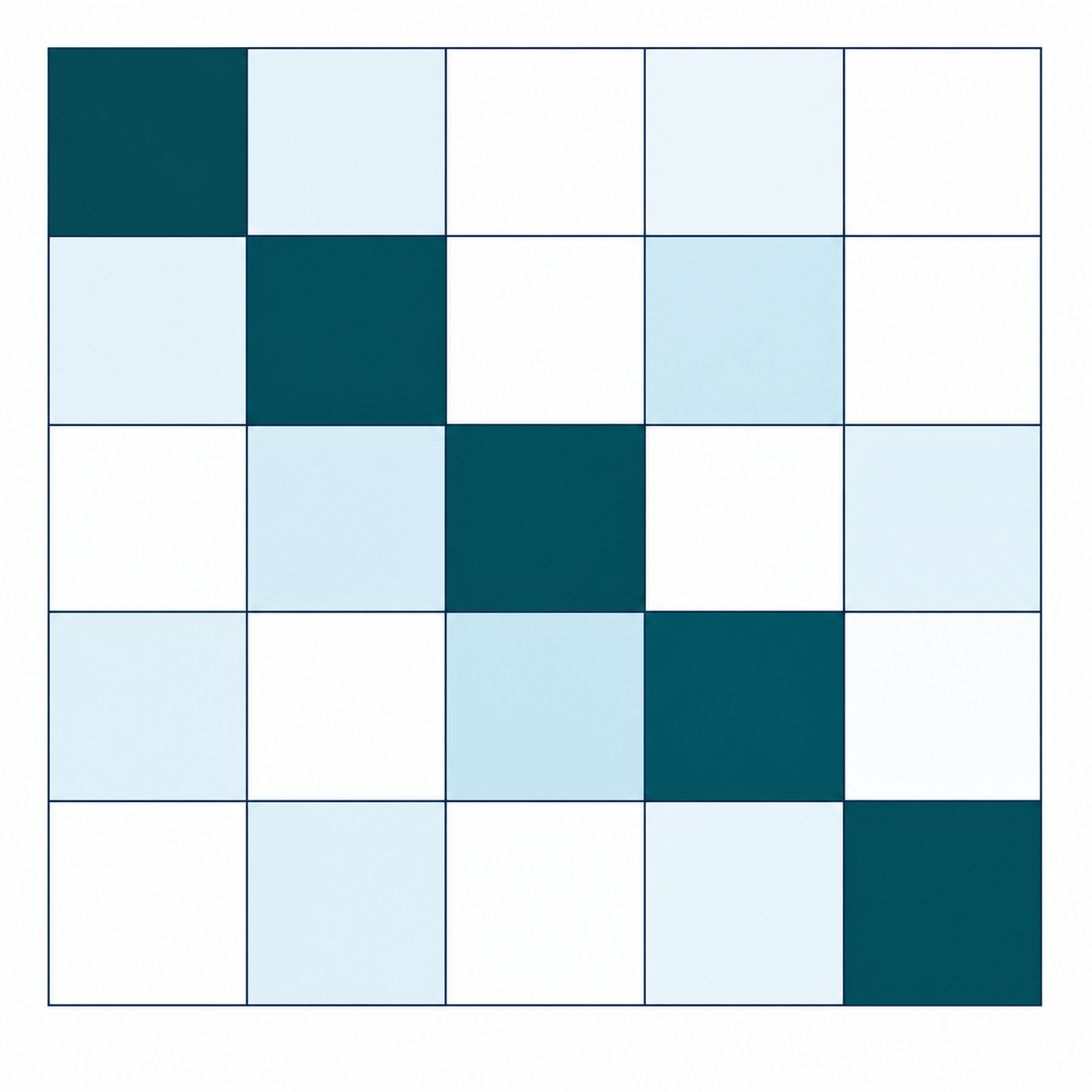
Attention mechanisms — letting models learn which frequency bands or time windows actually carry discriminative information for a given input, rather than processing the whole spectrogram uniformly
Mixture-of-experts approaches — using multiple specialized sub-models to handle the genuine diversity of underwater acoustic conditions, rather than forcing one architecture to generalize across all of them simultaneously
Regularization and data augmentation techniques — including spectrogram-based augmentation strategies specifically designed to improve robustness on exactly the low-SNR, out-of-distribution conditions where current models are weakest, by synthetically exposing models to noisier and more varied conditions than the base training data alone provides
None of this fully closes the gap yet. UATR in 2026 is a field where deep learning has clearly outperformed older, manually-engineered feature approaches, but where the core bottleneck — noisy, scarce, and narrow training data meeting an enormously variable real-world ocean — remains largely unsolved, and is likely to stay the central open problem in this field for some time yet.
Sources
"An underwater acoustic target recognition model based on heterogeneous spectral attention feature fusion," ScienceDirect, 2026
"Advancing underwater acoustic target recognition in low-SNR environments with UATR-DIFF-transformer," ScienceDirect, 2025
"Underwater Acoustic Target Classification Based on Dense Convolutional Neural Network," IEEE Xplore
"Unraveling Complex Data Diversity in Underwater Acoustic Target Recognition through Convolution-based Mixture of Experts," arXiv
"Underwater Acoustic Target Recognition based on Smoothness-inducing Regularization and Spectrogram-based Data Augmentation," arXiv
"Adversarial multi-task underwater acoustic target recognition: towards robustness against various influential factors," arXiv