What Is Underwater Domain Awareness — And Why the Ocean Is Defence AI's Next Frontier
Introduction: Knowing What's Out There
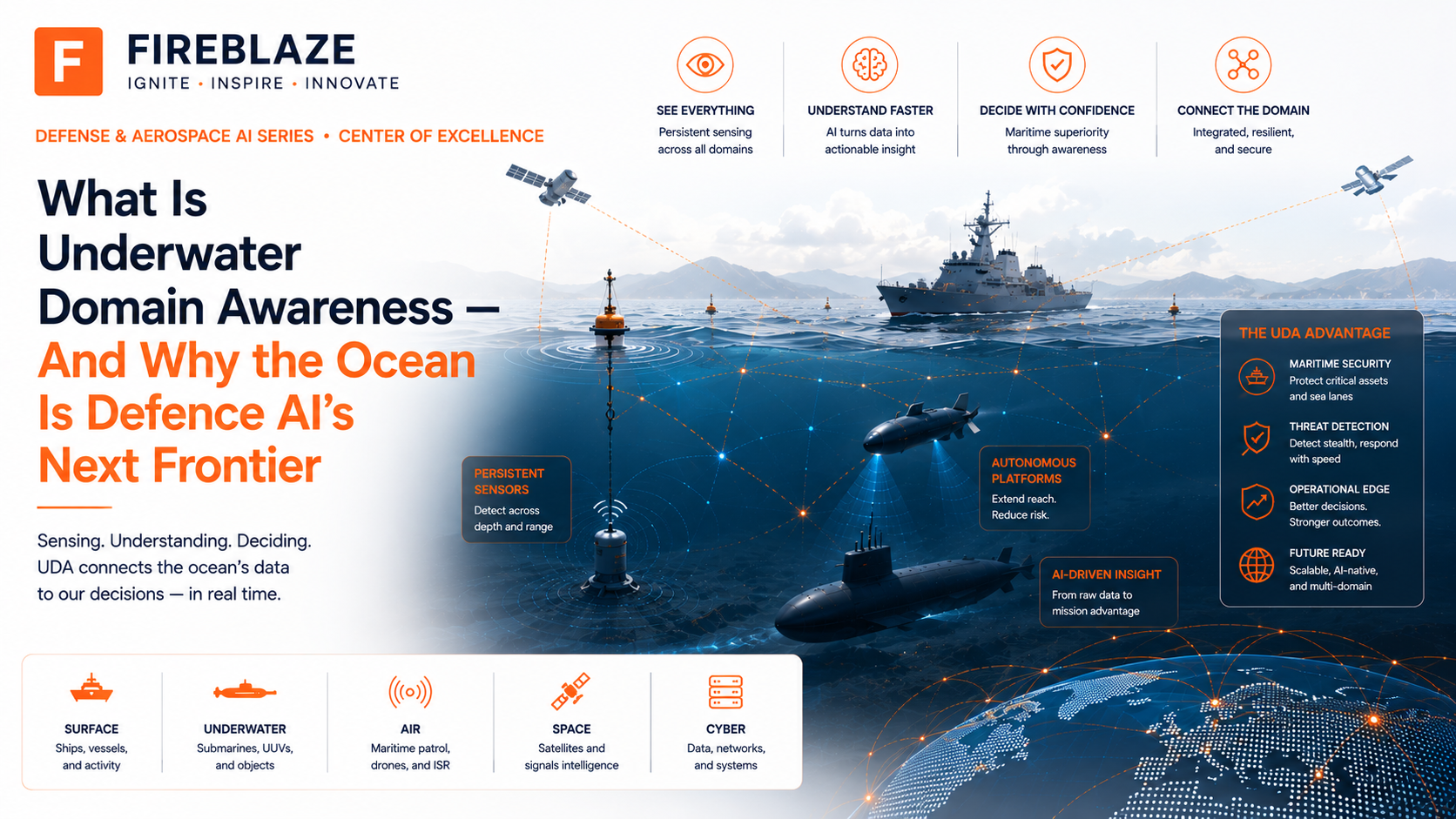
Every domain of modern warfare has converged on the same underlying problem: knowing what's out there, in real time, well enough to act on it. On land, that's called situational awareness. In the sky, it's air domain awareness. In orbit, satellite operators increasingly talk about space domain awareness — tracking not just where an object is, but what it's doing. The ocean has its own version of this problem, and it may be the hardest one to solve: Underwater Domain Awareness (UDA).
UDA is the sum of everything a navy, coast guard, or infrastructure operator needs to know about what's happening beneath the surface of the water — submarines, uncrewed underwater vehicles, divers, mines, and the health and security of the cables and pipelines that sit on the seabed. It sounds like a natural extension of domain awareness in any other environment. In practice, it's a fundamentally different engineering problem, because the physics of the ocean breaks almost every assumption that makes awareness easy everywhere else.
This piece opens a four-part series. Here we cover what UDA actually is and why it's structurally harder than every other domain. The three that follow go deeper: how passive and active sonar work, how AI turns raw acoustic signal into a classified target, and why submarines are specifically engineered to defeat all of it.
1. Why the Ocean Breaks the Rules
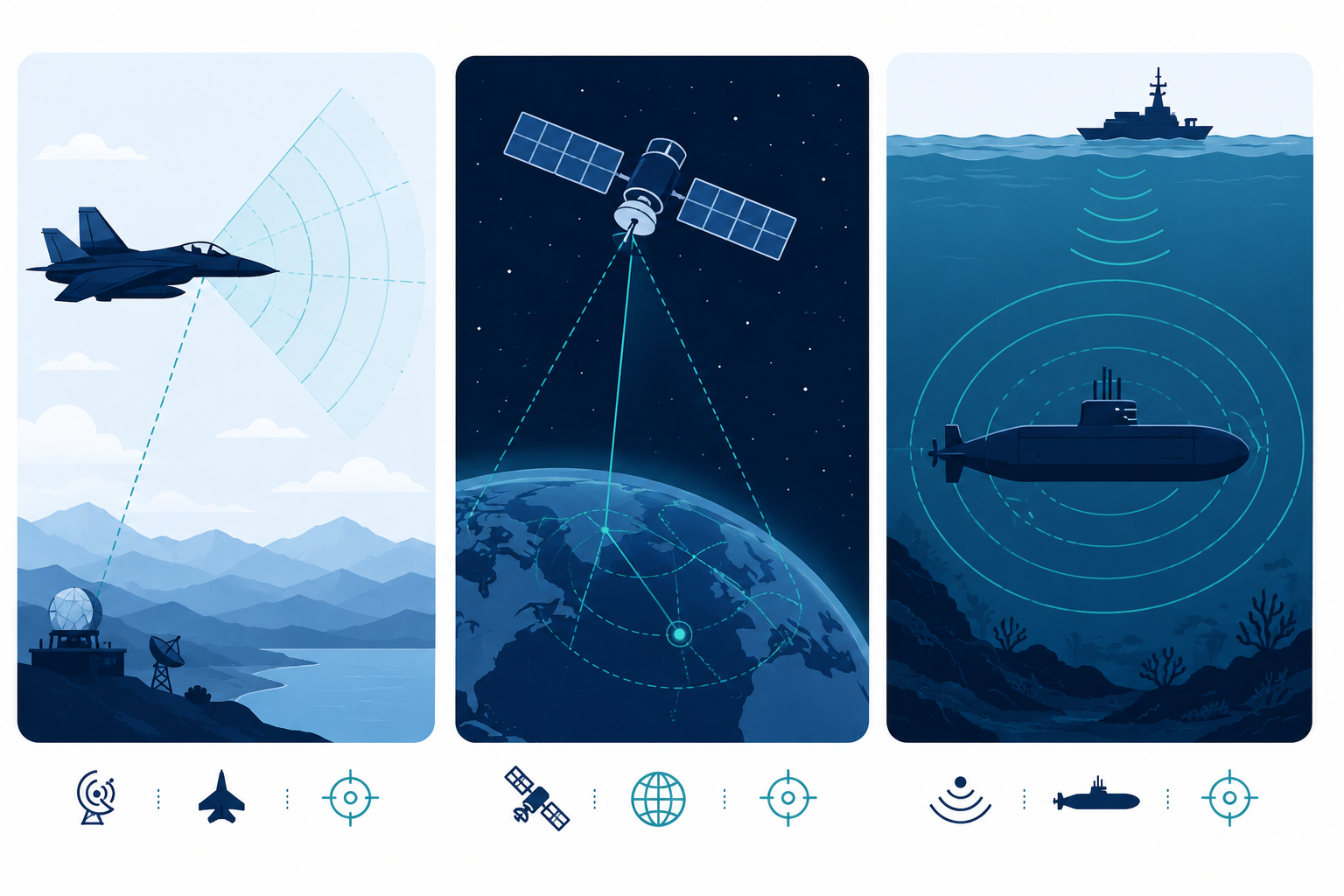
Domain awareness on land, in the air, and in space all lean on the same two tools: radar and satellite-based positioning. Neither works underwater.
Radio waves — the basis of radar, GPS, and most communications — are absorbed by seawater within centimeters. A submarine a few meters down is already invisible to any system that depends on radio frequency. GPS, similarly, simply does not function below the surface; anything operating underwater has to navigate by other means entirely, typically inertial navigation corrected by Doppler velocity logs, which drift and accumulate error over time and distance without an external correction signal.
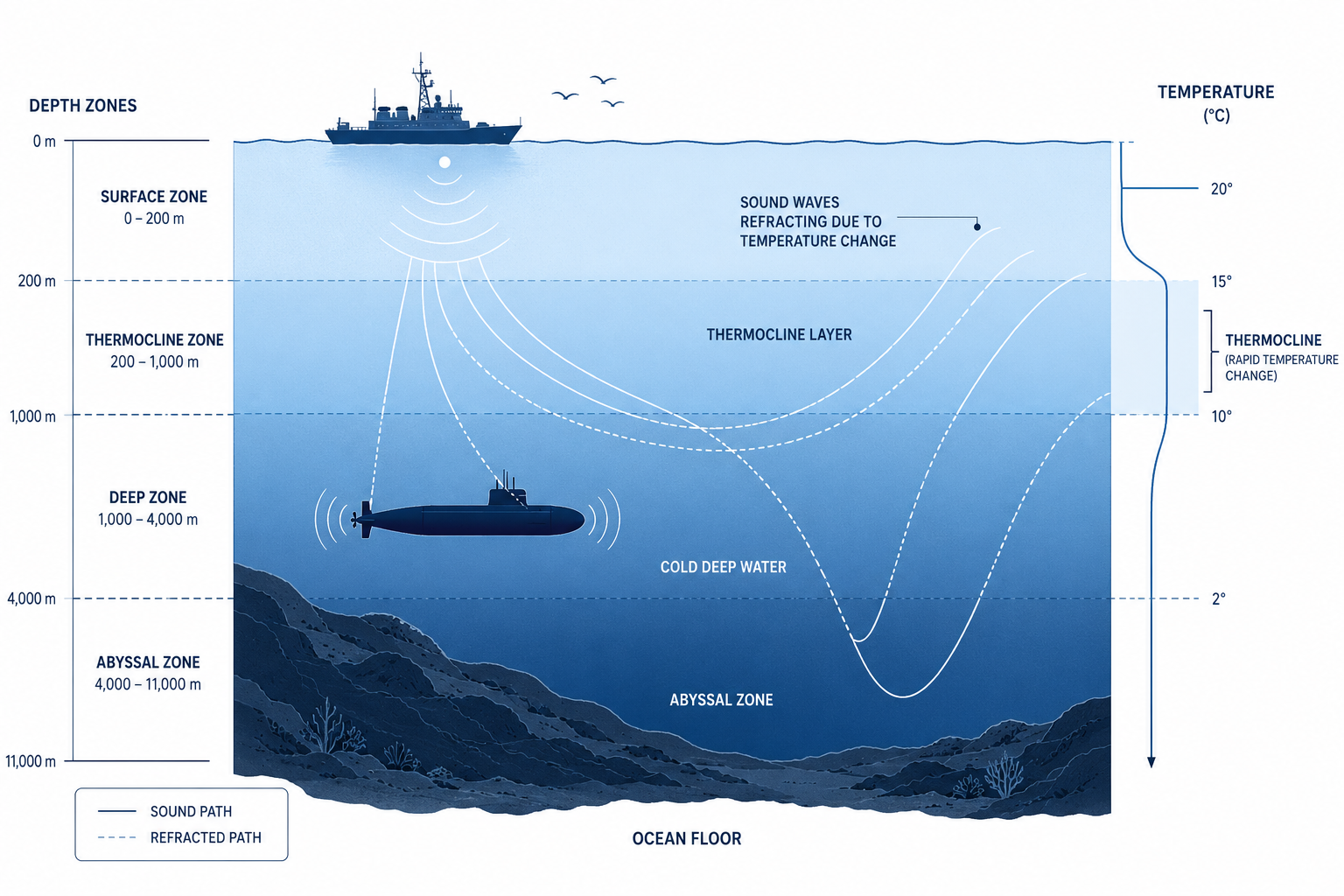
What does travel through water is sound. Sound propagates roughly four times faster in water than in air, and — depending on temperature and pressure gradients — can travel astonishing distances with very little loss, especially inside the deep-ocean SOFAR channel (Sound Fixing and Ranging channel), a depth band, typically around 600–1,200 meters in temperate waters, where the speed of sound reaches a local minimum. Sound entering this layer gets effectively trapped by refraction, bending back toward the channel's center rather than escaping upward or downward, and can as a result travel for thousands of kilometers with remarkably little energy loss. The SOFAR channel was discovered and exploited for exactly this reason during and after the Second World War, and it remains the physical basis for some of the longest-range passive listening systems in existence today.
This is why almost all underwater sensing, from mid-20th-century sonar to today's AI-driven systems, is built around acoustics rather than anything electromagnetic — and why "domain awareness" underwater has always meant, at its core, an audio processing problem before it's anything else.
2. UDA vs. Other Domains: A Structural Comparison
Factor
Air Domain Awareness
Space Domain Awareness
Underwater Domain Awareness
Primary sensing method
Radar (radio frequency)
Radar + optical telescopes
Acoustics (sonar)
Positioning
GPS
GPS / ground-based tracking
Inertial nav + Doppler logs (no GPS)
Signal travel speed
~300,000 km/s (light)
~300,000 km/s (light)
~1,500 m/s (sound in water)
Typical detection range
100s of km
1,000s of km
Often under 50 km, highly variable
Environmental interference
Weather, terrain
Solar activity, debris
Temperature layers, salinity, noise, currents
Target stealth design
Radar cross-section reduction
Passive tracking evasion
Acoustic quieting (hull design, propulsion)
Communication with own sensors
Near-instant, radio-based
Near-instant, radio-based
Slow, acoustic modems, severe bandwidth limits
3D search volume
Large but effectively 2D-ish (altitude bands)
Extremely large, sparse
Comparatively small in area, but fully volumetric and dense with clutter
Two rows deserve extra attention because they don't have a clean equivalent in any other domain.
Communication bandwidth. Radio doesn't propagate underwater, so anything communicating between two underwater nodes — a UUV reporting back to a mothership, or two seabed sensors coordinating — has to use acoustic modems, which are dramatically slower and lower-bandwidth than radio links, often measured in kilobits rather than megabits per second, and heavily affected by the same thermal layering that distorts sonar detection itself. This single constraint shapes almost every design decision in underwater autonomy: vehicles have to make far more decisions independently, because they simply cannot assume a fast, reliable link back to a human operator.
Target stealth design. Submarines are purpose-built, from the hull material to the propulsion system, to minimize the sound they radiate — which means underwater domain awareness isn't just fighting difficult physics, it's fighting an adversary actively engineering itself to be acoustically invisible. A stealth aircraft reduces its radar cross-section through shaping and coatings; a submarine does the acoustic equivalent through isolated machinery mounts, absorptive hull tiles, and propulsor design. The fourth piece in this series covers this in detail.
3. What UDA Actually Covers
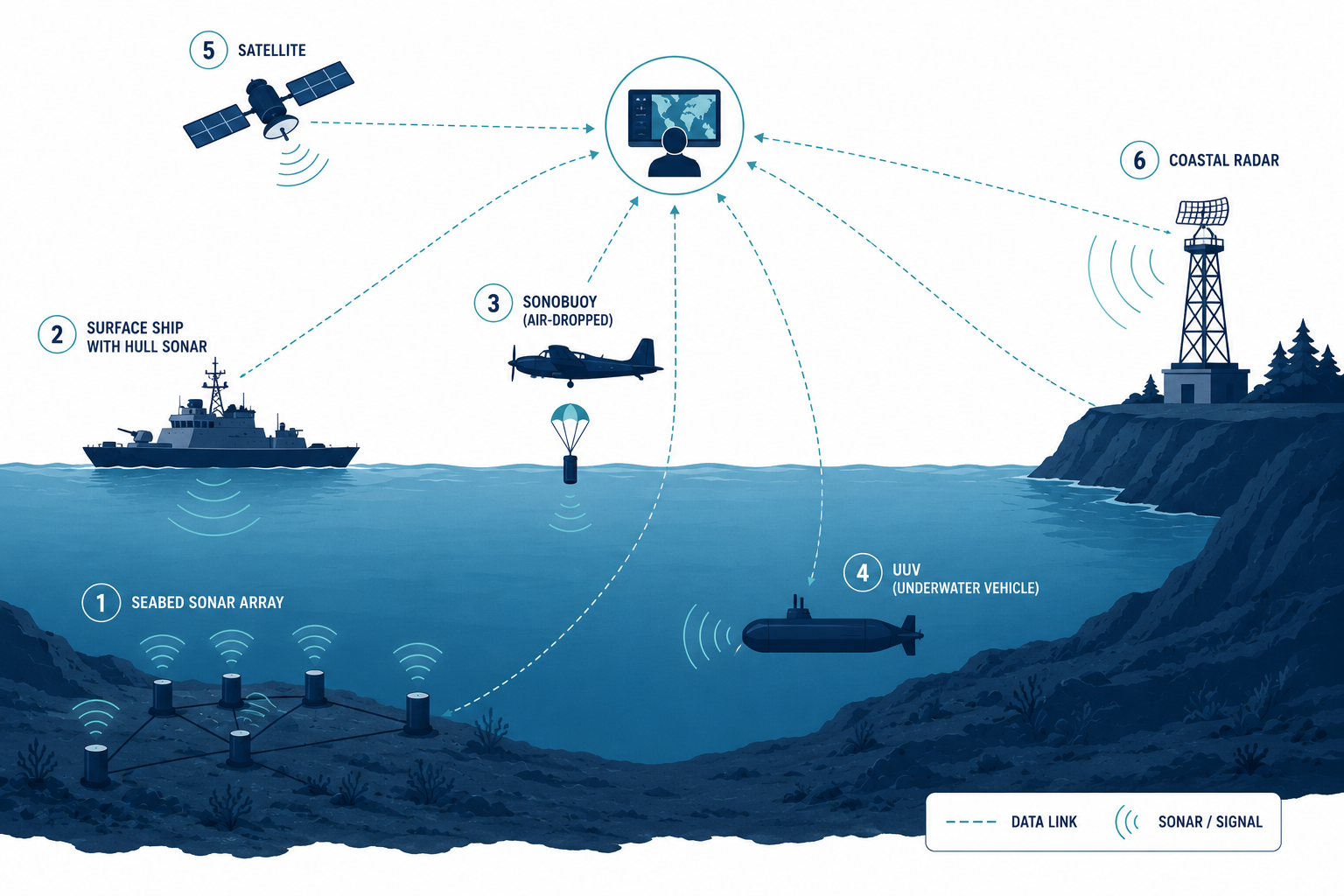
Underwater Domain Awareness isn't a single sensor or system — it's a layered set of capabilities, each with its own strengths, blind spots, and cost structure.
Fixed seabed sonar arrays. Permanent or semi-permanent listening posts placed on the ocean floor, typically covering strategic choke points or the approaches to naval bases and critical infrastructure. These trade mobility for persistence — once installed, they can listen continuously for years, but they cover a fixed geographic footprint and are expensive and slow to redeploy.
Hull-mounted and towed-array sonar. Sonar systems carried by surface ships and submarines themselves. Hull-mounted arrays are compact and always available but suffer from self-noise generated by the host ship's own machinery and flow noise. Towed arrays — long cables of hydrophones streamed hundreds of meters behind a vessel — get away from that self-noise and can achieve much better sensitivity, at the cost of reduced maneuverability while deployed.
Sonobuoys. Expendable, air-dropped acoustic sensors used by maritime patrol aircraft to search a wide area quickly. A single aircraft can seed a search area with dozens of sonobuoys, each relaying data back via radio (since the buoy itself sits at the surface, radio works fine for this last leg), giving a wide-area snapshot far faster than a single ship could achieve alone.
Unmanned Underwater Vehicles (UUVs). Autonomous or remotely operated vehicles that can patrol, map, or actively search using their own onboard sonar. The bandwidth constraint discussed above means these vehicles typically need a significant degree of autonomous decision-making capability rather than constant remote piloting.
Magnetic Anomaly Detection (MAD). Sensors, typically aircraft-mounted, that detect the distortion a large metal object — like a submarine's hull — causes in the Earth's local magnetic field. MAD has very short effective range compared to sonar, but it's immune to acoustic quieting entirely, which makes it a valuable complement rather than a replacement for acoustic methods.
Satellite and aerial optical/infrared. Limited use underwater specifically, since neither penetrates more than a few meters of clear water, but genuinely useful for detecting surfaced or near-surface vessels, wakes, and — in very clear, shallow water — submerged objects close to the surface.
AIS and vessel-tracking data fusion. Monitoring surface shipping patterns via the Automatic Identification System to flag suspicious behavior — for instance, a cargo vessel drifting off its charted course directly over a known cable route, or loitering somewhere with no obvious commercial reason to be there. This is a purely surface-level signal, but it's become an increasingly important early-warning layer for infrastructure protection specifically.
No single one of these is sufficient on its own. Effective UDA comes from fusing all of them into a coherent picture — which is exactly where AI has become central to how modern systems work, not as a replacement for any of these sensors, but as the layer that turns a flood of ambiguous acoustic and positional data into an actual, actionable, classified picture.
4. The Strategic Geography of UDA
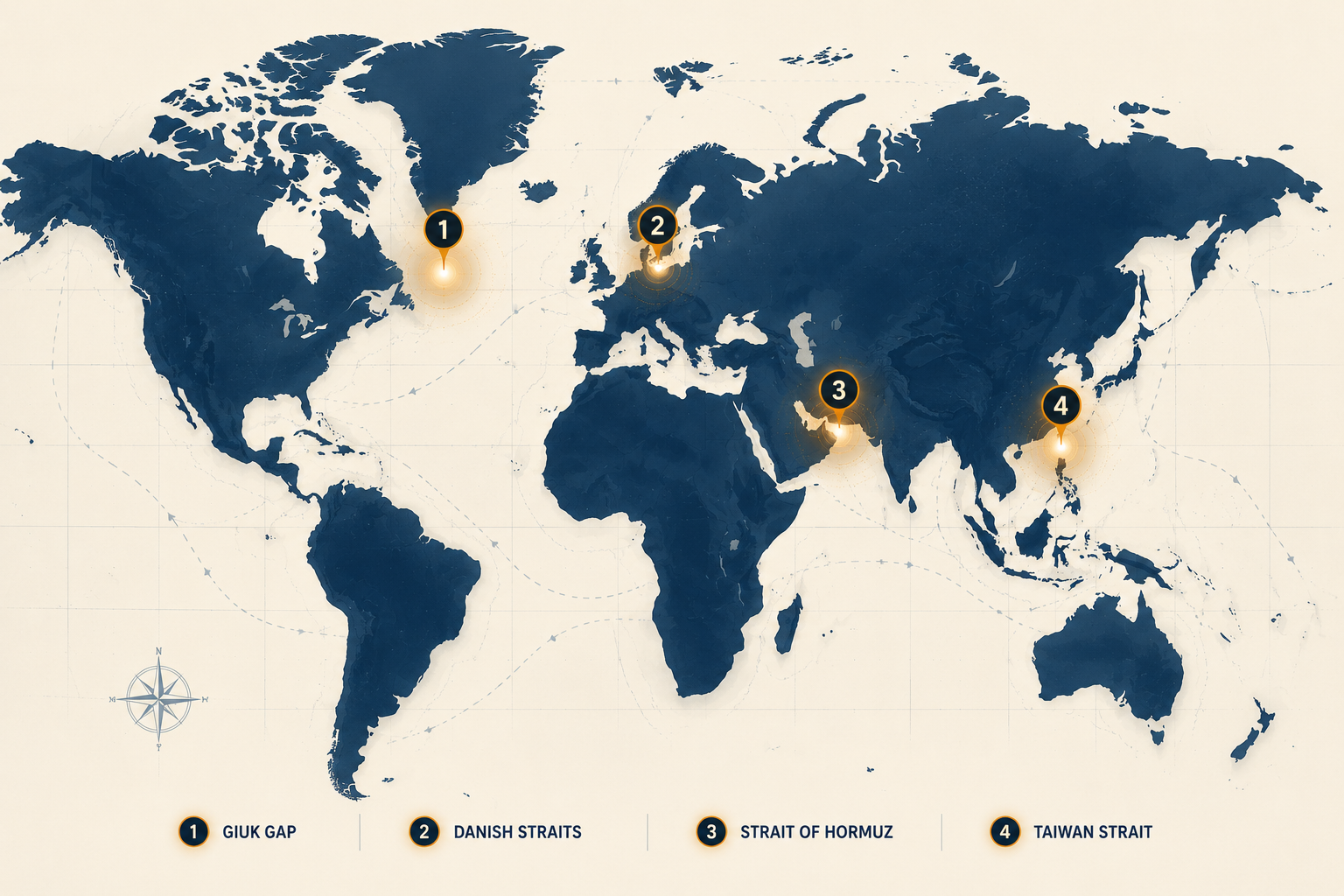
UDA isn't evenly important everywhere in the world's oceans — it concentrates heavily around a small number of geographic choke points where undersea traffic, whether submarines or cables, is forced to pass through a narrow, monitorable space:
The GIUK Gap (Greenland–Iceland–United Kingdom) — a long-standing NATO focus for tracking submarine transit between the Arctic and the open Atlantic
The Danish Straits (Great Belt, Little Belt, Øresund) — the only access points into and out of the Baltic Sea, and consequently a concentration point for both naval monitoring and undersea cable routing
The Strait of Hormuz — a critical chokepoint for both maritime trade and regional naval competition
The Taiwan Strait and South China Sea — an area of rapidly intensifying submarine fleet activity and undersea infrastructure buildout
Choke points matter for UDA the same way they matter for any surveillance problem: a fixed sensor network covering a narrow strait can achieve coverage that would be impossible to replicate across open ocean, which is why so much fixed-array and seabed-sensor investment concentrates specifically around these geographies rather than being spread evenly.
5. Why This Has Become Urgent
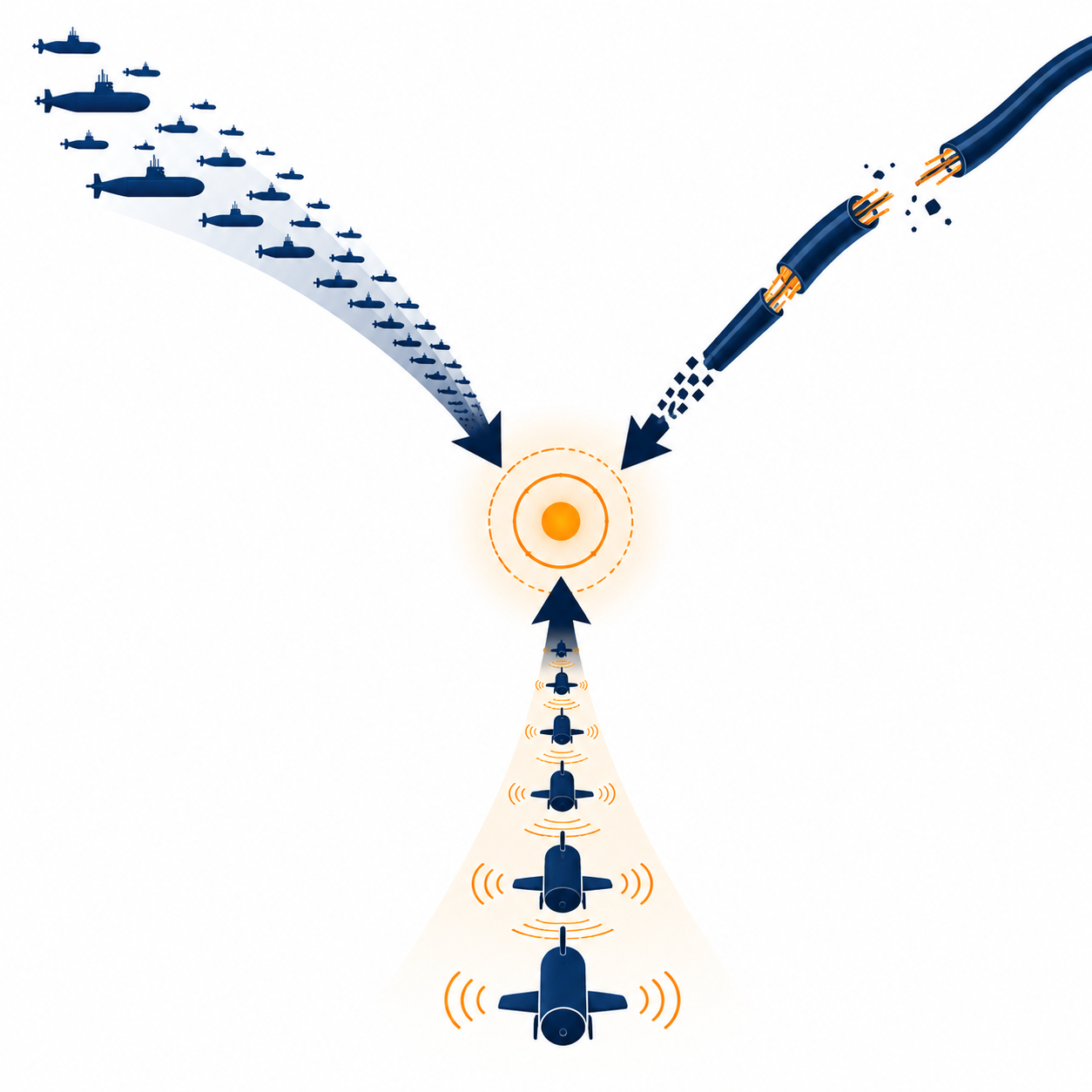
Three converging trends have pushed UDA from a niche naval specialty into a much more mainstream defence-AI priority.
Submarine proliferation. Naval forces across the Asia-Pacific region, the Middle East, and Europe are expanding and modernizing their submarine fleets, including newer generations that are quieter and harder to detect using older-generation sonar and analysis methods. This isn't just a numbers increase — it's a qualitative shift, where the acoustic advantage that older detection systems relied on is steadily eroding.
Undersea infrastructure has become a target. The world's internet and much of its electricity and gas now runs through undersea cables and pipelines, most of them undefended and lying exposed on the open seabed. Incidents of suspected sabotage against this infrastructure have made undersea infrastructure protection a genuine NATO-level security priority rather than a hypothetical — a topic covered in depth elsewhere in this content series.
Autonomy is changing what's operationally possible. Uncrewed underwater vehicles mean navies can now consider persistent, long-duration underwater surveillance missions that would be operationally or financially unrealistic with crewed submarines alone — which shifts UDA from "occasional patrol" toward something closer to continuous monitoring across contested waters.
6. Where AI Actually Fits
None of this works without automation, for a simple reason: acoustic data is enormous in volume and extremely difficult for a human listener to interpret reliably at scale. A trained sonar operator can learn to recognize specific vessel signatures by ear, but that skill takes years to develop and doesn't scale across a growing sensor network generating data continuously, around the clock, across dozens or hundreds of simultaneous contacts.
AI's role in UDA breaks down into a few concrete jobs:
Classification — is this acoustic contact a whale, a merchant ship, a fishing trawler, or a submarine? And if it's a vessel, what class, and ideally, which specific hull?
Detection in noise — pulling a faint, real signal out of an ocean full of biological noise, shipping traffic, and weather, without either missing genuine contacts or drowning operators in false alarms
Data fusion — combining acoustic, magnetic, optical, and AIS data into one coherent track rather than treating each sensor in isolation, which is where a lot of the genuinely hard systems-engineering work in modern UDA actually sits
Autonomy — allowing UUVs to patrol, search, and make basic operational decisions without needing a constant human-in-the-loop connection, which underwater communication bandwidth makes especially necessary rather than optional
The next three pieces in this series go deeper into each of these: how passive and active sonar actually work and where their tradeoffs sit, how AI turns a raw acoustic signal into a classified target through the full technical pipeline, and why submarines are built specifically to defeat exactly these detection methods — and what that arms-race dynamic means for how detection models have to evolve.
Sources
Multiple public defence and naval-technology reporting on undersea infrastructure security, 2025–2026
Academic literature on underwater acoustic sensing, SOFAR channel propagation, and marine acoustics fundamentals
NATO and EU public statements on undersea infrastructure protection initiatives and choke-point monitoring strategy