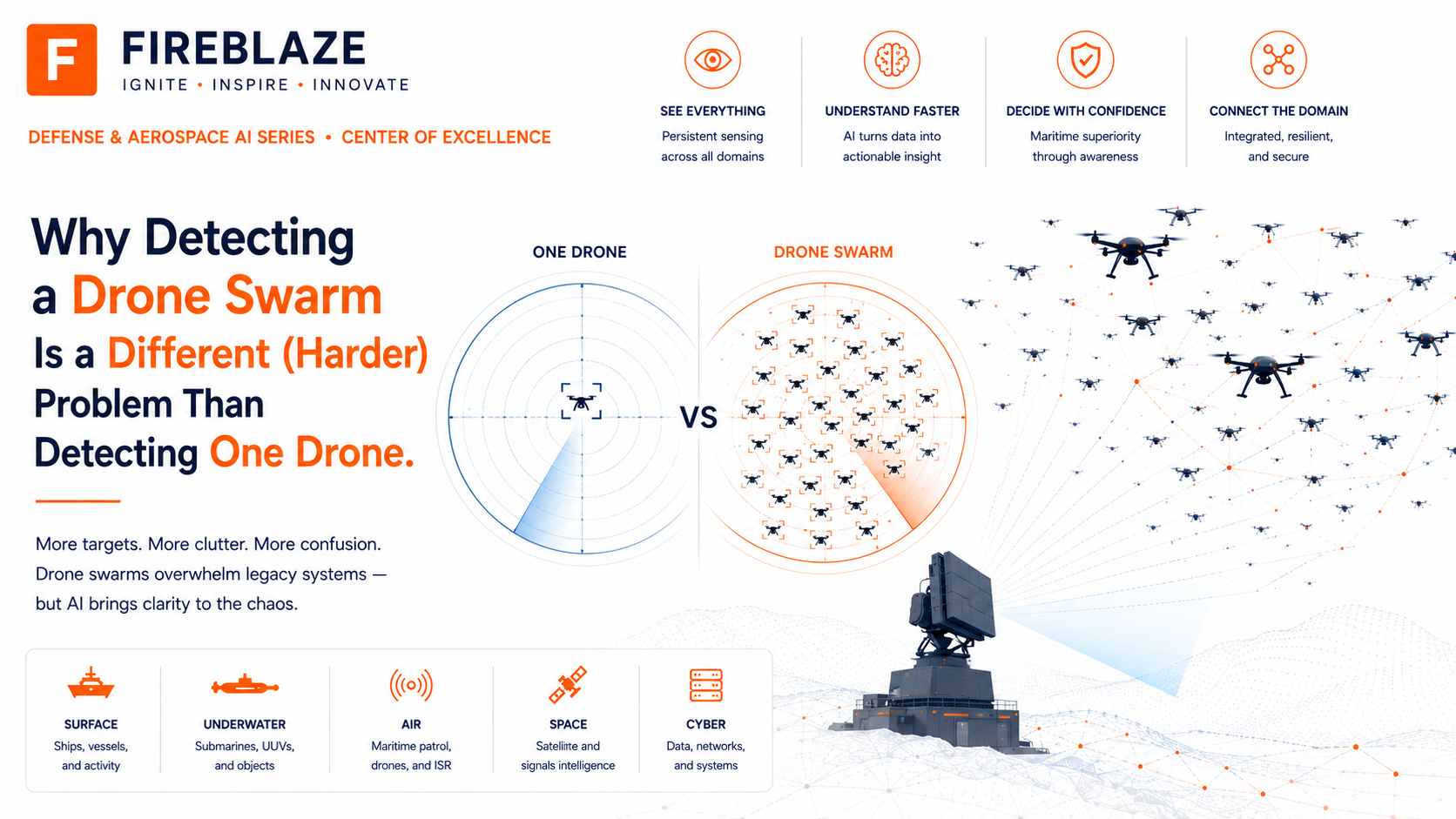
Why Detecting a Drone Swarm Is a Different (Harder) Problem Than Detecting One Drone
One Target Is a Detection Problem. Many Targets Is a Different Problem Entirely.
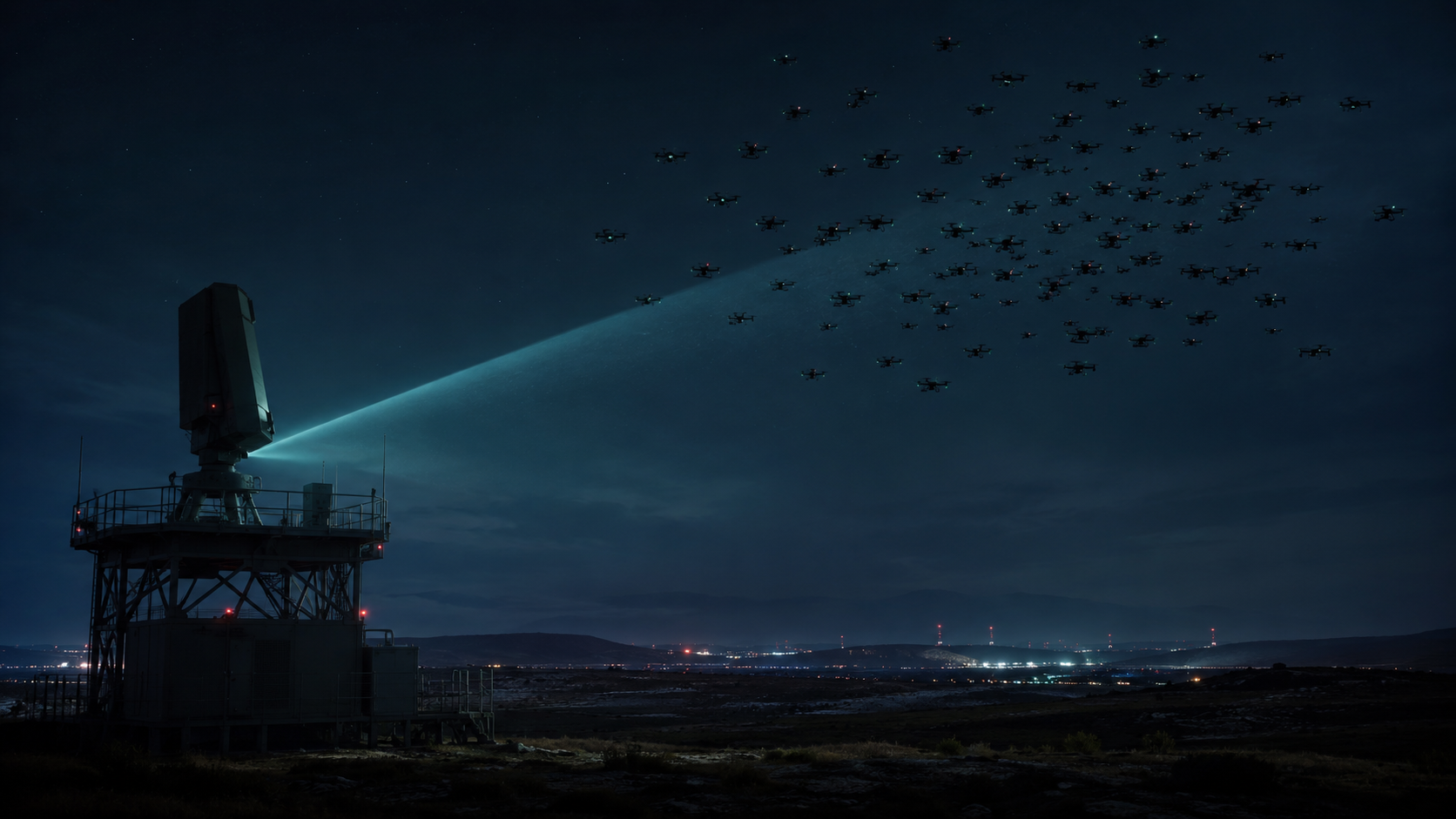
It's tempting to assume that detecting a drone swarm is just "detecting one drone, but more times." It isn't. Every sensor and every algorithm discussed elsewhere in this series — RF, radar, EO/IR, kinetic and directed-energy defeat systems — was originally proven against single or small numbers of targets. Scale the target count up to a real swarm, and entirely new failure modes appear that simply don't exist when there's only one thing to track.
Understanding why requires looking at four compounding problems: clutter, signal noise, tracking mathematics, and human decision-making under ambiguity.
Problem One: Individually Invisible, Collectively Confusing
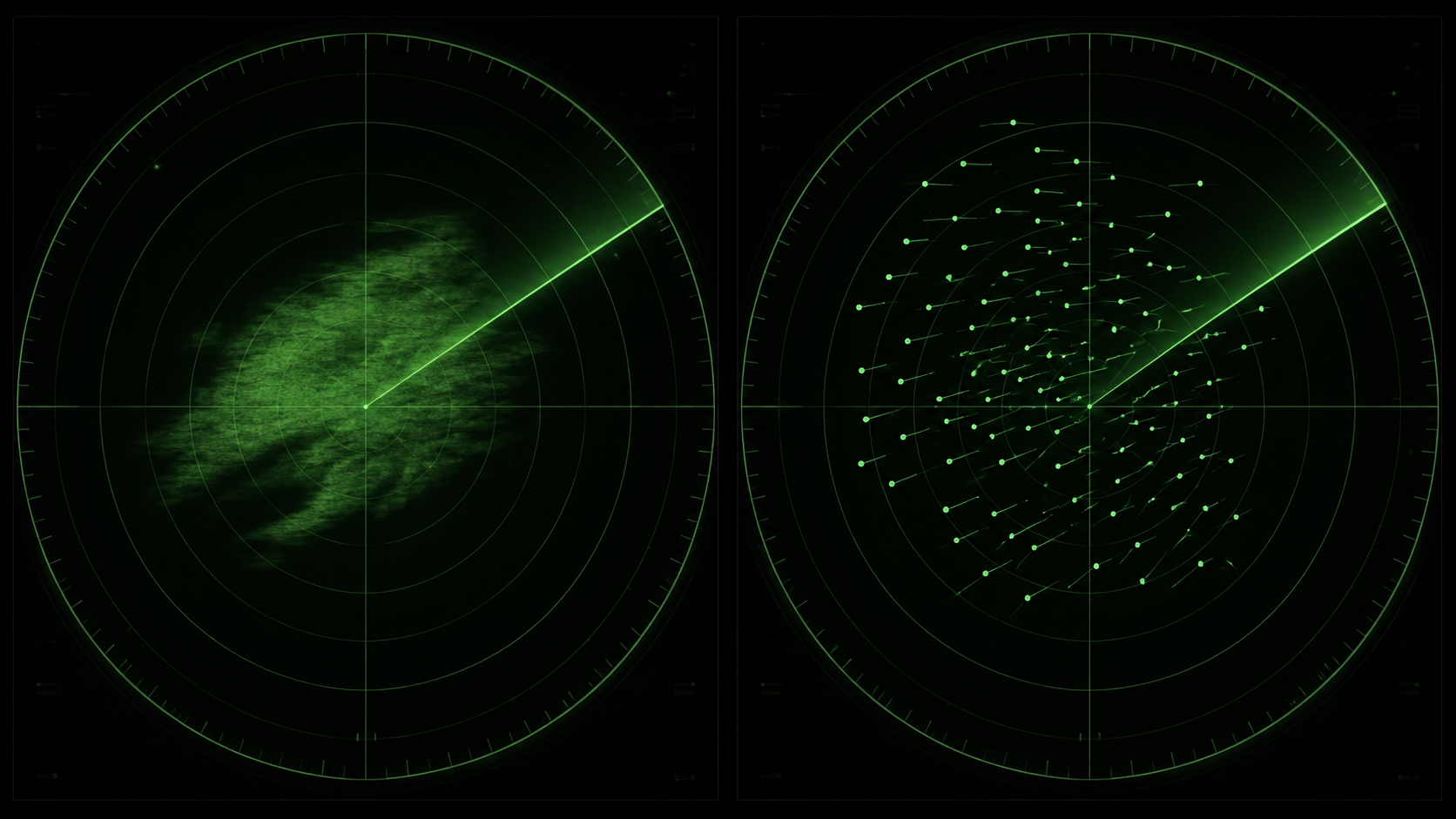
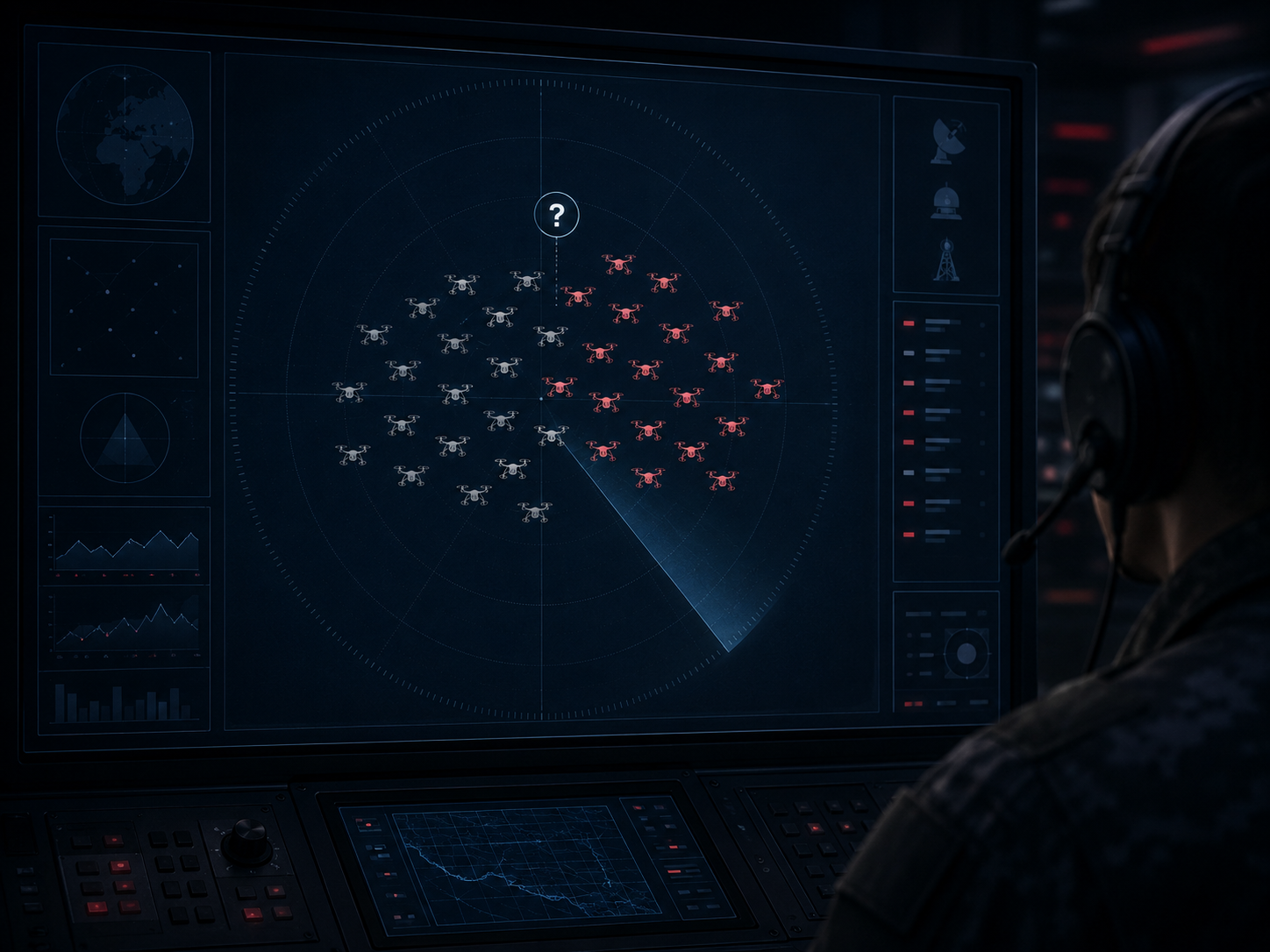
A single small drone already presents a difficult radar target because of its tiny radar cross-section (RCS) and slow, low-altitude flight profile — exactly the signature classic radar filtering was built to dismiss as clutter. Multiply that by dozens of drones flying close together, and something worse happens: their individually weak, low-RCS returns can blend into what looks like one large, confusing cluster rather than many distinct, trackable objects. One defense-industry summary put it starkly: the true danger of a swarm is that it can present as a single, massive, indistinct blob to legacy detection systems, rather than as the many discrete threats it actually is.
This isn't a hypothetical edge case. The current Guinness World Record for most unmanned aircraft airborne simultaneously stands at over 3,000 drones — and defense analysts note that even a coordinated swarm of just 100 could risk overwhelming a typical military base's detection and response capacity.
Problem Two: The Noise Floor Rises With Every New Emitter
RF detection faces its own version of this problem. A lone drone's control signal is already faint — often far weaker than the ambient electromagnetic noise around it. Add multiple drones operating in the same airspace, each with its own control and telemetry link, and the overall background RF noise level in that environment rises accordingly, making it harder for a detection system to isolate and identify any single drone's weaker signal from the growing crowd of legitimate targets it's trying to separate out. The problem compounds rather than simply repeating.
Problem Three: The Tracking Math Gets Combinatorially Harder
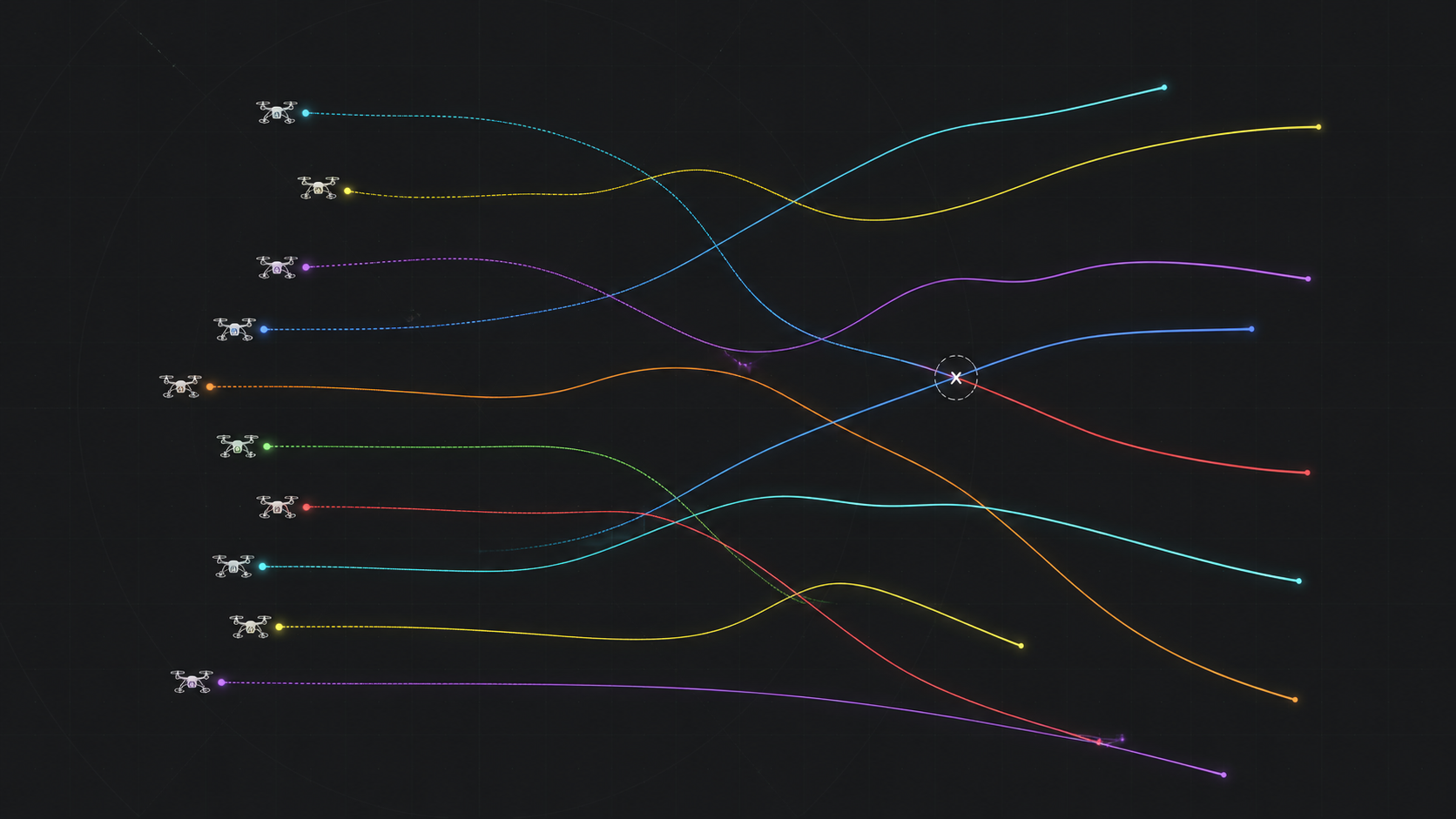
This is the part of the swarm problem that's easy to underestimate: even once a sensor has detected multiple objects, a system still has to solve multi-object tracking (MOT) — correctly figuring out, frame by frame, which detection belongs to which physical drone, especially as drones cross paths, fly in close formation, or briefly disappear behind terrain or each other.
Researchers describe this as inferring the time-varying state of multiple objects under uncertainty about how many objects there even are, when they appear or disappear from view, and how close together they're flying — all while contending with missed detections and clutter at the same time. This is a fundamentally different computational problem than tracking one object, and it's why swarm-aware systems increasingly rely on more sophisticated approaches: track-before-detect techniques that accumulate weak evidence over time rather than requiring a strong single-frame detection, and micro-Doppler analysis that can pick out the distinctive signature of individual rotor blades to help separate one drone from its neighbors even when their radar returns overlap.
Detection Challenge
Single Drone
Drone Swarm
Radar cross-section problem
Small target vs. clutter
Multiple small targets can merge into one clutter-like blob
RF background noise
One faint signal vs. noise floor
Noise floor itself rises with multiple emitters
Track association
Trivial — one object, one track
Combinatorial — which detection belongs to which drone?
Classification confidence
Higher — full sensor dwell time on one object
Lower — sensor attention divided across many objects
Operator cognitive load
Manageable
Can exceed human decision-making capacity
Problem Four: Swarms Are Designed to Create Doubt, Not Just Damage
Beyond the pure engineering challenge, swarms introduce a psychological and decision-making dimension that a single drone doesn't. A coordinated swarm can include real strike drones alongside cheap decoys, and from a defender's radar screen, the two can look identical in the critical seconds when a decision has to be made. Is this a real attack, or a diversion? Defense analysts have noted this ambiguity is a real tactical advantage for an attacker: defenses may fire expensive interceptors at non-lethal decoys while the actual strike drones go untouched, and human operators may hesitate to respond decisively — especially in urban or civilian-adjacent areas — precisely because the picture in front of them is genuinely unclear.
Coordinated jamming, terrain masking, and deliberately exploiting gaps in radar coverage can compound this further, allowing a swarm to behave, in the words of one industry analysis, like a shadow army that becomes visible only after it's too late to matter.
How AI Is Actually Addressing the Swarm-Specific Problem
Because the swarm problem isn't just "more of the single-drone problem," the solutions being developed are qualitatively different too, not just faster versions of single-target tools:
4D radar with adaptive processing — measuring range, azimuth, elevation, and Doppler velocity together, with faster update rates specifically tuned to resolve closely spaced, low-altitude, slow-moving clusters rather than filtering them out as clutter.
MIMO and phased-array/multi-beam radar configurations — designed explicitly to differentiate clustered drone echoes from background noise, rather than relying on a single beam sweeping past a whole cluster at once.
Protocol and RF pattern analysis — rather than trying to detect each drone's signal individually, some systems analyze packet timing, frequency-hopping patterns, and overall transmission density across a whole area to infer that coordinated swarm behavior is present, even when individual signals are too weak to isolate cleanly.
Graph-based swarm intelligence models — emerging research applies graph neural networks to model relationships between drones in a formation, aiming to recognize coordinated adversarial behavior as a pattern in itself, rather than treating each detected object as an isolated, unrelated track.
Distributed sensing architecture — rather than relying on one large, powerful sensor node as a single point of failure, newer concepts spread detection capability across many smaller, cheaper nodes, so a swarm can't defeat the whole detection picture by simply overwhelming one location.
The Bottom Line
A single drone is a hard target because it's small, slow, and quiet. A swarm is a genuinely different kind of problem: clutter compounds, noise floors rise, the tracking math becomes combinatorial rather than simple, and the attacker gets to actively exploit human hesitation and ambiguity as a weapon in its own right. None of the solutions covered elsewhere in this series — fused sensing, layered kill chains, kinetic and directed-energy defeat options — work at all against a swarm unless the detection and tracking layer underneath them can first turn a confusing blob of faint, overlapping signals into a confident list of individually tracked, individually assessed threats. That reframing — from "find the drone" to "resolve the crowd" — is the real reason swarm defense has become the defining challenge in modern counter-UAS work, and the reason every article in this series keeps circling back to the same theme: speed, scale, and confident automated decision-making, not any single silver-bullet sensor or weapon.
Sources referenced: peer-reviewed research on multi-sensor multi-object tracking (arXiv, 2026), Robin Radar and Skylock industry analyses on swarm detection, Sentrycs glossary on drone swarm countermeasures, SkyRadar analysis on stealth drone swarm detection, and arXiv research on RF noise floor effects in multi-drone environments.