Why Submarines Are Designed to Be Invisible to AI (And What That Means for Detection Models)
Introduction
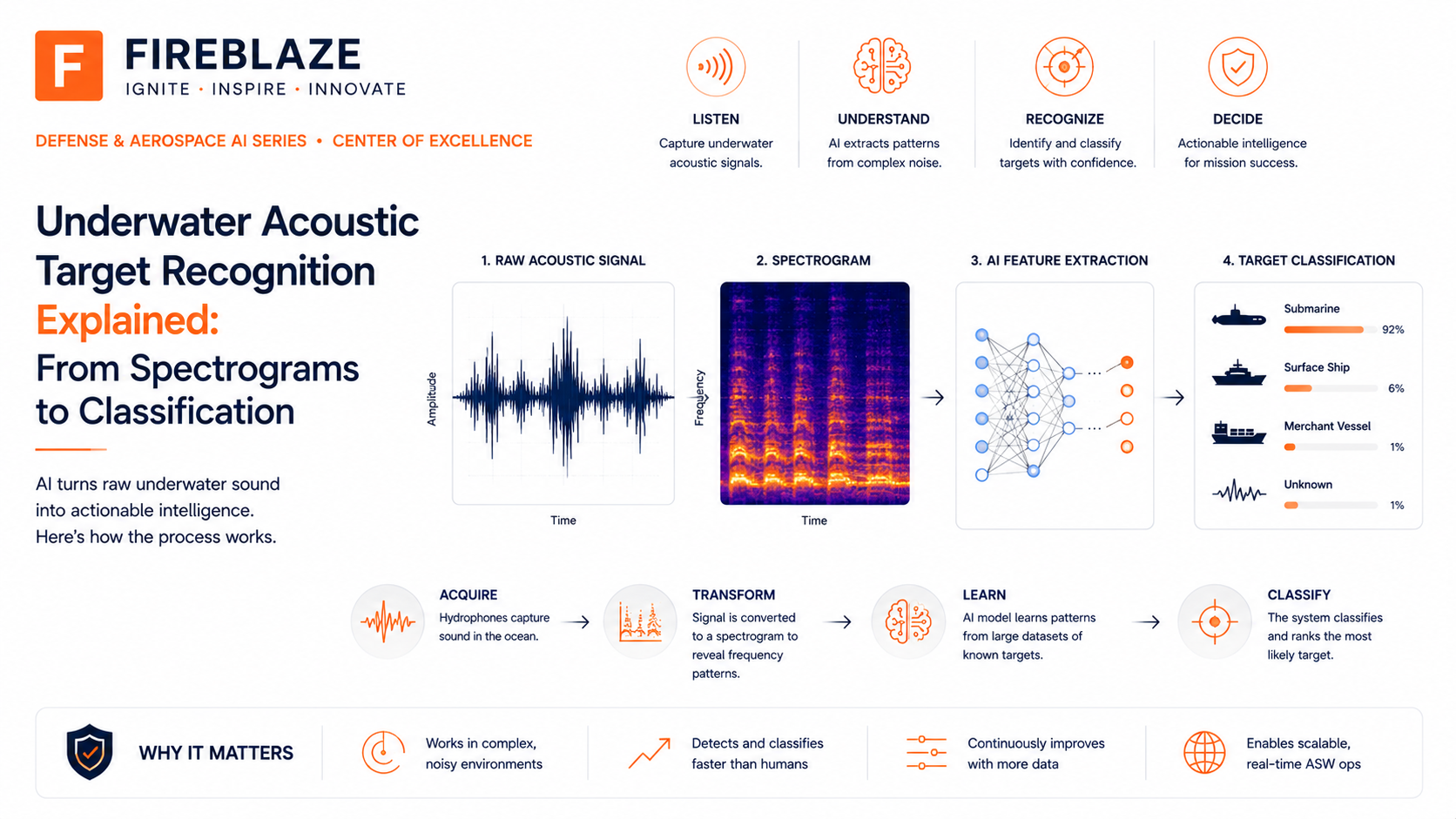
Every detection model discussed elsewhere in this series — passive sonar classifiers, active sonar echo-detection, multi-feature spectral fusion for underwater acoustic target recognition — is built to solve a problem that a submarine's entire design exists specifically to make harder. This isn't incidental. Acoustic stealth is one of the primary design goals of every modern submarine program, engineered into the hull, the propulsion system, and even the crew's operating procedures. This piece, the fourth and closing part of this series, covers what "quiet" actually means at an engineering level — the other half of understanding why underwater detection AI is such a hard problem. It's not just fighting ocean physics, as covered in the first two pieces in this series; it's fighting a target actively engineered against exactly the detection methods described in the third.
1. Where Submarine Noise Actually Comes From
A submarine radiates sound from several distinct sources, and quieting design has to address each one separately, because a submarine that's quiet in one respect but loud in another is still detectable.
Machinery noise — engines, pumps, generators, and other rotating or reciprocating equipment all vibrate, and those vibrations transmit through mounting points into the hull structure and out into the water
Propulsor noise — the propeller or pump-jet is often the single largest noise source at higher speeds, primarily through a phenomenon called cavitation
Flow noise — water moving across the hull surface itself generates noise, which increases with speed and with any surface irregularity, seam, or protrusion
Structure-borne noise — vibration transmitted through the hull structure from any of the above sources, radiating outward even from equipment not in direct contact with seawater, simply because the whole hull acts as a connected acoustic structure
2. The Countermeasures, One by One
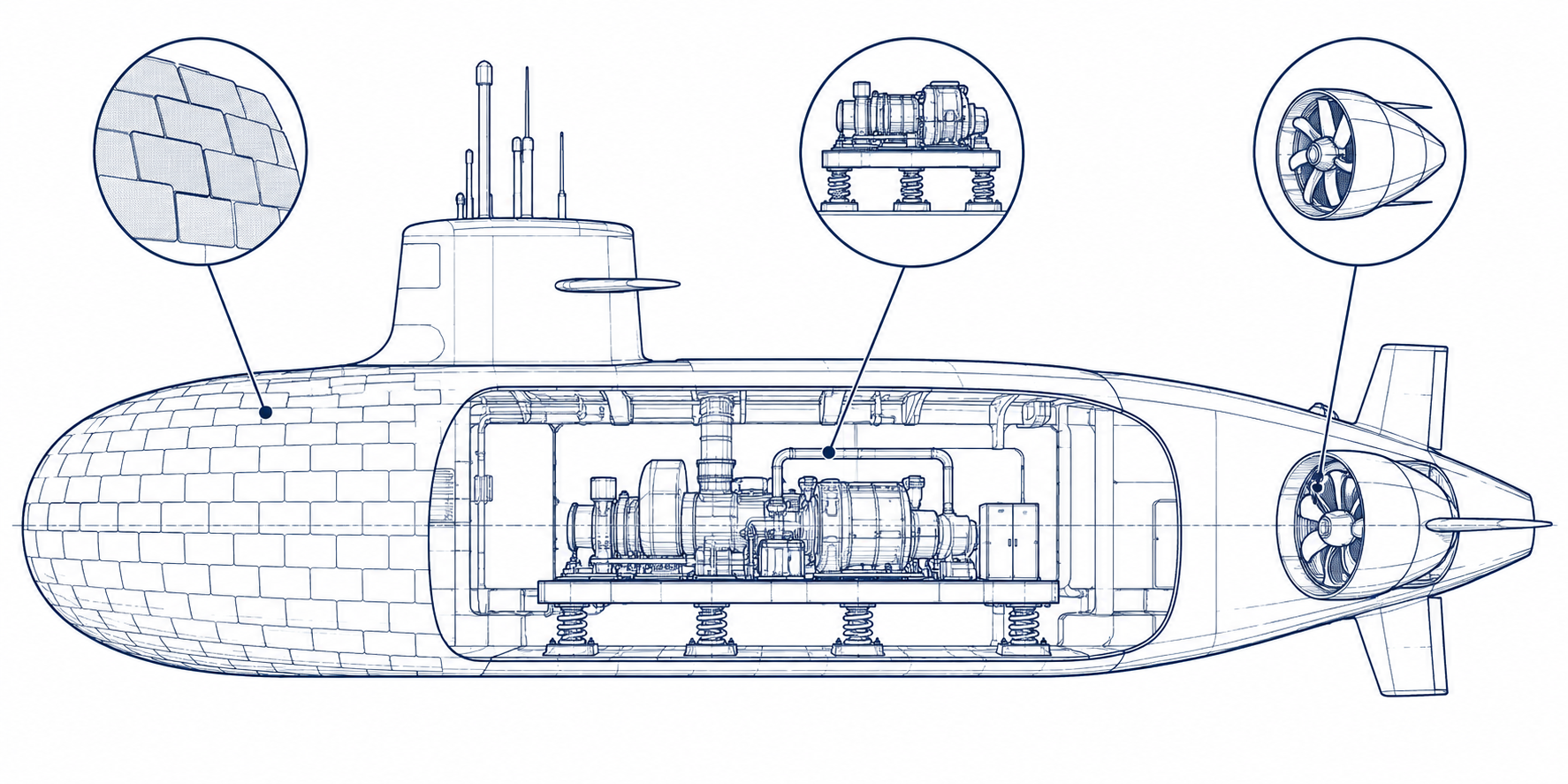
Machinery rafting and isolation. Rather than bolting engines and generators directly to the hull, quiet submarine designs mount them on isolated platforms — "rafts" — suspended on resilient mounts engineered specifically to absorb vibration before it can transmit into the hull structure. Multiple stages of isolation (a raft mounted on another raft, each stage further decoupling vibration) are common in the quietest designs, at the cost of additional weight, complexity, and internal space that could otherwise go toward other systems.
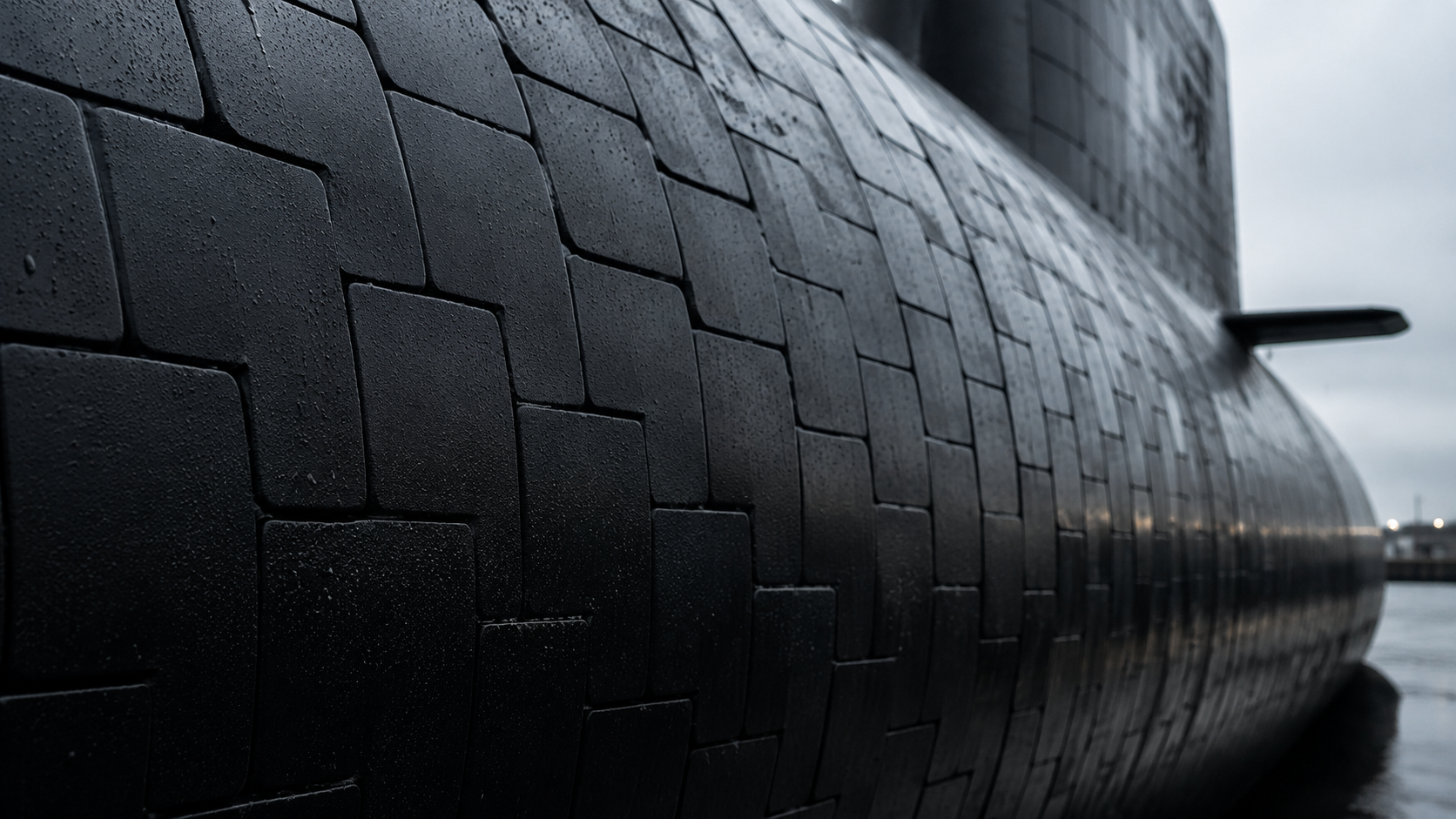
Anechoic tiles. Many modern submarine hulls are coated in a layer of rubber or polymer tiles specifically engineered to absorb sound rather than reflect it. This serves two separate purposes at once: it reduces the sound the submarine itself radiates outward from internal machinery, and it reduces the strength of any active sonar echo bouncing off the hull, since much of an incoming ping's energy is absorbed rather than reflected back toward the source. This is the direct underwater analogue of radar-absorbent coatings used on stealth aircraft, solving a broadly similar problem in a completely different physical medium.
Propulsor design. Modern quiet submarines increasingly favor pump-jet propulsors — a shrouded, multi-bladed design enclosed within a duct — over traditional open propellers, specifically because pump-jets delay the onset of cavitation, allowing higher speeds before the boat becomes acoustically loud. Cavitation itself is a physical phenomenon: as a propeller blade moves fast enough through water, it can create a zone of locally reduced pressure low enough for water to briefly vaporize into small bubbles, which then collapse violently as pressure recovers — this collapse is what generates cavitation noise, and it's one of the most distinctive and detectable acoustic signatures a vessel can produce, precisely because it's loud, broadband, and structurally different from steady machinery hum.
Electric and air-independent propulsion. Diesel-electric and increasingly air-independent propulsion (AIP) systems allow non-nuclear submarines to run on battery or fuel-cell power for extended periods without needing to run a noisy diesel generator or surface/snorkel to recharge. This makes them substantially quieter than nuclear-powered boats at low speed and on patrol, even though nuclear submarines retain significant advantages in range, sustained high speed, and total endurance that AIP boats can't match.
Speed discipline. Simply put: slower is quieter. Flow noise and propulsor cavitation both scale sharply with speed, so submarine crews operating in a deliberate stealth posture will typically run at a fraction of their maximum speed specifically to stay under the threshold where they become significantly louder — trading tactical speed and transit time directly for acoustic concealment, a tradeoff commanders have to actively manage rather than something the boat's design alone resolves.
3. Beyond Sound: Other Signatures Submarines Also Try to Minimize
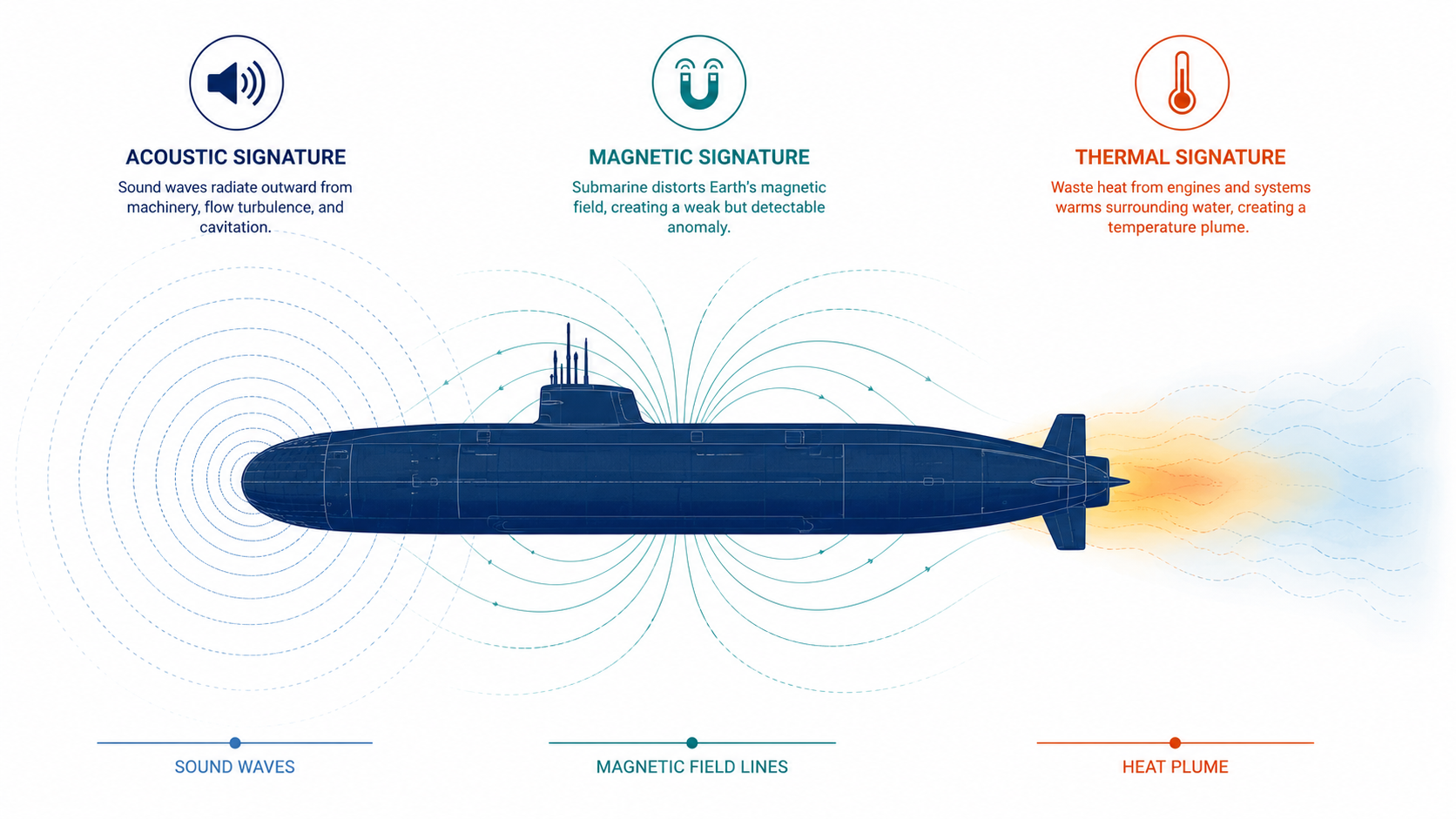
Acoustic quieting gets most of the attention, but it isn't the only signature a stealthy submarine design has to manage, and it's worth understanding why — because it directly explains why UDA, as discussed in the first piece of this series, has to be a multi-sensor problem rather than a purely acoustic one.
Magnetic signature. A submarine's steel hull and onboard machinery distort the Earth's local magnetic field, which is exactly what Magnetic Anomaly Detection sensors are built to pick up. Some navies use degaussing — deliberately treating a hull to reduce its magnetic signature — as a partial countermeasure, though MAD-range detection remains short enough that it functions more as a localization tool once a target is already suspected, rather than a wide-area search method.
Thermal and wake signatures. A submarine's machinery generates heat, and its movement through water can create subtle surface effects even at depth. Neither is typically a primary detection method today, but both illustrate the same underlying point: no single stealth countermeasure covers every way a submarine can, in principle, be detected.
The strategic implication. Because acoustic quieting doesn't help against magnetic anomaly detection, and vice versa, an adversary with access to multiple sensor types forces a submarine design to defend against all of them simultaneously — which is precisely why the layered, multi-sensor UDA approach described in the first piece of this series matters as much as any individual AI model's raw classification accuracy. A perfectly quiet submarine that hasn't also managed its magnetic signature isn't actually invisible; it's just invisible to one specific sensor type.
4. Quieting Is a Moving Target, Not a Fixed Achievement
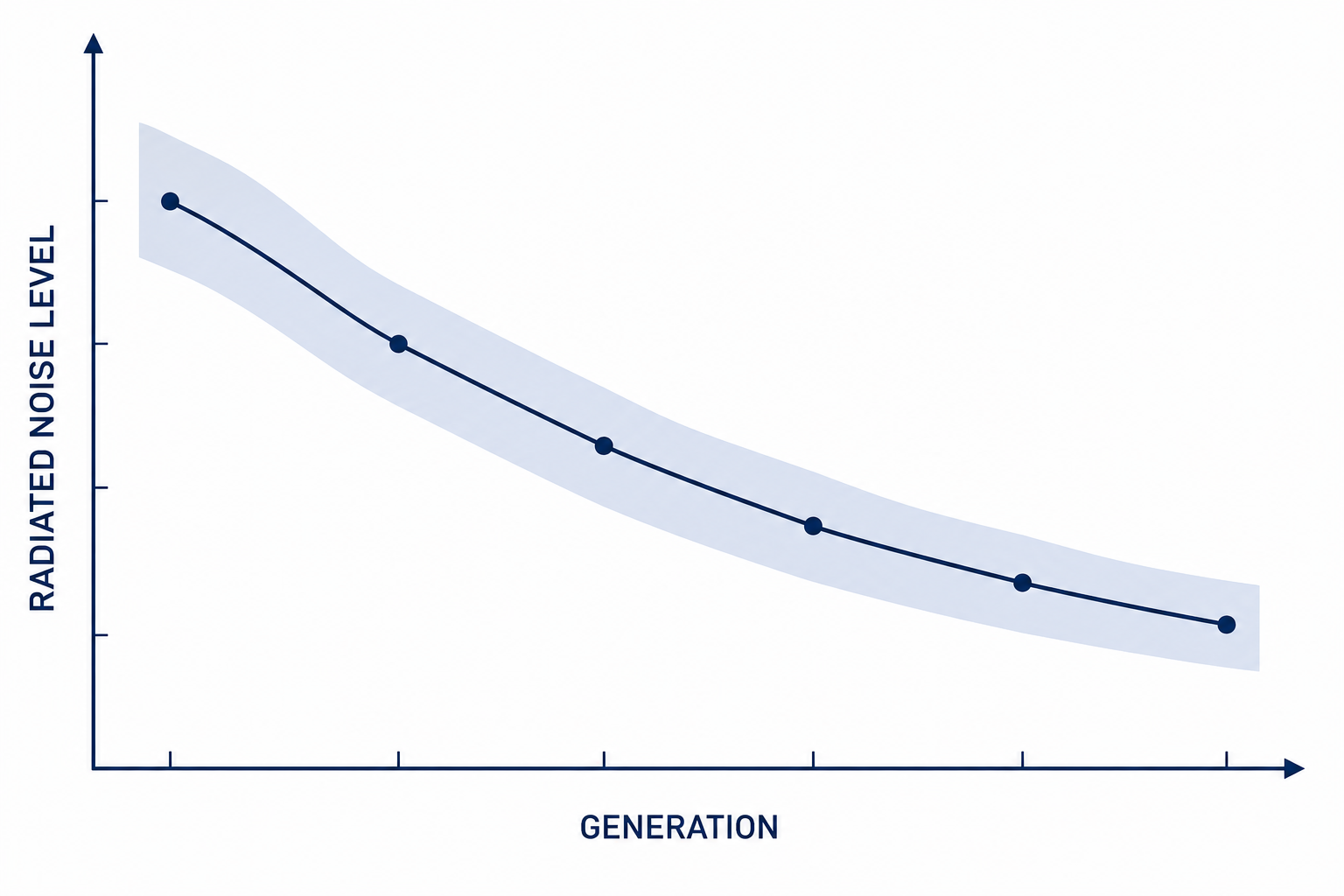
Submarine acoustic quieting has improved substantially across successive generations of submarine design worldwide, and open naval-analysis literature widely describes this as one of the defining undersea competitive dynamics of the past several decades: as quieting technology diffuses and improves globally, the range at which older-generation sonar systems can reliably detect newer submarines shrinks, sometimes dramatically, from one generation to the next.
This creates a specific, ongoing problem for detection systems, and for the AI models built on top of them: a classifier trained on acoustic signatures from older, louder submarine generations may simply have very little usable signal to work with against a newer, quieter target. It isn't that the classification model gets worse at its job in any absolute sense — it's that the underlying acoustic signature it depends on has been engineered to approach the ambient noise floor of the ocean itself, which is a physical limit no amount of algorithmic improvement alone can push through.
5. What This Means for Detection Models
This dynamic shapes AI-based underwater detection in a few concrete ways, each of which connects directly back to the other pieces in this series.
It pushes systems toward the low-SNR problem described in the UATR piece. As targets get quieter, more of the detection problem happens in exactly the noisy, low-signal regime where classification models are weakest and least reliable — which is why so much recent UATR research explicitly frames low-SNR robustness as the central open challenge rather than a secondary concern.
It pushes strategy toward active and multistatic sonar, discussed in the passive-vs-active piece. When passive listening alone doesn't reliably pick up a signature, active pinging — despite revealing the searcher's own position — becomes more operationally necessary, which is a significant part of why multistatic sonar has become a growing area of investment: spreading transmission risk across a network of sources rather than concentrating it on one platform.
It pushes toward sensor fusion rather than reliance on any single detection method. No individual sensor — acoustic, magnetic, optical — is sufficient against a target specifically engineered to defeat the primary one, which is why the layered, multi-sensor approach described in the first piece in this series matters structurally, not just as a nice-to-have redundancy measure.
It pushes toward wider-area, persistent sensing rather than point detection. If any single detection opportunity against a quiet target is individually unreliable, the practical answer is more opportunities, spread across more time and more area — which is a large part of the logic behind investment in distributed seabed sonar networks and persistent autonomous underwater vehicle patrols, rather than relying on periodic patrols alone to catch a fleeting acoustic window.
6. The Honest Takeaway
There's no version of this story where AI "solves" submarine detection outright. Acoustic quieting and detection algorithms are locked in the same kind of continuous competitive cycle as stealth aircraft and radar, or encryption and cryptanalysis — every improvement on one side raises the bar for the other, rather than settling the problem permanently in either direction. What AI actually changes is the efficiency of that competition: better classification models extract more usable signal from noisier, quieter targets than a human operator ever could alone, and better sensor fusion makes multi-source detection genuinely practical at a scale no human team could coordinate manually across dozens of simultaneous sensors and platforms. That's a real and significant capability shift — it just isn't the same thing as making the underlying physics problem disappear, and treating it as anything more than an ongoing arms race would misread what the engineering and research literature actually shows.
Sources
Open naval-analysis and defence-technology literature on submarine acoustic quieting design principles
Academic and naval-technology literature on cavitation physics, propulsor design, and machinery isolation systems
Public reporting on Magnetic Anomaly Detection and multi-sensor anti-submarine warfare approaches
Public reporting on multistatic sonar deployment trends in modern anti-submarine warfare, 2026